

A parent asked me recently: “My daughter’s school just switched from STEM to STEAM. Should I be worried they are watering down the science?” It is a fair question — and the answer is more interesting than most people expect. That single added letter, the A for Arts, represents one of the liveliest debates in modern education.
Let me break down what each term really means, what changes when you add the arts, what the evidence says, and how to think about which approach serves your child best. No jargon, no hype.
Table of Contents
- What STEM Education Means
- What STEAM Adds: The A for Arts
- STEM vs STEAM: Side-by-Side Comparison
- What the Research Actually Says
- The Criticisms of Each Approach
- Which Is Better for Your Child
- What to Look for in a School Program
- Frequently Asked Questions

What STEM Education Means
STEM stands for Science, Technology, Engineering, and Mathematics. As an educational movement, it took off in the early 2000s, driven by a simple observation: the modern economy runs on these fields, and schools were not producing enough graduates prepared for them.
But STEM is not just “more science classes.” Good STEM education is defined by integration and application: instead of learning math formulas in isolation, students use math to design a bridge; instead of memorizing biology terms, they run experiments. The emphasis is on problem-solving, inquiry, and hands-on projects rather than passive memorization.
In practice, a strong STEM program includes lab work, coding, design challenges, and real-world problem scenarios — the kind of learning where students build, test, fail, and iterate.
What STEAM Adds: The A for Arts
STEAM adds Arts to the mix — and “arts” here means more than painting. It covers visual arts, music, drama, design, and the humanities broadly. The core argument: creativity and design thinking are not extras; they are essential to innovation.
The classic example: an engineer can calculate the load a bridge must bear, but designing a bridge people love to look at — and want in their neighborhood — requires aesthetic judgment. Apple’s products did not conquer the world on specs alone; design was the differentiator. STEAM advocates argue schools should teach that integration deliberately.
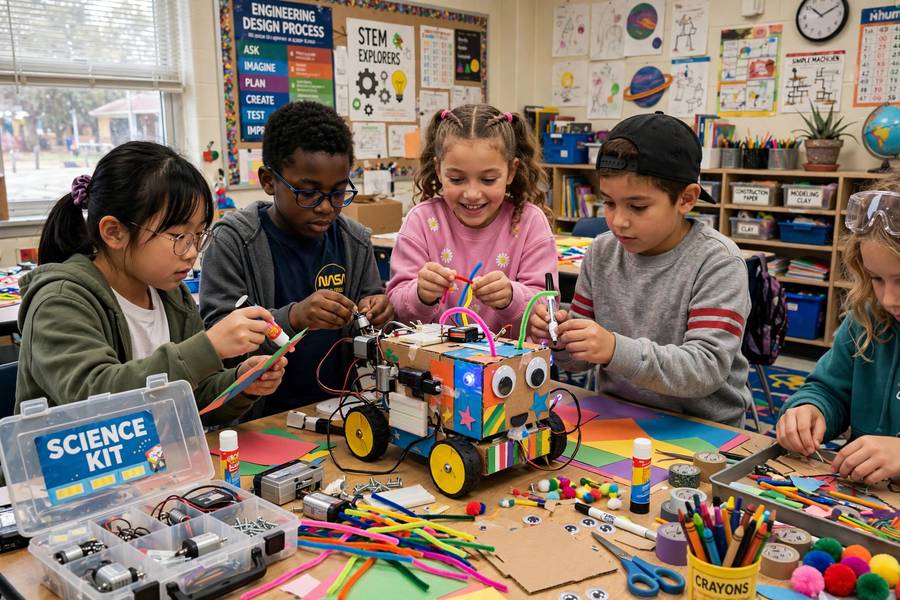
In a STEAM classroom, a robotics project also involves designing the robot’s appearance and presenting it persuasively. A statistics unit might end with students creating data visualizations that are both accurate and beautiful. The arts are not a break from “real” learning — they are woven into it.
STEM vs STEAM: Side-by-Side Comparison
| STEM | STEAM | |
|---|---|---|
| Focus | Technical mastery, analytical problem-solving | Technical mastery + creative design thinking |
| Typical activities | Labs, coding, math challenges, engineering builds | All of STEM’s, plus design, storytelling, visual communication |
| Skills emphasized | Logic, precision, quantitative reasoning | Logic + creativity, empathy, communication |
| Assessment | Often test/project-based on correctness | Adds evaluation of design quality and presentation |
| Best metaphor | “Can you solve it?” | “Can you solve it beautifully and explain it well?” |
The honest truth: in great programs, the difference is smaller than the debate suggests. Excellent STEM teachers already encourage creativity; excellent STEAM teachers do not sacrifice rigor. The labels matter less than the teaching.
What the Research Actually Says
Here is where I have to be straight with you: the research base is thinner than advocates on either side admit. There are no large randomized trials proving STEAM outperforms STEM or vice versa. What the evidence does support:
- Integrated, project-based learning beats siloed memorization — whether you call it STEM or STEAM. The integration is doing the work.
- Arts integration improves engagement, especially for students who do not identify as “math/science kids.” Engagement drives time-on-task, which drives learning.
- Design thinking correlates with innovation outcomes in industry studies — but translating that into K-12 curriculum effects is still early science.
My read: the A is not magic, but it is not fluff either. It broadens who feels welcome in technical learning, and that matters enormously.

The Criticisms of Each Approach
Critics of STEM argue it narrows education into job training, squeezes out the humanities, and treats children as future workers rather than whole people. There is also the equity concern: STEM programs often end up serving already-advantaged students.
Critics of STEAM argue the A dilutes focus — that adding arts is a feel-good move that steals time from the hard technical skills employers actually need. Some see it as arts advocates hitching a ride on STEM funding rather than a coherent pedagogy.
Both criticisms have teeth. A STEAM program that is really just STEM with occasional crafts is not delivering on its promise. A STEM program that produces brilliant technicians who cannot communicate is not either.
Which Is Better for Your Child
Forget the acronym for a moment and consider your child:
- A technically-minded kid who lives for how things work? Either works — look for depth and challenge, not the label.
- A creative kid who thinks they “hate math”? STEAM programs often provide the on-ramp that pure STEM does not. The arts connection can unlock technical interest.
- A child drawn to both? STEAM was practically invented for them.
- College and career plans? For choosing degrees and technical careers, what matters most is the rigor of the actual math and science instruction — verify that, regardless of acronym.
Also consider the school’s execution. A mediocre STEAM program loses to an excellent STEM program every time. Visit, watch a class, ask students what they are building.
What to Look for in a School Program
Whether the brochure says STEM or STEAM, look for these markers of quality:
- Real projects, not worksheets. Students should be building, experimenting, and presenting — regularly, not once a semester.
- Integration, not decoration. In STEAM, the arts should shape the project (design decisions, communication), not appear as a poster slapped on at the end.
- Failure is normal. Good programs celebrate iteration. If every project “works” the first time, the challenges are too easy.
- Teachers with depth. Ask about teacher training in the approach — a label without trained teachers is just marketing.
- Equity of access. Who gets into the program? The best programs pull in the curious, not just the already-advanced.
Strong foundations in math matter under either banner — the acronym does not replace core skills.
Bringing STEM and STEAM Home
You do not need a special program to get the benefits. At home: build things together (kits, LEGO engineering challenges, baking with precise measurements), visit science museums and maker faires, encourage drawing and designing around technical projects, and ask “how could we make this better?” about everyday objects. The key ingredients — curiosity, building, iterating — are free. A child who regularly takes things apart and sketches improvements is getting a STEM/STEAM education regardless of what the school brochure says. The Montessori method shares this hands-on philosophy — and if you’re mapping the long academic road, understanding what a doctoral dissertation actually involves puts the whole pipeline in perspective.

Frequently Asked Questions
STEM stands for Science, Technology, Engineering, and Mathematics. In education it means an integrated, hands-on approach where students apply these subjects to solve real problems rather than learning them in isolation.
STEAM adds Arts (visual arts, music, design, humanities) to STEM. STEAM weaves creativity and design thinking into technical projects, while STEM focuses purely on technical and analytical skills. In great programs the practical difference is smaller than the debate suggests.
There is no conclusive research proving one superior. Project-based integrated learning beats memorization under either label. STEAM tends to engage creative students who might otherwise avoid technical subjects, which is a genuine advantage.
Only in poorly designed programs. In strong STEAM programs the arts are integrated into projects (design decisions, communication) without reducing technical rigor. Always check the actual math and science instruction, not just the label.
Early — even preschoolers benefit from building, experimenting, and asking “what happens if.” Formal programs typically start in elementary school, but curiosity-driven exploration at home counts from the beginning.
Look past the acronym: visit classes, check for real projects vs worksheets, ask about teacher training, and see whether the program serves curious beginners or only advanced students. Execution matters more than the label.