Famous Company Slogans List: 50 Iconic Taglines & What Made Them Work

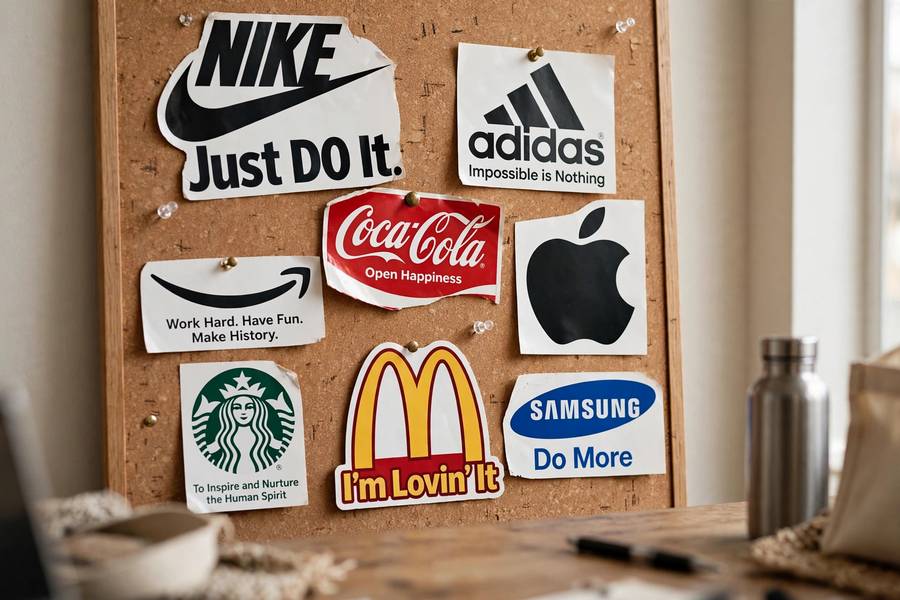
Some phrases transcend advertising and enter culture. ‘Just Do It.’ ‘I’m Lovin’ It.’ ‘Think Different.’ You know the brands without being told — that’s the power of an iconic slogan or tagline. But what separates these from the thousands forgotten? It’s not budget (though that helps). It’s pattern.
I’ve analyzed the most famous brand phrases in business history — not just to list them, but to extract WHY they worked. Because the patterns are learnable, and your business can use them. Here are 50 icons, organized by the technique that made each unforgettable.
The Imperatives: Commands That Moved Millions
1. Nike — ‘Just Do It’ (1988). Three words. A command that transcends shoes — it’s about action, courage, overcoming excuses. Worth billions in brand equity; unchanged for nearly 40 years. The lesson: the best taglines sell an attitude, not a product.
2. Apple — ‘Think Different’ (1997). Grammatically rebellious (‘differently’ would be correct), deliberately so — the rebellion WAS the message. Positioned Apple as the choice for creatives and non-conformists. Two words that defined a company’s identity for a generation.
3. Adidas — ‘Impossible Is Nothing’ (2004). Direct Nike counter-programming with philosophical depth — reframes limitation as perception. Four words, infinite aspiration.
4. Burger King — ‘Have It Your Way’ (1974). Customization as empowerment — positioned against McDonald’s standardization. A slogan that was also a business model statement.
5. Subway — ‘Eat Fresh’ (2000). Two syllables that repositioned fast food around health — devastatingly effective against fried competitors. Simplicity as strategy.
The Promises: Guarantees in a Phrase
6. BMW — ‘The Ultimate Driving Machine’ (1973). Not a car — THE driving machine. Superlative positioning that justified premium pricing for 50 years. The promise: this isn’t transportation, it’s the pinnacle.
7. De Beers — ‘A Diamond Is Forever’ (1948). Arguably the most valuable slogan ever written — it didn’t sell diamonds, it created the cultural REQUIREMENT of diamond engagement rings. Four words that built a multi-billion dollar tradition from nothing.
8. FedEx — ‘When It Absolutely, Positively Has to Be There Overnight’ (1982). The promise is the entire value proposition — reliability under pressure. Every word earns its place; the specificity (‘absolutely, positively’) is the memorability.
9. M&M’s — ‘Melts in Your Mouth, Not in Your Hands’ (1954). Product benefit as poetry — rhyming, visual, and a genuine differentiator (the candy shell). 70 years old and still working.
10. Avis — ‘We Try Harder’ (1962). The genius underdog positioning — turned #2 status into a virtue (we’re hungrier). Honesty as strategy; lasted 50 years.
The Identity Statements: Who You Are
11. Apple — ‘Think Different’ (see above — it works as both imperative and identity). 12. Harley-Davidson — lifestyle as identity (the brand IS rebellion, freedom, Americana — no tagline needed when the product is the statement). 13. McDonald’s — ‘I’m Lovin’ It’ (2003). First-person joy — customers saying it, not the company. The ‘I’m’ makes it personal and participatory.
14. L’Oréal — ‘Because You’re Worth It’ (1973). Spoke directly to women’s self-worth — revolutionary in an era of apologetic beauty marketing. The ‘you’ is doing heavy lifting: it’s about the customer, not the product. 15. MasterCard — ‘There Are Some Things Money Can’t Buy. For Everything Else, There’s MasterCard’ (1997). Priceless moments vs. purchasable ones — emotional storytelling that made a credit card about life, not transactions.
For the terminology behind these (slogan vs. tagline), my slogan vs tagline guide clarifies the distinction.
The Clever Ones: Wit as Memorability
16. Volkswagen — ‘Think Small’ (1959). The most counterintuitive car ad ever — celebrated smallness when America worshipped bigness. Honesty so disarming it became legendary. 17. Wendy’s — ‘Where’s the Beef?’ (1984). Became a national catchphrase, referenced by presidential candidates. Absurdity + repetition = cultural penetration.
18. Skittles — ‘Taste the Rainbow’ (1994). Surreal, colorful, nonsensical — and unforgettable. Proof that logic is optional when sensory appeal is strong. 19. Old Spice — ‘Smell Like a Man, Man’ (2010). Absurdist humor that resurrected a dying brand — the campaign was the product relaunch. 20. Dollar Shave Club — ‘Our Blades Are F***ing Great’ (2012). Profanity as authenticity — signaled anti-establishment positioning so clearly that Unilever paid $1 billion for it.
The Modern Icons: Digital Era Winners
21. Airbnb — ‘Belong Anywhere’ (2014). Two words capturing the entire sharing-economy promise — not lodging, belonging. 22. Uber — (implicit: transportation at a tap — the brand became the verb, the ultimate tagline achievement). 23. Netflix — ‘See What’s Next’ — forward-looking, content-promising, platform-defining.
24. Spotify — ‘Music for Every Moment’ — personalization as promise. 25. Tesla — (no tagline needed — the product and founder ARE the messaging; the anti-tagline strategy). 26. Amazon — ‘Work Hard. Have Fun. Make History.’ (internal motto as external signal). 27. Google — ‘Don’t Be Evil’ (former motto — notable for its abandonment being as famous as its adoption).
28. KFC — ‘It’s Finger Lickin’ Good’ — sensory, informal, crave-inducing. 29. Snickers — ‘You’re Not You When You’re Hungry’ — insight-based (hunger changes personality) turned into comedy gold. 30. Dos Equis — ‘The Most Interesting Man in the World’ — character as campaign; the slogan created a persona.

More Icons Worth Knowing (31–50)
31. Coca-Cola — ‘Taste the Feeling’ (and historically ‘The Pause That Refreshes,’ ‘It’s the Real Thing’). 32. Pepsi — ‘Live for Now.’ 33. Gillette — ‘The Best a Man Can Get.’ 34. Gillette (later) — ‘The Best Men Can Be’ (controversial repositioning). 35. Nike (also) — ‘Find Your Greatness.’
36. Adidas (also) — ‘Impossible Is Nothing.’ 37. Reebok — ‘Be More Human.’ 38. Under Armour — ‘Protect This House.’ 39. Puma — ‘Forever Faster.’ 40. New Balance — ‘Fearlessly Independent.’
41. BMW (also) — ‘Sheer Driving Pleasure.’ 42. Mercedes — ‘The Best or Nothing.’ 43. Audi — ‘Vorsprung durch Technik’ (Advancement through Technology — German as premium signal). 44. Toyota — ‘Let’s Go Places.’ 45. Honda — ‘The Power of Dreams.’
46. American Express — ‘Don’t Leave Home Without It.’ 47. Visa — ‘Everywhere You Want to Be.’ 48. Geico — ’15 Minutes Could Save You 15% or More on Car Insurance.’ 49. State Farm — ‘Like a Good Neighbor, State Farm Is There.’ 50. Allstate — ‘You’re in Good Hands.’
The Patterns: What Makes Them Unforgettable
After 50 icons, the patterns are clear. Brevity: the average is 3–4 words. Every iconic phrase could fit on a bumper sticker — because constraint forces clarity. Verbs: ‘Do,’ ‘Think,’ ‘Taste,’ ‘Eat’ — action words create energy; nouns sit still. Customer focus: ‘You’re Worth It,’ ‘I’m Lovin’ It’ — the customer is the subject, not the company.
Specificity: ‘Melts in Your Mouth, Not in Your Hands’ beats ‘Delicious Candy’ because specific is memorable and generic is invisible. Emotion over features: none of the top 50 describe product specs — they describe feelings, identities, and aspirations. Rhythm: read them aloud — most have natural cadence, rhyme, or alliteration. The ear remembers what the eye forgets.
Truth: the most enduring ones contain a real insight — ‘A Diamond Is Forever’ worked because it named something people wanted to believe; ‘We Try Harder’ worked because it was honest. Manufactured cleverness fades; genuine insight endures.
Apply these to your own branding — and for the naming foundation, my business name guide pairs with this.
What the Failures Teach
The forgotten slogans teach as much: companies that changed taglines every 2–3 years (brand confusion), slogans that overpromised (‘The Best’ without proof — forgettable puffery), phrases so generic they could fit any company (‘Quality. Service. Value.’ — could be anyone, so it’s no one), and taglines that didn’t survive translation (global brands learned this expensively).
The meta-lesson: an iconic slogan isn’t written — it’s EARNED through consistency. ‘Just Do It’ wasn’t iconic in 1988; it became iconic through 35 years of unwavering use across thousands of touchpoints. The phrase matters, but the commitment matters more. Pick well, then commit completely — that’s the actual secret behind every phrase on this list.
Key Takeaways
50 iconic slogans and taglines, organized by technique: imperatives, promises, identity statements, wit, and modern digital-era winners. The patterns behind them: brevity (3–4 words), verbs, customer focus, specificity, emotion over features, rhythm, and truth.
The real secret isn’t the writing — it’s the commitment. Iconic phrases became iconic through decades of consistent use. Pick well using these patterns, then commit completely.

Nike’s ‘Just Do It’ (1988) — three words, unchanged for nearly 40 years, worth billions in brand equity. De Beers’ ‘A Diamond Is Forever’ rivals it for economic impact, having created the diamond engagement ring tradition.
Brevity (3–4 words), action verbs, customer focus, specificity, emotional resonance over features, natural rhythm/rhyme, and genuine insight. Consistency over decades matters more than initial cleverness.
Apple ‘Think Different,’ BMW ‘The Ultimate Driving Machine,’ McDonald’s ‘I’m Lovin’ It,’ L’Oréal ‘Because You’re Worth It,’ FedEx ‘When It Absolutely, Positively Has to Be There Overnight.’
Decades, ideally. Changing taglines every few years signals brand confusion. ‘Just Do It’ (1988), ‘The Ultimate Driving Machine’ (1973), and ‘Melts in Your Mouth, Not in Your Hands’ (1954) prove longevity builds iconic value.