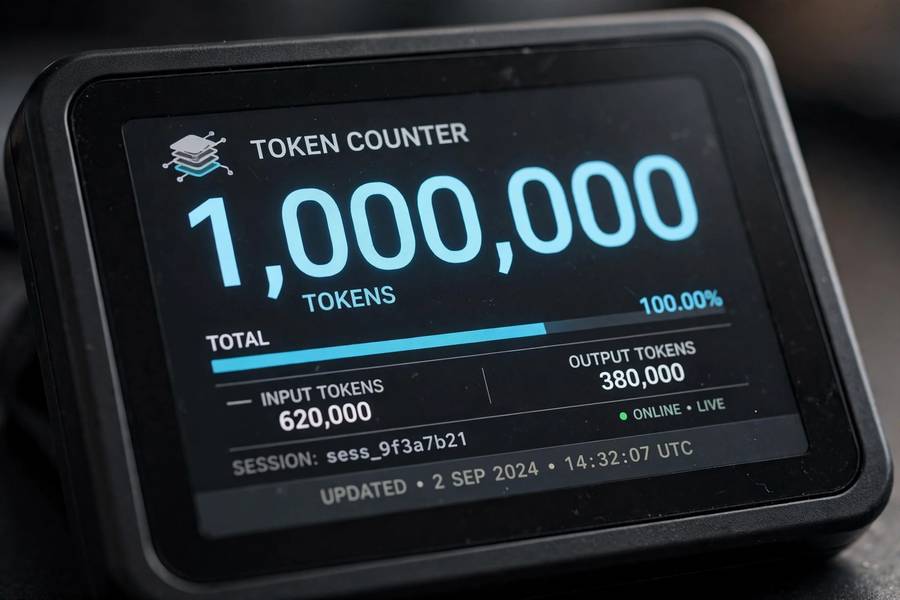
A million tokens. The number is so large it stops meaning anything — so let’s ground it: roughly 750,000 words, about 1,500 pages, ten novels, an entire small codebase, or a full day of transcribed conversation. A model with a 1-million-token context window can hold all of that in working memory simultaneously and reason across it. Two years ago this was science fiction. Now it’s a product feature.
But the headline number hides important realities about what “1 million tokens” actually delivers. This guide explains the scale honestly — what fits, what becomes possible, and where the marketing outruns the capability. For the foundational concept, see what a context window is.
Table of Contents
- How Big Is a Million Tokens, Really?
- What Fits in a Million Tokens
- What Becomes Possible at This Scale
- The Engineering Behind It
- Effective vs Advertised: The Comprehension Gap
- The Cost Reality
- When a Million Tokens Is Overkill
- What’s Next: Beyond a Million
- What Most People Get Wrong About the Million-Token Number
- Frequently Asked Questions

How Big Is a Million Tokens, Really?
Tokens aren’t words — they’re sub-word pieces, averaging about 0.75 words per token in English. So a million tokens ≈ 750,000 words. For intuition:
- ~1,500 pages of typical book text
- ~10 average novels (Harry Potter and the Sorcerer’s Stone is ~77K words — you could fit nearly ten)
- ~3,000 pages of dense technical documentation
- ~50,000 lines of code (roughly — code tokenizes less efficiently)
- ~20 hours of transcribed speech
- ~2,500 average web articles
Another framing: the entire Lord of the Rings trilogy is about 450,000 words — you could fit it nearly twice over, then ask detailed questions about Tom Bombadil’s motivations with full-text recall. The scale is genuinely hard to internalize because nothing in human working memory compares — it’s like holding ten books in mind simultaneously with perfect recall.
What Fits in a Million Tokens
Practical things people actually put in million-token windows:
Entire codebases. Small-to-medium repositories fit whole — every file, every dependency. “Find all the places we handle authentication” becomes answerable from complete information rather than grep fragments.
Document collections. Hundreds of PDFs — a litigation discovery set, a research literature collection, a company’s policy library. Upload once, query freely.
Long media. Hours of video transcripts, entire podcast series, meeting archives. The “watch everything and summarize” use case.
Extended histories. Months of conversation, years of email (for personal use), complete project histories. The model as institutional memory.
Training-scale examples. Thousands of few-shot examples for in-context learning — teaching the model a task by showing it done hundreds of times, all in the prompt.
The common thread: tasks where the relevant information is scattered across a large corpus and the value is in connecting it. A million tokens turns “search and piece together” into “just look at all of it.”
What Becomes Possible at This Scale
Repository-level code intelligence. Not “explain this function” but “how does data flow through this entire system?” Architecture questions, cross-file bug hunts, onboarding acceleration — the model sees the whole system the way a senior engineer does after months.
Corpus-scale analysis. “What are the recurring themes across these 300 customer interviews?” “Summarize the evolution of this argument across 50 papers.” Synthesis at scales where humans need teams and weeks.
The “everything” prompt. Complex tasks with massive specifications — entire style guides, complete API docs, full legal context — all in the prompt at once. The instruction-following gets dramatically better when the model has complete context rather than fragments.
Multimodal marathons. A million tokens of mixed text, images, video frames — analyzing a full lecture series with slides, or a day of security footage with logs.
Agentic long-horizon work. AI agents that maintain coherence over very long task sequences — research projects, complex analyses — using the window as extended working memory.
Each of these was either impossible or required elaborate scaffolding before. The window doesn’t just extend old capabilities — it enables workflows that didn’t exist.
The Engineering Behind It
A million tokens of attention is computationally ferocious — naive attention would need ~10^12 operations per layer. Making it practical required:
Efficient attention. Sparse patterns, sliding windows, linear approximations — techniques that capture most of full attention’s benefit at a fraction of the cost. The model doesn’t literally compare every token to every other; it approximates intelligently.
Positional encoding advances. Methods letting models trained on shorter sequences extrapolate to million-token inputs — the model needs to know WHERE each token is in a vast sequence, a harder problem than it sounds.
KV-cache engineering. Storing the computed key-value states for a million tokens takes enormous memory — systems innovations (quantization, offloading, paging) make it feasible.
Distributed inference. Million-token processing often spans multiple GPUs or machines — the infrastructure challenge behind the product feature.
The result is genuinely impressive engineering. But engineering can deliver capacity without delivering equal comprehension — which brings us to the gap.

Effective vs Advertised: The Comprehension Gap
The critical distinction: advertised window (tokens the model accepts) versus effective window (tokens the model actually uses well). Research consistently finds gaps:
Needle-in-haystack performance degrades with length — finding a specific fact in 1M tokens works worse than in 100K, which works worse than in 10K. The model accepts the haystack; finding needles gets harder as it grows.
Lost in the middle intensifies — with a million tokens, the “middle” is enormous, and middle-positioned information is systematically underused.
Reasoning over long spans is the hardest — holding fact A from token 10,000 together with fact B from token 900,000 for a multi-hop inference. This is where effective comprehension falls shortest of the advertised number.
What this means practically: treat “1M tokens” as “can accept 1M tokens” not “understands 1M tokens equally.” For critical applications, test with YOUR content at YOUR lengths. Benchmarks on synthetic needles don’t fully predict real-document performance.
The field is improving rapidly — each generation narrows the gap. But as of now, the gap is real and users should know it.
The Cost Reality
Million-token windows aren’t just technically impressive — they’re expensive:
Input pricing scales linearly with tokens. A 1M-token prompt costs ~100x a 10K prompt. At typical API rates, that’s dollars per query, not cents.
The caching question. Some providers offer prompt caching — repeated prefixes cost less. This helps for static documents queried repeatedly, but the first processing still costs full price.
The economic filter. Million-token usage makes sense for high-value queries (legal analysis, major research) and less sense for routine ones. Most applications should use the smallest window that does the job.
Self-hosted costs. Running open million-token models requires serious GPU memory — the KV cache alone for 1M tokens can exceed 100GB. This is datacenter territory, not desktop.
The cost reality is why RAG remains relevant despite giant windows — retrieval keeps per-query costs sane. The architecture decision isn’t just technical; it’s economic. Understanding how ChatGPT works as a product helps frame why providers price this way — attention is genuinely expensive to serve.
When a Million Tokens Is Overkill
Bigger isn’t always better:
Simple questions don’t need it — asking a quick question with a million-token document attached wastes money and may degrade answer quality (attention dilution).
Small documents fit in small windows — match the tool to the task.
High-volume applications — the per-query cost at scale is punishing. RAG or smaller windows with good retrieval win economically.
Precision tasks — when you need ONE fact from a large corpus, retrieval often beats stuffing. The model’s attention is finite; don’t make it search when a retriever can.
Latency-sensitive — million-token processing takes time. Real-time applications need leaner approaches.
The discipline: use the smallest context that accomplishes the task well. A million tokens is a capability, not a default. The best engineers I know are almost stingy with context — every token justified.
What’s Next: Beyond a Million
The trajectory points further:
10M+ windows are already appearing — the engineering continues scaling.
Infinite-context research — architectures (state-space models, recurrent hybrids) aiming to transcend the window concept entirely.
Better utilization — the frontier isn’t just bigger windows but making existing windows actually work — closing the effective-vs-advertised gap.
Agentic memory — moving beyond “bigger prompt” to real memory systems: read/write, hierarchical, persistent.
But the deeper question: how much context do tasks actually need? There’s a real possibility the field overshoots — building ever-larger windows while the binding constraints are reasoning quality and cost. The next breakthrough might not be 100M tokens but models that use 100K brilliantly. Scale impresses; effectiveness matters.
What Most People Get Wrong About the Million-Token Number
Three corrections I find myself making constantly. First: a million tokens isn’t a million words — it’s roughly 750,000, and for code or technical text, effectively less. People budget in words and overshoot by a third. Second: the window isn’t free headroom — every token you include costs money and attention. A million-token prompt means paying for a million tokens and diluting focus across all of them. Third, and most important: the number measures capacity, not comprehension. The model accepts a million tokens the way a lecture hall accepts a thousand students — being in the room isn’t the same as following the lecture. Size the task to the effective window, not the advertised one.
Frequently Asked Questions
About 750,000 words — roughly 1,500 pages, 10 novels, or an entire small codebase. It’s enough to hold massive document collections, whole repositories, or hours of transcripts in working memory simultaneously.
Repository-level code analysis, corpus-scale document synthesis, whole-book reasoning, long media analysis, and agentic long-horizon tasks. It enables workflows — like analyzing 300 documents at once — that previously required teams and weeks.
Not equally — there’s a gap between advertised window (tokens accepted) and effective window (tokens used well). Needle-finding degrades with length, middle-positioned information gets lost, and multi-hop reasoning over long spans is hardest. Test with your content at your lengths.
Roughly 100x a 10K-token prompt — dollars per query rather than cents at typical API rates. This is why the economic filter matters: million-token usage suits high-value queries, while RAG or smaller windows win for routine high-volume applications.
No. Simple questions waste money and may lose quality to attention dilution; high-volume apps face punishing per-query costs; precision tasks often favor retrieval. Use the smallest context that does the job well — a million tokens is a capability, not a default.