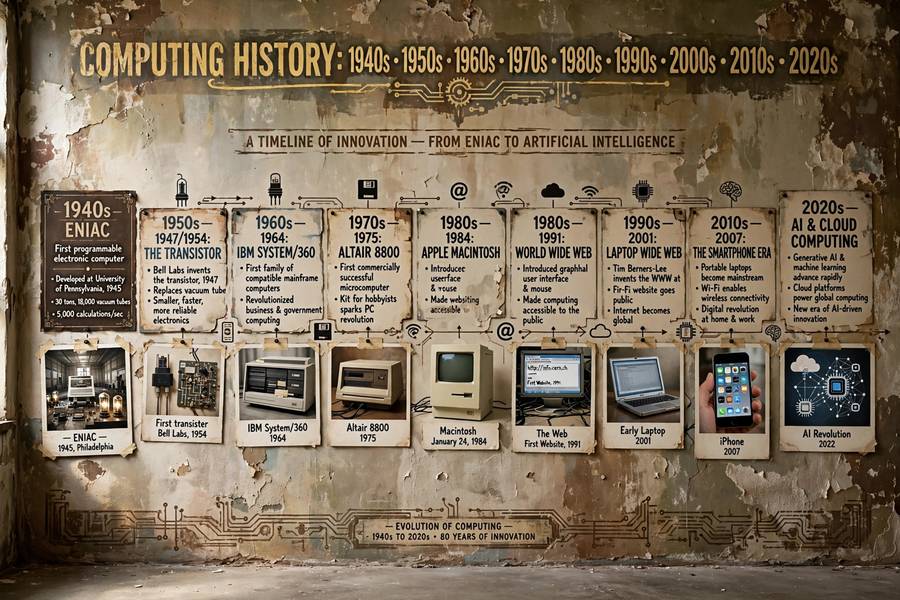
The history of artificial intelligence isn’t a straight line — it’s a sine wave. Peaks of euphoria, troughs of despair, each generation convinced the last one was naive and the next one is inevitable. I find the timeline genuinely useful, not as trivia but as a pattern-spotting instrument: once you’ve seen the pattern repeat three times, you start recognizing it in real time. That’s the point of this AI winter timeline — to give you the full arc, from the first sparks to today’s boom, so you can place the present moment on the curve.
Fair warning: timelines flatten drama. Behind every date below there were careers made and broken, grants won and lost, and researchers who were right too early — which in this field is indistinguishable from being wrong. Keep that in mind as we walk through it. For the conceptual background, my guide on what an AI winter is explains the mechanism behind the freezes.
Table of Contents
- 1950–1956: The Optimistic Dawn
- 1956–1969: The First Boom
- 1969–1974: Cracks Appear
- 1974–1980: The First AI Winter
- 1980–1987: The Expert Systems Boom
- 1987–1993: The Second AI Winter
- 1993–2011: The Quiet Thaw
- 2012–2022: The Deep Learning Spring
- 2022–Present: The Generative Boom
- What the Timeline Teaches Us
- Frequently Asked Questions
1950–1956: The Optimistic Dawn
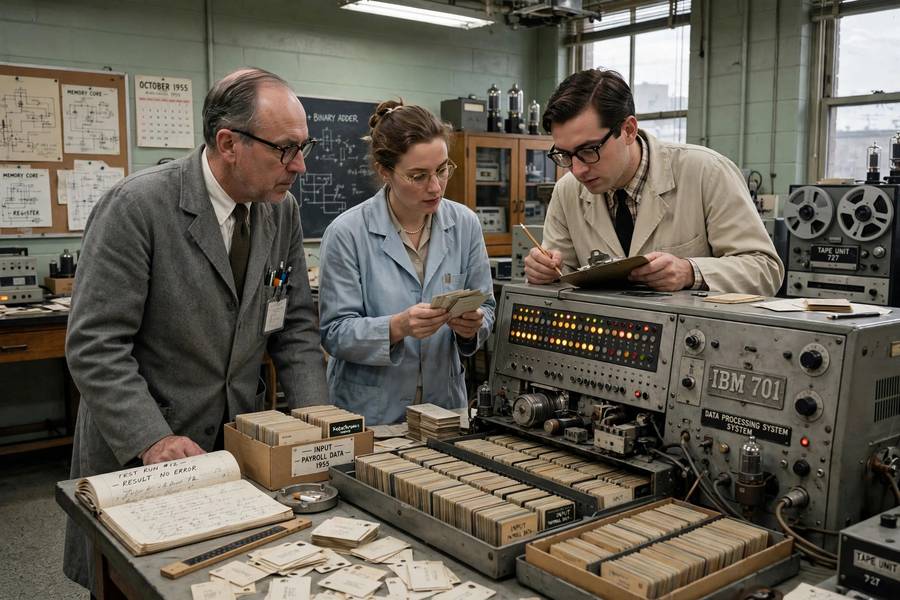
The story starts, as so many do, with a paper nobody fully appreciated at the time. Alan Turing’s 1950 “Computing Machinery and Intelligence” asked whether machines could think and proposed the test that still bears his name. Around the same time, early neural network concepts were being sketched — the perceptron wouldn’t arrive until 1958, but the seed was planted.
In 1956, the Dartmouth Summer Research Project on Artificial Intelligence gave the field its name and its founding myth. John McCarthy, Marvin Minsky, Nathaniel Rochester, and Claude Shannon gathered for two months, funded on the assumption that “a significant advance can be made” in a single summer. The confidence is almost touching in retrospect. They didn’t get their significant advance that summer. They got something better and worse: a field, a name, and a tradition of optimism that would both fuel and doom it.
What strikes me about this period is how reasonable the optimism felt. Computers were new and doubling in power. Every year brought a genuine breakthrough. Extrapolating that curve forward, human-level intelligence looked like an engineering project, not a scientific mystery. The error wasn’t stupidity — it was assuming the easy problems were representative of all problems.
1956–1969: The First Boom
The first boom delivered real, exciting results — in narrow domains. Programs proved mathematical theorems. The General Problem Solver tackled puzzles. ELIZA simulated a therapist well enough to fool some users. SHRDLU manipulated blocks in a virtual world using natural language. Each demo was a genuine achievement, and each demo was shown in the most favorable light possible.
Funding followed. DARPA poured money into AI research. Universities built labs. The promises escalated accordingly — researchers spoke of machines that would do any work a human could do, within a generation. Marvin Minsky reportedly suggested the problem of machine vision could be solved over a summer by an undergraduate. That anecdote gets retold as a joke now, but at the time it reflected genuine consensus.
The boom years established the pattern every later cycle would follow: real narrow successes, extrapolated into general claims, funded by people who couldn’t evaluate the extrapolation. If you want the fuller story of these early decades, my history of artificial intelligence goes deeper.
1969–1974: Cracks Appear
The cracks came from two directions: a book and a report. In 1969, Minsky and Papert published “Perceptrons,” demonstrating fundamental limitations of single-layer neural networks. The book’s technical claims were narrow, but its cultural effect was devastating — neural network research was effectively abandoned for a decade. A whole research direction got shelved because of a vibe shift disguised as a proof.
Then in 1973 came the Lighthill Report in the UK, commissioned to evaluate AI research. Its verdict was brutal: AI had failed to deliver on its grand promises, and the failures reflected fundamental limitations, not just engineering challenges. The UK government slashed AI funding almost entirely.
Meanwhile in the US, DARPA was conducting its own review, and the Mansfield Amendment of 1969 had already pushed military funding toward mission-relevant research. The “we’ll figure out applications later” era was ending. Researchers who had promised the moon were being asked to show the receipts, and the receipts were thin.
1974–1980: The First AI Winter
The first winter set in gradually, then suddenly. US funding dried up as DARPA redirected its budget. UK funding essentially vanished. Researchers who had built careers on AI grants scrambled — some left the field, some rebranded their work as something else, some kept going on fumes.
But here’s what the timeline usually omits: the winter years weren’t scientifically barren. This was when the foundations of modern AI were quietly laid. Researchers worked on knowledge representation, planning algorithms, and early machine learning with minimal resources. The field contracted to its committed core — the people who found the problems interesting regardless of funding. That contraction was painful and, in retrospect, productive. The winter did the field’s homework while nobody was watching.
The first winter ended not with a breakthrough but with a new story: expert systems. By 1980, a fresh narrative was ready, and the money came back.
1980–1987: The Expert Systems Boom
Expert systems were AI’s second act, and for a while it looked like the real thing. The idea was seductive: capture a human expert’s knowledge as rules, and the machine reasons like the expert. DEC reportedly saved tens of millions with XCON, a system that configured computer orders. Japan launched the Fifth Generation Computer Project, a massive national bet on AI. Governments and corporations poured money in.
The industry that grew around this was substantial — specialized Lisp machines, dedicated software companies, consulting practices. By the mid-1980s, the expert systems market was worth billions in today’s money. Universities taught it, companies bought it, magazines covered it.
But expert systems had a fatal flaw that the timeline makes obvious in hindsight: they were brittle. Rules written by hand broke on edge cases, couldn’t learn from experience, and became unmaintainable as they grew. Every expert system was a magnificent, intricate, frozen snapshot of knowledge that started decaying the day it shipped. The maintenance costs ate the savings. Customers noticed.

1987–1993: The Second AI Winter
The second winter began with a hardware event: the collapse of the specialized Lisp machine market. General-purpose workstations got fast enough and cheap enough to run AI software, which destroyed the business model of companies like Symbolics and Lisp Machines Inc. — and took the expert-systems ecosystem down with them.
Then the funding followed the hardware off the cliff. DARPA’s Strategic Computing Initiative wound down. Corporate AI labs were shuttered. The term “artificial intelligence” became professionally toxic again — researchers reached for “informatics,” “intelligent systems,” anything that didn’t carry the stink of broken promises.
This winter was deeper than the first in commercial terms — real companies died, real billions evaporated — but shallower in research terms, because the field had learned to survive on less. Machine learning, working under its unglamorous new names, kept advancing. Support vector machines, Bayesian methods, early neural networks — the toolkit of the future was being assembled in the cold.
1993–2011: The Quiet Thaw
The long thaw is the least dramatic and most important period on this timeline. AI didn’t come back with a bang — it came back as infrastructure. Nobody announced the end of the winter; the field just gradually became useful enough that the name stopped being embarrassing.
The milestones were practical, not philosophical. IBM’s Deep Blue beat Kasparov in 1997 — a triumph of engineering more than intelligence, but a cultural signal. Machine learning quietly conquered spam filtering, fraud detection, recommendation systems. The internet provided data at unprecedented scale. By the late 2000s, “machine learning” was a respectable discipline with real jobs and real products, and nobody needed to call it AI.
I think of this period as the field growing up. The grand promises were shelved. In their place: benchmarks, error rates, shipped products. The humility of the thaw years is what made the spring possible — researchers learned to promise less and deliver more, and the credibility rebuilt slowly.
2012–2022: The Deep Learning Spring
The spring had a specific birthday: 2012, when AlexNet crushed the ImageNet competition using deep neural networks trained on GPUs. The techniques had existed for years; what changed was data plus compute. Suddenly neural networks — the approach Minsky and Papert had buried in 1969 — worked spectacularly.
What followed was a decade of genuine, compounding progress. Image recognition, speech recognition, game-playing, language modeling — each year brought capabilities that would have seemed miraculous a decade earlier. The money returned, then flooded. Tech giants built enormous AI labs. Startups raised billions. “AI” was back, and this time the products were real.
The spring differed from previous booms in one crucial respect: the technology shipped. Previous booms sold demos and promises; the deep learning spring sold products people used daily. That deployment base is what makes the current moment structurally different from 1987 — and it’s the main reason I doubt a classic winter can fully repeat.
2022–Present: The Generative Boom
ChatGPT’s launch in late 2022 detonated the current boom. Generative AI — systems that produce text, images, code, video — went from research curiosity to mass-market product in months. The adoption curve was the fastest in technology history. Investment reached absurd levels. Every company became an AI company, or claimed to be.
We’re living in this chapter, so I won’t pretend to know how it ends. But the timeline gives us the questions to ask: Are promises outrunning delivery? Is investment outrunning revenue? Is the vocabulary inflating? The honest answers are uncomfortable — which is exactly why the timeline matters. We’ve seen this movie twice. The third showing might have a different ending, because the technology is more deployed and the field is larger, but the audience should still watch critically.
For the technical side of what’s actually driving current progress, see how AI models are trained — the scale of modern training is itself part of the story.
What the Timeline Teaches Us
Zoom out and the pattern is unmistakable: boom, overpromise, disappointment, winter, quiet work, thaw, boom. Each cycle is bigger than the last — more money, more people, more real capability. The winters don’t reset the field to zero; they reset the expectations to honest.
Three lessons from the full arc. First, the technology has never stopped improving — through both winters, the slow climb continued. Capability is monotonic; only belief is cyclical. Second, each winter was survivable for the committed and fatal for the tourists — a useful filter for where to place your own bets. Third, the thaws always came from unglamorous work done during the cold: better algorithms, more data, cheaper compute. Nobody predicted the spring; they built it.
Where are we now on the curve? High on the boom slope, with warning signs flashing. Whether the next chapter is a correction, a winter, or a plateau into maturity, the timeline’s advice is the same: build for the trough, enjoy the peak, and never confuse the two.
Frequently Asked Questions
There have been two generally recognized AI winters: the first from roughly 1974 to 1980, following overpromising in early symbolic AI, and the second from roughly 1987 to 1993, following the collapse of the expert-systems market. Both lasted about a decade.
The first AI winter ended with the rise of expert systems in the early 1980s — a new narrative about capturing human expertise as rules that attracted fresh government and corporate funding, most notably Japan’s Fifth Generation Computer Project.
The second AI winter was triggered by the collapse of the specialized Lisp machine hardware market in 1987, which destroyed the expert-systems industry’s business model. Funding then dried up as the brittleness and maintenance costs of expert systems became clear.
There was no single end date — the field thawed gradually through the 1990s and 2000s as machine learning became practically useful. The deep learning spring is usually dated to 2012 (AlexNet), and the current generative boom to late 2022 (ChatGPT).
No — we’re in a boom, arguably near its peak. Investment, hiring, and public attention are at historic highs. The relevant question isn’t whether we’re in a winter but whether the current boom shows the overheating signs that preceded previous freezes.