How Long Did the AI Winter Last? Dating Both Freezes

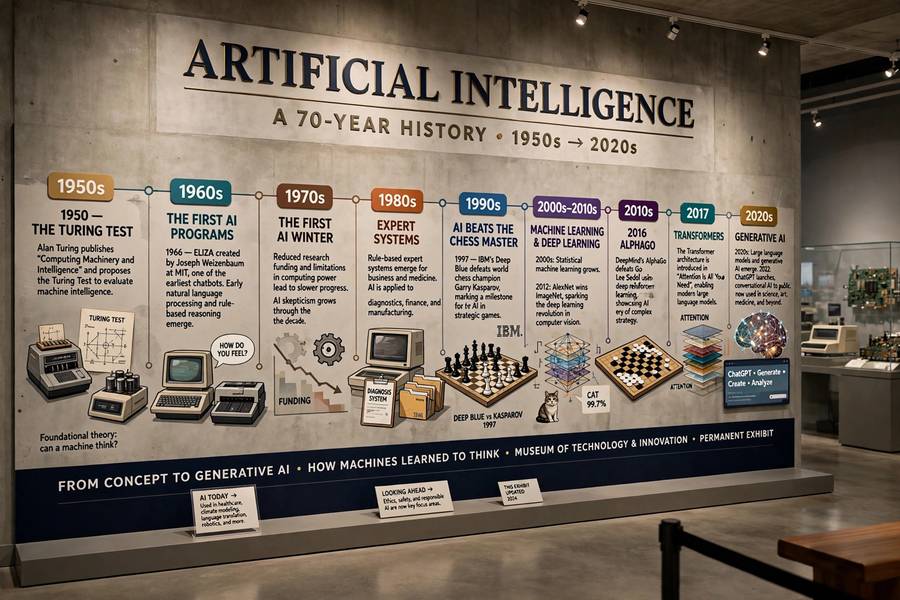
“How long did the AI winter last?” sounds like a simple question with a simple answer — and it’s neither. There were two major winters, historians disagree on the exact dates of both, and the boundaries are fuzzy because funding collapses don’t start and end on specific days. But the question deserves a serious answer, because the durations tell you something important: these weren’t blips. They were generational events that shaped the field for decades.
The short answer: the first AI winter lasted roughly 6-8 years (mid-1970s to early 1980s), and the second lasted roughly a decade or more (late 1980s through the 1990s, with effects into the early 2000s). Combined, AI spent the better part of twenty years in the cold — longer than many researchers’ entire careers. For context, see what AI winter is and the history of artificial intelligence.
Why the Dates Are Fuzzy
Winters don’t have start dates the way wars do. Funding declines gradually, then suddenly. A lab loses its grant in 1974; another holds on until 1976; a third pivots and survives. Was the winter “1974-1980” or “1973-1982”? Reasonable historians differ, because they’re dating a mood and a funding climate, not an event.
The standard approach dates winters by their trigger events and their thaw markers. Triggers: the Lighthill Report (1973) and DARPA cutbacks for the first; the Lisp machine collapse and expert system failures (1987+) for the second. Thaw markers: the expert system boom’s start (~1980) for the first winter’s end; the deep learning breakthroughs and big-data successes (~2006-2012) for the second’s end. Between trigger and thaw lies the winter — but both ends are gradients, not lines.
There’s also genuine disagreement about whether to count mini-winters — brief funding dips in the 1960s (after the perceptron criticism), or the early-2000s dot-com-bust effects on AI. Most histories stick to the big two, treating smaller dips as weather rather than climate. I’ll follow that convention but note the dissenters: some historians argue for a continuous “long winter” from the mid-70s to the mid-90s with only a brief expert-system spring interrupting it.
The First Winter: 1974 to 1980
The first winter’s trigger is conventionally dated to 1973-74: the Lighthill Report in the UK (1973) devastated British AI funding, and in the US, DARPA — stung by critical reviews including the American Study Group reports — sharply redirected its AI funding toward more applied projects around 1974-75. The Mansfield Amendment (1973), requiring defense research to show direct military relevance, added pressure.
The cold years: roughly 1974-1980. University AI labs shrank or closed. The ambitious natural language and robotics projects of the 1960s were defunded. Commercial AI was essentially nonexistent — there was no AI industry to collapse, only academic funding to vanish. Graduate students were warned away. The field’s public profile went from “machines that think” magazine covers to silence.
The thaw began around 1980-82, driven by expert systems: DEC’s XCON success story, the founding of expert system companies, Japan’s Fifth Generation announcement (1982), and renewed DARPA interest via the Strategic Computing Initiative (1983). By the mid-1980s, AI was booming again — the “spring” between winters. Duration of the deep freeze: about six years, with another couple of years of chill on either end. Short by the second winter’s standards, but long enough to scatter a generation of researchers.
The Inter-Winter Spring: 1980 to 1987
The period between winters deserves attention because it shows how fast hype rebuilds. From roughly 1980 to 1987, AI experienced a genuine boom: expert system companies proliferated, AI hardware (Lisp machines) sold well, governments launched massive programs, and the press rediscovered robot stories. Funding flowed, students returned, startups multiplied.
Lasting about seven years, this spring was actually longer than the first winter — a fact that surprises people who imagine the winters as one continuous ice age. The field genuinely recovered, genuinely produced commercial products, and genuinely believed the problems were solved. The expert system boom wasn’t a dead-cat bounce; it was a real industry with real revenue.
Its collapse is therefore the more sobering case study: a field can fully recover, build real businesses, and still freeze again when the underlying scaling problems reassert themselves. Springs don’t inoculate against winters. If anything, the inter-winter spring shows that recovery without addressing root causes (the knowledge bottleneck, the hype cycle) just sets up the next fall. The seven good years made the subsequent decade of cold feel like betrayal rather than continuity.
The Second Winter: 1987 to 2000
The second winter’s conventional start: 1987, when the Lisp machine market collapsed and expert system growth stalled. Some date it to 1988-89, when the bankruptcies became undeniable; others to the early 1990s, when DARPA’s AI funding hit its nadir. The freeze deepened through the early 90s: AI companies died, the Fifth Generation project wound down (1992), and “AI” became professionally toxic.
The core cold years: roughly 1988-1998 — a full decade. Longer than the first winter, deeper in commercial terms (there was now an industry to destroy), and more psychologically damaging (the déjà vu of watching it happen twice). Academic AI funding hit historic lows; the field survived largely through rebranding (machine learning, etc.) and through the stubbornness of researchers who refused to leave.
Thaw markers cluster around 1997-2006: Deep Blue beating Kasparov (1997) showed AI could still capture imagination; the dot-com boom funded applied machine learning; and the mid-2000s brought the methodological breakthroughs (improved neural network training, the data deluge, GPU computing) that led to the 2012 deep learning explosion. Most historians end the second winter around 2000-2005, with 2012 (AlexNet) as the definitive “spring has arrived” moment. Duration: roughly 10-13 years of deep cold, depending on where you draw the lines.

The Long Tail: Effects Into the 2000s
Even after funding returned, winter effects lingered. The “AI” label remained suspect in academic circles well into the 2000s — top researchers published as “machine learning” people through the decade. Venture capital stayed wary of AI startups until the 2010s; the dot-com bust (2000-2001) had independently chilled tech investment, compounding the effect.
Curriculum and career effects persisted longest. A generation of computer science students (1990s-2000s) was taught that AI was a failed field — symbolic AI as a cautionary tale, neural networks as a historical footnote. Textbooks treated the winters as the field’s defining story. This educational framing meant the deep learning pioneers of the 2000s were working against their own field’s orthodoxy, which is part of why the breakthroughs came from outsiders and stubborn veterans rather than the mainstream.
The cultural thaw lagged the technical one by years. Public “AI” remained associated with disappointment until the mid-2010s — Siri (2011), Watson’s Jeopardy win (2011), and then the deep learning wave gradually rebuilt the brand. Full rehabilitation arguably didn’t arrive until the 2020s. From that perspective, the second winter’s shadow stretched nearly two decades — a reminder that reputations recover slower than funding.
How Historians Date Them Differently
The dating disagreements are worth summarizing, because they reveal what “winter” means to different scholars. The “short” school dates tightly around funding data: first winter 1974-1980, second 1987-1993, treating the late 90s as recovery. The “long” school extends both: first 1973-1983, second 1987-2005, emphasizing the label’s toxicity and cultural chill beyond the funding trough.
Some historians argue the two-winter framing itself is misleading — that it was really one long crisis of the symbolic AI paradigm (1970s-1990s) with an expert-system bubble interrupting it, and that the true dividing line is paradigmatic (symbolic vs statistical/connectionist) rather than chronological. Others count additional mini-winters: the late-1960s perceptron backlash, the early-2000s dot-com effects.
My take: the two-winter framing is useful pedagogically but the “long” school captures the lived experience better. If you were an AI researcher in 1999, being told the winter “ended in 1993” would have been news to you — the funding, the students, and the respect hadn’t returned. Lived winters are longer than funded winters. Date accordingly.
What the Durations Tell Us
The durations carry three lessons. First, hype cycles resolve slower than anyone expects. Six years for the first winter, over a decade for the second — the gap between promise and delivery isn’t a quarterly miss, it’s a generational event. Anyone modeling AI’s future on short cycles is ignoring the data.
Second, recoveries are real but fragile. The seven-year spring between winters proves fields can fully rebound — and then freeze again. Recovery isn’t immunity; it’s intermission unless root causes are addressed. The current boom’s durability depends on whether its foundations (learning from data, genuine utility, diversified applications) are sounder than expert systems’ were. I believe they are, but belief isn’t evidence.
Third, the human timescale matters. A ten-year winter is a career. Researchers who entered the field in 1988 spent their formative years in the cold; many left permanently. The field’s current leadership reflects this selection — the stubborn, the rebranded, the newcomers. Institutional memory of the winters now resides with a shrinking cohort of veterans. As they retire, the lived warning fades, and the cycle’s conditions for repetition quietly reassemble. Forgetting takes about a generation. Winters last about a generation. That’s not a coincidence — it’s the mechanism.
Comparing to Other Tech Winters
AI winters weren’t unique — technology hype cycles produce winters regularly. Nuclear power’s winter (post-Three Mile Island/Chernobyl) lasted decades. Virtual reality had winters in the 1990s and 2010s before its current (tentative) spring. Nanotech, biotech, and clean tech have all had funding freezes after hype peaks. The pattern is general: promise, investment, disappointment, withdrawal, slow rebuilding.
What distinguishes AI winters is their length and repetition — two major freezes totaling ~20 years is exceptional. Most tech winters are single events; AI had two because the field’s core promises (machine intelligence) are grander and harder to falsify than “better solar panels.” Grand promises produce grand disappointments, which produce long winters.
The encouraging comparison: fields that survive winters often emerge stronger — nuclear engineering’s safety culture, biotech’s rigorous clinical pipeline, VR’s patient hardware iteration. AI’s post-winter culture (benchmarks, empirical rigor, modest claims) similarly reflects hard-won maturity. Winters are terrible; they’re also educational. The tuition is just brutally expensive.
Frequently Asked Questions
There were two major AI winters: the first lasted roughly 6-8 years (mid-1970s to early 1980s), and the second lasted roughly a decade or more (late 1980s through the 1990s, effects into the early 2000s). Combined, AI spent the better part of twenty years in reduced funding and activity.
The first AI winter is conventionally dated from 1973-74 (the Lighthill Report and DARPA funding cuts) to about 1980-82 (the expert system boom’s beginning). The deep freeze lasted roughly six years, triggered by the failure of 1960s AI promises and genuine technical walls.
The second AI winter ran roughly from 1987 (Lisp machine market collapse, expert system stall) through the late 1990s, with thaw markers around 1997-2006 and definitive recovery with deep learning around 2012. The deep cold lasted about a decade — longer and commercially deeper than the first.
Yes — roughly 1980 to 1987 saw a genuine AI boom with expert system companies, Lisp machine sales, and massive government programs. It lasted about seven years, longer than the first winter. Its collapse shows that recovery without addressing root causes just sets up the next freeze.
Because winters are funding climates and moods, not events — labs lost funding at different times, and the “AI” label’s toxicity outlasted the funding trough. “Short” datings use funding data; “long” datings include the cultural chill. Lived winters were longer than funded ones.
Keep reading: