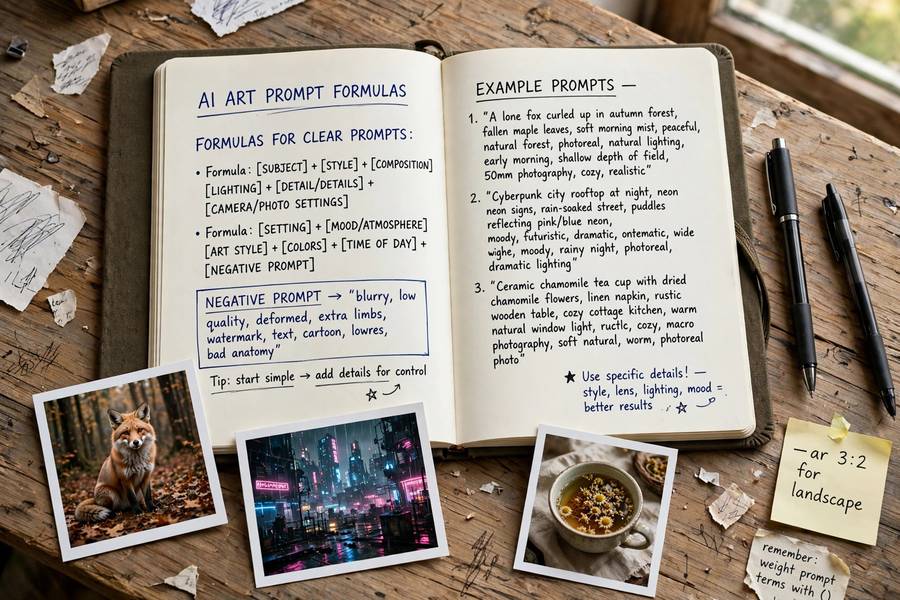
My first prompts were terrible. “Cool dragon” produced a cool-ish dragon and I thought I was done — until I saw what the same tool made for someone who actually knew how to write. The difference wasn’t talent or secret parameters. It was vocabulary: specific words, in a sensible order, describing concrete things. Prompting is a learnable skill with a short learning curve and a high ceiling, and this guide compresses the first month of learning into one read. The why-it-matters backdrop: can AI make art. The tool mechanics: how Midjourney works.
Table of Contents
- The 4-Part Prompt Formula
- Part 1: Subject (Be Absurdly Specific)
- Part 2: Details (The Difference-Makers)
- Part 3: Style and Medium
- Part 4: Mood, Light, and Composition
- Word Choice: What Works and What Doesn’t
- The 7 Beginner Mistakes (I Made Them All)
- Iterating: The Real Skill
- Frequently Asked Questions

The 4-Part Prompt Formula
Every strong prompt has four ingredients, in roughly this order:
[Subject] + [Details] + [Style/Medium] + [Mood/Light/Composition]
Example: weathered fisherman mending nets on a dock (subject) , deep wrinkles, salt-stained canvas coat, seagulls overhead (details) , oil painting (style) , overcast morning light, melancholy mood, wide composition (mood/light).
Why this order: the model weights earlier words slightly more, and subject-first matches how the training captions were usually written. It’s not a law — you can absolutely lead with style — but subject-first is the reliable default.
Why four parts and not more: each part answers one question the model needs answered — what, which specifics, rendered how, feeling how. Prompts missing a part leave that question to chance. “A dragon” answers only what; everything else is a dice roll. The formula just ensures you’ve placed your bets deliberately.
Memorize the four parts. Everything below is elaboration.
Part 1: Subject (Be Absurdly Specific)
Vague subjects produce vague images. The fix is specificity — and beginners consistently underestimate how much:
- Weak:
a dog→ Strong:an elderly golden retriever with a graying muzzle - Weak:
a castle→ Strong:a crumbling stone castle on a sea cliff, banners tattered - Weak:
a woman→ Strong:a middle-aged cartographer with ink-stained fingers and round spectacles
Three specificity levers:
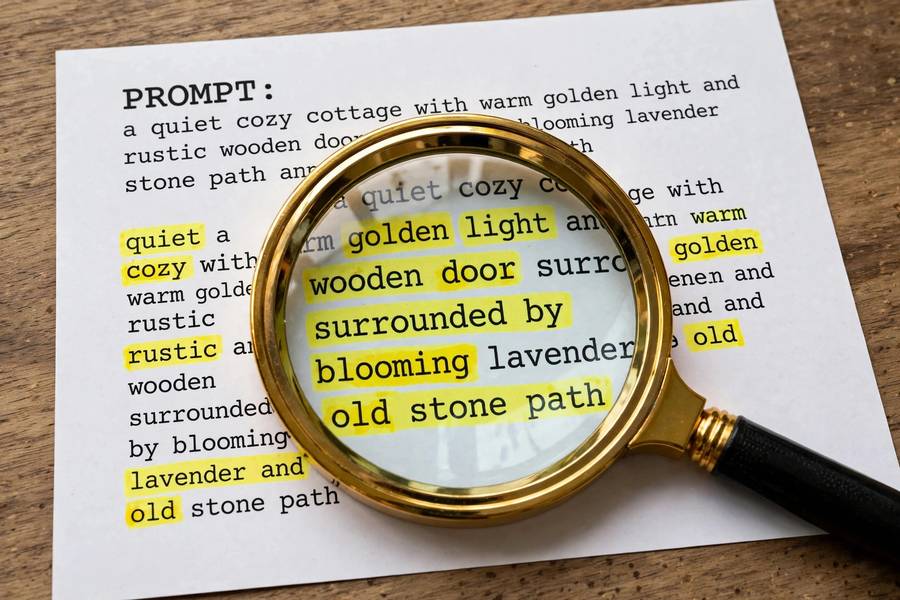
- Adjectives that mean something visual. “Weathered,” “tattered,” “graying” describe visible properties. “Beautiful,” “nice,” “cool” don’t — they’re judgments, and the model can’t see judgments.
- Age, state, and condition. Old vs. young, worn vs. pristine, calm vs. agitated — state words dramatically change outputs because they map to clear visual differences.
- What’s happening. Subjects doing things beat subjects existing: “a baker pulling bread from a stone oven” beats “a baker.” Action implies context, context implies composition.
The test: could a sketch artist draw something concrete from your subject line alone? If yes, it’s specific enough. If they’d have to ask three questions first, keep writing.
Part 2: Details (The Difference-Makers)
Details are where good prompts separate from great ones. After the subject, add 2-5 concrete details — textures, materials, small elements, environmental touches:
a lighthouse on a cliff → a lighthouse on a cliff, peeling white paint, rust-streaked door, seagulls circling, wild grass bending in wind, distant cargo ship
What makes a good detail:
- Textures and materials: “cracked leather,” “brushed steel,” “wet cobblestone” — material words are visual gold because texture is highly renderable.
- Small storytelling elements: “a half-finished letter on the desk,” “muddy boots by the door” — details that imply a world beyond the frame.
- Environmental interaction: “rain streaking the window,” “dust motes in sunbeams,” “steam rising from the cup” — the subject in a world, not floating in void.
What to avoid: detail-stuffing. Ten details compete with each other and dilute the subject. I aim for 3-5, each earning its place. If removing a detail doesn’t change the image meaningfully, it was noise.
Ordering trick: put the most important details first. In long prompts, late details get less attention — front-load what matters.
Part 3: Style and Medium
Style words tell the model how to render. The big categories:
- Medium: “oil painting,” “watercolor,” “charcoal sketch,” “3D render,” “photograph” — the single highest-impact style choice.
- Era/movement: “Art Deco,” “ukiyo-e,” “impressionist,” “1980s anime” — historical styles are coherent visual neighborhoods.
- Genre treatment: “cyberpunk,” “dark fantasy,” “cottagecore,” “solarpunk” — mood-genres that reshape everything.
- Artist-adjacent description: describe qualities (“dramatic chiaroscuro like Caravaggio”) rather than naming living artists — same steering, cleaner ethics.
Two rules: one dominant style (style-stacking produces mud — “watercolor oil painting photo” helps nothing), and match style to subject or deliberately clash it. A watercolor battle scene is a choice; make it deliberately or don’t make it.
Beginner-friendly style starters that rarely disappoint: “cinematic photograph,” “epic fantasy digital painting,” “cozy storybook illustration,” “minimalist vector art.” Each is a well-learned neighborhood — reliable, attractive, hard to break.

Part 4: Mood, Light, and Composition
The part beginners skip and experts never do. Lighting and mood words transform identical subjects:
- Lighting: “golden hour,” “dramatic side lighting,” “soft diffused window light,” “neon glow,” “moonlit,” “backlit silhouette” — lighting is the fastest mood lever in prompting.
- Color direction: “warm autumn palette,” “desaturated blues,” “vibrant complementary colors” — palette words unify the image.
- Mood: “melancholy,” “triumphant,” “serene,” “ominous,” “whimsical” — the model maps emotional language to visual choices with real fluency.
- Composition: “wide establishing shot,” “close-up portrait,” “aerial view,” “rule of thirds,” “symmetrical composition” — camera and framing language borrowed from photography and film.
Try this experiment: generate your subject four times, changing only the lighting word — “golden hour,” “overcast,” “neon night,” “candlelit.” Same subject, four different emotional worlds. That’s the power of part four, and it’s why two people can prompt “the same thing” and get unrecognizably different results.
Word Choice: What Works and What Doesn’t
A quick phrasebook from experience:
Works — concrete visual words: weathered, tattered, gleaming, translucent, overgrown, rusted, backlit, silhouetted, intricate, ornate, minimal, monolithic, delicate, massive.
Works — specific references: “85mm portrait,” “long exposure,” “impasto,” “cel shading,” “isometric,” “double exposure” — technical terms from art and photography translate precisely.
Doesn’t work — empty intensifiers: “very,” “really,” “super,” “extremely.” The model doesn’t do adverbs of degree well. “Very detailed” is weaker than one concrete detail.
Doesn’t work — subjective judgments: “beautiful,” “amazing,” “cool,” “nice,” “awesome.” These describe your reaction, not the image. Replace with what makes it beautiful: the light, the texture, the composition.
Doesn’t work — contradictory piles: “minimalist yet highly detailed, dark yet vibrant, realistic cartoon.” Contradictions don’t average out; they confuse. Pick a lane.
Use sparingly — quality cheerleading: “masterpiece,” “8k,” “trending on ArtStation,” “award-winning.” These had more effect on older models; modern ones need them less. One such term is fine; a bouquet of them is cargo-cult prompting.
The 7 Beginner Mistakes (I Made Them All)
- One-word prompts. “Dragon.” You get a dragon — the model’s default dragon, the most average dragon in latent space. The default is never the interesting choice.
- Prompting the vibe instead of the visuals. “Make it feel nostalgic” vs. “faded 1970s photograph, warm color cast, light leaks.” Translate feelings into visual facts.
- Changing everything between iterations. If generation 1 is close but the lighting’s wrong, change only the lighting words. Change five things and you’ll never learn what each one does.
- Ignoring aspect ratio. A portrait-subject prompt at landscape ratio fights itself. Match
--arto your composition (or your tool’s equivalent) before judging the prompt. - Giving up after one generation. The first result is a draft. Professionals iterate 10-50 times on important pieces. Your third generation is where your real prompting starts.
- Copying prompts without understanding them. Borrowed prompts work until they don’t — and when they break, you can’t fix what you don’t understand. Always ask why each phrase is there.
- Blaming the tool for prompt problems. “Midjourney can’t do hands” — sometimes true, but “my prompt didn’t describe the hands’ position, lighting, or detail level” is true more often. Assume the prompt first, the tool second.
Iterating: The Real Skill
Here’s the secret the guides bury: prompting is 20% writing, 80% iterating. The workflow that actually produces great work:
- Write the 4-part prompt. Best first guess, following the formula.
- Generate and diagnose. Don’t just react (“meh”) — diagnose specifically: the composition works but the palette is wrong; the style landed but the subject drifted.
- Change one thing. The single most important iteration discipline. One variable per generation lets you learn causality — which words do what.
- Keep what works, cut what doesn’t. Prompts evolve by accretion and pruning. Save versions that work; note which phrases earned their keep.
- Know when to restart. If you’re 15 iterations deep and fighting the prompt, the concept may need reframing, not tweaking. Fresh prompt, same idea, different angle — often faster than iteration 16.
Build a swipe file: every prompt that produced something you loved, saved with a note about why it worked. In a few months it becomes a personal style manual — and that’s the moment prompting stops being a trick and becomes a craft. How to use Midjourney is the natural next step for tool-specific technique.
Frequently Asked Questions
Use the 4-part formula: specific subject + concrete details + style/medium + mood, lighting, and composition. Example: “weathered fisherman mending nets, salt-stained coat, oil painting, overcast morning light, melancholy mood.” Specific visual words beat vague praise every time.
Avoid empty intensifiers (“very,” “really”), subjective judgments (“beautiful,” “cool,” “amazing”), and contradictory piles (“minimalist yet highly detailed”). Replace judgments with the visual facts that cause them — describe the light, texture, and composition instead.
Aim for one rich sentence covering the four parts — roughly 15-40 words. Longer isn’t better: 3-5 well-chosen details beat 15 competing ones. Front-load the most important words, since earlier terms carry slightly more weight.
The most common causes are vague subjects (“a dog” instead of “an elderly golden retriever”), missing style/medium words, no lighting or mood direction, and giving up after one generation. Diagnose specifically, change one thing per iteration, and expect to iterate 10+ times on important pieces.
Yes, mildly — earlier words carry slightly more weight, so lead with your subject, then details, then style, then mood and lighting. More important than order is changing only one element between iterations so you learn what each word actually does.