
Prompt engineering has a legitimacy problem — not because the skill is fake (it’s very real), but because the course market around it is flooded with opportunists selling “100 secret prompts” to people who’d be better served learning principles. I’ve seen $200 courses containing less insight than a good blog post, and free resources outperforming premium ones. The skill deserves better than its marketplace.
So let’s be blunt about what prompt engineering is, what courses can actually teach, and how to tell the real ones from the repackaged. For the wider education landscape, see the best AI courses online.
Table of Contents
- What Prompt Engineering Actually Is
- Do You Even Need a Course?
- What Good Prompt Engineering Courses Teach
- The Two Flavors: Chat vs Applied
- Evaluating a Prompt Engineering Course
- The Snake Oil Catalog
- Free Alternatives That Actually Work
- Prompt Engineering as a Career: Reality Check
- What to Do After You Finish
- Frequently Asked Questions
What Prompt Engineering Actually Is
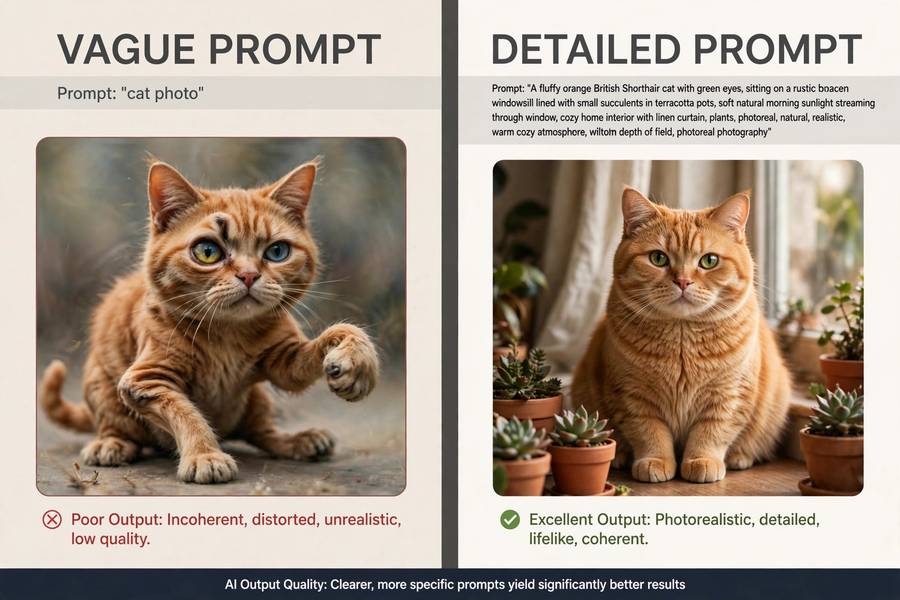
Strip away the hype: prompt engineering is the skill of communicating effectively with AI models to get useful outputs. It has real depth — understanding how models interpret instructions, structuring context, decomposing complex tasks, iterating systematically, designing prompts for applications (not just chat). Practitioners develop genuine expertise; the difference between novice and expert prompting is enormous and measurable.
What it ISN’T: memorizing magic phrases. There are no secret incantations. “Act as an expert” isn’t a spell — it’s a context-setting technique that works for understandable reasons, and understanding the reasons matters more than the phrase. Anyone selling prompts as products is selling fish instead of teaching fishing.
The skill has two layers: principles (how models process instructions, what context they need, how to structure complex requests) which are durable, and tactics (specific phrasings, tool-specific features) which expire. Good courses teach principles with tactics as examples. Bad courses sell tactics as principles.
Do You Even Need a Course?
Honest answer: maybe not. Prompting is learned primarily through practice — deliberate, reflective practice with good guidance. The guidance part is where courses help, but excellent guidance exists free. My own guide on how to get better answers from ChatGPT covers the core techniques at no cost.
Consider a course when: you want structured progression instead of self-directed wandering, you value feedback on your prompts from someone skilled, you’re learning application-level prompt design (system prompts, chains, evaluation) where the complexity justifies instruction, or your employer is paying and the credential matters internally.
Skip the course when: you just want to get better at chatting with AI — practice with good free guidance will get you there. Don’t pay for what reps give free.
The meta-point: prompting skill correlates with practice volume more than with instruction quality. A mediocre course plus 100 hours of practice beats an excellent course plus 10 hours. Budget your time accordingly.
What Good Prompt Engineering Courses Teach
Mental models. How LLMs process prompts — prediction, context windows, instruction following. Not deep technical detail, but enough mechanism that techniques make sense rather than seeming magical.
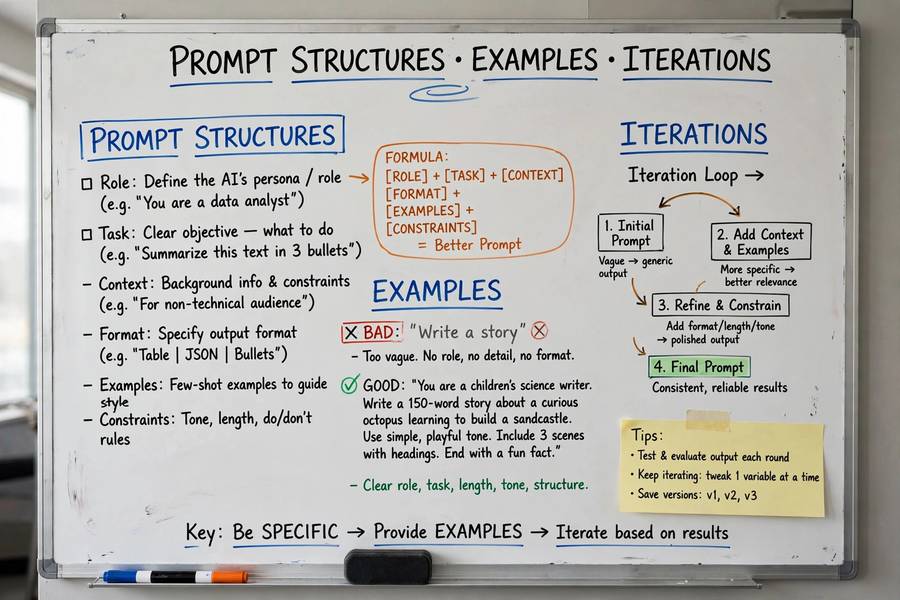
Core techniques with rationale. Role prompting, few-shot examples, chain-of-thought, structured output, constraint specification — each taught with WHY it works, so you can adapt rather than copy.
Task decomposition. Breaking complex jobs into prompt sequences. This is the advanced skill — orchestrating multiple calls, managing context across them, handling failures. Where real expertise lives.
Iteration methodology. Systematic improvement: diagnosing bad outputs, forming hypotheses, testing changes. The debugging mindset applied to prompts.
Evaluation. How do you know a prompt is good? For applications, this means testing frameworks and metrics. For personal use, it means developing taste — which courses can accelerate through examples and critique.
Limitations and failure modes. When prompting can’t fix something (model capability limits, knowledge gaps), and what to do instead. Honest courses teach the boundaries.
Notice what’s missing: lists of prompts to memorize. That’s the tell.
The Two Flavors: Chat vs Applied
Chat prompting courses teach getting better outputs from conversational AI — for writing, analysis, brainstorming, learning. The audience is everyone. The skills are broadly useful. The ceiling is personal productivity.
Applied prompt engineering teaches designing prompts for applications — system prompts, API integration, chaining, evaluation, reliability. The audience is builders. The skills are engineering. The ceiling is products.
These are different disciplines sharing a name. A chat prompting course won’t teach you to build a reliable AI feature; an applied course is overkill if you just want better ChatGPT outputs. Match the flavor to your goal — and be suspicious of courses claiming to cover both deeply. They’re different depths.
If you’re starting out, my beginner guide on how to learn prompt engineering as a beginner maps the learning path free.

Evaluating a Prompt Engineering Course
Instructor does the work. The instructor should be a visible practitioner — writing about prompting, building with AI, showing their work. Theorists teaching prompting is like non-swimmers teaching swimming.
Principles over prompts. Preview the curriculum: does it teach WHY techniques work? Are there explanations of model behavior? Or just prompt collections? The former transfers; the latter expires.
Exercises, not just examples. You learn prompting by prompting. Courses with extensive hands-on exercises, challenges, and (ideally) feedback beat lecture-only courses decisively.
Current. Prompting best practices evolve with models — what worked for GPT-3 doesn’t all apply to current models. Check dates; prefer recent.
Honest about limits. Good courses discuss when prompting fails and what the alternatives are (fine-tuning, RAG, different tools). Courses presenting prompting as omnipotent are selling fantasy.
Appropriate scope. A focused course (“prompt engineering for data analysis”) beats a sprawling one (“master all prompting!”) — specificity signals real expertise.
The Snake Oil Catalog
The prompt engineering marketplace’s greatest hits of nonsense:
“1000+ premium prompts.” Prompt collections without principles. Expire on contact with new models. The “premium” is marketing.
“Secret prompts the experts don’t want you to know.” There are no secret prompts. This is conspiracy marketing applied to education.
“Become a certified prompt engineer in 2 hours.” Expertise in 2 hours is a contradiction in terms. The certificate is the product; the learning is the packaging.
“Prompts that print money.” Business-opportunity framing for a skill course. The prompts don’t print money; the underlying business does, and that’s not taught.
AI-generated course content. Courses about prompting, written by AI, with no human expertise. The irony would be funny if people weren’t paying for it.
“Never write a bad prompt again.” Absolutist promises for a probabilistic skill. You’ll write bad prompts forever — expertise is diagnosing and fixing them faster.
The pattern: legitimate courses sell skill development; snake oil sells shortcuts, secrets, and certainty. Skill development is honest work marketed honestly. Everything else is a red flag.
Free Alternatives That Actually Work
The free path is strong here — arguably stronger than in most AI topics:
- Deliberate practice with a good techniques guide. The reps are the education.
- Community prompt libraries — studying real prompts that work, with context. Better than purchased collections because they come with discussion.
- Model documentation — the official guides from AI labs are excellent and free. They want you to prompt well; it’s in their interest.
- Build something. A personal project requiring good prompts teaches faster than any course — necessity is the best instructor.
- The prompt journal. Save what works, note why. Your personal playbook becomes more valuable than any course’s templates.
Many top prompt engineers are self-taught through exactly this path. The course is optional acceleration, not required infrastructure.
Prompt Engineering as a Career: Reality Check
“Prompt engineer” as a job title exists but is narrower than the hype suggests. Reality:
- Dedicated prompt engineer roles exist at AI-forward companies, but they’re fewer than the courses imply and usually require broader skills (product sense, evaluation, sometimes coding).
- Prompting as part of a role is the real market — marketers, analysts, developers, writers who prompt expertly as part of bigger jobs. This is where the skill pays.
- The skill premium is real but bundled. Nobody hires “prompt engineer” alone; they hire someone excellent whose excellence includes prompting.
Don’t take a prompt engineering course expecting a job title. Take it expecting a skill that amplifies whatever you already do. That’s the honest value proposition — considerable, but different from the marketing.
What to Do After You Finish
A prompt engineering course ends; the skill doesn’t. The post-course plan:
Build the prompt journal habit. Every time a prompt works unusually well (or fails interestingly), save it with notes on why. Within months you’ll own a personal reference more valuable than any course material — because it’s tuned to your tasks.
Take on a real project. Volunteer for the AI-related task at work nobody wants, or build a personal tool that needs good prompting. Real constraints — real users, real stakes — teach faster than exercises.
Study other people’s prompts. Community libraries, open-source AI projects, shared system prompts. Reading good prompts critically (why did they structure it this way?) builds taste faster than writing alone.
Revisit fundamentals quarterly. Models change; your prompting should evolve with them. Techniques that were essential two years ago are obsolete; new capabilities need new approaches. The skill isn’t static — treat it as a practice, not a completed course.
Teach someone. Explaining prompting to a colleague forces you to articulate principles instead of reciting tricks. If you can’t explain why a prompt works, you don’t fully understand it yet.
Frequently Asked Questions
The skill of communicating effectively with AI models to get useful outputs — structuring instructions, providing context, decomposing complex tasks, and iterating systematically. It has real depth: principles (durable) and tactics (expiring). It’s about understanding, not memorizing magic phrases.
Sometimes — good ones teach transferable principles with extensive practice and accelerate learning meaningfully. But prompting is learned primarily through practice, and excellent free guidance exists. Consider a course for structure, feedback, or application-level design; skip it if you just want better chat outputs.
Red flags: selling prompt collections as the product, “secret prompts” marketing, 2-hour expertise promises, AI-generated content with no human expertise, absolutist guarantees, and no explanation of WHY techniques work. Legitimate courses sell skill development, not shortcuts.
Yes — deliberate practice with a good techniques guide, community prompt libraries, official model documentation, and building personal projects teach it well. Many top prompt engineers are self-taught. Courses are optional acceleration, not required infrastructure.
Dedicated roles exist but are fewer than hyped and usually require broader skills. The bigger market is prompting as part of other roles — marketers, analysts, developers who prompt expertly. Learn it as a skill that amplifies your existing work, not as a standalone job ticket.