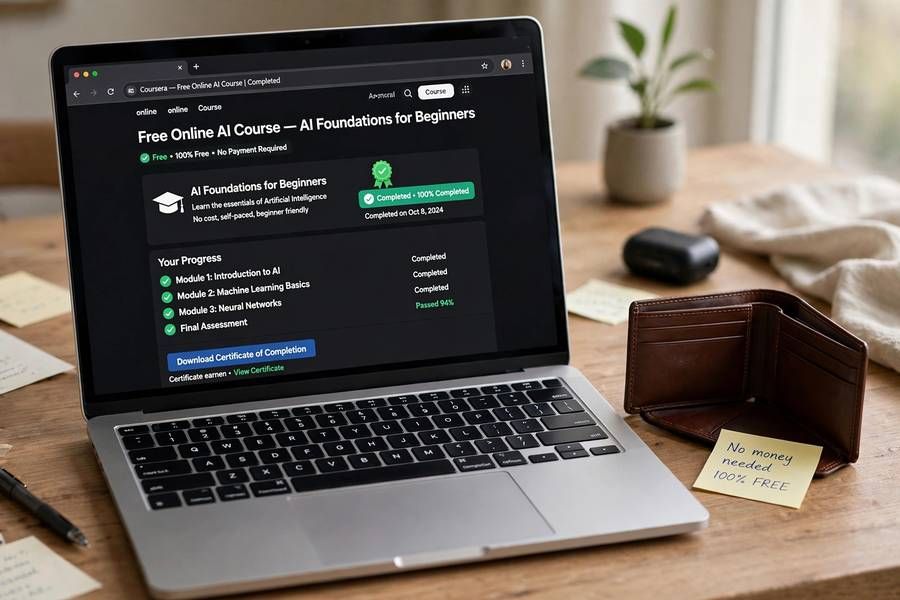
The best-kept secret in AI education: you can go from zero to genuinely knowledgeable without spending anything — and pick up certificates along the way. Not sketchy certificates from diploma mills, but legitimate credentials from real institutions and platforms. The free tier of AI education isn’t the scraps; in many cases it’s the main course, with paid tiers selling convenience and credentials rather than fundamentally better teaching.
But “free with certificate” has fine print, and the landscape is full of almost-free offers designed to upsell you. This guide maps where the real free credentials live, what’s actually free versus freemium, and how to extract maximum value without opening your wallet. For paid options and the broader landscape, see the best AI courses online.
Table of Contents
- Why So Much Quality AI Education Is Free
- The Truly Free: Content and Certificate Both Free
- The Freemium Model: Free Learning, Paid Certificate
- Audit Tracks: The Platform Loophole
- University Open Courseware
- Big Tech Free Programs
- The Catches: Reading the Fine Print
- Maximizing Free Learning: A Strategy
- The Free-Learning Traps
- Frequently Asked Questions

Why So Much Quality AI Education Is Free
Three forces make AI education unusually free. First, the field’s culture: AI research grew up on open publishing — papers, code, and lectures shared freely. That ethos extends to teaching. Second, strategic generosity: big tech companies offer free AI education because a larger AI-literate workforce benefits their platforms. Third, competition: with thousands of courses competing, free is a customer-acquisition strategy — the hope is you’ll convert to paid eventually.
The result: the free tier isn’t charity or leftovers. It’s a battlefield where providers compete for your attention with genuinely good content. As a learner, you’re the beneficiary — exploit it shamelessly.
The Truly Free: Content and Certificate Both Free
These give you real certificates at zero cost:
Vendor and platform fundamentals courses. Major cloud providers and AI companies offer free introductory courses with free completion badges/certificates — usually for their ecosystems, but the fundamentals transfer. The certificates are real (verifiable, shareable) though narrow in scope.
Nonprofit and initiative programs. Various AI literacy initiatives, often backed by foundations or governments, offer free courses with certificates — particularly for AI fundamentals and responsible AI. Quality varies, but the best are excellent and the credentials are legitimate.
Community-driven programs. Study groups and open cohorts that issue completion certificates. The credential value is modest, but the learning (and network) can be outstanding.
The pattern: truly-free certificates cluster at the introductory level. Nobody gives away advanced credentials free — the economics don’t work. Use free certificates for foundations and early momentum; expect to pay (or prove skill other ways) for advanced signaling.
The Freemium Model: Free Learning, Paid Certificate
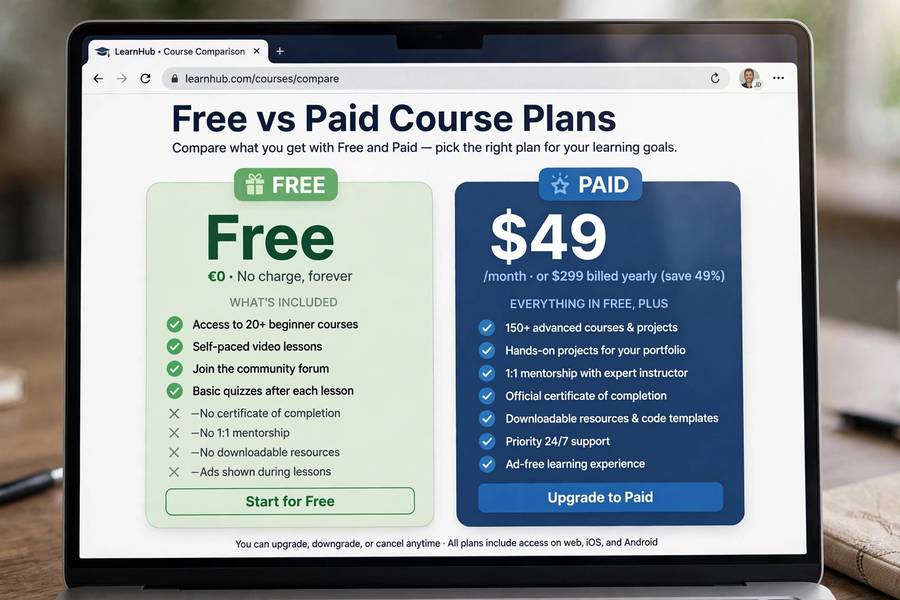
The most common structure: course content free, verified certificate paid ($30–$100 typically). This is actually the sweet spot for most learners, because:
- The learning is what matters most, and it’s free. Watch everything, do the exercises, build the projects — $0.
- The certificate is optional. Decide at the end whether the credential serves a purpose worth the fee.
- No risk. You never pay for a course you might not finish. Finish first, then buy the receipt.
The strategy: treat every freemium course as free. Complete it, build the portfolio projects, and only then evaluate the certificate purchase against a specific need — a job application, LinkedIn credibility for recruiter searches, an employer requirement. Most learners discover they don’t need most certificates once the learning is done.
One caution: some platforms time-limit free access or withhold graded assignments from free tiers. Check what’s actually included before investing weeks — “free” that excludes the assessments is free-er than it looks.
Audit Tracks: The Platform Loophole
Most major course platforms let you audit courses free — full video access, no certificate, sometimes no graded assignments. This is the loophole that makes expensive courses free:
- Audit the content, learn everything, build the projects independently.
- Skip the certificate unless you need it (see the freemium logic above).
- Supplement assessments with your own projects — which matter more anyway.
Auditing is how you take a $500 specialization for $0. The platform gets a potential future customer; you get the education. Everyone wins except the certificate industry, which will survive.
The main limitation: some courses restrict audit access to older versions or exclude hands-on labs. For video-heavy courses this barely matters; for lab-heavy technical courses, check what’s included.
University Open Courseware
The deepest free resource: actual university courses, published openly:
- Lecture videos from top AI/ML courses — the same lectures paying students attend, free on video platforms.
- Assignments and materials — many courses publish problem sets, readings, and project specs openly.
- No certificate (usually) — this is the trade. You’re getting the education of a $5,000 course for $0, minus the credential.
For self-directed learners with discipline, open courseware plus independent projects is arguably the highest-ROI education path in existence. The missing pieces — structure, feedback, credentials — can be supplemented: structure from study groups, feedback from communities, credentials from cheaper targeted certificates.
The honest assessment: open courseware demands the most self-discipline but delivers the deepest learning per dollar (infinite ROI — division by zero). If you can sustain it, nothing beats it.
Big Tech Free Programs
The major AI and cloud companies run extensive free education programs — partly talent pipeline, partly ecosystem building:
- Cloud AI fundamentals — free courses with badges for each major cloud’s AI services. Narrow but practical, and the badges have real enterprise value.
- AI literacy initiatives — free short courses aimed at general audiences, often with shareable completion certificates.
- Developer programs — free advanced content for builders, sometimes with certification paths.
These are genuinely useful and genuinely free — the catch is ecosystem specificity. A cloud provider’s free course teaches their tools well and general concepts adequately. Learn the concepts, treat the tool specifics as examples, and you’ll extract lasting value regardless of which platform you eventually use.
The Catches: Reading the Fine Print
“Free” that demands payment details. Some “free trials” ask for your billing information upfront and auto-convert to paid. If it demands payment info before showing any lesson, walk away — legitimate free courses don’t need it.
Certificate vs completion. “Free certificate” sometimes means a PDF you generate yourself (fine) versus a verifiable credential (better). Know which you’re getting.
Time-limited access. Free tiers sometimes expire — “free for 7 days” is a trial, not free. Check durations before starting.
Upsell pressure. Free courses as funnels for paid programs is normal; aggressive upselling inside the learning experience is a quality signal (bad). The best free courses respect your attention.
Quality variance. Free includes everything from world-class to worthless. The selection criteria from my main guide apply doubly here — free doesn’t excuse bad, and bad free courses waste the one resource you can’t get back: time.
Credential inflation. As free certificates proliferate, each one’s signaling value drops. This is fine — you’re here for learning first. Just don’t collect certificates expecting them to impress; collect skills.
Maximizing Free Learning: A Strategy
The optimal free path:
- Start with free literacy courses (with or without certificates — the knowledge is the point).
- Audit one structured specialization in your chosen direction — free.
- Supplement with open courseware for depth where you need it.
- Build public projects throughout — your real credential, free to create.
- Add selective paid certificates only where a specific purpose justifies the cost.
- Read — best AI books for beginners are cheap or library-free and deliver depth no video course matches.
Total cost: $0–$100. Total value: comparable to thousands in paid courses, if you bring the discipline. The money was never the barrier — sustained effort is. Free education removes every excuse except the real one.
The Free-Learning Traps
Free education has failure modes that paid education doesn’t. Knowing them saves you the one thing free courses still cost — time:
The paradox of free: no sunk cost, no commitment. When a course costs nothing, quitting costs nothing, and quit rates for free courses are catastrophic. The fix is manufacturing commitment: public goals, study partners, scheduled sessions. Treat free courses with paid-course seriousness or they’ll evaporate.
Collecting courses instead of completing them. Bookmarking forty courses feels like progress. It’s hoarding. The number of courses you’ve saved predicts nothing; the number you’ve finished predicts everything.
Confusing watching with learning. Free video is the easiest medium to consume passively. If you’re not pausing to try things, taking notes, or doing the exercises, you’re watching television about AI, not learning AI.
Avoiding the hard parts because no one’s watching. In paid cohorts, structure pushes you through difficult weeks. Free and self-paced, you’re on your own — and the temptation to skip the math-heavy or debugging-heavy sections is strong. Those sections are usually the most valuable ones.
Never paying when paying would help. The free purist who spends six months stuck on something a $50 course would have unblocked in a week. Free is a strategy, not a religion. When the ROI is obvious — structure, feedback, a credential you actually need — spend the money without guilt. The goal is learning efficiently, not spending zero.
Frequently Asked Questions
Yes — vendor programs, nonprofit initiatives, and some platforms offer genuinely free courses with real certificates, mostly at the introductory level. The most common model is freemium: content free, verified certificate paid ($30–$100), which you can decide on after completing.
Auditing means accessing course videos and materials free without a certificate or graded assignments. Most major platforms allow it. It’s how you take expensive specializations for $0 — learn everything, build projects independently, and skip the credential unless you need it.
Modestly — they show initiative and structured learning, but employers weight demonstrated skill (projects, interviews) far more heavily. Treat free certificates as learning milestones and motivation, not as job-winning credentials.
Common catches: credit-card-required “free trials” that auto-convert, time-limited access, certificates that cost extra, withheld assessments in free tiers, and upsell pressure. Legitimate free courses don’t need your payment details — check the fine print before starting.
Yes — free courses, audit tracks, university open courseware, documentation, and community resources cover everything from literacy to advanced topics. The investment required is time and discipline, not money. Add selective paid certificates only where a specific purpose justifies it.