The 1980s were supposed to be AI’s decade. Not in the vague, hand-wavy sense — in the concrete, billions-of-dollars, dedicated-hardware sense. Expert systems were going to bottle human expertise and sell it by the license. For a few glorious years, they did. Then the whole edifice collapsed so completely that it took the field’s funding down with it and gave us the second AI winter. I think this story is the single most instructive episode in AI history, because it’s the one today’s boom most resembles — and the differences are as revealing as the similarities.
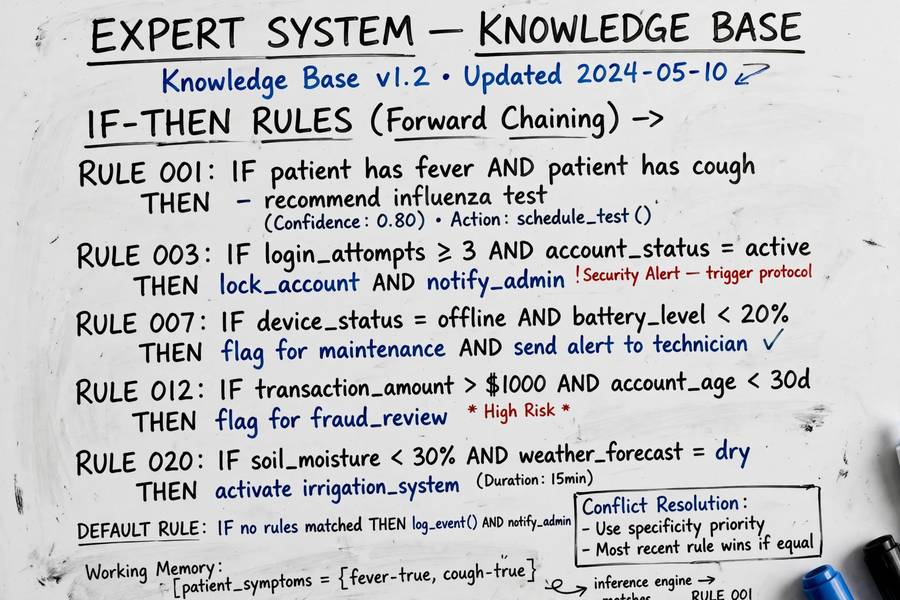
An expert system, in case the term has faded: software that encodes a human expert’s knowledge as explicit if-then rules, then applies those rules to solve problems. If findings A and B, then conclusion C. If the order contains parts X and Y, then configuration Z. The knowledge came from interviewing experts; the reasoning came from an “inference engine” that chained the rules together. Simple idea. Enormous consequences. For the broader context of the freezes, see my guide to the AI winter.
Table of Contents
- The Seductive Idea
- The Boom Years: Money, Machines, and Momentum
- XCON: The Poster Child
- Japan Bets the Country
- The Brittleness Problem
- The Hardware Collapse
- The Winter Arrives
- What Expert Systems Got Right
- The Parallels to Today (and the Differences)
- Frequently Asked Questions
The Seductive Idea
The pitch for expert systems was, frankly, irresistible. Human experts are expensive, inconsistent, and mortal — they retire, taking decades of knowledge with them. What if you could extract that knowledge, encode it as rules, and run it forever? A tireless expert in a box, available 24/7, never wrong about what it knows.
The early results backed the pitch. DENDRAL inferred molecular structures from mass spectrometry data. MYCIN identified bacterial infections — in tests, it matched or beat human specialists. These weren’t toys; they were serious systems doing serious work in narrow domains. The inference seemed obvious: if it works for chemistry and medicine, it’ll work for everything.
I want to pause on why this was so seductive, because the seduction is the story. Expert systems promised to skip the hard part of AI — understanding — and go straight to the valuable part: behaving expertly. It was intelligence without comprehension, and for a while, nobody cared about the difference. The systems worked. The customers paid. The future looked like a straightforward scaling problem: more experts interviewed, more rules written, more domains conquered.
The Boom Years: Money, Machines, and Momentum
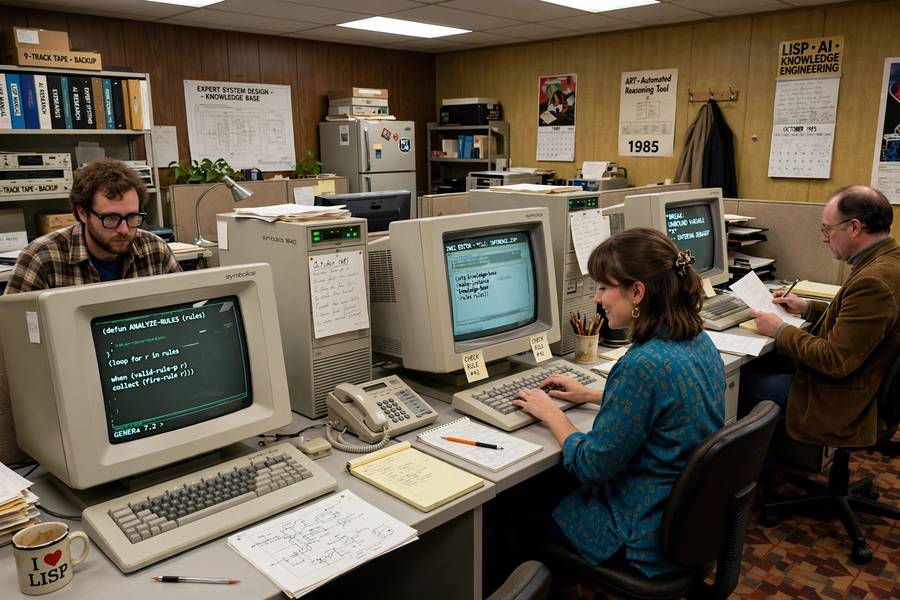
By the mid-1980s, expert systems were a genuine industry. Specialized companies — Symbolics, Lisp Machines Inc., Teknowledge, Intellicorp — sold dedicated hardware and software. The Lisp machine was a beautiful, doomed artifact: a workstation optimized for running AI software, costing tens of thousands of dollars, bought by labs and corporations that believed AI was the future of computing.
Consulting practices sprang up to build expert systems for corporate clients. Universities launched courses and programs. Trade press covered the industry breathlessly. Market estimates ran into the billions. The US government funded the Strategic Computing Initiative; DARPA money flowed. It felt, to everyone inside it, like the permanent arrival of AI as an industry.
The history of artificial intelligence shows this as the field’s second great boom — bigger in commercial terms than the first, with real products and real revenue. That’s what made the collapse so shocking. This wasn’t a lab curiosity losing grant money. This was an industry dying.
XCON: The Poster Child
Every boom needs a poster child, and expert systems had XCON (later renamed R1). Built at Carnegie Mellon for Digital Equipment Corporation, XCON configured VAX computer orders — matching components, checking compatibility, generating assembly instructions. DEC credited it with saving tens of millions of dollars annually.
XCON was genuinely impressive and genuinely useful. It encoded the knowledge of DEC’s best configuration experts into thousands of rules and applied them tirelessly. Orders that took experts hours took XCON minutes. It was the proof that the model worked — and it was cited endlessly as evidence that expert systems would transform every knowledge-intensive industry.
But XCON also previewed the problems. Its rule base grew to thousands of rules, and maintaining them became a job in itself. Rules interacted in unexpected ways. Changes in DEC’s product line required constant knowledge-base surgery. XCON worked because DEC committed serious ongoing resources to feeding it — a commitment most customers weren’t prepared to make. The poster child was also the warning label, if you read the fine print.
Japan Bets the Country
The boom went geopolitical in 1982 when Japan’s Ministry of International Trade and Industry launched the Fifth Generation Computer Project — a decade-long, government-funded moonshot to build computers that could reason, understand language, and run expert systems natively. The budget was enormous. The ambition was total: Japan would leapfrog the US and own the future of computing.
The West panicked, productively. The US and UK launched response programs. Funding surged globally. The Fifth Generation project became the symbol of AI’s seriousness — this wasn’t academic play anymore; nations were betting industrial policy on it.
It failed. Not embarrassingly all at once, but gradually and then completely. The project’s goals — logic programming at scale, natural language understanding, expert systems everywhere — ran into the same brittleness problems as commercial expert systems, compounded by betting on Prolog as the language of the future just as the rest of the world standardized on something else. By the early 1990s, the project was wound down, its ambitions quietly shelved.
The lesson isn’t that government moonshots are foolish — it’s that betting a national strategy on a technology’s current paradigm is dangerous. Paradigms shift. The Fifth Generation bet on rules; the future belonged to learning.

The Brittleness Problem
Here’s the technical heart of the collapse, and it’s worth understanding because it’s a general failure mode, not a historical curiosity.
Expert systems were brittle in three specific ways. First, the knowledge acquisition bottleneck. Extracting expertise from humans turned out to be brutally hard. Experts often can’t articulate how they know things — much of expertise is tacit, pattern-based, unconscious. Knowledge engineers spent months interviewing experts and produced rule bases that captured the letter of expertise while missing its spirit.
Second, the maintenance nightmare. A rule base of 5,000 rules isn’t five times harder to maintain than 1,000 rules — it’s fifty times harder, because rules interact. Change one rule and three others break in ways nobody predicted. As domains evolved — new products, new regulations, new edge cases — the knowledge base rotted. Keeping it current cost nearly as much as building it.
Third, the cliff edge of competence. Expert systems had no graceful degradation. Inside their domain, they were brilliant. One step outside it, they were confidently wrong — and they were always confident. A human expert knows when they’re out of their depth; an expert system happily applied medical expert-system rules to cases the rules were never meant to cover. There was no “I don’t know” — only wrong answers delivered with machine certainty.
Brittleness is the tax on explicit knowledge. Everything must be stated; nothing can be learned; the system can’t adapt. It’s the opposite of how modern systems work — which is why how AI models are trained today looks so different. Learning systems degrade gracefully and improve with data. Rule systems shatter and rot without maintenance.
The Hardware Collapse
The commercial collapse had a specific trigger: in 1987, the market for specialized Lisp machines imploded. General-purpose workstations — Sun, Apollo, and eventually PCs — got fast enough and cheap enough to run AI software. Why buy a $50,000 Lisp machine when a $10,000 workstation runs your expert system fine?
This killed Symbolics, Lisp Machines Inc., and the hardware ecosystem overnight. And because the software companies were entangled with the hardware companies — same customers, same sales channels, same conferences — the software side caught the same cold. Teknowledge, Intellicorp, and the consulting practices built around expert systems withered.
It’s a classic platform story: the expert-systems industry built its economics on expensive specialized infrastructure, and commoditization destroyed the margins. The technology didn’t stop working — the business model stopped working, and in a commercial industry, that’s the same thing.
The Winter Arrives
With the industry collapsing, funding followed. DARPA wound down the Strategic Computing Initiative. Corporate AI labs closed. Government grants dried up. And culturally, “artificial intelligence” became a phrase that marked you as a relic of a failed fad. Researchers rebranded — “intelligent systems,” “informatics,” anything but AI.
The second winter lasted roughly from 1987 to 1993. It was commercially deeper than the first — real companies died, real fortunes were lost — but the research core survived, smaller and humbler. Machine learning continued under its unglamorous aliases. The statistical methods that would power the next boom were being developed in the cold.
What strikes me most: the winter wasn’t caused by expert systems failing to work. They worked — within limits, with maintenance, in narrow domains. The winter was caused by the gap between what was promised (expertise in a box, for every industry) and what was delivered (brittle, expensive, high-maintenance systems for narrow problems). Promises, not technology. Again.
What Expert Systems Got Right
It’s easy to treat expert systems as a pure cautionary tale, but they got important things right — and modern AI has quietly reabsorbed several of them.
They were interpretable. You could read the rules. You could explain exactly why the system reached a conclusion. Modern deep learning struggles with this — we have powerful systems whose reasoning we can’t fully inspect. The current interest in explainable AI is, in part, expert systems’ revenge.
They encoded real knowledge. The knowledge acquisition bottleneck was real, but the knowledge acquired was real too. Modern retrieval-augmented systems and knowledge graphs are descendants of the idea that explicit knowledge has value alongside learned patterns.
They worked in high-stakes narrow domains. Where the domain was stable and the rules were clear, expert systems delivered genuine value. That lesson — narrow beats broad, stable beats shifting — still applies.
The failure wasn’t the idea of encoding knowledge. It was the idea that encoding knowledge was all you needed.
The Parallels to Today (and the Differences)
Now the uncomfortable part: mapping this onto the present.
Parallels. Today’s AI boom also features systems that are brilliant inside their domain and shaky outside it. Today’s boom also has a maintenance story nobody likes to discuss — models that need constant updating, evaluation, and guardrails. Today’s boom also has its poster children (impressive demos, big claimed savings) and its national moonshots. And today’s boom also sometimes lacks a graceful “I don’t know.”
Differences. The crucial one: modern systems learn. An expert system’s knowledge was frozen at authoring time; a modern model’s knowledge updates with training and can be extended with retrieval. That doesn’t eliminate brittleness — hallucinations are brittleness wearing a friendlier mask — but it changes the economics. Maintenance is still required, but it’s a different kind of maintenance.
The other difference is deployment depth. Expert systems were sold as products; modern AI is woven into infrastructure. It’s harder to have a winter when the technology is load-bearing in thousands of companies’ daily operations.
My take: the expert-systems story warns us about overclaiming narrow brilliance as general intelligence, about maintenance costs that eat the savings, and about business models built on expensive specialized infrastructure. Those warnings are live. The differences give us reasons for measured optimism, not complacency.

Frequently Asked Questions
Expert systems were 1980s AI software that encoded human experts’ knowledge as explicit if-then rules, then used an inference engine to apply those rules to problems like medical assessment or equipment configuration. They worked well in narrow domains but were brittle outside them.
Expert systems didn’t directly cause the winter — the gap between their promises and reality did. When their brittleness, maintenance costs, and the 1987 collapse of the Lisp machine hardware market destroyed the industry’s economics, funding dried up across AI, triggering the second AI winter (roughly 1987–1993).
XCON (later R1) was an expert system built at Carnegie Mellon for Digital Equipment Corporation that configured VAX computer orders. DEC credited it with saving tens of millions of dollars annually, making it the poster child of the expert systems boom — though its growing maintenance burden also previewed the technology’s limits.
Launched in 1982, it was Japan’s decade-long government moonshot to build reasoning computers based on logic programming and expert systems. It ultimately failed as the technology proved too brittle and the industry moved toward learning-based approaches instead of rule-based ones.
Yes, in narrow form. Rule-based systems survive in domains with stable, explicit knowledge — tax software, configuration tools, industrial control, and compliance checking. Modern AI has also reabsorbed their strengths: interpretability and explicit knowledge now complement learning-based systems rather than competing with them.