If you’ve ever watched a technology go from “this changes everything” to “this is a scam” to “oh, this is just useful now” in the span of a few years, you’ve watched the hype cycle do its work. The AI hype cycle is the most dramatic version of this pattern in modern technology — partly because AI’s promises are the grandest, and partly because its disappointments are the most public. Understanding the cycle won’t let you predict the future, but it will stop you from mistaking the weather for the climate.
I use the hype cycle as a mental model the way sailors use charts: not to control the sea, but to avoid the rocks. Here’s the full map — the five phases, where AI has been through them before, and how to read your current position. The freezes at the bottom of the cycle are what I cover in my guide to the AI winter.
Table of Contents
- The Five Phases, Plainly Stated
- Phase 1: The Innovation Trigger
- Phase 2: The Peak of Inflated Expectations
- Phase 3: The Trough of Disillusionment
- Phase 4: The Slope of Enlightenment
- Phase 5: The Plateau of Productivity
- AI’s Trips Around the Cycle
- Where Is AI Right Now?
- How to Use the Cycle Without Being Used by It
- Frequently Asked Questions
The Five Phases, Plainly Stated
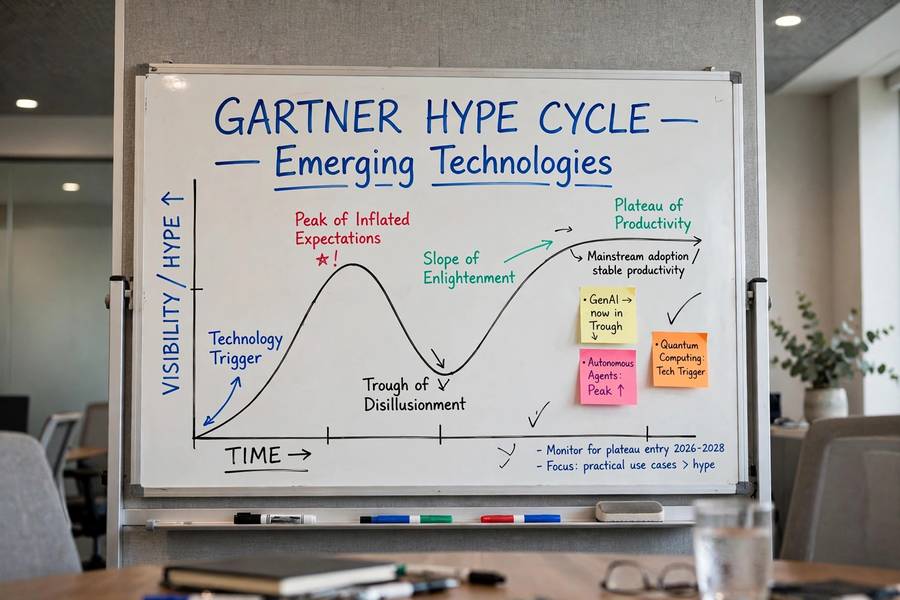
The hype cycle model — popularized by Gartner, though the pattern predates the branding — describes how new technologies move through public and commercial attention. Five phases:
- Innovation trigger — a breakthrough appears; early excitement begins.
- Peak of inflated expectations — hype exceeds reality; everyone piles in.
- Trough of disillusionment — the technology fails to meet inflated expectations; interest collapses.
- Slope of enlightenment — realistic understanding emerges; practical uses develop.
- Plateau of productivity — the technology becomes boring, useful infrastructure.
The model’s genius is that it separates the technology’s actual progress (which tends to climb steadily) from attention (which spikes and crashes). The technology doesn’t get worse in the trough — the story about the technology gets worse. That distinction is everything.
Critics note the model is descriptive, not predictive — it tells you where you are, not what’s next, and the timing of each phase is unknowable in advance. Fair. It’s a compass, not a clock. But when you’re lost, a compass is exactly what you need.
Phase 1: The Innovation Trigger
Every cycle starts with something genuinely new. A research breakthrough, a surprising demo, a product that does something nobody expected. Early coverage is technical and measured — the only people paying attention are the ones who understand what happened.
For AI, innovation triggers are easy to spot in hindsight: the perceptron in 1958, the first expert systems in the late 1970s, AlexNet in 2012, the transformer architecture in 2017, ChatGPT in 2022. Each was a real advance. Each was initially understood by a small circle.
The trigger phase is short and honest. Nobody’s lying yet — there’s simply not enough attention to lie to. The danger of this phase isn’t hype; it’s obscurity. Most triggers fizzle. The ones that don’t get noticed, and then the cycle begins in earnest.
If you’re an early adopter type, this is your phase — maximum signal, minimum noise. The price of admission is doing your own evaluation, because there’s no consensus to lean on yet.
Phase 2: The Peak of Inflated Expectations
This is the fun phase, and the dangerous one. The trigger gets popularized, simplified, and extrapolated. Media coverage shifts from “interesting research result” to “the world will never be the same.” Money floods in — venture capital, corporate R&D, government grants. Startups multiply. Every company adds the technology to its pitch deck.
The peak has recognizable warning signs. Vocabulary inflation: the technology’s name starts appearing everywhere, often attached to things that barely use it. Prediction escalation: forecasts shift from product timelines to civilizational transformation. Celebrity experts: people with no technical background become the loudest voices. FOMO funding: investors fund companies because competitors are funding them.
AI has peaked multiple times: the late 1960s (machines will do any human work within a generation), the mid-1980s (expert systems will revolutionize every industry), and arguably right now (AGI is around the corner). Each peak felt, at the time, like the reasonable assessment of obvious trends. That’s the thing about peaks — they’re only visible from the other side.
The history of artificial intelligence reads as a series of peaks, each higher than the last, each convinced it was the final one.
Phase 3: The Trough of Disillusionment
The trough arrives when the gap between promises and delivery becomes undeniable. Not when the technology fails — when the story fails. Products underdeliver. Startups die. Funding evaporates. Media coverage flips from worship to mockery. The technology’s name becomes an embarrassment.
AI’s troughs are the winters I write about elsewhere — the mid-1970s and late 1980s freezes, when funding collapsed and the field’s own name became toxic. The trough is where the hype cycle does its most important work: it kills the unsustainable and tests the real.
Two things are true about the trough simultaneously. First, it’s genuinely painful — careers end, companies die, good research goes unfunded. Second, it’s productive — the survivors are the committed, the work gets honest, and the foundations for the next cycle get laid quietly. The trough is the field doing its homework while nobody’s watching.
The trough’s duration is the cycle’s cruelest variable. AI’s troughs lasted about a decade each. If you’re timing the market, that’s an eternity. If you’re building for the long term, it’s a rounding error.

Phase 4: The Slope of Enlightenment
The slope is where the adults take over. Expectations reset to realistic. The technology’s actual strengths and limits become understood — not through manifestos but through deployment. Second- and third-generation products appear, built by people who learned from the first generation’s failures. Methodologies, best practices, and boring infrastructure emerge.
AI’s slopes are the underappreciated eras: the early 1980s between the winters (expert systems done carefully), and especially the 1990s–2000s, when machine learning quietly became infrastructure — spam filters, fraud detection, recommendation engines. Nobody called it a revolution. It just worked.
The slope is my favorite phase because it’s where the real value gets created. The peak creates valuations; the slope creates value. If you’re choosing where to build a career or a company, the slope offers the best ratio of opportunity to competition — the tourists have left, the problems are real, and the tools actually work.
You can recognize the slope by its vocabulary: people start talking about error rates, edge cases, maintenance costs, and ROI. Boring words. Beautiful words.
Phase 5: The Plateau of Productivity
The plateau is the promised land nobody celebrates. The technology works, it’s widely deployed, and nobody finds it remarkable anymore. It becomes infrastructure — as exciting and as essential as electricity. Mainstream adoption is broad. The criteria for value are clear and commercial.
Parts of AI have reached the plateau: optical character recognition, spam filtering, recommendation systems, speech-to-text for standard accents. These are genuine AI successes that nobody calls AI anymore — the ultimate compliment. When a technology reaches the plateau, it disappears into the background of everyday life.
The plateau is the cycle’s quiet punchline: the technology finally delivers on a version of the original promise, years late, under a different name, and nobody throws a parade. The revolution happened; it was just slower and more boring than the peak predicted.
AI’s Trips Around the Cycle
AI is unusual in having ridden the full cycle at least twice, and it’s currently deep into a third trip. That repetition is itself informative.
Trip one (1956–1980): Trigger at Dartmouth, peak in the 1960s, trough in the 1970s winter, slope in the late 1970s, plateau… never quite reached before the next trigger arrived.
Trip two (1980–1993): Trigger with expert systems, peak mid-1980s, trough in the late-1980s winter, slope through the 1990s, plateau for the narrow applications that survived.
Trip three (2012–present): Trigger with AlexNet, peak arguably now with generative AI, trough… pending? That’s the trillion-dollar question.
Notice that each trip is bigger — more money, more people, more real capability. The cycles don’t reset to zero; they ratchet. Even if trip three hits a trough, it starts from a higher floor than trip two did. That’s the optimistic reading of the cycle, and I think it’s the correct one.
Where Is AI Right Now?
The question everyone wants answered. My honest assessment: we’re at or near the peak of inflated expectations for generative AI specifically, while narrower AI applications sit comfortably on plateaus.
The peak warning signs are all present: vocabulary inflation (everything is “AI-powered”), prediction escalation (AGI timelines measured in years), FOMO funding (record rounds for pre-revenue companies), and celebrity experts (the loudest voices often the least technical). None of this means the technology is fake — the peak of inflated expectations always contains real technology. It means the expectations are inflated relative to the technology.
What comes next is unknowable on a schedule, but the cycle suggests the shape: a period where some promises fail visibly, funding tightens, and the conversation gets more honest. Whether that’s a mild correction or a true trough depends on how far expectations have to fall to meet reality.
I don’t say this to be gloomy. The peak is also when the most interesting building happens — the slope’s winners are usually founded at the peak. The cycle punishes believers and rewards builders. Choose accordingly.
How to Use the Cycle Without Being Used by It
Practical advice for navigating the hype cycle as a builder, buyer, or observer:
At the peak: build, don’t believe. Use the funding and attention to build real things, but don’t internalize the hype. Keep a private, honest assessment of what the technology can and can’t do, and update it with evidence, not headlines.
In the trough: buy, don’t flee. The trough is when talent is cheap, expectations are honest, and the real problems are visible. The best AI companies of the next cycle will be founded in the trough — they always are.
On the slope: systematize. This is when methodologies, infrastructure, and best practices compound. Put effort into the boring work — evaluation, monitoring, maintenance. It pays off on the plateau.
On the plateau: harvest. The technology is now infrastructure. Compete on execution, distribution, and integration rather than novelty.
And through all phases: watch AI policy developments, because regulation increasingly shapes where each phase lands. The cycle describes attention and markets; policy describes the guardrails.
The hype cycle isn’t a reason for cynicism — it’s a reason for timing. The technology is real. The pattern is real. The winners are the ones who respect both.

Frequently Asked Questions
The AI hype cycle is the recurring pattern of inflated expectations followed by disillusionment that AI goes through: an innovation trigger, a peak of inflated expectations, a trough of disillusionment (the “AI winter”), a slope of enlightenment, and finally a plateau of productivity where the technology becomes useful infrastructure.
The five phases are: 1) Innovation Trigger — a breakthrough generates early excitement; 2) Peak of Inflated Expectations — hype exceeds reality; 3) Trough of Disillusionment — expectations collapse; 4) Slope of Enlightenment — realistic understanding and practical uses emerge; 5) Plateau of Productivity — the technology becomes mainstream and boring.
Generative AI appears to be at or near the peak of inflated expectations, showing classic warning signs like vocabulary inflation, escalating predictions, and FOMO-driven funding. Narrower AI applications like spam filtering and recommendation systems have already reached the plateau of productivity.
AI has completed the full cycle at least twice — the symbolic AI boom and bust (1956–1980) and the expert systems boom and bust (1980–1993) — and is currently deep into a third trip driven by deep learning and generative AI. Each cycle has been larger than the last.
It’s descriptive rather than predictive — it helps you recognize where you are, not what’s next or when. Critics note the timing of phases is unknowable in advance. Still, as a framework for separating a technology’s steady progress from the volatility of public attention, it has proven remarkably durable.