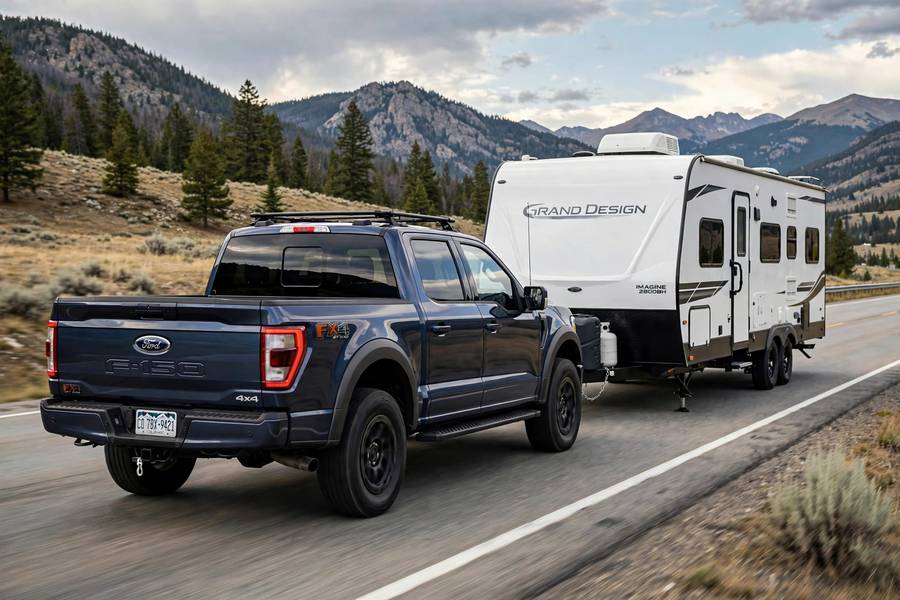
Towing is where drivetrain marketing meets physics, and physics always wins the argument. I’ve set up hundreds of tow vehicles — adjusted hitches, wired brake controllers, explained weight distribution to glazed-eyed owners — and the AWD-versus-4WD towing question has a clearer answer than most drivetrain debates. It comes down to what you’re towing, where you’re towing it, and one spec that matters more than the badge: the tow rating. Here’s the full picture, from boat ramps to mountain grades. The drivetrain fundamentals are in my AWD vs 4WD breakdown.
Table of Contents
- The Short Answer
- Tow Ratings: The Spec That Actually Decides
- Launching the Load: Traction Off the Line
- Boat Ramps: The Great Equalizer
- Hills and Grades: Where Low Range Earns Its Keep
- Highway Towing: The Long Haul
- Transmission and Cooling: The Real Towing Limits
- Setup Matters More Than Drivetrain
- Frequently Asked Questions
The Short Answer
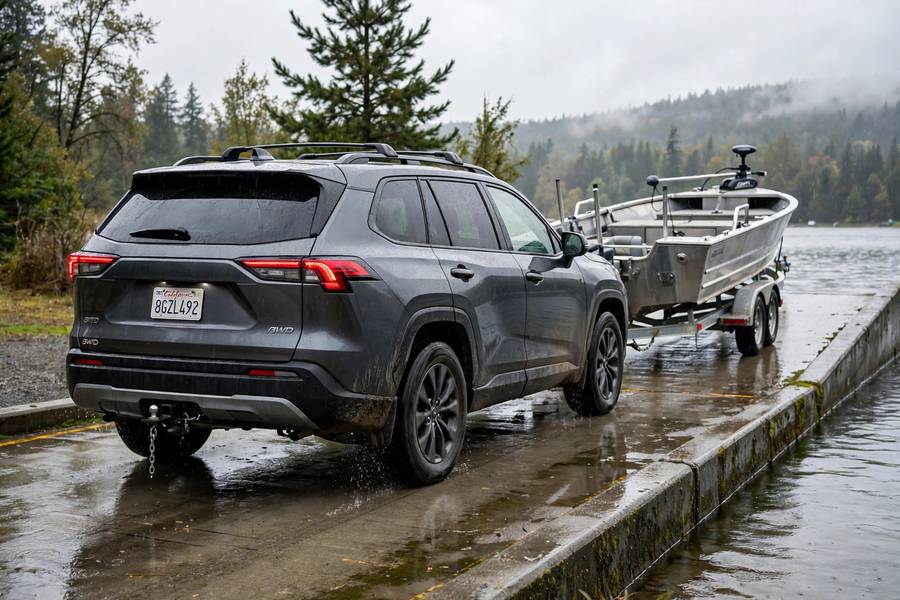
For serious towing — heavy trailers, steep grades, boat ramps, off-pavement — 4WD wins, and it’s not close. The reasons: higher tow ratings (4WD trucks are built on stronger frames with bigger cooling and braking), 4WD Low for controlled launches on grades and ramps, and locked 4WD for slippery launch surfaces. For light towing — small utility trailers, jet skis, a couple of dirt bikes — AWD is perfectly capable and more pleasant, since most AWD tow vehicles are also better daily drivers.
The honest framing: drivetrain is rarely the limiting factor in towing. Tow rating, tongue weight, trailer brakes, and hitch setup decide safety. The drivetrain decides how confidently you launch and how you handle the ugly spots. Match the vehicle to the trailer first; the drivetrain question answers itself second.
Tow Ratings: The Spec That Actually Decides
Before any drivetrain debate, read the tow rating — the manufacturer’s maximum, determined by SAE J2807 testing that includes acceleration, hill climbing, braking, and cooling performance. A 4WD half-ton truck typically rates 9,000 to 13,000 pounds. An AWD crossover typically rates 3,500 to 5,000 pounds. That gap has almost nothing to do with AWD versus 4WD as traction systems and everything to do with the vehicles they’re attached to: frame strength, brake size, cooling capacity, and suspension.
The critical rule: never exceed the rating, and treat 80 percent of the rating as your practical limit for comfortable, safe towing. A trailer at 100 percent of rating is legal but miserable — slow, hot, and twitchy in crosswinds. The rating also assumes a properly distributed load with 10 to 15 percent of trailer weight on the tongue. Get the tongue weight wrong and no drivetrain on earth will make the rig stable.
One more spec people miss: payload capacity. Tongue weight counts against payload, and a 1,000-pound tongue weight plus four adults plus gear can exceed a truck’s payload before you ever approach its tow rating. I’ve seen more overloaded-by-payload rigs than overloaded-by-trailer rigs. Check both numbers.
If you’re truck shopping rather than speccing new, don’t skip my guide to buying a used car — high-mileage tow rigs hide expensive secrets behind shiny paint.
Launching the Load: Traction Off the Line
Launching a heavy trailer from a stop is the moment traction matters most. The trailer’s tongue weight presses down on the rear hitch, unloading the front axle slightly and loading the rear — which is actually helpful for rear-drive launches but means the front wheels have less grip to contribute.
Here’s where the systems differ. A 4WD truck in 4H launches with a locked 50/50 split: the front axle pulls its full share regardless of the weight transfer, and on a slippery surface (wet grass, gravel lot, snowy road) that locked front pull is decisive. In 4L, the torque multiplication lets you ease a heavy trailer into motion with minimal throttle — no clutch smell, no wheelspin, just steady pull.
An AWD vehicle launches well on pavement — the electronics shuffle torque rearward as weight transfers back, and modern systems are quick. But on a slippery launch surface with a heavy trailer, clutch-pack AWD systems work hard: sustained slip while pulling 4,000 pounds up a wet grade generates serious heat in the coupling. For occasional light towing it’s a non-issue. For regular heavy towing on loose surfaces, it’s the wrong tool.
Boat Ramps: The Great Equalizer
The boat ramp is towing’s ultimate traction test: a steep, wet, algae-slicked concrete slope, often with the tow vehicle’s rear wheels near the waterline. This is where I’ve seen more drivetrain drama than anywhere else, and where 4WD earns its reputation.
The scenario: you’re pulling 5,000 pounds of boat and trailer up a slimy 15-percent grade. In a 4WD truck, you engage 4L before you start, and the combination of locked axles and torque multiplication walks the rig up with barely any throttle. Wheelspin is minimal because the gearing does the work. It’s almost boring — which is exactly what you want on a boat ramp.
In an AWD vehicle, the same ramp is harder. The system can do it — electronics plus decent tires manage most ramps — but there’s more wheelspin, more clutch-pack heat, and less margin. And here’s the part nobody mentions until it happens: if the AWD coupling overheats mid-ramp, you can lose rear drive at the worst possible moment, halfway up, with the boat trying to drag you back down. It doesn’t happen often, but when it does, it’s memorable for everyone watching.
Ramp technique matters regardless of drivetrain: engage 4WD/traction systems before the pull, use the lowest effective gearing, steady throttle with no sudden inputs, and have a spotter. And rinse the undercarriage afterward — ramp water is corrosive.
Hills and Grades: Where Low Range Earns Its Keep
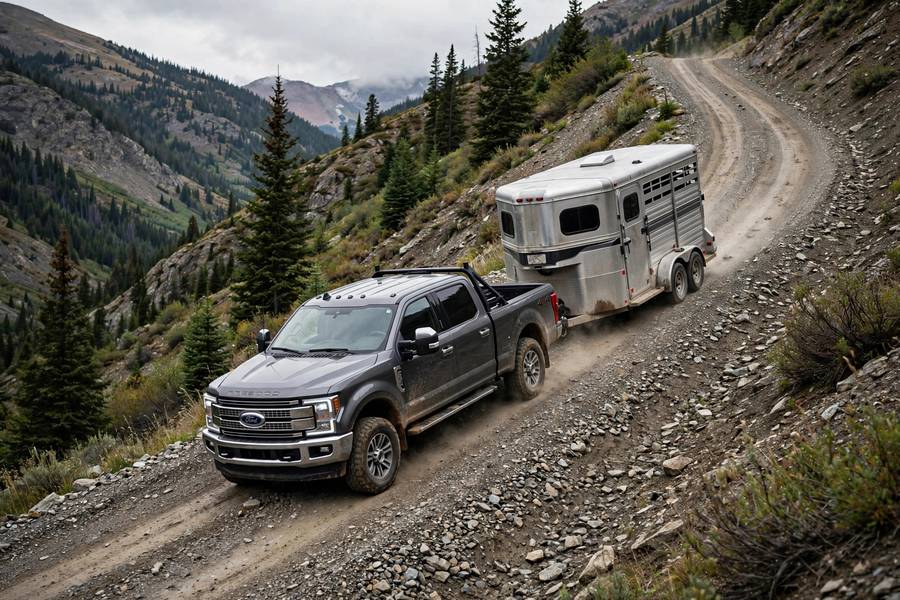
Long mountain grades separate the tow vehicles from the pretenders, and the separator usually isn’t the drivetrain — it’s cooling and gearing. Climbing a 6-percent grade for ten miles with 8,000 pounds behind you generates enormous heat in the transmission and engine. Trucks built for towing have the transmission coolers, larger radiators, and lower axle ratios to handle it. Most AWD crossovers don’t, which is why their tow ratings are lower.
Where 4WD specifically helps on grades: 4L for the steep, slow stuff — maneuvering a trailer up a steep gravel driveway, or crawling a loaded trailer over rough ground to a campsite. The gearing lets the engine work at efficient rpm instead of straining, and the locked axles prevent the wheelspin that digs ruts. Descending: 4L first gear gives engine braking that holds a heavy trailer back without cooking the brakes. I’ve seen brake fade put a rig in a runaway situation; engine braking in low range is the prevention.
For highway grades, both systems rely on the transmission: tow/haul mode, locked-out overdrive, letting the engine rev. The drivetrain badge is irrelevant at 60 mph on the interstate. Gearing, cooling, and brakes do the work.
Highway Towing: The Long Haul
On the highway, AWD and 4WD are nearly indistinguishable for towing — because a part-time 4WD truck tows in 2WD on dry interstate, and an AWD vehicle’s system is mostly idle in steady cruising. What matters on the highway: wheelbase (longer is more stable), weight (heavier tow vehicle controls the trailer better), trailer brakes (electric brakes with a properly adjusted controller are non-negotiable above 3,000 pounds), and sway control.
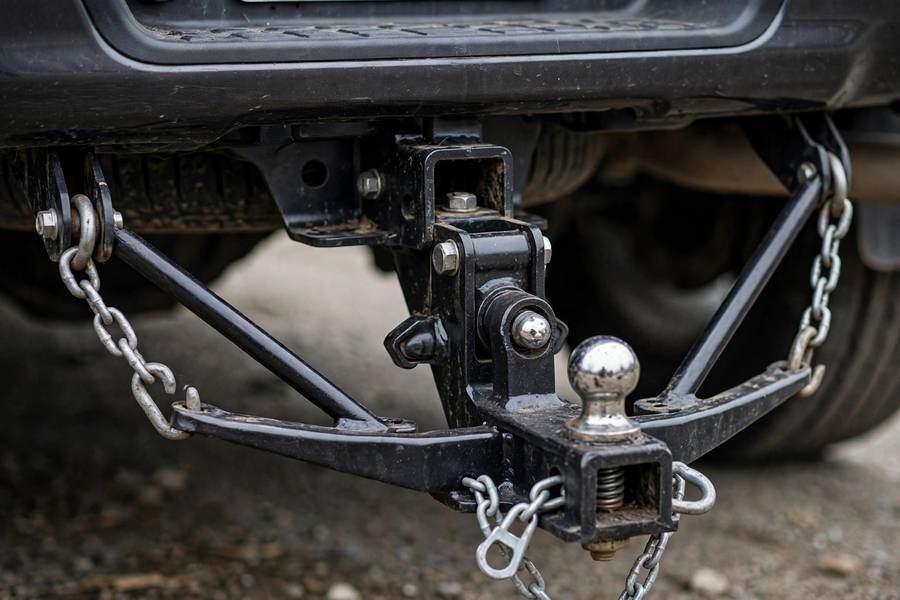
Crosswinds and passing semis are the highway’s traction test, and it’s about stability, not driven wheels. A weight-distribution hitch with sway control transforms a marginal rig into a confident one — it’s the single best investment in towing safety, far beyond any drivetrain choice. Proper setup: trailer level, 10-15 percent tongue weight, weight-distribution bars tensioned per the manual, brake controller gain set so the trailer brakes lead slightly.
The drivetrain does matter in one highway scenario: rain. An AWD tow vehicle in a downpour has a genuine stability advantage, shuffling torque to maintain composure if the trailer starts pushing. It’s not a substitute for slowing down — nothing is — but it’s real.
Transmission and Cooling: The Real Towing Limits
Ask any transmission shop what kills tow vehicles and the answer is heat, not traction. Towing multiplies transmission load enormously — the torque converter generates heat proportional to slip, and pulling grades at low speed with high throttle is maximum slip. Transmission fluid breaks down above about 225°F sustained; above 250°F, damage accelerates fast.
This is why tow-package trucks include auxiliary transmission coolers, and why I tell every tower to watch transmission temperature if the truck has a gauge (or add an aftermarket gauge if it doesn’t — $150 that can save a $4,000 transmission). Change transmission fluid more often when towing: cut the normal interval in half. Towing is severe service, whatever the brochure says.
Engine cooling matters too: the radiator, fan clutch, and coolant all work harder. If your temperature gauge climbs on grades, back off the throttle and downshift rather than pushing through — an overheated engine on a grade with a trailer is how head gaskets die. The drivetrain choice doesn’t change any of this. Cooling capacity is a vehicle-design issue, and it’s the actual ceiling on most towing.
Setup Matters More Than Drivetrain
I’ll end where I always end with towing customers: the setup decides safety, not the badge. The checklist I run through on every tow vehicle that comes through my shop: hitch rated for the trailer weight with the correct ball size; weight-distribution hitch for anything over 5,000 pounds or with significant tongue weight; trailer brake controller installed and adjusted; trailer tires (not past 5-6 years old regardless of tread — trailer tires age out); all lights working; mirrors adequate to see past the trailer; tire pressures set for the load (truck and trailer).
Then the driving: 55-65 mph max regardless of the speed limit, doubled following distance, no sudden inputs, plan stops early, and pull over when tired — trailer sway accidents correlate strongly with driver fatigue. I’ve set up 2WD trucks that towed beautifully and 4WD trucks that were death traps because the owner skipped the basics. The drivetrain is the last 10 percent. The setup is the first 90.
Frequently Asked Questions
For heavy towing, 4WD wins: higher tow ratings, 4WD Low for controlled launches on grades and boat ramps, and locked traction on slippery surfaces. For light towing under 3,500-5,000 lbs, AWD is perfectly capable and more pleasant as a daily driver. Match the vehicle’s tow rating to your trailer first.
Yes, within the vehicle’s tow rating — typically 3,500-5,000 lbs for AWD crossovers. AWD handles pavement launching and rainy highway towing well. Avoid sustained heavy towing on slippery surfaces, which can overheat clutch-pack AWD couplings.
No — tow in 2WD on dry highways. Locked 4WD on dry pavement causes drivetrain binding and wastes fuel with zero benefit at highway speed. Use 4WD High only for slippery launch surfaces, boat ramps, and off-pavement towing; 4WD Low for steep, slow maneuvering.
Setup, not drivetrain: staying within tow rating and payload capacity, 10-15% tongue weight, a weight-distribution hitch with sway control for heavier trailers, working trailer brakes with an adjusted controller, and proper tire pressures. These decide safety far more than AWD vs 4WD.
Towing generates major transmission heat, which is the number one killer of tow-vehicle transmissions. Use tow/haul mode, watch transmission temperature (keep it under 225°F sustained), change fluid twice as often when towing regularly, and ensure the vehicle has adequate transmission cooling for the load.