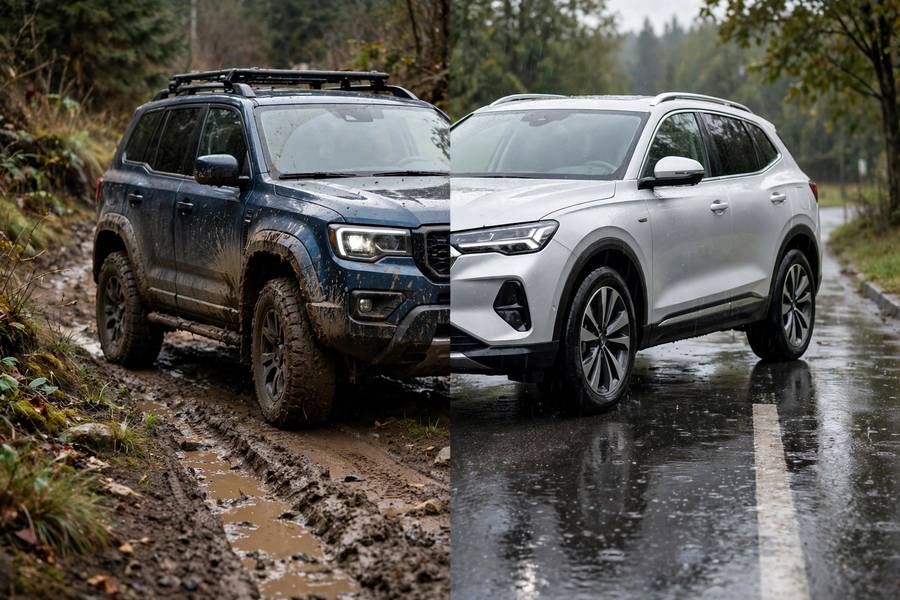
Walk into any dealership and the salesperson will tell you AWD and 4WD are basically the same thing. They’re not. I’ve spent ten years around cars — including pulling apart transfer cases in the shop — and the difference matters more than most buyers realize. Pick the wrong one and you’re either paying for capability you’ll never use or getting stuck where the other system would’ve walked through.
We break down what torque is in cars step by step in a separate guide.
Let me explain AWD vs 4WD the way I’d explain it to a friend spending their own money — because that’s the standard I hold everything I write to.
Contents
- The One-Sentence Difference
- How AWD Works
- How 4WD Works
- The Transfer Case: 4WD’s Secret Weapon
- AWD vs 4WD: Head-to-Head
- When AWD Wins
- When 4WD Wins
- What About 4×4 vs 4WD?
- Which Should You Buy?
- AWD and 4WD Maintenance Differences
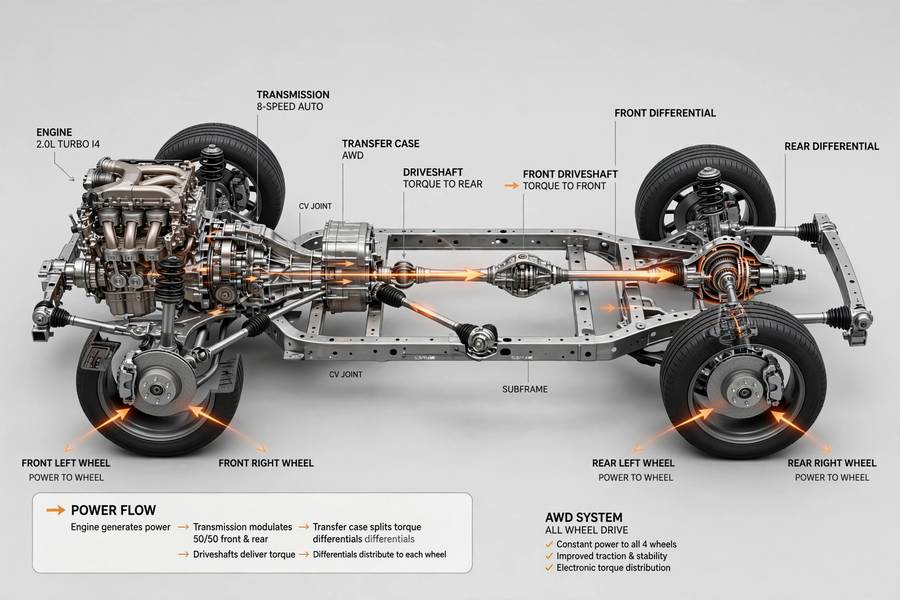
The One-Sentence Difference
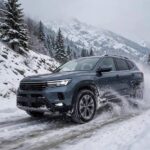
AWD (all-wheel drive) is an always-on system that automatically sends power to whichever wheels need it — designed for on-road traction in rain, snow, and light off-roading.
4WD (four-wheel drive) is a driver-selectable system built for serious off-road use, with a low-range gear for crawling over rocks, through mud, and up steep grades.
Same number of driven wheels. Completely different philosophy. AWD is a safety net you never think about; 4WD is a tool you deliberately engage.
How AWD Works
AWD systems run all the time. There’s no button, no lever, no decision for you to make. The car’s computer constantly monitors wheel slip and shuffles power between front and rear axles — sometimes in milliseconds — sending torque wherever there’s grip.
Most modern AWD is front-biased: under normal cruising, nearly all power goes to the front wheels (better fuel economy), and the rear axle engages when sensors detect slip. Some performance systems do the opposite. A few (like Subaru’s symmetrical AWD, which I’ve always respected for its mechanical honesty) split power more evenly all the time.
The key limitation: AWD has no low-range gearing. It can’t multiply torque for extreme situations. It’s brilliant at keeping you moving on slippery pavement and handling a muddy campsite road. It’s not designed for rock crawling.
How 4WD Works
4WD is part-time by design. You drive around in 2WD (usually rear-wheel drive) for normal use, then engage 4WD when conditions demand it — via a lever, dial, or button.
Engaging 4WD locks the front and rear axles together so they turn at the same speed. That’s incredibly effective off-road, where you want maximum traction everywhere. But it’s the reason for the golden rule of 4WD: never use it on dry pavement. Locked axles can’t accommodate the different wheel speeds needed for turning on high-grip surfaces — you’ll get binding, tire scrubbing, and eventually broken drivetrain parts. I learned this watching a customer destroy a transfer case in a parking lot.
4WD systems come in two flavors:
– Part-time 4WD — the classic: 2H, 4H, 4L modes, driver-selected. Found in Wranglers, 4Runners, most pickups.
– Full-time 4WD — has a center differential allowing 4WD on pavement (Land Cruiser, some Land Rovers). More complex, more expensive, more capable everywhere.
The Transfer Case: 4WD’s Secret Weapon
The transfer case is what separates real 4WD from everything else, and it’s the component most buyers never hear about.
It’s a gearbox sitting behind the transmission that does two jobs: splits power between front and rear axles, and provides low range — typically around a 2:1 to 4:1 gear reduction. Low range multiplies engine torque massively, letting the vehicle crawl over obstacles at walking pace without riding the clutch or overheating the transmission.
That crawling ability is the whole game off-road. AWD can’t do it. No low range, no crawl. When you’re picking through boulders or descending a steep grade, low range isn’t a luxury — it’s the difference between control and chaos.
AWD vs 4WD: Head-to-Head
| AWD | 4WD | |
|---|---|---|
| Engagement | Automatic, always on | Driver-selected |
| Low range | No | Yes |
| Dry pavement | Fine | Damaging (part-time) |
| Fuel economy | Slightly worse than 2WD | Better in 2WD mode |
| Maintenance | Minimal extra | Transfer case fluid, more complexity |
| Off-road ability | Light trails, snow, mud | Serious terrain |
| Cost | Moderate premium | Higher premium |
| Best for | Daily drivers in variable weather | Off-roaders, towers, rural work |
When AWD Wins
Be honest about your life: if your “off-roading” is a gravel driveway and ski trips, AWD wins decisively.
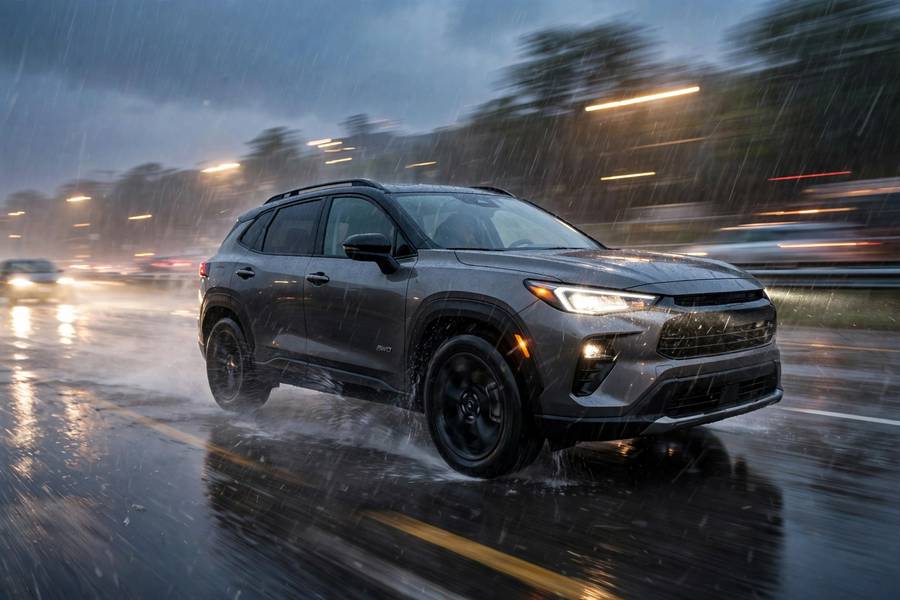
- Rain and snow on pavement — AWD’s automatic, instant response is ideal. No decisions, no forgetting to disengage.
- Fuel economy — modern AWD systems are efficient; you’re not dragging around a heavy transfer case in 2WD… well, actually you kind of are with 4WD’s extra hardware even in 2WD mode.
- Simplicity — nothing to engage, nothing to break from misuse. The number of 4WD drivetrains I’ve seen damaged by dry-pavement use would horrify you.
- Cost — cheaper to buy, cheaper to maintain, cheaper to run.
For probably 90% of buyers who think they need 4WD, AWD is the right answer. I say that as someone who loves proper 4WD hardware.
When 4WD Wins
But when you actually need it, nothing else substitutes:
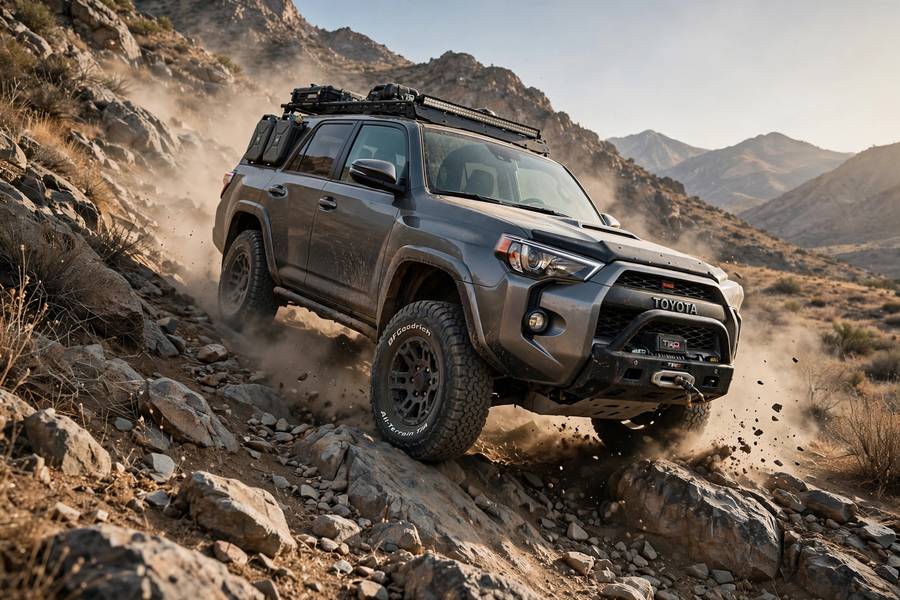
- Real off-roading — rocks, deep mud, steep grades. Low range is non-negotiable.
- Towing heavy loads on slippery surfaces — boat ramps are the classic 4WD moment. That slimy concrete incline has humbled many AWD crossovers.
- Deep snow — not “snowy commute” (AWD handles that) but “unplowed road to the cabin” territory.
- Rural/work use — farms, construction sites, places where the road is a suggestion.
- Durability under abuse — body-on-frame 4WD trucks are built to take punishment that would total a unibody crossover.
What About 4×4 vs 4WD?
Same thing. 4×4 is just shorthand notation: 4 wheels total, 4 driven. 4WD is the spelled-out version. Dealers and brochures use them interchangeably, and so can you.
(AWD is sometimes written as “all-wheel drive” — never 4×4. If you see 4×4 on the badge, it’s the selectable off-road system.)
Which Should You Buy?
My mechanic’s advice, no fluff:
Buy AWD if: you drive mostly on pavement, deal with rain/snow, want traction without thinking about it, and your adventures end where the pavement does. This is most people, and there’s zero shame in it.
Buy 4WD if: you tow boats, hunt, camp beyond maintained roads, live somewhere plows don’t reach, or genuinely go off-road. And commit to learning how to use it properly — including when not to engage it.
Buy neither (save your money) if: you live somewhere dry and flat and just liked the sound of it. A good set of tires on a 2WD car outperforms a 4WD on bald all-seasons every single time. Tires matter more than drivetrain — that’s the hill I’ll die on.
Related: buy a used car.
Would I spend my own money on 4WD? I did — on a truck that tows and goes places crossovers can’t. Would I recommend it to my sister who commutes in the suburbs? Absolutely not — she’d get AWD and never think about it again. Match the tool to the job.
AWD and 4WD Maintenance Differences
Owning the system is part of the decision, so here’s what each costs you over time.
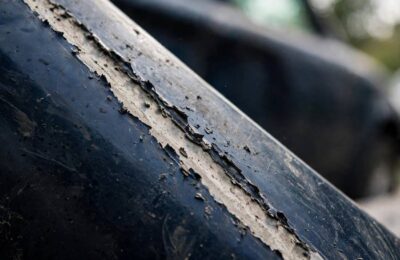
AWD maintenance is mostly invisible: the system is sealed and automatic. The main requirements are keeping all four tires matched — same brand, model, size, and within 2/32″ tread depth of each other. Mismatched tires make the center differential work constantly to compensate for different rolling diameters, and I’ve seen that burn out differentials that should have lasted the car’s life. Rotate tires religiously (every 5,000–7,500 miles) to keep wear even. Some AWD systems have serviceable differential fluid (30,000–60,000 miles); check your manual.
4WD maintenance demands more attention: transfer case fluid changes (typically 30,000–60,000 miles — check the manual, and use the specified fluid), front differential service, and periodic engagement. That last one surprises people: part-time 4WD systems should be engaged for a few miles monthly (on a loose surface, never dry pavement) to keep seals lubricated and actuators working. Let it sit disused for a year and the shift motor may refuse when you finally need it.
The cost difference over 100,000 miles is real but not dramatic — maybe a few hundred dollars in extra fluid services for 4WD. The bigger cost is misuse: dry-pavement 4WD driving destroys transfer cases ($2,000–4,000), while AWD has no equivalent failure mode because there’s nothing to misuse. Another quiet point for the automatic system.
Frequently Asked Questions
AWD is an always-on automatic system for on-road traction in rain and snow. 4WD is a driver-selectable system with low-range gearing built for serious off-road use. AWD you never think about; 4WD you deliberately engage.
Neither is universally better. AWD is better for daily driving in variable weather — simpler, more efficient, automatic. 4WD is better for real off-roading, towing on slippery surfaces, and deep snow, thanks to its low-range gearing.
No — not part-time 4WD. Engaging 4WD on dry pavement locks the axles together, causing binding, tire scrubbing, and eventual drivetrain damage when turning. Switch back to 2WD on high-grip surfaces.
Yes, AWD significantly helps acceleration and stability in snow. But it doesn’t help you stop or turn — that’s tires and brakes. Good winter tires on a 2WD car often outperform AWD on worn all-season tires.
Yes. 4×4 is shorthand for four-wheel drive (4 wheels, 4 driven). The terms are used interchangeably for the selectable off-road drivetrain system.