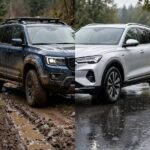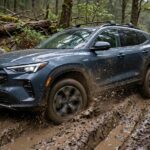
Every winter I get the same customer: a nervous new 4WD truck owner, or a smug AWD crossover driver, each convinced their drivetrain is the snow king. Then I ask them one question — “What tires are you running?” — and watch the confidence drain. After twenty years turning wrenches in a snow-belt shop, I can tell you the AWD-versus-4WD debate misses the point most buyers actually care about. Here’s how the two systems really behave in winter, where each one shines, and what matters more than either. For the full mechanical breakdown, see my AWD vs 4WD comparison.
Table of Contents
- The Short Answer: It Depends on the Snow
- What AWD Actually Does in Winter
- What 4WD Actually Does in Winter
- Ground Clearance: The Factor Nobody Mentions
- The Tire Truth Nobody Wants to Hear
- Handling and Cornering on the White Stuff
- Everyday Winter Commuting: Who Wins
- When 4WD Is Genuinely the Right Call
- Frequently Asked Questions
The Short Answer: It Depends on the Snow
For plowed streets and light snow, AWD is usually the better pick. It works automatically, it’s seamless, and it reacts to wheel slip in milliseconds — faster than any human can shift a lever. You just drive, and the system quietly shuffles power around. No modes to remember, no binding worries.
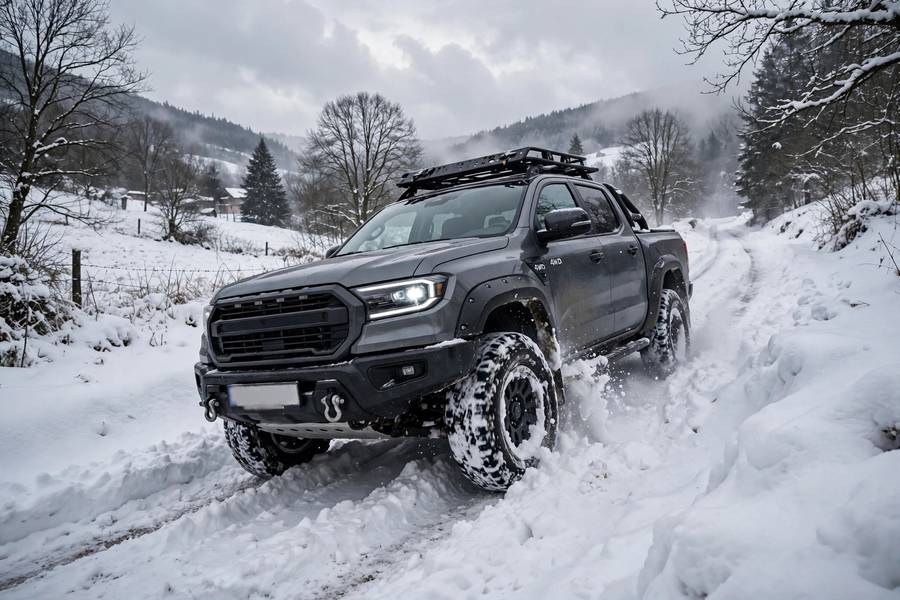
For deep, unplowed snow, steep driveways, or getting yourself unstuck, 4WD wins. The difference is 4WD Low: a gear reduction (typically around 2.5:1 to 4:1) that multiplies torque massively for crawling through the ugly stuff. An AWD system with a slipping clutch pack can overheat doing that kind of work. A locked 4WD transfer case shrugs it off.
So the honest answer is boring but true: AWD for the winter most people actually drive in, 4WD for the winter the plow never reaches. Anyone who tells you one is universally “better” in snow is selling you something — probably the vehicle they’re sitting in.
What AWD Actually Does in Winter
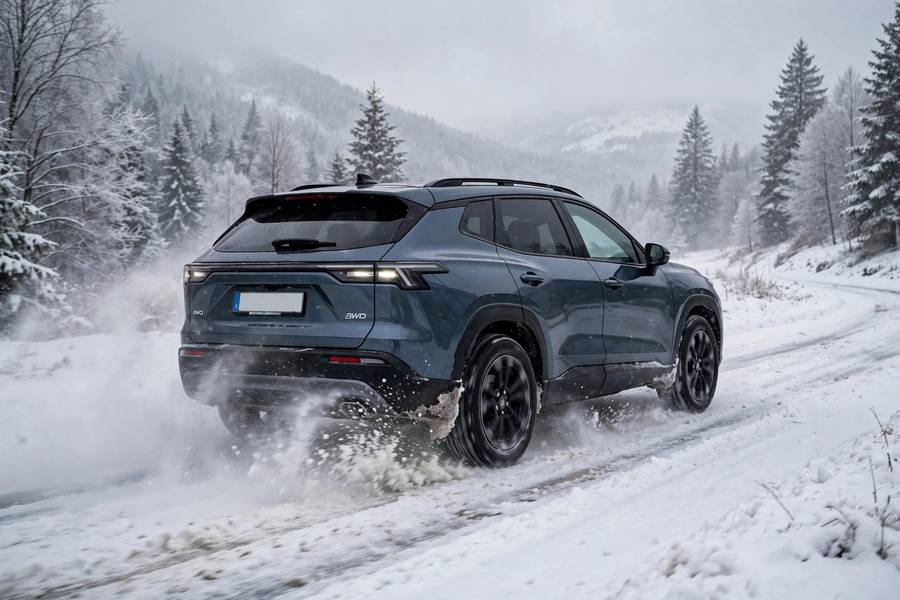
AWD is the automatic, always-on (or always-ready) system. In most modern AWD cars, the vehicle runs in front-wheel drive most of the time and sends up to 50 percent of torque rearward the instant the front wheels slip. Better systems use torque vectoring, which can send different amounts of power to individual wheels — left or right — to pull the car straight when one side is on ice.
The big advantage in snow is reaction speed. Electronic clutch packs and brake-based torque vectoring engage in roughly 100 to 200 milliseconds. Your foot takes about three times longer than that to reach the brake pedal. On a slushy highway on-ramp, that speed keeps the car composed while you’re still processing that the rear end felt light.
The limitation is heat and clutch duty cycle. AWD systems that rely on clutch packs to engage the rear axle can overheat under sustained slip — say, rocking back and forth trying to get out of a snowbank. I have seen more than one crossover come in with a cooked rear coupling and a repair bill north of $1,200. AWD is brilliant at preventing you from getting stuck. It is less brilliant at getting you unstuck.
For the full rundown of the hardware behind that winter behavior, see what all-wheel drive is.
What 4WD Actually Does in Winter
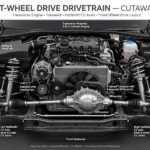
4WD is the deliberate system. You choose when to engage it, and when you do, a transfer case locks the front and rear driveshafts together so they turn at the same speed. No clutches deciding anything, no electronics guessing — a mechanical connection that splits power 50/50, front to rear.
In snow, that mechanical certainty is the selling point. When you flip into 4WD High before a sketchy hill, you know exactly what the truck is doing. When you drop into 4WD Low and crawl through a drift at walking pace with tripled torque, nothing in the AWD world can match that grunt.
The trade-off is that locked system binds on high-traction surfaces. Dry pavement or even partially plowed roads with dry patches will fight a locked transfer case, building up stress that eventually breaks something expensive — U-joints, axle shafts, the transfer case chain. That’s why part-time 4WD demands driver judgment: engage it when the surface is consistently slippery, disengage when it isn’t. Forget, and you’ll learn what a $2,000 transfer case rebuild feels like.
Ground Clearance: The Factor Nobody Mentions
Here is something the drivetrain debate always buries: a 2WD truck with 11 inches of ground clearance will drive through 8 inches of snow without drama, while an AWD crossover with 6 inches of clearance will high-center on a snowdrift and sit there, all four wheels spinning, drivetrain completely irrelevant.
Clearance determines whether you float over the snow or plow into it. Most 4WD trucks ride 9 to 12 inches off the ground. Most AWD crossovers ride 6 to 8 inches. That 3-to-4-inch gap matters more than the badge on the fender in deep snow. I’ve pulled AWD vehicles off snow berms where the owner was furious at the “useless” system — but the drivetrain was fine; the belly was just dragging on packed snow.
When you’re comparing winter capability, check the clearance spec first and the drivetrain second. The drivetrain gets you traction. Clearance decides whether you need that traction in the first place.
The Tire Truth Nobody Wants to Hear
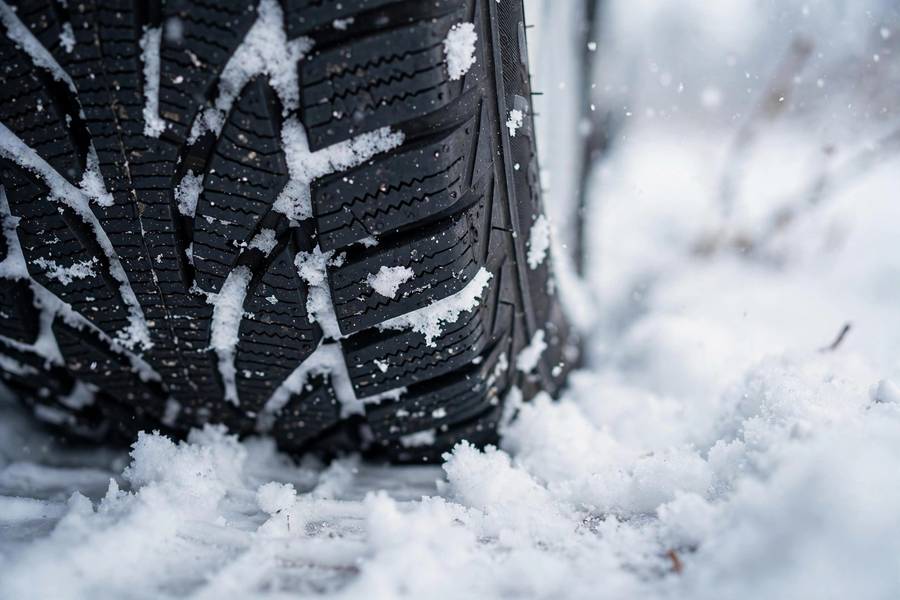
Now the part that gets me in trouble at dinner parties: a 2WD car on proper winter tires will out-brake, out-corner, and out-accelerate an AWD car on all-seasons in real winter conditions. Every time. AWD helps you go. Tires help you go, stop, and turn — and stopping is the one that keeps you alive.
The numbers aren’t close. On ice, a dedicated winter tire compound (soft rubber loaded with silica, full of sipes) can stop a car up to 30 to 40 percent shorter than an all-season. No drivetrain technology shortens your stopping distance. AWD doesn’t help you brake. 4WD doesn’t help you brake. Physics doesn’t care how many wheels are driven when you’re asking four contact patches the size of your palm to grip ice.
All-seasons are a compromise — literally named for their compromise. Their rubber hardens below about 45°F, and hardened rubber on ice grips about as well as a hockey puck. If you’re spending money to be safer in snow, spend it on winter tires first and worry about the drivetrain badge second. My shop does more winter tire swaps than anything else from November through March, and the customers who switch never go back.
Handling and Cornering on the White Stuff
On curvy, snow-covered roads, AWD generally feels more composed than 4WD. The reason is simple: AWD systems (especially full-time ones) allow the front and rear axles to turn at different speeds, which is what you need when cornering. A locked 4WD system resists that speed difference, which is why part-time 4WD feels stiff and “crabby” turning on partially cleared roads.
That said, AWD’s composure breeds overconfidence, and overconfidence in winter is the most dangerous option on the menu. I’ve straightened out more wrecked AWD vehicles than I can count, and the driver’s story is always the same: “I had AWD, I thought I’d be fine.” AWD gets you moving with deceptive ease. It does nothing for you when you’re entering a snowy corner 15 mph too fast. The ditch doesn’t care about your drivetrain.
The cornering rule in snow is unglamorous: slow in, gentle on the throttle, and trust the stability control. Every modern AWD and 4WD vehicle has electronic stability control, and it’s worth more than the drivetrain choice for keeping you pointed straight.
Everyday Winter Commuting: Who Wins
For the commute most people actually drive — plowed roads, occasional slush, a snowy morning before the plow arrives — AWD is the clear winner. It requires zero driver input, it handles the 95 percent of winter that’s just wet and slippery, and it doesn’t punish you for forgetting to switch modes.
The fuel economy difference matters here too. AWD systems typically cost you 1 to 3 mpg versus the 2WD version of the same vehicle, because you’re spinning extra hardware. Part-time 4WD in 2WD mode avoids most of that penalty, but nobody buys a 4WD truck for its fuel economy anyway, and winter commuting in 2WD mode means you don’t have the traction when the surprise storm hits at 5 p.m.
Convenience has a safety dimension in commuter duty: an AWD system you never have to think about protects you in the moments you forget to engage 4WD. The number of 4WD owners I see driving through a snowstorm in 2WD — because they didn’t want to “waste” the 4WD — is depressingly high.
When 4WD Is Genuinely the Right Call
There are situations where 4WD isn’t just better, it’s the only sensible choice. Unplowed rural roads. Steep, snowy driveways where you need 4WD Low’s torque multiplication. Towing in winter — a trailer on a snowy grade is a job for locked 4WD, not a clutch-pack AWD. Getting unstuck from a snowbank, where the AWD coupling is exactly the component most likely to overheat.
There’s also the simplicity argument for trucks that work hard. A manual-shift transfer case with a real mechanical linkage is about as bulletproof as vehicle technology gets. No software updates, no sensor calibrations, no “AWD system fault” warnings on the dash at the worst possible moment. When I’m advising someone who actually works in winter conditions — plow operators, rural mail carriers, contractors — I point them at 4WD with proper tires, every time.
The honest dividing line: if winter is something you drive through to get to work, get AWD. If winter is something you work in, get 4WD.
Frequently Asked Questions
For everyday winter driving on plowed roads, yes — AWD reacts faster, needs no driver input, and handles slush and light snow better. For deep unplowed snow, steep grades, or getting unstuck, 4WD wins thanks to 4WD Low’s torque multiplication. The right answer depends on the winter you actually drive in.
AWD handles moderate snow well, but deep snow is its weak point. Clutch-based AWD systems can overheat when wheels slip for a long time, and most AWD vehicles have lower ground clearance than 4WD trucks. For deep snow, 4WD with high clearance and winter tires is the safer choice.
Yes. AWD and 4WD help you accelerate but do nothing to shorten braking distance or improve cornering grip on ice. A 2WD car on winter tires out-brakes an AWD car on all-seasons. Tires are the single most important winter safety upgrade.
4WD High works fine on consistently snowy highways, but on partially cleared roads with dry patches, a locked part-time 4WD system binds and stresses the drivetrain. For mixed winter highway conditions, full-time AWD is more forgiving because it allows axle speed differences.
The usual culprits are all-season tires, low ground clearance (the car’s belly drags on packed snow), or an overheated AWD coupling from prolonged wheel slip. AWD prevents most stuck situations, but it can’t overcome bad tires or snow deeper than your clearance.