When you tap your phone to pay, your actual card number never travels to the merchant. Instead, the card network — Visa, Mastercard, and their peers — substitutes a special token: a surrogate value that works for that transaction but reveals nothing if intercepted. This is network tokenization, and it’s one of the largest-scale security systems on Earth, quietly protecting trillions in transactions.
This guide explains how it works technically, how it differs from other tokenization approaches, and why the card networks built it. For the general concept, see how tokenization works.
Table of Contents
- Network Tokenization in One Paragraph
- The Problem It Solves
- How It Works: The Token Flow
- Network Tokens vs PANs: What’s Different
- Network Tokenization vs Other Tokenization
- The Security Properties
- Lifecycle Management: Provisioning to Deletion
- Adoption and Impact
- When the Token Service Goes Down: Outages and Fallbacks
- Frequently Asked Questions
Network Tokenization in One Paragraph
Network tokenization is a system operated by card networks (Visa, Mastercard, etc.) that replaces primary account numbers (PANs — the actual card numbers) with network-issued tokens for digital transactions. When you store a card in a phone wallet or with an online merchant, the network provisions a token bound to that device or merchant; transactions use the token, and only the network can map it back to the real PAN. If intercepted, the token is useless outside its designated context.
The Problem It Solves
The pre-tokenization world had a structural weakness: actual card numbers spread everywhere. Every merchant you bought from stored your PAN (or enough data to reconstruct transactions). Every breach of any merchant exposed real card numbers — usable anywhere, by anyone, until canceled.
The consequences: – Mass breaches exposed millions of real PANs simultaneously. – Card-not-present fraud exploded with e-commerce — stolen PANs used online without the physical card. – The reissuance treadmill — every major breach meant canceling and reissuing cards, updating every stored credential, massive operational cost.
Network tokenization attacks the root cause: if merchants never hold real PANs, breaching merchants yields nothing useful. The sensitive data stays with the network (which is heavily secured); everyone else handles tokens (which are worthless out of context).
How It Works: The Token Flow
The choreography, step by step:
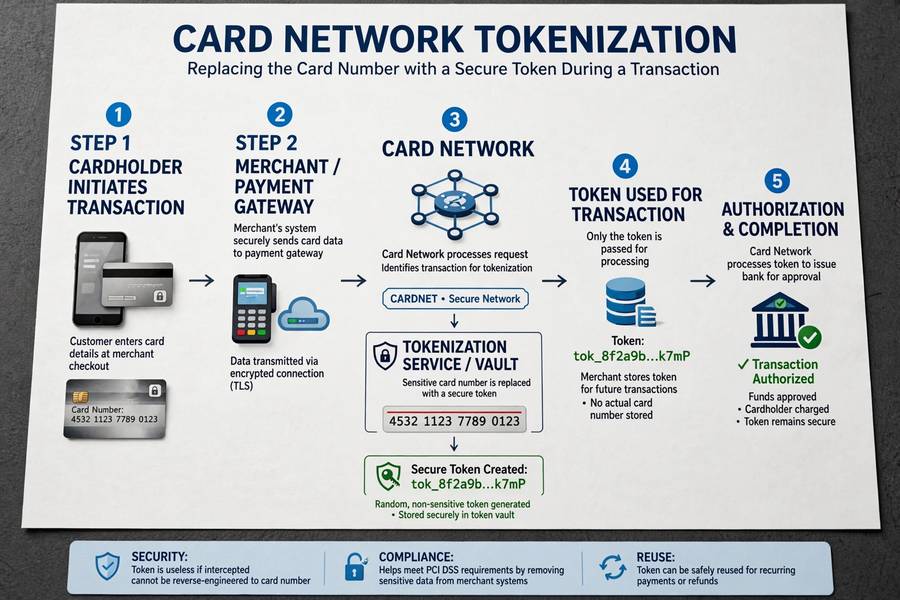
- Token request. You add your card to a digital wallet or online merchant. The wallet/merchant requests a token from the card network (via the issuing bank).
- Verification. The issuer verifies you — the legitimate cardholder — through authentication (bank app approval, SMS code, biometrics). This binds the token to verified identity.
- Token provisioning. The network generates a token: a 13–19 digit number that looks like a card number (passes format checks) but isn’t your PAN. It’s cryptographically bound to a specific device, merchant, or channel.
- Token stored. The wallet or merchant stores the token — never your PAN. Their systems handle only the surrogate.
- Transaction. When you pay, the token travels through the payment system instead of your PAN.
- Detokenization. The network (and only the network) maps the token back to your PAN for authorization with the issuer.
- Authorization. The issuer approves based on the real account; the merchant sees only approval, never the PAN.
The critical property: steps 5–6 happen within the network’s secured infrastructure. The PAN exists at the endpoints (your bank, the network) but never in the merchant’s systems.
Network Tokens vs PANs: What’s Different
Network tokens look like card numbers but behave differently:
Domain restriction. A token provisioned for Merchant A doesn’t work at Merchant B. A token for your phone doesn’t work from a different device. Stolen tokens are useless outside their designated domain — this is the key security property.
Cryptograms. Each transaction includes a dynamic cryptogram — a one-time code proving the transaction came from the legitimate token holder. Even if someone copies the token number, without the cryptogram machinery, they can’t transact.
Lifecycle controls. Tokens can be suspended, deleted, or refreshed independently of the PAN. Lose your phone? The tokens are killed; your physical card keeps working. This granular control is impossible with raw PANs.
No PAN exposure. The fundamental difference — the real number never leaves the network/issuer boundary in digital flows. Every system downstream of the network handles only tokens.
Network Tokenization vs Other Tokenization
How network tokenization differs from the other flavors:
Vs merchant/acquirer tokenization: merchants can tokenize PANs in their own vaults (replacing stored card numbers with merchant-specific tokens). But these tokens only work within that merchant’s systems. Network tokens work across the payment ecosystem — any merchant accepting the network — because the network itself does the mapping.
Vs payment processor tokens: processors tokenize for their clients similarly — scoped to the processor. Network tokenization is scoped to the network, which is broader.
The hierarchy: network tokens sit at the top — issued by the network, usable anywhere the network operates, with the strongest domain controls. Merchant and processor tokens are narrower, useful within their domains but not portable.
Why both exist: defense in depth. A merchant might use network tokens for transactions AND vault their own tokens for internal systems. Layers of tokenization, each reducing PAN exposure in its domain.
The Security Properties
What network tokenization guarantees — and doesn’t:
Guarantees: – Intercepted tokens can’t be used outside their domain (merchant/device binding). – Breached merchant databases yield tokens, not PANs — useless to attackers. – Dynamic cryptograms prevent replay — captured transaction data can’t be reused. – Token lifecycle can be managed without reissuing physical cards.
Doesn’t guarantee: – Protection against authorized-push fraud (you authorizing a scammer’s transaction — the token works fine because YOU authorized it). – Merchant-side security generally — tokens protect PANs, not the merchant’s other data. – Privacy from the network/issuer — they still see everything (that’s their job).
The honest assessment: network tokenization dramatically reduces the value of breaching merchants and the blast radius of PAN theft. It doesn’t solve fraud — it moves the battleground from “steal the number” to harder attacks. That’s genuine progress, not total victory.
Lifecycle Management: Provisioning to Deletion
Tokens have lifecycles, managed by the network:
Provisioning: as described — verified identity, bound token issued.
Active use: transactions flow, cryptograms validate, the token serves.
Suspension: temporarily disabled — suspicious activity, user request. Reversible.
Deletion: token killed permanently — device sold, merchant relationship ended, user request. The PAN continues unaffected.
PAN changes: if your card number changes (reissue), tokens can be updated automatically — the network maps old tokens to the new PAN. This is the “account updater” magic: your stored credentials keep working across card reissues without you doing anything.
The user experience win: this lifecycle is mostly invisible. You tap, it works, and behind the scenes tokens are provisioned, validated, and managed. Good security infrastructure disappears into the experience — network tokenization is a case study in that principle.
Adoption and Impact
The scale is staggering:
Volume: network tokens now represent a huge and growing share of digital transactions — billions of tokens provisioned, trillions in transaction value protected.
Fraud reduction: tokenized transactions show significantly lower fraud rates than PAN-based ones — the domain restrictions and cryptograms work as designed.
Ecosystem effects: as tokenization becomes default, the value of stealing PANs declines — attackers shift to other methods (social engineering, authorized-push fraud), which are harder to scale than database theft.
The trajectory: toward tokenization as the default for all digital transactions, with PANs increasingly confined to the physical card itself. The long-term vision: card numbers that never leave the network’s walls.
The broader lesson extends beyond payments: the network tokenization model — central issuance, domain-bound tokens, lifecycle management — is a template for protecting any sensitive identifier at scale. Understanding what an AI model is is a different domain, but the architectural principle (centralize the sensitive mapping, distribute only surrogates) applies broadly in security design.
When the Token Service Goes Down: Outages and Fallbacks
The uncomfortable question about any centralized security infrastructure: what happens when the center fails? Network tokenization has had its outages, and the failure patterns are instructive.
What breaks. When a network’s token service degrades, provisioned tokens can’t be detokenized — transactions using those tokens fail at the network, even though the issuer, the merchant, and the cardholder are all fine. Wallet taps decline. Saved-card checkouts error. The blast radius is wide precisely because adoption is wide — the system’s success becomes its fragility.
The fallback hierarchy. Payment systems are designed with graceful degradation in mind. When token detokenization fails, the typical fallback sequence is: retry the token path (transient errors resolve fast), then fall back to PAN-based processing where the PAN is available (physical card present, manual entry), then decline cleanly with a clear error. Note what this implies: the PAN fallback only works where a PAN exists to fall back to. A phone wallet with no physical card nearby has no fallback — which is why wallet outages feel total to the user.
What merchants should build for. Token-path failures are rare but real, so resilient checkout design matters: surface clear errors (“try another payment method”) rather than generic failures, don’t cache and retry tokenized transactions aggressively (you’ll hammer a recovering service), and monitor token authorization rates separately from overall authorization rates so you can distinguish a token outage from a general payments problem.
The design lesson. Centralized token services trade local failure modes for global ones — fewer incidents, but bigger ones. The mitigation isn’t decentralization (that would defeat the purpose); it’s operational excellence at the center plus honest fallback design at the edges. Every tokenization architect should have a written answer to “what does our system do when the token service is unreachable” — and it shouldn’t be “we hadn’t considered that.”
Frequently Asked Questions
A system operated by card networks (Visa, Mastercard) replacing card numbers (PANs) with network-issued tokens for digital transactions. Tokens are bound to specific devices or merchants and useless if stolen outside their domain. Only the network can map tokens back to real PANs.
Network tokens are issued by the card network and work across the payment ecosystem; merchant or processor tokens are scoped to those entities’ systems. Network tokenization also includes dynamic cryptograms per transaction and network-managed lifecycle (provisioning, suspension, deletion).
No — these wallets use network tokenization. Your device holds a network-issued token bound to that device, not your PAN. Merchants receive only the token. If the token were intercepted, it couldn’t be used on another device or merchant.
No — it dramatically reduces PAN theft value and card-not-present fraud from breaches, but doesn’t stop authorized-push fraud (you authorizing scammers) or other attack types. It moves the battleground from stealing numbers to harder attacks — genuine progress, not total victory.
The tokens provisioned to that device can be suspended or deleted remotely without affecting your physical card or other devices’ tokens. This granular lifecycle control — impossible with raw card numbers — is a key advantage of network tokenization.