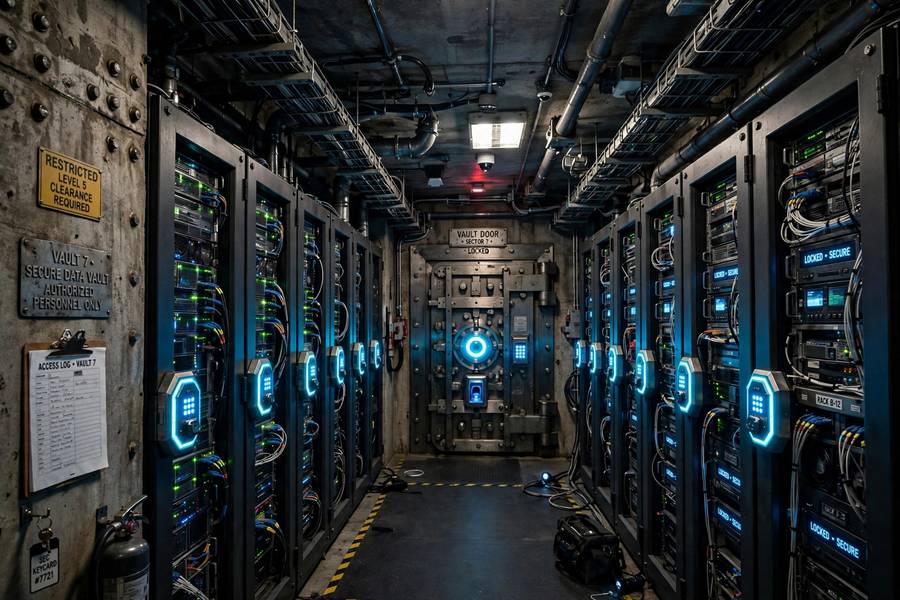
Every time sensitive data gets replaced by a random token — a payment card number swapped for a meaningless string, a social security number replaced by a reference code — something, somewhere, remembers the mapping. That something is the token vault: a highly secured database that stores the relationship between tokens and the original sensitive values. It’s the memory behind the magic, and understanding it explains both why tokenization is powerful and where its risks concentrate.
This guide explains token vaults technically: what they store, how they’re protected, and the architectural trade-offs of the vault model. For the broader process, see how tokenization works.
Table of Contents
- The Token Vault in One Paragraph
- What the Vault Actually Stores
- How Tokenization Uses the Vault
- Why the Vault Is the Crown Jewel
- Protecting the Vault: The Security Stack
- Vault vs Vaultless Tokenization
- Operational Realities: Running a Vault
- The Single Point of Failure Question
- Token Vault Failure Modes: What Actually Breaks
- Frequently Asked Questions
The Token Vault in One Paragraph
A token vault is a secure database that stores mappings between tokens (random, meaningless surrogate values) and the original sensitive data they replace. When a system needs the real value — to process a transaction, display data to an authorized user — it presents the token to the vault, which looks up and returns the original. The vault is the only place where the token-to-data relationship exists, making it both the system’s memory and its most critical security asset.
What the Vault Actually Stores
The vault’s contents, precisely:
Token-to-value mappings. The core: each token paired with its original sensitive value. Token “7X9K-2M4P” → the actual data it stands in for. These mappings are the vault’s reason for existing.
Metadata. Creation timestamps, which system requested the token, token type/format, expiration if applicable, and audit trails of access. The operational context around each mapping.
Access policies. Rules governing who can detokenize what, under which conditions. The vault enforces these — it’s not just storage, it’s a policy enforcement point.
What it does NOT store: the business logic, the applications using tokens, or (ideally) anything beyond what’s needed for mapping. Good vault design is minimal — the less in the vault, the less exposed if compromised.
The design principle: the vault knows the secrets so nothing else has to. Applications throughout the organization handle meaningless tokens; only the vault — and authorized detokenization flows — touch real data.
How Tokenization Uses the Vault
The lifecycle, step by step:
- Sensitive data arrives. A system captures data needing protection.
- Token requested. The tokenization service generates a random token (or derives one deterministically — more on vaultless below).
- Mapping stored. The token-to-value pair is written to the vault, encrypted.
- Token distributed. The requesting system gets only the token. The sensitive value never leaves the vault’s protection boundary (in the ideal architecture).
- Token used freely. Downstream systems — analytics, logs, databases — handle tokens, which are worthless if stolen.
- Detokenization on demand. When the real value is needed (authorized transaction, legitimate display), the vault looks up the mapping and returns it through a secured channel.
The elegance: sensitive data’s blast radius shrinks to the vault. A breach of any token-holding system yields nothing useful — the tokens are random strings without the vault’s mappings. This is why tokenization is so powerful for data security: it doesn’t just encrypt data, it removes it from most systems entirely.
Why the Vault Is the Crown Jewel
Concentration is the vault model’s strength and weakness:
Strength: instead of securing sensitive data across dozens of systems, you secure it in one place. Security resources concentrate where they matter most. The vault gets the best encryption, the strictest access controls, the most monitoring — because it’s the one place that needs it.
Weakness: the vault becomes the highest-value target in the architecture. Compromise the vault, and the tokenization’s protection evaporates — every token becomes reversible. This is the fundamental trade-off of the vault model: reduced attack surface area, increased attack value density.
This is why vault security isn’t just “good” — it must be exceptional. The entire security proposition rests on the vault holding. Organizations adopting tokenization are really adopting a bet: that they can secure one system extraordinarily well, better than they could secure many systems adequately.
Protecting the Vault: The Security Stack
What “exceptional” looks like in practice:
Encryption at rest. Vault contents encrypted with strong algorithms, keys managed in hardware security modules (HSMs) — not sitting on the same servers.
Encryption in transit. All vault communications over mutually-authenticated encrypted channels. No plaintext mappings anywhere in transit.
Access control. Strict authentication for every vault operation, least-privilege authorization, separation of duties (no single person can both create and extract mappings unchecked).
Network isolation. The vault lives in a segregated network zone — not directly internet-accessible, communicating only with authorized services through controlled interfaces.
Monitoring and alerting. Every access logged, anomalous patterns flagged (unusual detokenization volumes, off-hours access, new clients). The vault is the most watched system in the architecture.
Key management. Encryption keys in HSMs, rotated regularly, with split knowledge (no single person holds complete key material). Losing keys means losing data — key management is existential.
Backup and recovery. Encrypted backups, tested restoration, geographic redundancy. The vault must survive disasters — losing the mappings means losing the data permanently.
This stack is expensive and operationally demanding — which is why many organizations use tokenization-as-a-service rather than building vaults themselves.
Vault vs Vaultless Tokenization
The alternative architecture: vaultless (also called stateless) tokenization, which eliminates the mapping database:
How it works: instead of storing random token-to-value mappings, vaultless systems use cryptographic algorithms (format-preserving encryption, typically) to derive tokens deterministically from the original values. The same input always produces the same token — no lookup needed, because the “mapping” is computed, not stored.
Advantages: no vault to secure (the crown-jewel problem disappears), no database scaling concerns, simpler operations, no single point of failure for storage.
Disadvantages: the cryptographic keys become the crown jewels instead (lose the key, lose everything — same concentration, different asset); less flexible (can’t easily support token lifecycle features like expiration independent of cryptography); algorithmic complexity.
The choice: vault-based for maximum flexibility and when operational maturity supports it; vaultless for simpler operations and when key management is stronger than database security in your organization. Both are legitimate; the right answer depends on your threat model and operational capacity.
Operational Realities: Running a Vault
Beyond security theory, vaults demand operational excellence:
Performance. Every tokenization and detokenization hits the vault — it’s in the critical path. Latency budgets are tight (milliseconds matter in transaction flows), requiring careful engineering: caching strategies (careful — caching sensitive mappings has its own risks), read replicas, geographic distribution.
Availability. If the vault is down, tokenization stops — and often, business stops with it. High availability isn’t optional; it’s architectural. Multi-region deployment, failover tested regularly.
Scaling. Vaults must scale with transaction volume — and the scaling must not compromise security. This tension (performance vs protection) is the central operational challenge.
Compliance. Vaults sit at the intersection of data protection regulations — access logging for audits, data residency requirements, right-to-erasure complications (deleting a mapping IS erasing the data, which is elegant for compliance).
The build-vs-buy decision: most organizations shouldn’t build vaults. The security and operational bar is extremely high, and specialized providers do it better. Building your own vault is justified only at very large scale or with unusual requirements — and even then, think twice.
The Single Point of Failure Question
The honest architectural critique: vaults concentrate risk. Responses:
It’s a managed concentration. Yes, the vault is critical — but it’s also the best-defended system you have. Concentration with commensurate protection beats distribution with mediocre protection everywhere.
Redundancy addresses availability. Multi-region, tested failover, geographic distribution — the single point of failure is an operational problem with operational solutions.
The alternative isn’t risk-free. Distributing sensitive data across many systems (the pre-tokenization status quo) means many attack surfaces, each less defended. That’s not less risk — it’s differently distributed risk, usually worse.
Defense in depth still applies. The vault is the core, but surrounding systems still get appropriate security. Tokenization reduces exposure; it doesn’t eliminate the need for security hygiene elsewhere.
The vault model represents a philosophical position: concentrate what you must protect, protect the concentration extraordinarily well, and free everything else from the burden. It’s worked well enough to become the standard for sensitive data protection — which is strong evidence, if not proof.
Token Vault Failure Modes: What Actually Breaks
Theory is clean; operations are messy. The failure modes I’ve seen in vault deployments, in rough order of frequency:
Latency degradation, not outage. The vault rarely goes fully down — more often it slows. A lookup that took 8ms takes 400ms under load, and transaction flows with tight timeouts start failing. The effect looks like a payment problem; the cause is vault capacity. The fix is boring: load testing at realistic peaks, not averages, and read-replica strategies designed before the incident.
Key management incidents. Lost, corrupted, or mishandled encryption keys are the catastrophic case — the mappings survive but become unreadable, which is functionally identical to data loss. This is why split knowledge and HSM-backed keys aren’t bureaucratic overhead; they’re the difference between an incident and an extinction event.
Mapping bloat. Vaults accumulate dead mappings — tokens for closed accounts, expired sessions, abandoned carts. The database grows, lookups slow, backups balloon. Lifecycle policies (expire and purge mappings on a schedule) are unglamorous and essential.
Configuration drift. The vault was deployed perfectly; six months of “temporary” changes later, a staging system has vault access it shouldn’t. Privilege sprawl is the slow failure — nothing breaks loudly, the security posture just quietly erodes until an audit (or an attacker) notices.
The pattern: vaults fail operationally long before they fail cryptographically. Invest accordingly.
Frequently Asked Questions
A secure database storing mappings between random tokens and the original sensitive data they replace. It’s the only place where token-to-data relationships exist, making it both the system’s memory and its most critical security asset.
The tokenization’s protection is compromised — every token becomes reversible to its original data. This is why vaults receive exceptional security: HSM-backed encryption, network isolation, strict access controls, and comprehensive monitoring. The vault is the highest-value target by design.
An alternative that derives tokens cryptographically from original values (format-preserving encryption) instead of storing random mappings. No vault database needed — but the cryptographic keys become the critical asset instead. Simpler operations, less flexibility than vault-based approaches.
Usually not — the security and operational bar (HSM key management, high availability, millisecond latency, compliance) is extremely high, and specialized providers do it better. Building your own is justified only at very large scale or with unusual requirements.
Architecturally yes, but it’s a managed concentration: multi-region redundancy addresses availability, and exceptional security addresses compromise risk. The alternative — sensitive data distributed across many less-defended systems — is generally worse. Concentration with commensurate protection beats distributed mediocrity.