Tokenization vs Data Masking: Which Data Protection Fits?

Tokenization and data masking are the two most confused data protection techniques — both hide sensitive data, both get recommended for compliance, and they’re often mentioned in the same breath. But they solve different problems through different mechanisms, with different trade-offs. Choosing wrong means either inadequate protection or unnecessary complexity. I’ve seen both mistakes, and they’re equally expensive.
This guide compares them directly: how each works, what each is for, and when to use which (or both). For the tokenization deep-dive, see how tokenization works.
The Short Version
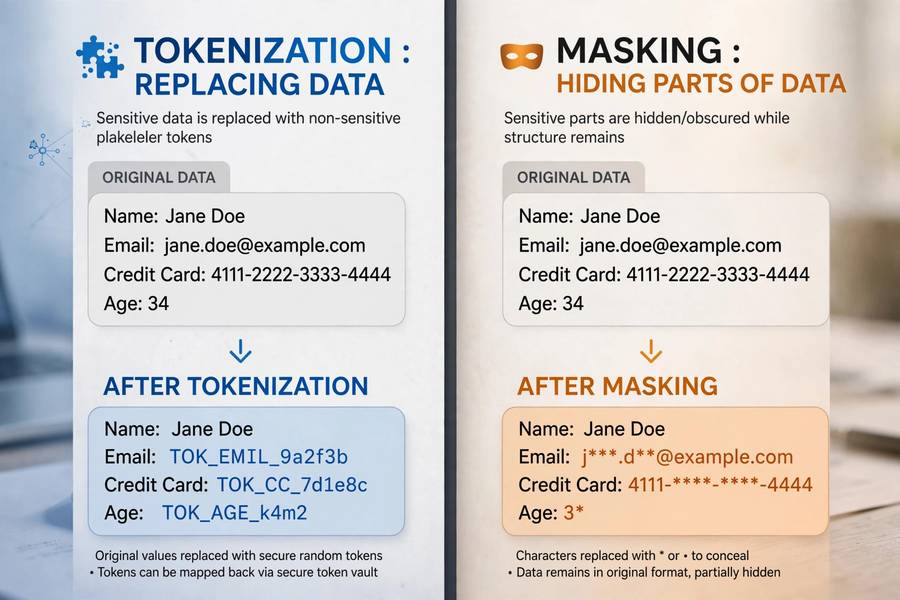
Tokenization replaces sensitive data with random surrogate values (tokens), storing the mapping in a secure vault. Reversible by authorized systems. Used when the real data must remain accessible for legitimate operations.
Data masking obscures sensitive data in place — showing partial data (*--1234), replacing with fictitious values, or scrambling. Typically irreversible (or not intended to be reversed). Used when people need to work with data-like values without seeing the real ones.
The one-line distinction: tokenization preserves the ability to recover the original (for authorized purposes); masking is about preventing exposure where recovery isn’t needed.
How Tokenization Works (Recap)
Briefly: sensitive value → random token (via vault mapping or cryptographic derivation) → token used throughout systems → original recoverable only through the vault by authorized parties. The sensitive data is removed from most systems entirely — they handle meaningless surrogates.
Key properties: reversible (by design, through controlled detokenization), format-flexible (tokens can look like the original data type), and vault-dependent (the mapping must be stored and secured somewhere).
How Data Masking Works
Data masking transforms sensitive data into obscured versions, through several techniques:
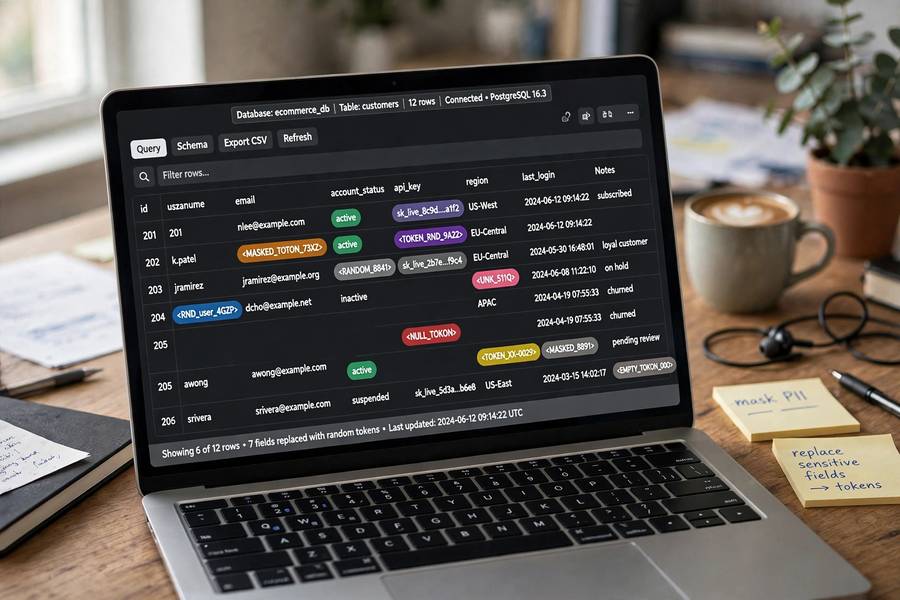
Static masking. Create a sanitized copy of a database with sensitive fields masked — for development, testing, analytics. The masked copy is what non-production systems use. The original stays in production.
Dynamic masking. Mask data in real-time as it’s accessed — different users see different levels based on their role. A support agent sees “*-–*12-34″; a privileged user sees the full value. Same underlying data, different views.
Masking techniques: – Redaction: replace with fixed characters (XXX-XX-1234) — shows format, hides value. – Substitution: replace with fictitious but realistic values (a fake name for the real name) — preserves data utility for testing. – Shuffling: rearrange values within a column — real values, wrong rows. Breaks the association. – Nulling: replace with null/empty — simplest, destroys utility but guarantees protection. – Encryption-as-masking: encrypt the value — technically reversible with keys, but treated as masked for unauthorized viewers.
The common thread: the masked data stays where the original was (same database, same application) — it’s the VIEW that’s protected, not the storage location.
The Fundamental Difference
This is the conceptual core:
Tokenization removes sensitive data from systems. The PAN isn’t in the merchant’s database at all — only the token is. Protection through absence.
Masking obscures sensitive data in place. The data (or a transformed version) remains in the system; what’s protected is who can see the real values. Protection through obscurity of view.
The architectural implications are profound: – Tokenization changes WHERE data lives (vault vs everywhere). – Masking changes WHO SEES WHAT (role-based views of data that stays put).
They’re complementary because they address different layers: tokenization for storage and transmission architecture; masking for access and display.
Reversibility: The Decisive Axis
The practical question that often decides: do you need the original back?
Need reversibility → tokenization. Payment processing, customer service (“I need to see the actual account”), regulatory operations — anywhere the real value must be recoverable by authorized parties. Tokenization’s vault provides controlled reversibility.
Don’t need reversibility → masking. Development databases, analytics, testing — where realistic-looking data is needed but real values aren’t. Masking’s irreversibility is a feature: there’s nothing to steal, no vault to protect.
The gray zone: dynamic masking with privileged full views is effectively reversible for those users — which means it needs tokenization-like controls for the privileged tier. The categories blur at the edges; the principles still guide.
The security implication: irreversible protection (masking) is simpler to secure — no vault, no keys, nothing to reverse. Reversible protection (tokenization) is more powerful but demands the vault’s security apparatus. Choose the simplest mechanism that meets the requirement.
Use Cases: Where Each Shines
Tokenization excels: – Payment processing (the flagship — PANs must be recoverable for authorization) – Stored credentials (card-on-file, where charging requires the real account) – Any flow where the original value is needed downstream by authorized parties – Compliance scope reduction (removing PANs from systems entirely)
Data masking excels: – Non-production environments (dev/test with realistic data, zero real exposure) – Analytics and BI (analysts need patterns, not individual records) – Customer service displays (agents see partial data — enough to verify, not enough to steal) – Data sharing (partners get masked datasets preserving statistical properties) – Regulatory “minimum necessary” compliance (show only what’s needed for the role)
The pattern: tokenization for operational flows needing the real data; masking for human/data access where real values aren’t required. Production systems tokenize; people-facing views mask.
Security Comparison
Tokenization security rests on: vault protection, token unpredictability, access controls on detokenization. The attack surface is the vault — concentrated, heavily defended. Breach the vault, game over.
Masking security rests on: the masking transformation’s irreversibility and the access controls enforcing who sees what. The attack surface is broader — every system holding masked data — but each holds less value.
Which is “more secure”? Wrong question — they protect against different threats: – Tokenization defeats: bulk data theft (thieves get tokens), scope creep (systems never hold PANs). – Masking defeats: insider overexposure (agents see only what they need), non-production leaks (dev databases contain no real data).
The honest answer: neither is universally superior. Tokenization provides stronger protection for data-in-systems (removal beats obscuring); masking provides more practical protection for data-in-use (people need to see something). Most mature organizations use both — which brings us to…
Combining Them: The Layered Approach
The sophisticated pattern — and what most large organizations actually do:
Tokenize at the boundary. PANs become tokens at ingestion — the storage architecture holds surrogates.
Mask at the presentation layer. When humans view tokenized data, mask the tokens themselves or show partial originals through controlled detokenization + masking. Support agent sees “*-–*12-34″ — masked view of a detokenized value, or masked token.
Mask non-production. Development and analytics environments get masked copies — of already-tokenized data, for defense in depth.
The layers compose: tokenization protects the data architecture; masking protects the human interfaces; together they cover storage, transmission, and display. Each layer’s failure is contained by the others.
This layered thinking — not “which one” but “where does each fit” — is the mark of mature data protection programs.
Worked Example: The Customer Support Workflow
Abstract comparisons are useful; a concrete workflow shows how the two techniques divide the labor. Take a payment company’s customer support operation.
The setup. Support agents handle billing disputes. To do their job, they need to identify the customer’s payment method — but they don’t need the full card number, and the company doesn’t want hundreds of agents with PAN access. The architecture uses both techniques at different layers.
Tokenization at the data layer. The CRM stores tokens, not PANs. When a customer calls, the agent’s screen shows a token reference — meaningless on its own, useless if the agent’s workstation is compromised or the agent goes rogue. The sensitive data simply isn’t in the support system. If the agent needs the last four digits to confirm identity (“can you confirm the card ending in 1234?”), those are stored as a separate masked attribute — not derived from a detokenization.
Masking at the display layer. For the rare cases requiring more — a supervisor investigating a suspected fraud ring — the flow is: controlled detokenization (supervisor role only, each access logged and time-bounded) followed immediately by dynamic masking. The supervisor sees “*-–*45-67″ — enough to correlate across cases, not enough to transcribe a usable number. The full PAN appears on screen only in exceptional, individually approved circumstances.
What each technique contributes. Tokenization removed the PAN from the support infrastructure entirely — the baseline exposure for hundreds of agents is zero. Masking then governs the narrow exception path — the handful of privileged views where some visibility is operationally necessary. Neither alone would suffice: tokenization without masking leaves the detokenization path overexposed; masking without tokenization leaves the underlying database full of PANs for any attacker who bypasses the view layer.
The design principle this illustrates. Apply the strongest, simplest protection at the deepest layer (remove the data — tokenization), then manage the residual human need with the lighter control (obscure the view — masking). Depth first, then precision. Most “which should we use” debates dissolve once you see that the techniques answer different questions at different depths.
Decision Framework
Ask in order:
- Must the original be recoverable? Yes → tokenization. No → masking (simpler).
- Where’s the exposure? In systems/storage → tokenization (remove it). In human views → masking (obscure it).
- What’s the compliance driver? Scope reduction → tokenization. Least-privilege display → masking. (Both are tools in the broader AI compliance toolkit — different controls for different risks.)
- Non-production use? Almost always masking (no reason to put real or reversible data in dev).
- Budget and complexity? Masking is simpler and cheaper to implement; tokenization demands vault infrastructure. Don’t over-engineer.
The default: if you’re unsure, you probably need both in different places — tokenization where data flows operationally, masking where humans look at it. The question is rarely either/or; it’s where each belongs.
Frequently Asked Questions
Tokenization replaces sensitive data with random surrogates stored in a vault (reversible by authorized systems) — it removes data from systems. Data masking obscures data in place (showing partial or fictitious values) — it controls who sees what. Tokenization is for operational flows needing the real data; masking is for views where real values aren’t required.
Neither universally — they defeat different threats. Tokenization better protects data-in-systems (removal beats obscuring; thieves get worthless tokens). Masking better protects data-in-use (people see only what they need). Most mature organizations use both: tokenization at the architecture layer, masking at the presentation layer.
Yes, and they should be. Common pattern: tokenize at ingestion (PANs become tokens in storage), mask at display (humans see partial values), mask non-production copies. The layers compose — each one’s failure is contained by the others. This layered approach is standard in mature programs.
When the original doesn’t need recovery: development/test databases, analytics, data sharing with partners, and role-based display (support agents seeing partial data). Masking is simpler and cheaper — no vault infrastructure. Choose the simplest mechanism meeting the requirement.
Properly masked data is not intended to be reversible — that’s the point. (Dynamic masking with privileged full views is an exception, needing tokenization-like controls for the privileged tier.) If you need reversibility, that’s the signal to use tokenization instead.
Keep reading: