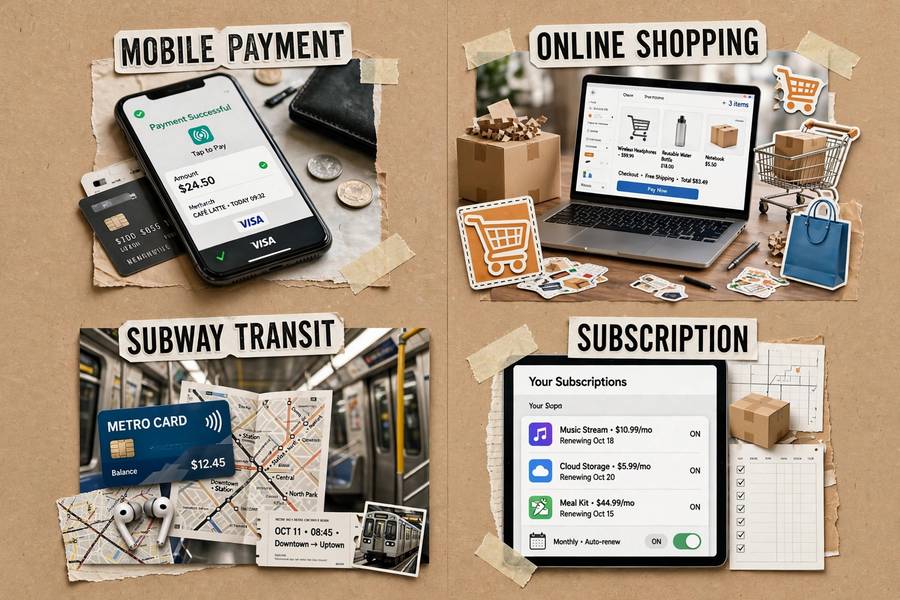
Tokenization isn’t one product — it’s a technique applied across the payment landscape, each use case with its own token types, flows, and benefits. The mobile wallet tap, the saved card at checkout, the subway turnstile, the recurring subscription — different experiences, same underlying principle: replace sensitive numbers with context-bound surrogates. Understanding the use cases shows why tokenization became infrastructure rather than just a feature.
This guide tours the major applications: where tokens work, why each use case needs them, and what’s distinctive about each. For the underlying technology, see how tokenization works.
Table of Contents
- Mobile Wallets: The Flagship Use Case
- E-Commerce Card-on-File
- Subscriptions and Recurring Payments
- Transit: Speed Meets Security
- In-App Purchases
- Wearables and IoT Payments
- Peer-to-Peer Transfers
- Virtual Card Numbers: Single-Use Tokens
- B2B and Corporate Payments: Tokens as Spend Control
- Emerging: What’s Next
- Frequently Asked Questions
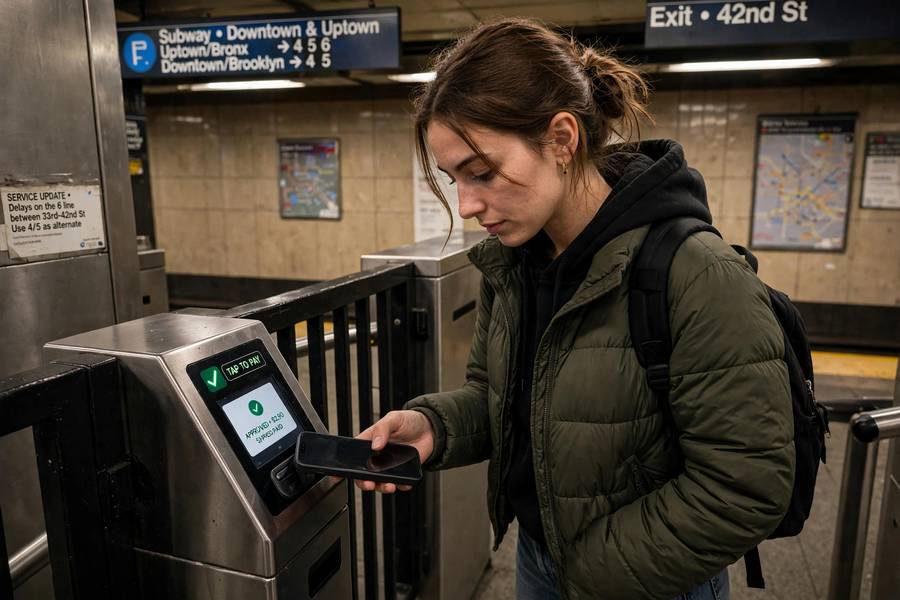
Mobile Wallets: The Flagship Use Case
The tap-to-pay on your phone is tokenization’s showcase — device-bound network tokens in secure elements, biometric-gated, cryptogram-protected. Why it’s the flagship:
The security story is strongest here. Hardware secure elements, biometric authentication, device binding, dynamic cryptograms — every layer of tokenization’s protection stack, deployed together. It’s more secure than the physical card it replaces (which has a static number printed on it, usable by anyone who copies it).
The UX is invisible. Tap, authenticate, done. Users get better security with less friction — the rare case where the secure option is also the convenient one.
The scale proves it. Billions of provisioned tokens, trillions in transaction value. This isn’t experimental — it’s the default for digital payments in most developed markets.
What makes it work: the device as a trust anchor. The secure element’s hardware isolation plus biometric gating creates an authentication chain (you → device → token → network) that’s very hard to break. The token is the credential; the device is the proof of legitimacy.
E-Commerce Card-on-File
The “save my card for faster checkout” experience — merchant-bound tokens replacing stored PANs:
The problem it solves: what e-commerce is in its early days meant merchants storing actual card numbers (or enough data to charge them), creating massive breach targets. The breach headlines of the 2010s were largely this.
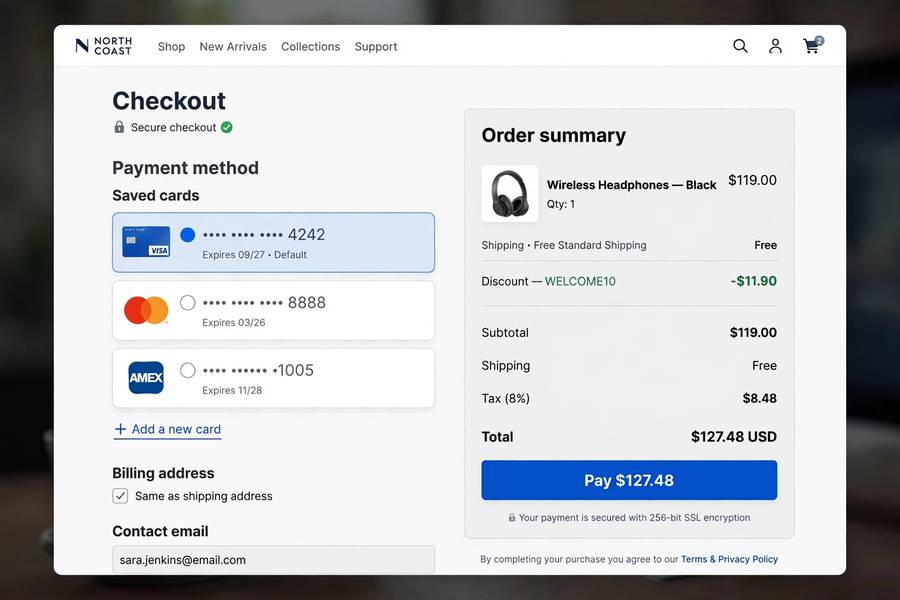
How tokens fix it: the merchant stores a network token bound to their business. Checkout charges the token; the network maps it to the PAN. A breach yields tokens useless anywhere else.
The UX benefit: account updater — when your card is reissued, tokens update automatically. No more “your payment failed, please update your card” across twenty subscriptions. This alone justifies tokenization for merchants (failed payments are expensive).
The conversion angle: saved-token checkout is faster (one click vs typing 16 digits), and faster checkout converts better. Security that improves business metrics — the easiest sell in payments.
Subscriptions and Recurring Payments
The subscription economy runs on stored credentials — and tokenization makes it sustainable:
Credential longevity. Cards expire, get reissued, get lost. Raw PAN storage meant constant churn — failed renewals, dunning emails, lost customers. Tokens with automatic updating survive card changes transparently.
Reduced involuntary churn. The industry term for “customer wanted to pay but the card failed.” Tokenization’s account-updater functionality directly reduces it — a measurable revenue impact.
Security for the long term. Subscriptions store credentials for years. Years of PAN storage is years of breach exposure. Tokens bound to the merchant relationship eliminate that exposure while preserving functionality.
Regulatory alignment. Stored-credential frameworks (mandates, authentication requirements) map cleanly onto tokenized flows — the token IS the stored credential, with its own lifecycle and controls.
For subscription businesses, tokenization isn’t just security — it’s revenue protection. The business case writes itself.
Transit: Speed Meets Security
Public transit is tokenization’s most demanding use case — and its most impressive:
The speed requirement. Transit gates must process in ~300 milliseconds — no time for slow authentication or network round-trips. The token model accommodates this: pre-provisioned tokens, offline-capable validation, cryptograms verified at speed.
The volume. Millions of taps daily in major systems. The infrastructure handles scale that would crush less efficient designs.
The UX: tap and walk. No tickets, no apps open, no friction. Tokenization enables the “just tap your phone” experience that transformed urban transit.
Why it matters beyond transit: it proves tokenization works under the hardest constraints — speed, volume, offline tolerance. If it works at a subway turnstile at rush hour, it works anywhere.
In-App Purchases
Mobile apps selling digital goods, rides, food — in-app payments tokenized:
Platform wallets. App stores tokenize through their own systems — the app never sees PANs, the platform handles the token layer.
Frictionless flow. Biometric confirmation, token charged, done. The conversion optimization is extreme — every removed step increases purchase rates.
The platform dynamic: app stores as tokenization intermediaries — they hold the relationship (and the tokens), apps get paid without touching sensitive data. Centralization with security benefits.
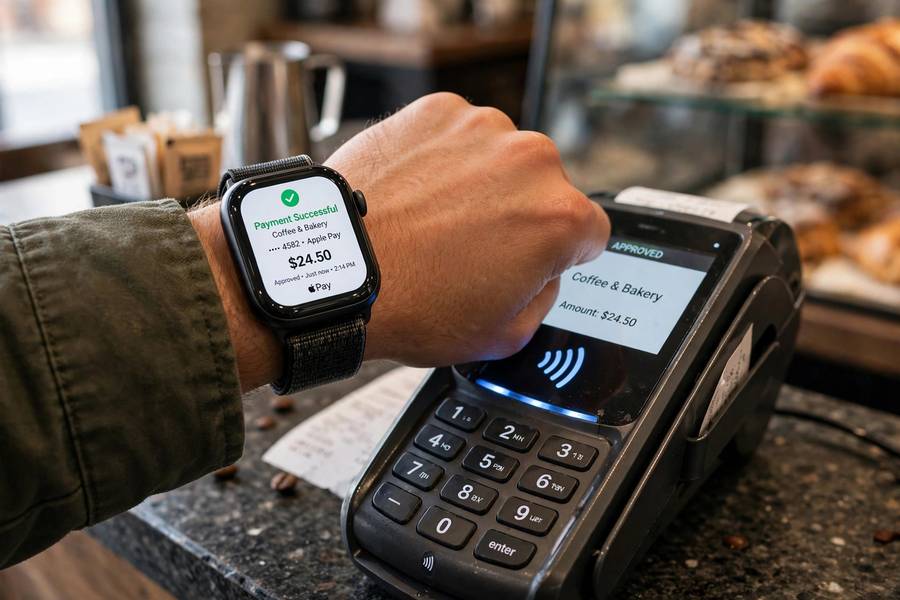
Wearables and IoT Payments
The expanding frontier — paying with watches, rings, even connected cars:
Constrained devices. Wearables lack the UI for complex authentication — tokenization’s “provision once, tap simply” model fits perfectly. The heavy security lifting happens at provisioning; usage is frictionless.
The provisioning challenge: getting tokens onto devices with minimal interfaces — usually via a paired phone app. The UX design here is subtle and important.
IoT payments: connected cars paying for fuel/charging, smart appliances reordering supplies. Tokenization provides the credential layer — devices hold tokens, not PANs, limiting exposure if (when) IoT devices are compromised.
The trajectory: payments disappearing into objects and environments. Tokenization is the security foundation making “invisible payments” possible without catastrophic risk.
Peer-to-Peer Transfers
Person-to-person payments (sending money to friends) use tokenization differently:
Account tokens. Rather than card PANs, P2P systems tokenize bank account references — the same surrogate principle applied to account numbers.
The social engineering dimension: P2P fraud is mostly authorized-push (tricking users into sending), which tokenization doesn’t prevent — the token works because the user authorized it. The technology solves data theft, not deception.
The lesson: tokenization’s scope is specific — it protects stored/transmitted credentials. It doesn’t solve fraud types that don’t depend on credential theft. Understanding the boundary prevents overconfidence.
Virtual Card Numbers: Single-Use Tokens
One of tokenization’s cleverest applications: virtual card numbers — unique, often single-use card numbers generated for individual online purchases, mapped to your real account behind the scenes.
How they work. Before buying from an unfamiliar site, you generate a virtual number through your bank’s app or browser extension. The number looks and behaves like a real card number — the merchant processes it normally — but it’s a token: bound to that merchant, that amount, sometimes that single transaction. The network maps it to your real account at authorization.
Why they’re powerful. The threat model they defeat is the sketchy-merchant breach — the small online store with questionable security that gets compromised six months later. Your real PAN was never there; the virtual number is. And since the token is merchant-bound and possibly single-use, the breached number is worthless — it can’t be used elsewhere, and it may not even be usable again at the same merchant.
The trade-off. Virtual numbers add friction — generating a number per purchase is a step users must remember. Adoption has been modest compared to wallets, which automate the equivalent protection invisibly. The technology is arguably better than merchant tokens for one-off purchases (tighter binding, no stored credential at all), but the UX never quite caught on at scale. A case study in the principle that the best security is the kind users don’t have to think about.
Where they shine anyway. High-risk contexts — unfamiliar merchants, trial subscriptions you might forget to cancel (set the virtual number’s limit or expiry and the “forgotten subscription” problem solves itself), and shared-expense scenarios. Niche, but the niche is real.
B2B and Corporate Payments: Tokens as Spend Control
Corporate card programs have quietly become one of tokenization’s most sophisticated use cases — not just for security, but for control.
The problem. A company issues cards to hundreds of employees. Traditional approach: physical cards with shared limits, expense reports after the fact, and the eternal finance-team question of who spent what on which vendor. Control is retrospective — you find out about misuse in the expense report, weeks later.
The tokenized approach. Virtual tokens issued per employee, per vendor, per purpose — each with embedded constraints: this token works only at this supplier, up to this amount, within this date range. The token IS the policy. An employee can’t accidentally (or deliberately) use the office-supplies token at a restaurant — the domain binding rejects it at authorization time.
Why this is architecturally interesting. It’s tokenization’s domain-binding property repurposed from security to governance. The same mechanism that makes a stolen merchant token useless elsewhere makes a misused corporate token fail at the wrong merchant. Security property and business control, same primitive.
The reconciliation win. Because each token is purpose-bound, transaction data arrives pre-categorized — the finance system knows this charge was the marketing team’s ad spend before anyone files an expense report. Tokens collapse the gap between authorization and accounting. For finance teams drowning in expense reports, this is the actual value proposition; the security is the bonus.
Emerging: What’s Next
Where payment tokenization is heading:
Broader identifier tokenization. The model expanding beyond cards — bank accounts, identity documents, health identifiers. The architectural pattern (central mapping, distributed surrogates) generalizes.
Programmable tokens. Tokens with embedded rules — spend limits, merchant categories, time windows. Credentials that enforce policy, not just identity.
Cross-border harmonization. Token standards converging globally — the current patchwork of schemes consolidating.
Central bank digital currencies. CBDC designs incorporating tokenization principles — privacy-preserving digital cash with the same surrogate architecture.
The meta-trend: sensitive identifiers of all kinds moving toward tokenized architectures. Payments led because the fraud costs forced innovation; other domains are following as their breach costs mount. The token vault model — explained in my companion pieces — is becoming a general pattern for sensitive data, not just a payments technique.
Frequently Asked Questions
Everywhere digital payments happen: mobile wallets (tap-to-pay), e-commerce saved cards, subscriptions, transit systems, in-app purchases, wearables, and IoT payments. Each use case applies the same principle — replace card numbers with context-bound surrogates — adapted to its constraints.
Tokens survive card reissuance through automatic updating, eliminating the failed-payment churn of expired cards. They also remove long-term PAN storage exposure. For subscription businesses, tokenization is revenue protection as much as security — fewer failed renewals, less breach risk.
Pre-provisioned device tokens enable sub-300-millisecond gate processing — the token and cryptogram validate fast enough for rush-hour throughput. It’s tokenization under the hardest constraints (speed, volume, offline tolerance), proving the architecture scales to extremes.
No — it excels at preventing credential-theft fraud (breaches yielding usable card numbers) but doesn’t stop authorized-push fraud where users are tricked into authorizing payments themselves. Tokenization solves data theft, not deception. Understanding this boundary prevents overconfidence.
An emerging concept: tokens with embedded rules like spend limits, allowed merchant categories, or time windows. The token becomes not just an identifier but a policy-enforcing credential — extending tokenization from “who” to “under what conditions.”