PCI DSS — the Payment Card Industry Data Security Standard — is the rulebook for handling card data, and tokenization is one of its favorite tools. Done right, tokenization can dramatically shrink your compliance scope: systems that never touch real card numbers face far fewer requirements. Done wrong, it’s expensive theater — tokens that don’t actually reduce scope, implementations that auditors reject.
This guide explains what PCI DSS actually requires around tokenization: the standard’s position, what qualifies, and the implementation details auditors check. Note: this is educational, not legal advice — compliance decisions need qualified assessors. For the technology itself, see how tokenization works.
Table of Contents
- PCI DSS in Brief
- The Standard’s Position on Tokenization
- Scope Reduction: The Prize
- What Qualifies as Tokenization Under PCI DSS
- Token Vault Requirements
- The Assessors’ Checklist
- Common Compliance Failures
- Tokenization and PCI DSS v4.0
- The Scope-Reduction Math: A Worked Example
- Frequently Asked Questions
PCI DSS in Brief
PCI DSS is a set of security requirements for any organization that stores, processes, or transmits cardholder data. It’s enforced contractually (by the card brands through acquirers), not by law — but “voluntary” is misleading when non-compliance means losing the ability to accept cards.
The standard’s core logic: define cardholder data, define the systems touching it (the “cardholder data environment” or CDE), and apply ~300 requirements to those systems. Everything in the CDE gets audited; everything outside doesn’t. This scope boundary is where tokenization’s value lives.
The requirements cover: network security, access control, encryption, monitoring, testing, and policies — comprehensive and demanding. Compliance is expensive, which is why reducing scope is so valuable.
The Standard’s Position on Tokenization
PCI DSS doesn’t mandate tokenization — it’s one option among several for protecting stored card data (alongside encryption, truncation, masking). But the PCI Security Standards Council has published specific guidance on tokenization, and the position is clear:
Tokenization is recognized as a valid method for protecting stored account data — IF implemented per the guidance.
The key principle: tokens that can’t be mapped back to PANs by the token holder may take systems out of scope. The scope question hinges on reversibility: if a system holds tokens AND can reverse them (has vault access), it’s in scope. If it holds tokens that are irreversible to it, it may be out of scope.
The guidance documents detail requirements for token generation, vault security, and the conditions for scope reduction. They’re the authoritative source — this article summarizes, but implementers should read the actual guidance.
The standard’s stance is pragmatic: tokenization works when done right, and “done right” has specific, auditable criteria.
Scope Reduction: The Prize
Why organizations tokenize for PCI: scope reduction. The math:
Without tokenization: card numbers flow through your e-commerce platform, order management, CRM, analytics, backups — each system touching PANs is in the CDE, each gets the full requirement set. Compliance cost scales with scope.
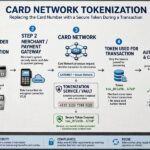
With tokenization: PANs are tokenized at the boundary (ideally before entering your systems at all — hosted payment fields, network tokens). Downstream systems handle only tokens. If those tokens are properly irreversible to those systems, they’re out of scope — or in significantly reduced scope.
The impact: organizations have cut PCI scope by 80–90% through tokenization — from hundreds of in-scope systems to a handful. The compliance cost savings are enormous, often justifying tokenization projects on economics alone.
But: scope reduction isn’t automatic. It requires the tokenization to meet the standard’s criteria AND assessor agreement. “We tokenize” without meeting the criteria is just a claim — auditors verify.
What Qualifies as Tokenization Under PCI DSS
Not every “token” qualifies. The criteria:
Irreversibility by the holder. The system holding tokens must not be able to reverse them to PANs. If the same system holds both tokens and vault access, no scope reduction — it’s just indirection.
Token generation security. Tokens must be generated securely — unpredictable, unique, with no mathematical relationship to the PAN derivable by the holder. Weak token generation (sequential numbers, reversible algorithms accessible to holders) fails.
No PAN remnants. Tokenized systems must not retain PANs in any form — logs, caches, error messages, backups. One stray PAN in a log file can pull a system back into scope. This is where implementations most often fail.
Vault separation. The token vault (which CAN reverse tokens) must be properly secured and is itself in scope — but it’s ONE system instead of dozens. The vault’s requirements are stringent (it’s the crown jewel).
Documentation. The tokenization architecture, data flows, and scope rationale must be documented for assessors. “Trust us” isn’t a control.
Token Vault Requirements
The vault — the system that CAN map tokens to PANs — faces the full weight of requirements:
It’s in scope, fully. No scope reduction for the vault itself. It stores the sensitive mappings, so it gets the complete requirement set.
Key management. If vaultless/cryptographic tokenization is used, key management requirements apply rigorously — HSMs, split knowledge, rotation.
Access controls. Strict authentication, least privilege, separation of duties for vault operations.
Monitoring. Comprehensive logging of all vault access, with alerting on anomalies.
Network segmentation. The vault must be isolated — not reachable from untrusted networks, communicating only with authorized systems.
The trade-off made explicit: you concentrate the compliance burden into the vault (fully in scope, heavily controlled) to free everything else. One heavily-audited system instead of dozens — the economics almost always favor this.
The Assessors’ Checklist
What qualified security assessors (QSAs) verify for tokenization claims:
- Data flow diagrams — showing exactly where PANs exist and where only tokens exist. Every flow documented.
- Token irreversibility proof — demonstrating that token-holding systems cannot reverse tokens (no vault access, no keys, no algorithms).
- No PAN leakage — sampling logs, caches, databases, backups for PAN remnants. Forensic verification, not just assertions.
- Vault security — the vault itself assessed against all applicable requirements.
- Token generation review — the algorithm/method verified as secure and unpredictable.
- Scope rationale documentation — the written argument for why each system is in or out of scope, tied to evidence.
- Ongoing monitoring — not just point-in-time, but processes ensuring continued compliance (change management, periodic verification).
Assessors are skeptical by profession — they’ve seen tokenization claims that don’t hold up. Come prepared with evidence, not assertions.
Common Compliance Failures
PANs in logs. The #1 failure. Application logs, debug output, error messages capturing full PANs. Tokenize the main flow but log the PAN in exceptions — scope blown.
Shared vault access. Token-holding systems with network access to the vault “just in case.” If they CAN reverse, they’re in scope regardless of whether they DO.
Weak tokens. Sequential or predictable tokens that don’t meet the unpredictability bar. Sometimes legacy “tokenization” that’s really just masking.
Scope creep. New systems added that touch PANs without going through the tokenization boundary. The architecture decays without governance — a pattern familiar from AI compliance programs, where controls erode unless continuously maintained.
Documentation gaps. The implementation is fine but undocumented — assessors can’t verify what isn’t documented. In compliance, undocumented = didn’t happen.
Assuming network tokens = automatic compliance. Network tokenization helps enormously, but you still need proper implementation, documentation, and assessment of YOUR systems. The network’s compliance doesn’t transfer to you.
Tokenization and PCI DSS v4.0
The current major version (4.0) refined several relevant areas:
Customized approach. v4.0 allows alternative implementations meeting the requirement’s intent — relevant for novel tokenization architectures that don’t fit prescriptive controls exactly.
Stronger authentication. Multi-factor requirements expanded — affecting vault access controls directly.
Targeted risk analysis. More emphasis on risk-based decisions — tokenization architectures should include documented risk analysis.
The trajectory: the standard increasingly recognizes tokenization and similar technologies as preferred approaches, with requirements evolving to match. Stay current — compliance is a moving target, and v4.0’s changes are substantive.
The constant: regardless of version, the core principle holds — systems that can’t access PANs face fewer requirements. Tokenization’s value proposition is version-independent.
The Scope-Reduction Math: A Worked Example
Abstract claims about scope reduction are easy; the concrete math is what convinces. Here’s a realistic mid-size e-commerce operation, before and after proper tokenization.
Before. PANs flow through: the storefront application, the order management system, the CRM (support agents viewing full numbers), the data warehouse (analytics on raw PANs), the email service (order confirmations including card data — yes, this happens), and the backup infrastructure covering all of the above. Six system groups in scope, each requiring the full control set: hardening, logging, access reviews, vulnerability scanning, penetration testing. The annual assessment covers all of it. Typical assessment effort: measured in months, cost measured in six figures.
After. PANs are captured in hosted payment fields (the payment page iframe comes from the processor — PANs never touch the merchant’s servers), tokenized at the boundary. The storefront, order management, CRM, warehouse, email, and backups handle only tokens. The token vault — operated by the processor, not the merchant — is the only PAN-touching system, and it’s the processor’s compliance burden, not the merchant’s.
The result. The merchant’s in-scope footprint collapses to the token-handling systems under a reduced control set — the SAQ (self-assessment questionnaire) drops from the full SAQ D to a dramatically shorter variant. Assessment effort drops from months to weeks. The compliance cost reduction routinely pays for the tokenization project within the first assessment cycle.
Where the math breaks. If any one of those six systems retains a single PAN pathway — the CRM’s “view full card” feature for support, the warehouse’s historical table nobody migrated, the email service’s legacy template — the scope reduction unravels for that system. The worked example only works if the PAN removal is complete. Partial tokenization is the most expensive kind: you pay for the project and keep the scope.
Frequently Asked Questions
No — but it can dramatically reduce your compliance scope. Systems holding only irreversible tokens may fall out of scope, cutting requirements significantly. The token vault itself remains fully in scope. Tokenization is a scope-reduction tool, not a compliance shortcut.
Tokens must be unpredictable and irreversible by holders, no PAN remnants in tokenized systems (logs, caches, backups), the vault properly secured and segmented, token generation verified secure, and everything documented for assessors. The PCI Council’s tokenization guidance details the criteria.
Yes, if the tokens are truly irreversible to those systems (no vault access, no keys, no PAN remnants). Organizations have cut scope 80–90% this way. But it’s not automatic — it requires meeting the criteria and assessor agreement, verified with evidence.
PANs leaking into logs, caches, or error messages in supposedly tokenized systems. The main flow tokenizes correctly, but an exception log captures a full PAN — and that single remnant can pull the system back into full scope. Forensic verification of no PAN remnants is essential.
No — this is educational information about the standard’s tokenization provisions. Compliance decisions should involve qualified security assessors (QSAs) and legal counsel. PCI DSS is enforced contractually through card brand programs, and requirements evolve (currently v4.0).