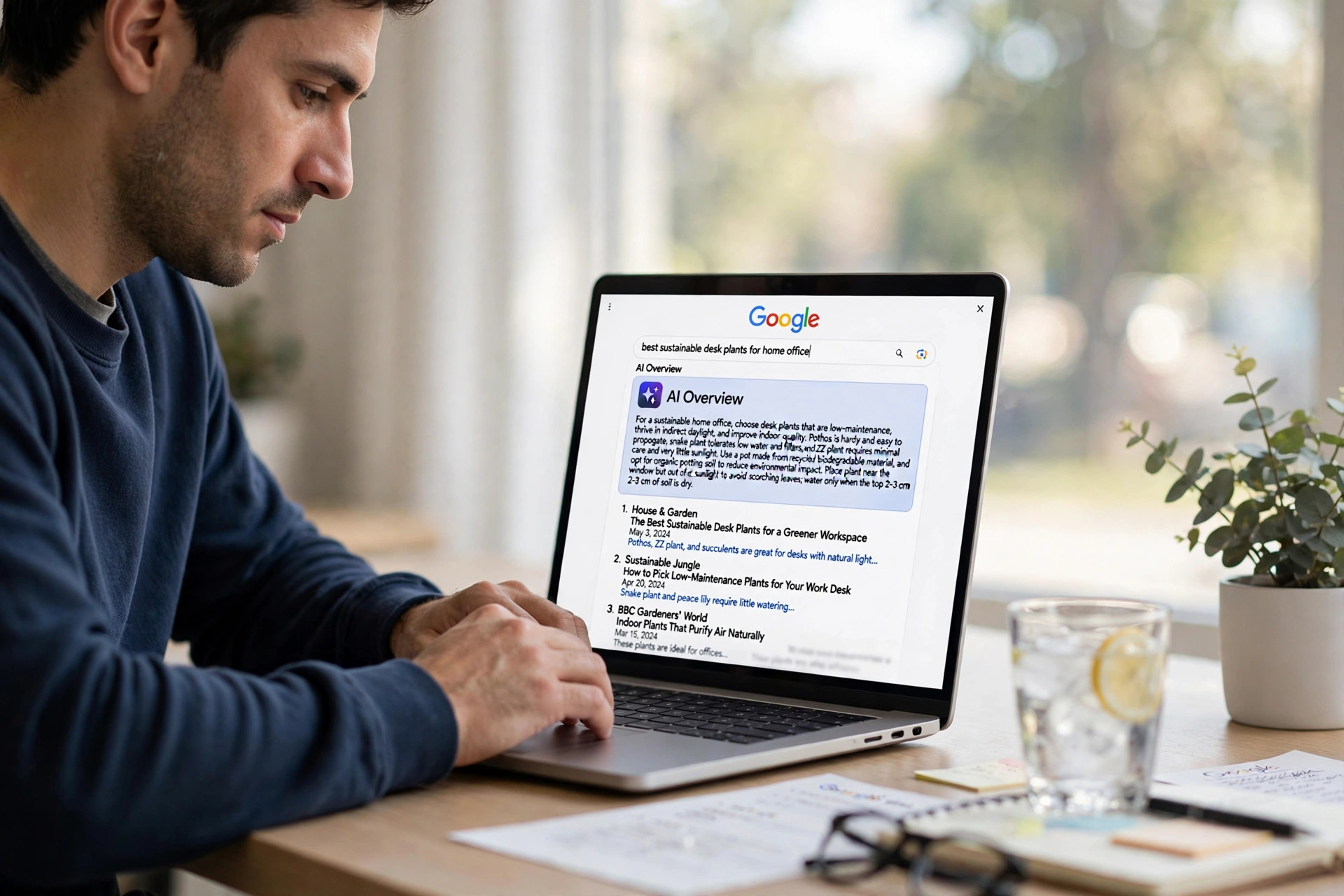
Three developments landed within two weeks: AI Overviews spread across branded searches, Google made human review explicit for AI-assisted content and metadata, and a nearly 14-day spam update finished rolling out. Here is the practical response for site owners.
The October 2026 Google AI search updates did not announce a ban on AI-written pages, and they did not create a shortcut to visibility. They did something more useful: they exposed where a modern publishing operation can fail. A brand can now be summarized before the searcher reaches its site. A polished AI draft can still carry invented facts into a title, meta description, schema field or image alt text. And a ranking dip during an update can tempt a team into “fixes” before it has diagnosed the problem.
The answer is not to abandon AI or chase a new acronym. It is to control the facts that describe your brand, require a named human to review every search-facing field, and measure changes against a dated baseline. That is slower than pressing Publish on a raw draft. It is also far cheaper than correcting a confident error after Google has repeated it.
Branded search has become an AI-answer surface
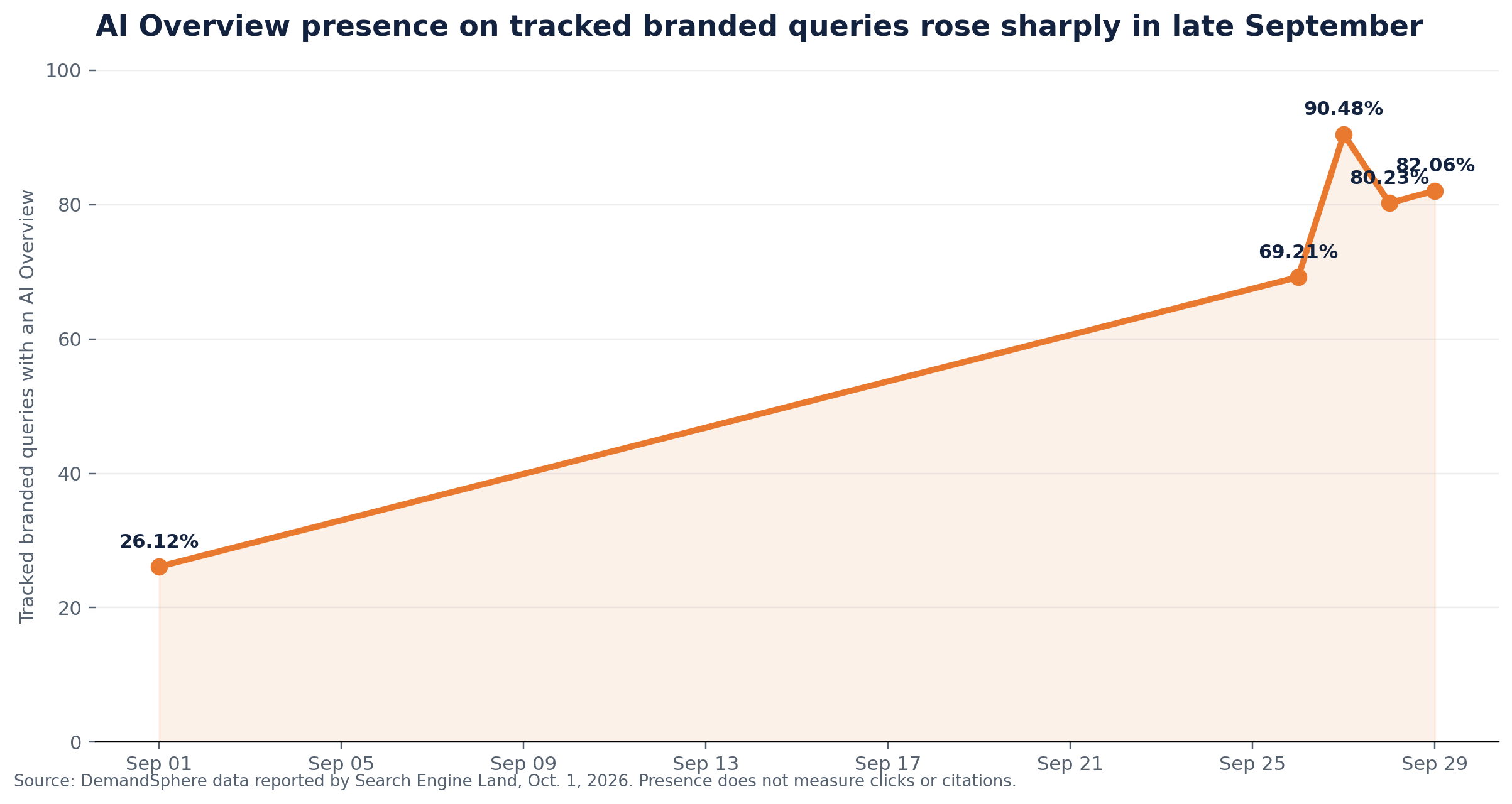
Branded queries used to feel predictable: a person typed a company name, saw the official site and clicked. DemandSphere data reported by Search Engine Land shows how quickly that assumption changed in late September. AI Overviews appeared on 26.12% of its tracked branded queries on September 1, then rose to 90.48% on September 27 and remained above 80% on September 28 and 29.
The numbers are important, but their limits are just as important. The tracker counted whether an AI Overview appeared. It did not require the overview to cite the brand, and it did not measure clicks, conversions or a loss in branded click-through rate. A separate test found AI Overviews for 93 of 100 enterprise brands, but that also does not prove a universal traffic effect.
For a site owner, the operational change is clear even before the click data settles: your brand SERP now needs editorial monitoring. Search your bare brand name and high-value modifiers such as reviews, pricing, location, support and alternatives. Record whether an AI Overview appears, what claims it makes and which sources it cites. Repeat the check across time and relevant markets because a single search can vary by location, device and day.
Then fix wrong information at its source. Your About, Contact, service and product pages should agree with your Google Business Profile and credible third-party listings. Clear entity information, consistent names and addresses, current product facts, and first-party evidence give search systems less room to assemble a misleading description.
Google made manual review explicit — including metadata
On October 1, Google logged an update to its guidance on using generative AI content. The revised guidance explains that generative models can produce inaccuracies and says human fact-checking and review should happen before publication. The scope is wider than the article body: it includes title elements, meta descriptions, structured data and image alt text.
That scope matters because metadata often escapes the editorial pass. A writer may verify the body while a plugin generates a title at scale, a product feed fills schema, or a vision model writes alt text without seeing the final crop. Those fields can appear in Search, so an error can become the promise a searcher sees before opening the page.
The update was documentation, not an announced ranking-system change. Google’s longstanding position also remains: appropriate use of AI is not automatically against its guidelines; automation used primarily to manipulate rankings violates its spam policies. The practical dividing line is not “human versus machine.” It is useful, original and checked work versus scaled output that adds little value or misrepresents facts.
Editorial rule: Treat every AI-assisted field as unverified until a person checks the claim, the cited source and the final page context.
The September spam update gives you a clean comparison window
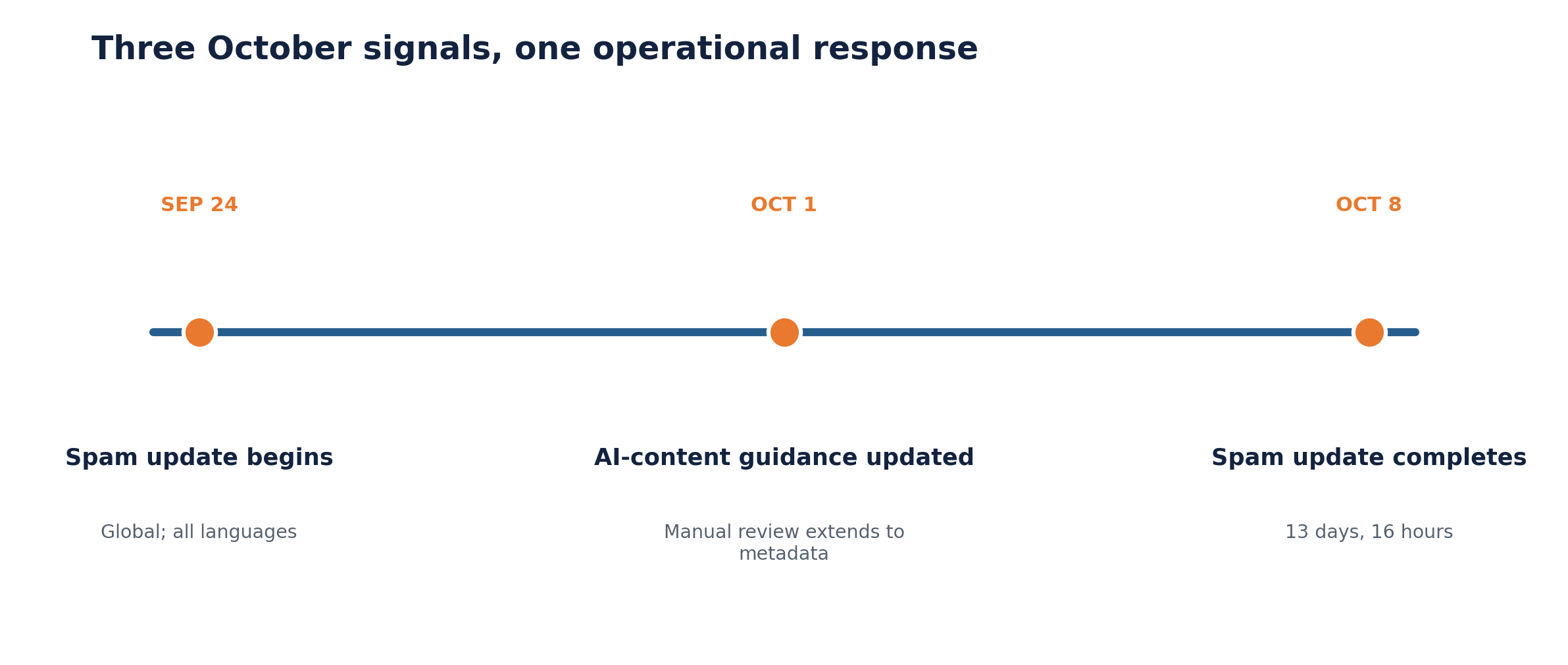
Google’s September 2026 spam update began on September 24 and completed on October 8 after 13 days and 16 hours. Google said it applied globally and across languages. It did not identify a single tactic, industry or content type as the target, so a traffic change during that period is not a diagnosis by itself.
Use the rollout as a measurement window. In Google Search Console, compare September 24–October 8 with a comparable period before the rollout and, once enough data is available, a period after completion. Segment by page type, query group, country and device. Look for changes that persist across multiple days and appear in impressions, clicks and average position—not only in a third-party rank tracker.
If the decline is concentrated, inspect the affected template or content group. Check indexing status, manual actions, canonical signals, internal links and whether the pages provide original evidence beyond what already exists. If the decline is sitewide, widen the review to technical availability, security, policy compliance and large-scale publishing patterns. Resist changing titles or deleting pages simply because two dates overlap.
A five-step publication gate protects speed without wasting it
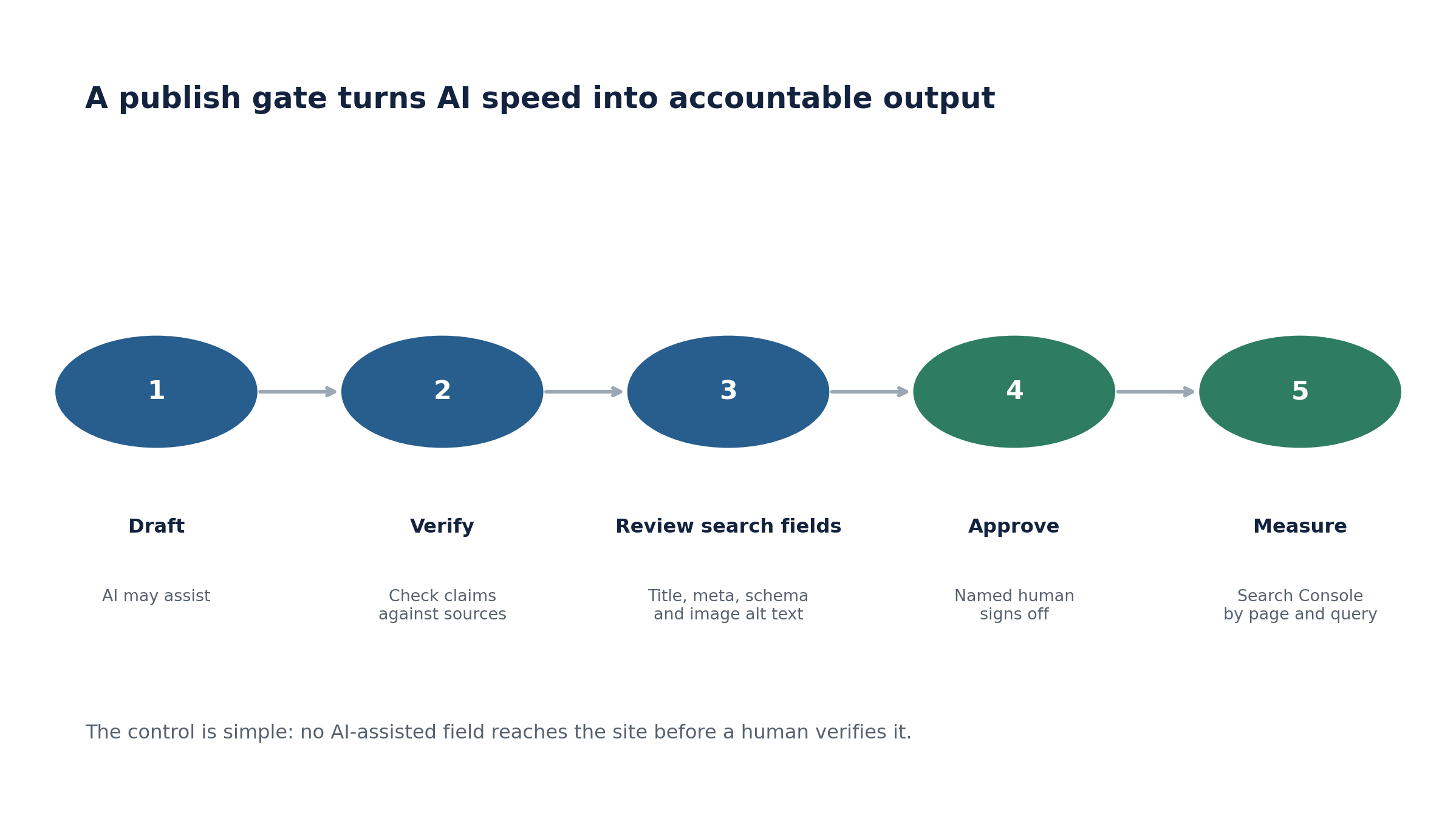
Draft with a specific brief. Define the reader, question, evidence standard and page purpose before asking AI for structure or copy. A vague brief produces fluent commodity content.
Verify every material claim. Open the underlying source, check dates and scope, and remove claims that cannot be supported. For changing topics, record when the source was checked.
Review the search-facing layer. Read the SEO title, meta description, schema, image alt text, captions and internal-link anchors as carefully as the body. Confirm that each field describes what is actually on the page.
Require accountable approval. A named editor should decide that the page is accurate, useful and ready. Automated checks can flag omissions; they cannot own the final judgment.
Measure without promising. Track impressions, clicks, rankings, conversions and AI citations where observable. Report the evidence, not a ranking guarantee. Search systems and result formats continue to change.
What site owners should do this week
Audit branded AI results. Check your brand name plus reviews, pricing, support, location and alternatives. Save the date, query, country, device and cited sources.
Create one source of truth. Make key facts consistent across the website, Business Profile, trusted directories and owned social profiles. Correct contradictions before adding more content.
Add a pre-publication checklist. Include body facts, title, meta description, schema, image alt text, author details, dates and links. No field is “just metadata.”
Segment post-update data. Compare stable periods in Search Console and separate branded from non-branded queries. Investigate patterns before editing pages.
Strengthen evidence. Replace generic summaries with first-party examples, original screenshots, expert review, tested steps, current product facts or clearly sourced data.
None of these actions guarantees a ranking improvement. They do create a defensible publishing system: one that can show what was checked, why a claim is present and how performance changed after publication. That is the useful lesson behind the Google AI search updates: visibility is becoming more mediated, while responsibility for accuracy remains with the publisher. If you want background on how these systems produce answers, read what AI agents are used for and how they differ from simple chatbots.
Frequently asked questions
No. Google says appropriate use of AI or automation is not automatically against its guidelines. The risk is using automation primarily to manipulate rankings or producing scaled pages without meaningful value. Accuracy, originality, usefulness and human review still matter.
Google made manual fact-checking and review explicit for AI-generated material before publication. The review also covers titles, meta descriptions, structured data and image alt text.
The cited September data measured whether an AI Overview appeared, not clicks or conversions. A traffic effect may exist for an individual site, but it must be tested with that site’s own Search Console and analytics data.
Compare Search Console performance before, during and after the September 24–October 8 rollout. Segment by page, query, country and device, then investigate sustained patterns alongside indexing, technical and policy checks.
FAQ schema does not guarantee rankings. Google stopped showing FAQ rich results in 2026. Accurate FAQ markup can still keep the page’s question-and-answer structure machine-readable, but it should only describe content visible on the page.