Why Is the Sky Blue? The Science, Simply Explained


Every child asks it, and most adults cannot quite answer it. Why is the sky blue? The short version is that sunlight looks white but is actually made of many colors, and the air scatters the blue part of that light in every direction. Your eyes receive that scattered blue light from all over the sky, so the whole dome looks blue. That is the whole mystery in one paragraph, but the details are genuinely beautiful.
To understand it fully, you need three pieces: what sunlight is, what air does to it, and how your eyes interpret the result. None of the pieces are complicated on their own. Together they explain not just the blue sky, but red sunsets, white clouds, and why the sky looks different on other planets. Let us walk through it step by step.

Sunlight Is Not Really White
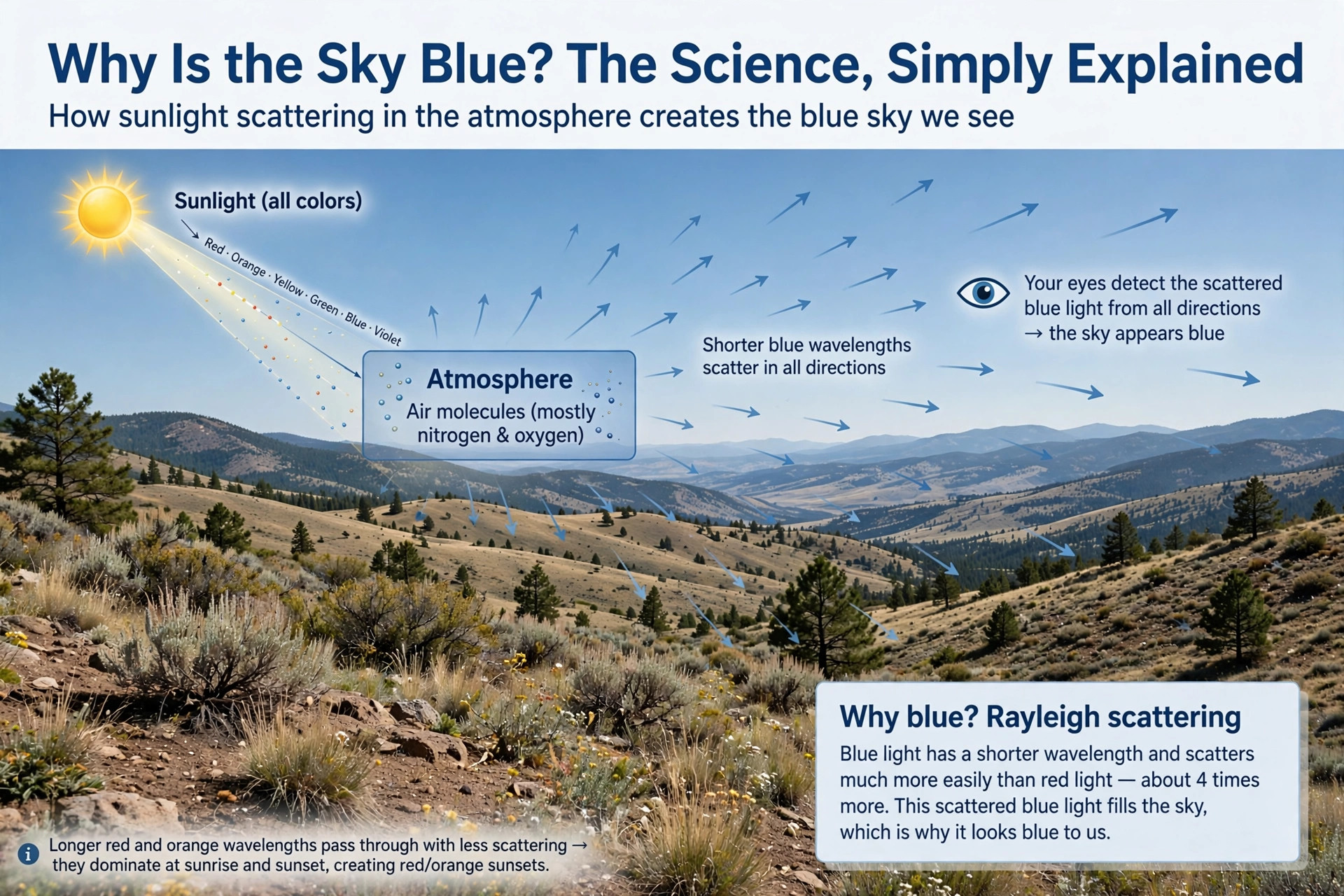
Sunlight looks white to us, but it is a blend of every color in the rainbow. You can see this yourself with a prism, which splits white light into a spectrum, or after a rainstorm when the same splitting happens in water droplets and you get an actual rainbow. Each color is light vibrating at a different wavelength. Red light has long, lazy waves. Blue light has short, tight waves. That difference in wavelength is the key to everything.
Think of the wavelengths like different sized balls rolling through a forest. Long red waves are like big beach balls rolling between the trees. They mostly pass through untouched. Short blue waves are like marbles. They bounce off everything. When sunlight enters Earth’s atmosphere, the blue light collides with air molecules far more often than the red light does, and each collision scatters it in a new direction.
This scattering has a name: Rayleigh scattering, after the physicist Lord Rayleigh who explained it in the 1800s. The amount of scattering depends strongly on wavelength. Blue light, with its short waves, scatters about five times more than red light. That single fact paints the sky.
What the Air Actually Does
Earth’s atmosphere is mostly nitrogen and oxygen molecules, and they are tiny compared to the wavelength of visible light. When sunlight hits them, the blue portion gets scattered in all directions: up, down, sideways, everywhere. The red, orange, and yellow light mostly continues straight through toward the ground.
Now imagine standing outside looking up. Light is arriving at your eyes from every patch of sky, and a large fraction of what reaches you from any direction is scattered blue light. The sky is not a blue object. It is empty space that looks blue because blue light is bouncing around in the air between you and space. You are seeing scattered sunlight, not a colored ceiling.
This also explains why the sun itself looks yellowish-white rather than blue. When you look directly at the sun, you are seeing the light that traveled straight through, with much of its blue scattered away. What is left is richer in the longer wavelengths, which our eyes read as warm white or pale yellow.
Why Sunsets Turn Red and Orange
The same physics explains sunsets, and it is the best proof the theory works. When the sun sits low on the horizon, its light travels through much more atmosphere to reach you than at noon. All that extra air scatters away even more of the blue light, and starts scattering the green and yellow too.
By the time the light arrives, mostly reds and oranges remain. The sun looks red, and the clouds near the horizon light up in pink and gold because they are reflecting that reddened light. A vivid sunset is just the daytime blue-sky process pushed to its extreme by a longer path through the air.
Dust, pollution, and water vapor change the show. Tiny particles in the air scatter light differently than molecules do, which is why sunsets after volcanic eruptions or during wildfire season can be unusually dramatic. The extra particles add more scattering, painting broader and deeper colors across the sky.
Why Clouds Are White and Space Is Black
Clouds are made of water droplets, which are much larger than air molecules. When light hits them, all wavelengths scatter roughly equally instead of favoring blue. Equal scattering of all colors looks white to our eyes, which is why clouds are white. Very thick clouds look gray because so much light gets scattered and absorbed that little reaches your eyes.
And space? There is no air up there to scatter anything. Without an atmosphere, sunlight travels in straight lines and the background is black, which is why photos from the Moon show a pitch-black sky even in full daylight. The blue sky is entirely an atmosphere effect. No air, no blue.
This is also why the sky looks different on other planets. Mars has a thin atmosphere full of fine dust, which scatters red light more effectively, giving it butterscotch skies and blue-tinged sunsets, the exact reverse of Earth. Same physics, different air, different sky.
The Role Your Eyes Play
There is one more twist. Violet light actually scatters even more than blue, so by pure physics the sky should look violet. It does not, for two reasons. First, the sun emits less violet light than blue. Second, human eyes are less sensitive to violet and more sensitive to blue. Our eyes also blend the scattered violet with other wavelengths, and the result our brain reports is blue.
Color vision is a partnership between physics and biology. The atmosphere does the scattering, but your eyes and brain do the interpreting. Bees, which see ultraviolet light, would describe our sky very differently. The blue sky is real, but it is also, in a small way, a human-specific experience.
Why Is the Sky Blue at Different Times of Day
The sky is not one fixed blue. It shifts through the day, and each shift is the same scattering physics at a different sun angle. In the early morning, the sun’s light travels through more atmosphere than at noon, so some blue gets scattered away before reaching you. The morning sky often looks paler, almost washed out near the horizon, deepening to richer blue overhead.
Midday brings the deepest blue, because the sun is high and its light takes the shortest path through the air. Less atmosphere means less scattering of the other colors, so the blue dominates cleanly. This is the classic blue sky of postcards, and it is also when the physics is working in its simplest form.
Late afternoon reverses the morning process in slow motion. As the sun descends, the light path lengthens, blue scatters out progressively, and the sky near the sun warms through white to gold. Photographers call the hour before sunset the golden hour for exactly this reason. The light itself changes color as the atmosphere filters it, which is why everything looks warmer and softer.
Weather adds variation on top. After rain, the air is washed clean of dust and particles, and the blue looks especially vivid. On hazy days, extra particles scatter all wavelengths more evenly, muting the blue toward white or gray. The sky is a real-time readout of what is floating in the air above you.
Why Is the Sky Blue? Simple Experiments to Try
You can demonstrate Rayleigh scattering in your kitchen. Fill a clear glass with water, add a tiny drop of milk, and shine a flashlight through it in a dark room. The water looks bluish from the side, where scattered light reaches your eyes, and the light emerging from the far side looks yellowish-red. The milk particles play the role of air molecules, scattering the short blue wavelengths just like the atmosphere does.
A prism offers the other half of the story. Shine sunlight or a bright flashlight through it onto a white wall and watch the white light split into its component colors. This is the spectrum hiding inside ordinary daylight. Once you have seen it, the idea that blue light behaves differently from red light stops being abstract.
For the full experience, watch a sunset with the physics in mind. Notice how the sun reddens as it drops, how the blue deepens overhead while the horizon glows, and how clouds catch the changing colors. You are watching Rayleigh scattering happen live, across the whole sky. Few science lessons come with a better view.
The next time you step outside on a clear day, look up with new eyes. The blue above you is sunlight shattered into its colors by the air itself, a physics demonstration running continuously overhead. Sunsets, white clouds, the black sky of space: they are all the same story told at different angles. Few questions that sound this simple have answers this satisfying.
Frequently Asked Questions
Why is the sky blue in simple terms?
Sunlight contains all colors, and air molecules scatter short blue wavelengths in every direction much more than other colors. Your eyes receive that scattered blue light from all over the sky, so it looks blue. This scattering is called Rayleigh scattering, and it works the same way everywhere on Earth.
Why is the sunset red instead of blue?
At sunset, sunlight travels through more atmosphere, which scatters away the blue light and even some green and yellow. The red and orange light that remains reaches your eyes, coloring the sun and nearby clouds.
Why are clouds white if the sky is blue?
Cloud droplets are much larger than air molecules, so they scatter all wavelengths of light equally. Equal scattering of all colors appears white to our eyes. Very thick clouds look gray because so much light gets scattered and absorbed that little reaches your eyes.
Why is the sky black in space?
There is no atmosphere in space to scatter sunlight, so light travels in straight lines and the background stays black. The blue sky exists only because Earth has air.
Would the sky be blue on other planets?
It depends on the atmosphere. Mars has dusty air that scatters red light more, giving it pale orange skies. A planet with an atmosphere like Earth’s would have a blue sky too. The color of any sky is really a fingerprint of the air creating it.