How Do Magnets Work? The Simple Science Explained



Stick a magnet to your refrigerator and it just hangs there, defying gravity, day after day, asking for nothing. It’s such an ordinary miracle that most of us stopped wondering about it around age seven. But how do magnets work, really? What’s actually happening inside that little chunk of metal that lets it pull, push, and stick without touching anything?
The answer involves some of the strangest and most wonderful physics in everyday life: invisible fields that fill the space around magnets, electrons behaving like tiny spinning tops, and a deep connection between magnetism and electricity that powers everything from your phone’s speaker to the motor in an electric car. Here’s the whole story, no physics degree required.
How Do Magnets Work? The Short Version
Every magnet is surrounded by an invisible magnetic field — a region of space where magnetic forces act. When you bring a piece of iron near a magnet, the field reaches out and pulls on the iron’s atoms. The magnet doesn’t need to touch the iron because the field is already there, filling the space around it.
Inside the magnet, the secret is alignment. The electrons in every atom act like microscopic magnets themselves (they have a property called “spin” that makes them magnetic). In most materials, these tiny atomic magnets point in random directions and cancel each other out. In a magnet, huge numbers of them point the same way, and their fields add up instead of canceling. A magnet is just a material where the atomic magnets got organized.
Inside a Magnet: Domains
Here’s the slightly deeper version, because it’s genuinely fascinating. In magnetic materials like iron, atoms group into microscopic regions called domains. Within each domain, all the atomic magnets point the same direction. But in an unmagnetized piece of iron, the domains point every which way — north here, south there — so the whole piece has no overall magnetism.
When you magnetize iron — say, by stroking it repeatedly with a strong magnet in one direction — you’re physically rotating those domains into alignment. More and more domains swing around to point the same way, like a crowd that gradually starts facing the stage. Once enough domains line up, the piece becomes a magnet itself.
This is also why dropping a magnet or heating it can weaken it. Heat makes atoms jiggle violently, which scrambles the domains back into randomness. A magnet heated past its “Curie temperature” (around 770°C for iron) loses its magnetism entirely. The alignment is order, and heat is chaos — chaos wins if you push it far enough.
Poles: Why Every Magnet Has Two
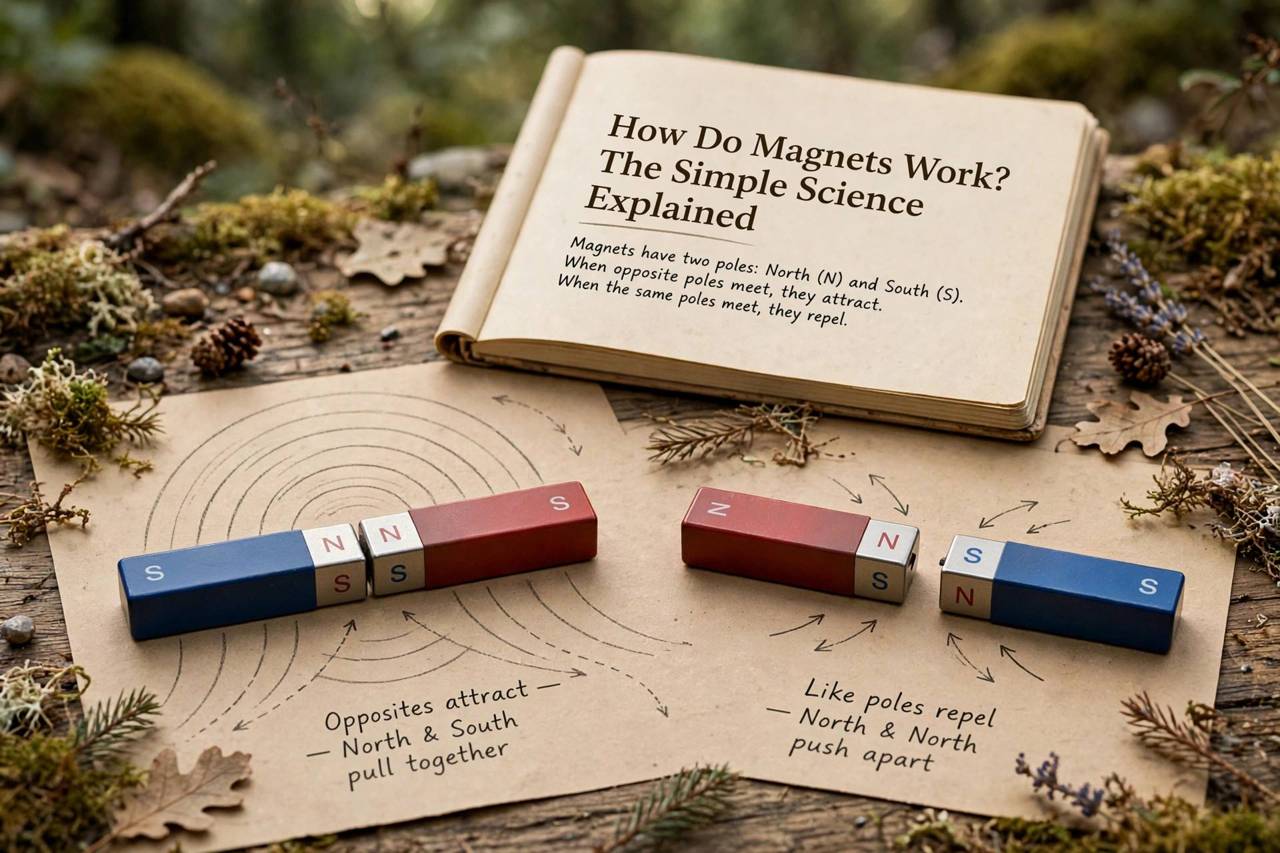
Every magnet has a north pole and a south pole, and you can never separate them. Cut a magnet in half and you don’t get a north piece and a south piece — you get two smaller magnets, each with its own north and south pole. Cut those in half and you get four. This goes all the way down to the atom: every electron is a tiny magnet with two poles.
Opposite poles attract (north pulls south) and like poles repel (north pushes north). This isn’t a rule someone invented — it’s a consequence of how magnetic fields are shaped. The field lines loop out of the north pole, curve around through space, and re-enter at the south pole. When two opposite poles face each other, their fields mesh together smoothly and pull the magnets together. When like poles face each other, the fields clash and push apart.
The Earth itself is a giant magnet with north and south magnetic poles, which is why compasses work. A compass needle is just a tiny magnet, free to rotate, aligning itself with Earth’s field. Navigators have been exploiting this for a thousand years without knowing about electrons or domains.
Magnetism and Electricity: The Deep Connection
Here’s where it gets really interesting. Magnetism and electricity aren’t two separate phenomena — they’re two faces of the same thing, called electromagnetism. Moving electric charges create magnetic fields, and changing magnetic fields create electric currents.
This is why an electromagnet works: run electric current through a coil of wire, and the coil becomes a magnet. Turn off the current, and the magnetism disappears. Electromagnets are everywhere — in junkyard cranes that lift cars, in doorbells, in the relays that switch circuits, in MRI machines that see inside your body.
It works in reverse, too. Move a magnet near a coil of wire, and electric current flows in the wire. This is electromagnetic induction, discovered by Michael Faraday in 1831, and it’s the principle behind nearly all electricity generation on Earth. Spin a magnet inside coils (a generator), and you get current. Power stations — coal, gas, nuclear, hydro, wind — are all just elaborate ways of spinning magnets near coils. The electricity lighting your room right now was almost certainly born from magnetism.
The Different Kinds of Magnets
Not all magnets are the same, and the differences matter for what they’re used in.
Permanent magnets stay magnetic without any power source. The familiar fridge magnet is a permanent magnet, usually made from ferrite (a ceramic material) — cheap and weak. Stronger permanent magnets use rare-earth metals like neodymium. A neodymium magnet the size of a coin can hold up several kilograms. They’re in headphones, hard drives, wind turbines, and electric vehicle motors.
Temporary magnets act magnetic only while inside another magnet’s field. A paperclip stuck to a magnet becomes slightly magnetic itself and can pick up another paperclip — that’s temporary magnetism, and it vanishes when you remove the original magnet.
Electromagnets, as described above, switch on and off with electric current. Their strength can be precisely controlled, which makes them ideal for everything from tiny headphone drivers to massive industrial lifters.
Magnets in Your Daily Life
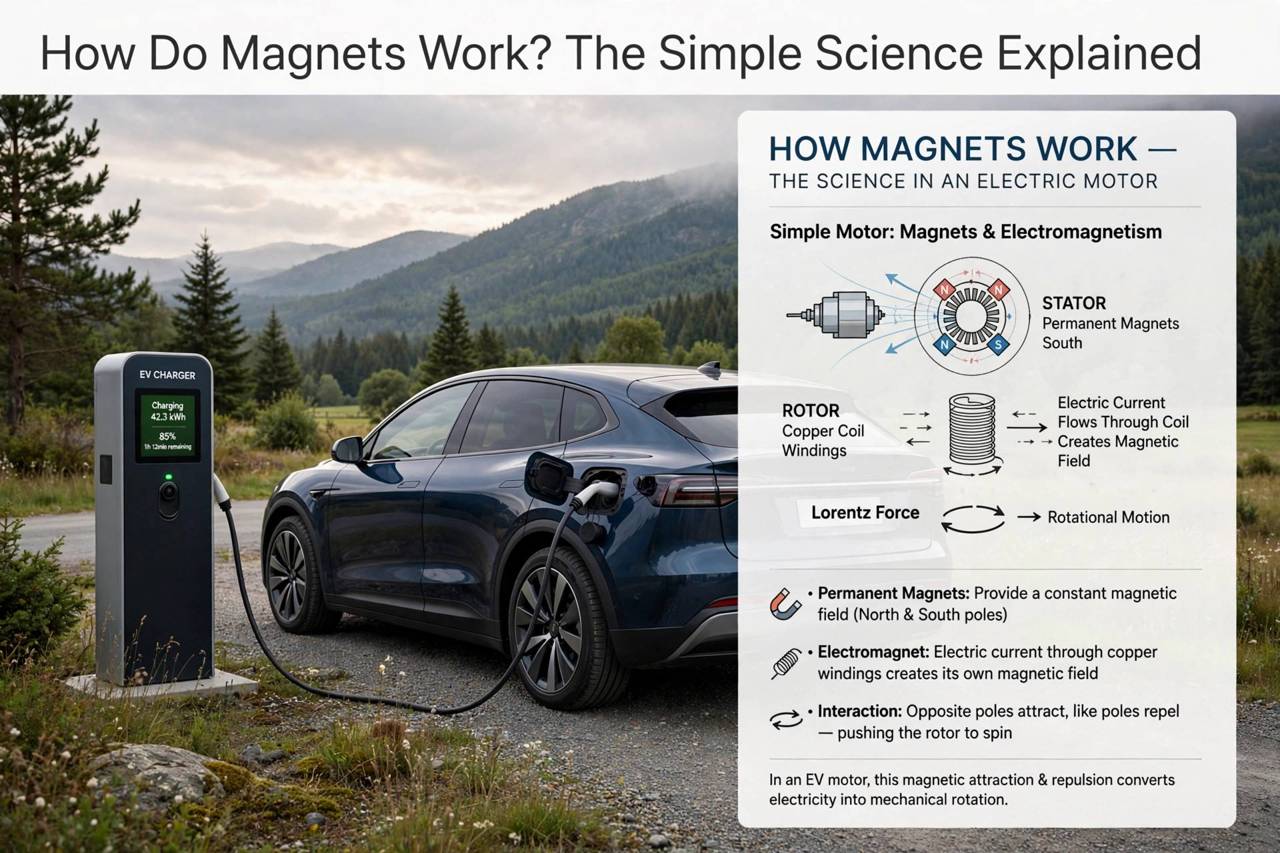
Once you know what to look for, magnets are everywhere. Your phone’s speaker and vibration motor use magnets. Your car’s alternator, starter motor, and (if it’s electric) drive motors are fundamentally magnets and coils. Credit card stripes and hotel key cards store data magnetically. Cabinet latches, shower door seals, magnetic phone mounts, the clasps on bags and jewelry — all magnets.
On the bigger scale, maglev trains float above their tracks on magnetic repulsion, eliminating friction. Particle accelerators steer beams of particles with enormous electromagnets. The compass in your phone does the same ancient trick digitally, using a tiny magnetometer chip to sense Earth’s field. And inside your body, the iron in your blood is very slightly magnetic — not enough to matter, but a fun fact for dinner parties.
The electric vehicle revolution is really a magnet revolution in disguise. EV motors are sophisticated arrangements of permanent magnets and electromagnets converting electrical energy to motion with remarkable efficiency. Our explainer on how electric vehicles work shows what all that magnetism achieves on the road.
Myths About Magnets, Debunked
Magnets attract myths almost as strongly as iron. Let’s clear up the persistent ones.
“Magnets can cure diseases.” Magnetic therapy bracelets and mattress pads are a large industry built on a small idea: that magnets improve blood flow or relieve pain. The scientific evidence for these claims is essentially nonexistent in well-controlled studies. Static magnets from a bracelet are far too weak to meaningfully affect anything inside your body. Save your money — though the placebo effect, to be fair, is real and powerful.
“A strong magnet can wipe your credit cards from across the room.” The magnetic stripe on a card needs a fairly strong, close-range field to be damaged. A fridge magnet brushed against your wallet won’t do it; a powerful neodymium magnet pressed directly on the stripe might. Normal everyday exposure — phones, laptop speakers, magnetic clasps — is not a realistic threat to modern chip cards, which don’t rely on the stripe anyway.
“Magnets will erase your phone or laptop.” This was a real concern decades ago for floppy disks and CRT monitors. Modern phones and laptops use flash storage and solid-state components that are unaffected by ordinary magnets. You’d need an industrial-strength magnet to cause damage — not anything in your home.
“The Earth’s magnetic poles are about to flip and it’ll be a catastrophe.” The poles do reverse every few hundred thousand years, and we’re arguably overdue. But the process takes thousands of years, and the fossil record shows life sailed through previous reversals without mass extinctions. Compass navigation would need recalibration; civilization would not end.
“You can make free energy with magnets.” Perpetual-motion machines using magnets are a perennial internet fixture, and they never work — because they can’t. Magnetic forces are conservative: energy you gain moving toward a magnet, you lose moving away from it. Every “free energy” magnet motor ever demonstrated has had a hidden battery or a measurement error. Physics keeps its books balanced.
Frequently Asked Questions
How do magnets work in simple terms?
Magnets work through an invisible magnetic field that surrounds them. Inside the magnet, the magnetic fields of countless atoms are aligned in the same direction, adding up to a strong overall field. This field pulls on magnetic materials like iron even across empty space.
Why do magnets attract only certain metals?
Only materials with the right atomic structure — mainly iron, nickel, cobalt, and some alloys — respond strongly to magnets. Their atoms have unpaired electrons whose magnetic fields can align with an external field. Most other materials (wood, plastic, aluminum, copper) don’t have this property, so magnets ignore them.
Do magnets ever run out of magnetism?
Permanent magnets weaken very slowly over decades, but heat, physical shock, and strong opposing magnetic fields can demagnetize them faster. Heating iron above about 770°C destroys its magnetism completely by scrambling the aligned atomic domains.
Why can’t you separate a magnet’s north and south poles?
Because magnetism comes from the alignment of atoms, and every atom is itself a tiny two-poled magnet. Cutting a magnet just creates smaller magnets, each with both poles. Magnetic monopoles (a lone north or south pole) have never been observed in nature.
What’s the connection between magnets and electricity?
They’re two aspects of electromagnetism: moving electric charges create magnetic fields, and changing magnetic fields generate electric currents. This relationship powers electric motors, generators, transformers — essentially the entire electrical grid.