

Hi, I’m Sophia. A neighbor once asked me, “Is an electric car just a giant phone with wheels?” Not a terrible summary — but there’s more going on under an EV’s floor than most people realize, and it’s simpler than your smartphone’s tech. Here’s the whole picture, minus the buzzwords.
Table of Contents
- The One-Sentence Version
- The Battery: The Heart of the Whole Thing
- The Electric Motor: Why EVs Feel Instant
- The Inverter and Controller: The Translators
- Regenerative Braking: Your Brakes Charge the Battery
- Charging: Levels, Speeds, and What to Actually Expect
- Range: What Really Determines How Far You Go
- EV vs Gas Car: The Mechanical Differences
- Maintenance: What Changes and What Doesn’t
- Frequently Asked Questions

The One-Sentence Version
An electric vehicle stores electricity in a big battery pack, converts that stored energy into the right kind of electricity with an inverter, and feeds it to an electric motor that turns the wheels. Everything else — the charging, the software, the fancy screens — exists to manage that simple flow of energy. If you only take one idea from this article, take this one: an EV has about 20 moving parts in its drivetrain. A gas car’s drivetrain has over 2,000. That difference explains almost everything about how they drive, how they break, and what they cost to own.
The Battery: The Heart of the Whole Thing
The battery pack is the most expensive, heaviest, and most important part of any electric car. It usually sits flat under the floor between the front and rear wheels, which is why EVs have such a low center of gravity and handle so planted in corners. That flat rectangle is not one giant battery — it is thousands of individual lithium-ion cells grouped into modules, and those modules grouped into the pack.
Think of it like this: each cell is a brick, each module is a wall, and the pack is the house. A typical EV battery holds anywhere from 40 to 100+ kilowatt-hours (kWh) of energy. The kWh is the unit that matters — it is the size of the fuel tank, basically. A bigger kWh number means more stored energy, which generally means more range.
What kind of batteries do EVs use?
Almost every modern EV uses lithium-ion chemistry, usually in one of two flavors:
- NMC (nickel manganese cobalt): Higher energy density, meaning more range per pound. Most long-range EVs use these.
- LFP (lithium iron phosphate): Cheaper, longer-lasting, and you can charge them to 100% regularly without worry. Common in standard-range models.
On battery degradation, the honest answer: yes, batteries degrade, but far slower than your phone’s. EV packs have liquid cooling plus software that babies the cells — real-world data shows roughly 10–15% capacity loss after 200,000 miles.
The 12-volt battery still exists
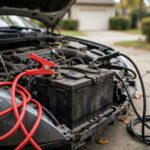
Every EV still has a regular 12-volt battery for lights, infotainment, and door locks. The big traction battery stays “asleep” until needed. So if your EV is dead in the morning, nine times out of ten it is the boring 12-volt battery, not the expensive one.
The Electric Motor: Why EVs Feel Instant
This is the part that hooks people the first time they drive an EV. Press the accelerator and the car just goes — no revving, no waiting for gears to change, no drama. That immediacy is not a party trick; it is physics.
An electric motor produces maximum torque from zero RPM. A gas engine has to spin up to a sweet spot before it makes real pulling power — that is why a gas car downshifts and revs loudly when you floor it. An EV motor has all its torque the instant electricity flows. No hunting, no waiting, no noise.
Most EVs use either a permanent-magnet motor (efficient, great at low speeds) or an induction motor (cheaper, tough). Many dual-motor cars use one of each — the efficient one for cruising, the powerful one when you stomp on it. Single motor means one driven axle; dual motor means all-wheel drive, with no driveshaft running through the cabin because each motor can sit right on its axle.
This is also why EVs are so quiet. There is no combustion, no explosion cycle, no exhaust. What you hear is mostly tire noise and a little motor whine at speed. Some people love the silence. Others find it eerie the first week and then never want to go back.
The Inverter and Controller: The Translators
The battery stores energy as direct current (DC). The motor wants alternating current (AC). Something has to translate, and that something is the inverter — a box of power electronics that converts DC to AC and controls exactly how much power flows, thousands of times per second.
The motor controller is the brain paired with it. When you press the accelerator, you are not mechanically opening anything — you are telling the controller how much torque you want, and it modulates the inverter’s output to deliver exactly that. Lift off the pedal and it cuts power instantly. This electronic precision is why EV traction control and stability systems react faster than gas-car equivalents: the motor can adjust torque in milliseconds, where a gas engine needs time to change its revs.
If you want a relatable comparison, how cruise control works in a gas car is mechanical and slow by comparison — an EV’s controller does the same job with software and electricity, and it is dramatically more precise.
Regenerative Braking: Your Brakes Charge the Battery
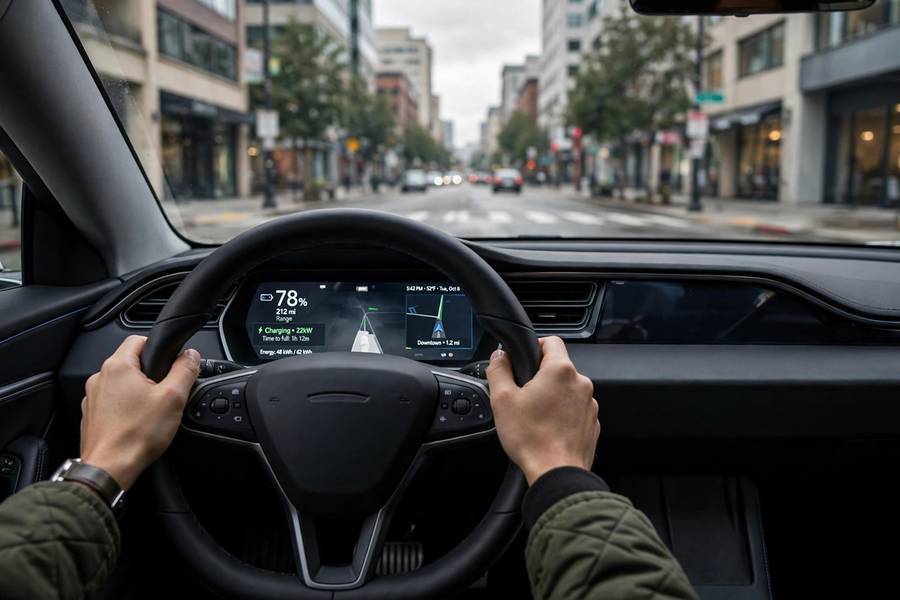
When you lift off the accelerator or press the brake in an EV, the electric motor runs in reverse: instead of consuming electricity to make motion, it uses motion to make electricity — which goes back into the battery.
The effect on driving is called one-pedal driving: lift off to slow down, press to speed up. I was skeptical until I lived with it for a week. Now going back to a gas car feels laggy.
Regenerative braking also means brake pads last far longer — the friction brakes often only engage at low speeds or hard stops. Some EV owners go 100,000 miles on original pads. In stop-and-go city driving, regen recaptures a meaningful chunk of energy that would otherwise become brake heat.
Charging: Levels, Speeds, and What to Actually Expect
Charging is where most of the confusion lives. Here is the real breakdown.
Level 1: The regular wall outlet
Plug into any standard 120V household outlet and you get about 3-5 miles of range per hour. Slow, but if you drive 30 miles a day and the car sits overnight, the math works.
Level 2: The 240V setup
A dryer-style outlet or dedicated wall charger gives 20-40 miles of range per hour — most EVs fill overnight. If you own your home, this is the one upgrade worth making.
DC fast charging: The road-trip saver
These are the big stations along highways, adding 100-200+ miles in 20-30 minutes. The part nobody tells you clearly: charging is not linear. EVs charge fastest from 10% to 80%, then slow dramatically for the last 20% to protect the battery. Road-trip pros charge from ~15% to ~80% and keep moving — that is the fast window.
The connector situation
North America is settling on the NACS connector (Tesla’s design, now the standard for almost every brand). If you are shopping now, just check that the car supports NACS or comes with an adapter — do not overthink it.
Range: What Really Determines How Far You Go
The range number on the sticker is a lab-tested estimate. What moves it in real life:
- Speed: Aerodynamic drag is the biggest enemy. Cruising at 80 mph drains noticeably more than 65 mph — the single biggest factor on highway trips.
- Temperature: Cold weather is the famous range killer. Expect 20-40% less range in freezing weather; the battery is less efficient and the cabin heater is an energy hog. Heat pumps help a lot.
- Driving style: Aggressive acceleration and hard braking (instead of regen) cost range. Smooth inputs pay off.
- Cargo and tires: A loaded car and inefficient tires add up.
My rule of thumb for buyers: figure out your real daily mileage, add a comfort buffer, and pick a car whose EPA range covers that with room to spare. If you drive 40 miles a day, you do not need 400 miles of range. You need 200 and a home charger.
EV vs Gas Car: The Mechanical Differences
Put the two side by side and the contrast is stark:
| Gas car | Electric car | |
|---|---|---|
| Energy storage | Fuel tank | Battery pack |
| Power source | Engine (~2,000 moving parts) | Motor (~20 moving parts) |
| Transmission | Multi-gear, needs shifting | Single-speed reduction gear |
| Emissions at tailpipe | Yes | None |
| “Refueling” | 5 minutes at a gas station | Hours at home, ~30 min on road trips |
| Oil changes | Yes | No |
| Brake wear | Normal | Much lower (regen) |
The connectivity angle is worth a mention too. Modern EVs are rolling computers with over-the-air updates — the car can gain features and fix bugs overnight, like your phone. The wireless systems that make that possible rely on the same principles as how WiFi works, just applied to a car instead of a house.
Maintenance: What Changes and What Doesn’t
Less maintenance is one of the real, verified advantages — not marketing fluff. Gone: oil changes, spark plugs, timing belts, transmission fluid, exhaust repairs, fuel filters. Still here: tires (EVs are heavy and torquey, so they wear a bit faster — budget accordingly and buy EV-rated tires), cabin air filters, wiper fluid, and eventual brake fluid flushes.
And since software is such a big part of the EV experience, it helps to know these systems are continuously refined from real-world data — similar to how AI models are trained — with updates pushed to your car.

Frequently Asked Questions
An EV stores electricity in a large battery pack under the floor. An inverter converts that stored DC power into AC power, which feeds an electric motor that turns the wheels. Pressing the accelerator tells the motor controller how much power to send — instantly, with no gears and no combustion.
Real-world data shows most EV batteries retain about 85-90% of their original capacity after 200,000 miles. Thermal management and software safeguards mean degradation is gradual, not sudden, and most manufacturers warranty the battery for 8 years or 100,000 miles.
At home on a 240V charger, most EVs fill overnight (6-10 hours). On a DC fast charger, you can typically go from 10% to 80% in 20-30 minutes — that’s the fast window. Charging slows significantly above 80% to protect the battery.
Yes, but expect 20-40% less range in freezing temperatures. The battery is less efficient in the cold and the cabin heater uses significant energy. Cars with heat pumps perform noticeably better, and pre-conditioning the battery while still plugged in helps a lot.
Regenerative braking runs the electric motor in reverse when you slow down, converting the car’s motion back into electricity that recharges the battery. It enables one-pedal driving, recovers range in stop-and-go traffic, and dramatically reduces brake pad wear.
Generally yes. EVs have no oil changes, spark plugs, timing belts, or transmission service. Brake pads last far longer thanks to regenerative braking. The main ongoing costs are tires (which wear somewhat faster on heavy, torquey EVs) and eventually the cabin air filter and wiper fluid — routine stuff.