Why Do We Have Leap Years? The Story Behind Feb 29

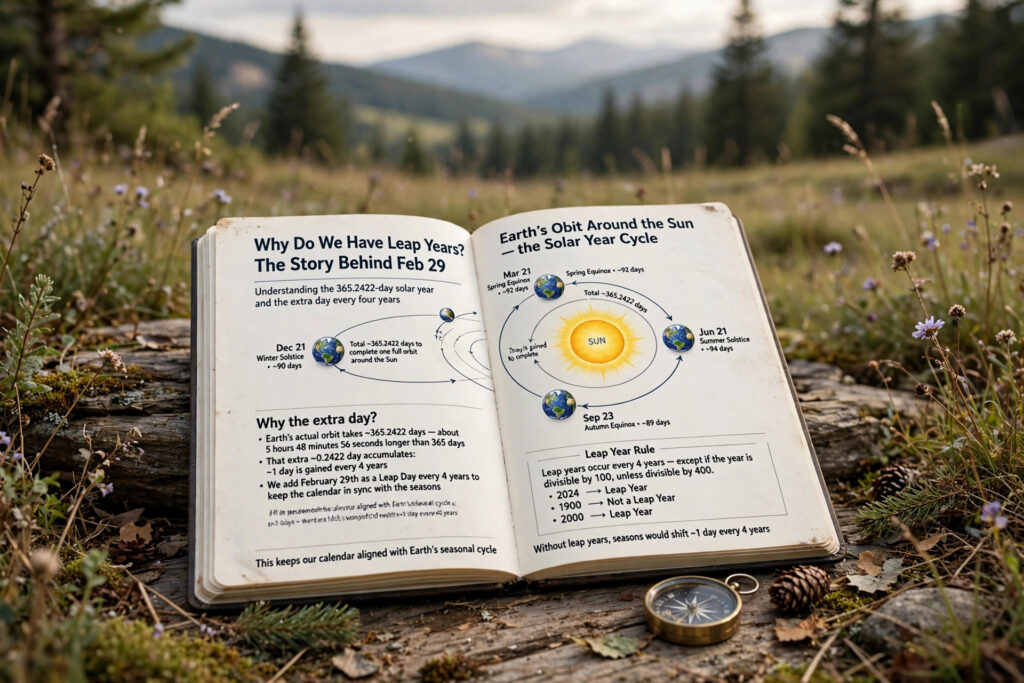
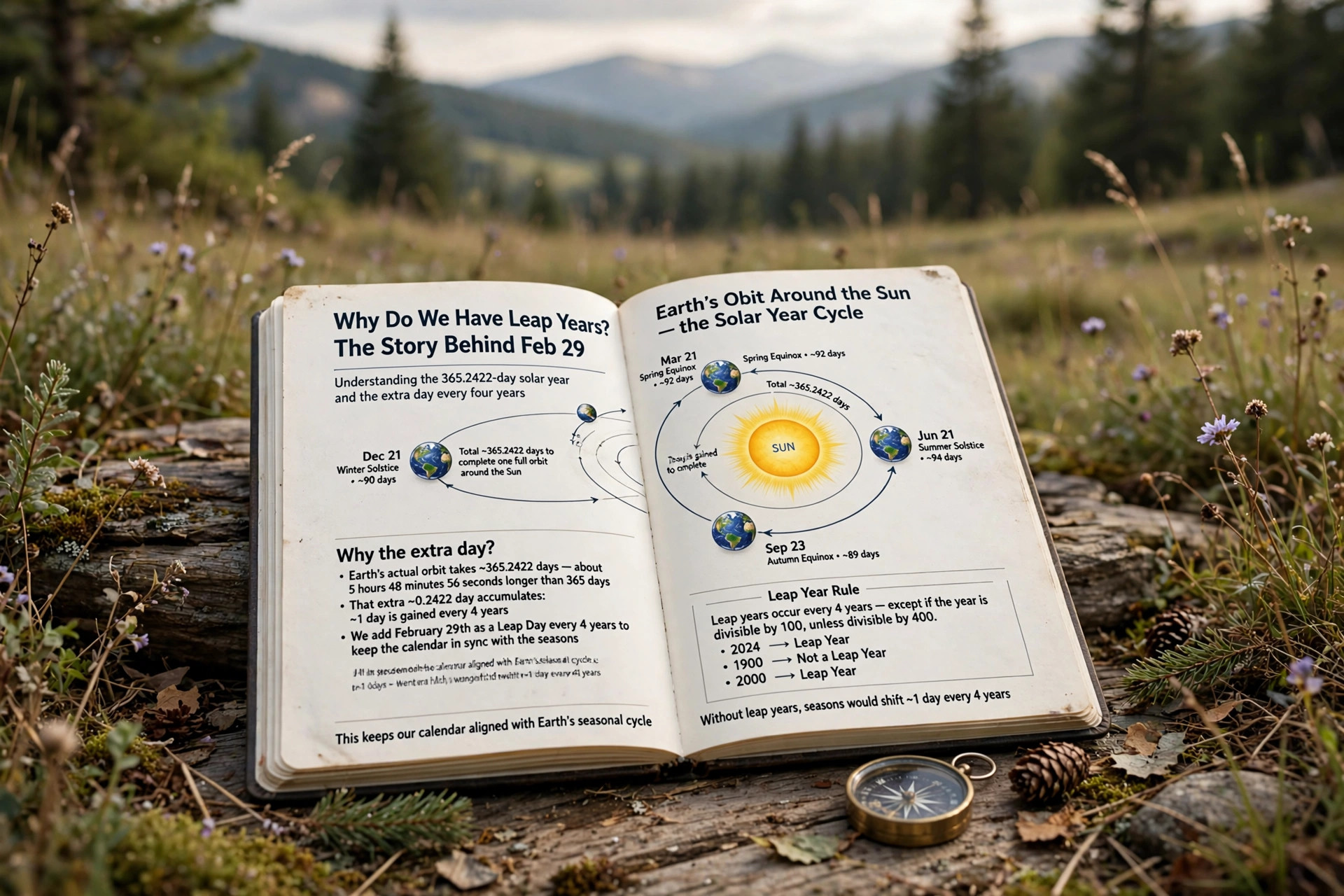
Why do we have leap years? Because a year is not actually 365 days long. Earth takes about 365 and a quarter days to complete one orbit around the sun, and that leftover quarter-day is the whole reason February occasionally grows a 29th day. Without leap years, our calendar would drift out of sync with the seasons, and after a few centuries we would be celebrating Christmas in the middle of summer. The fix is beautifully simple: save up the leftover fractions for four years, then add one full day. Here is how that elegant hack works, and the 2,000-year story behind it.
The mismatch is small but relentless. Every year, the calendar falls about six hours behind the sun. After four years, that is a full day. After a century, it is nearly 24 days. Calendars are promises that January means winter and July means summer, and leap years are how we keep that promise.
The Quarter-Day Problem
A solar year, one full trip of Earth around the sun, lasts approximately 365.2422 days. We cannot have a calendar with fractional days; you cannot schedule a meeting for 0.2422 of a day. So every calendar in history has faced the same choice: round down to 365 and let the seasons slide, or invent a correction. Rounding down is what the earliest calendars did, and the sliding was dramatic: within a human lifetime, harvest festivals would migrate across months.
The leap year is the correction we settled on. Add one day every four years, and the average calendar year becomes 365.25 days, astonishingly close to the true 365.2422. The remaining error is tiny: about 11 minutes per year. But tiny errors accumulate too, which is why the story doesn’t end there.
Julius Caesar’s Fix: The Julian Calendar
In 45 BCE, Julius Caesar reformed the Roman calendar on the advice of the astronomer Sosigenes, creating the Julian calendar: 365 days, with an extra day every fourth year. It was a vast improvement over the chaos it replaced; the old Roman calendar had drifted so badly that priests were inserting extra months by political whim. Caesar’s reform even required a one-time correction year of 445 days, the longest year in recorded history, to reset the seasons. Romans called it the Year of Confusion, which feels about right.
The Julian calendar’s leap-every-four-years rule held for over 1,600 years. But that 11-minute annual error kept ticking. By the 1500s, the calendar had drifted about ten days ahead of the sun, and the spring equinox, which determines the date of Easter, was landing on March 11 instead of March 21. The Catholic Church, which cared deeply about Easter’s date, decided something had to be done.

The Gregorian Upgrade: The 400-Year Rule
In 1582, Pope Gregory XIII introduced the Gregorian calendar, the one we use today, with a clever refinement. The rule most people know, every fourth year is a leap year, stayed. But century years got special treatment: a century year is a leap year only if it is divisible by 400. So 2000 was a leap year, but 1900 was not, and 2100 will not be.
That single exception trims the average calendar year to 365.2425 days, missing the true solar year by only about 26 seconds per year. At that rate, it will take over 3,000 years for the calendar to drift by a single day. It is one of humanity’s most successful pieces of engineering, hiding inside something we all take for granted.
The switchover itself was dramatic: to fix the accumulated ten-day drift, October 4, 1582 was followed directly by October 15, 1582. Ten days simply never happened in Catholic countries. Protestant and Orthodox countries adopted the new calendar over the following centuries, with some holding out until the 1900s, which is why historical dates from that era sometimes carry confusing double labels.
Who Gets Born on February 29?
About one person in 1,461 is born on a leap day, which makes leap-day babies, leaplings, genuinely rare. Legally, there is no mystery: in most places, a person born on February 29 turns a year older on February 28 or March 1 in non-leap years, depending on local law. Culturally, though, leaplings get the best party trick in existence: celebrating a 30th birthday at age seven and a half, in leap years.
The town of Anthony, Texas, has embraced this oddity fully, declaring itself the Leap Year Capital of the World and hosting a festival every leap year for leap-day babies. It is exactly the kind of delightful, pointless tradition that makes you fond of humanity.
Leap Day Traditions Around the World
February 29 has collected folklore the way old attics collect boxes. In Ireland and Britain, tradition holds that women may propose marriage on leap day, a custom sometimes traced to a deal supposedly struck between St. Bridget and St. Patrick. In Greece, getting married in a leap year is considered unlucky, and many couples avoid it. In Taiwan, leap years are thought to bring bad luck to the elderly, and some families observe customs meant to protect aging parents.
None of this has any astronomical basis, of course. But it is a reminder that calendars are not just math; they are stories we agree to tell together, and leap day is where the story gets a bonus chapter.

What Would Happen Without Leap Years?
Without any correction, the calendar would lose about 24 days per century against the seasons. After 100 years, the spring equinox would arrive in mid-April by calendar reckoning. After 400 years, summer would start in what the calendar calls November. After about 700 years, the seasons would be fully inverted: January in the northern hemisphere would be midsummer. Agriculture, school terms, holidays, everything tied to the seasons would detach from the calendar entirely. Leap years are a small price for keeping the year honest.
Why Do We Have Leap Years Instead of a Cleaner Fix?
It is a fair question: if the problem is a quarter-day mismatch, why not just make every year 365.25 days long and be done with it? Because calendars serve humans, not astronomers. A calendar with fractional days would mean midnight drifting by six hours every year; within a week, noon would fall at midnight. The leap day bundles the awkward fraction into a single, predictable, even festive correction. Alternatives have been proposed, including a fixed 364-day calendar with a bonus week, but none survived contact with reality: the cost of switching the entire world to a new system dwarfs the tiny inelegance of February 29.
There is also a smaller cousin worth knowing: the leap second. Earth’s rotation is irregular, so timekeepers occasionally add a second to keep atomic clocks aligned with the planet. It is the same idea at a different scale, tiny corrections to keep human time honest against astronomical time.
Leap Years in Other Calendars
The Gregorian calendar is not the only system wrestling with this. The Hebrew calendar, a lunisolar system, adds an entire leap month seven times in every 19-year cycle to keep lunar months aligned with solar seasons; without it, Passover would drift through the year. The Islamic calendar skips the correction entirely, letting its twelve lunar months cycle through the seasons over 33 years, which is why Ramadan moves through the calendar. The Chinese calendar adds leap months based on precise solar terms. Every civilization hit the same astronomical wall and invented its own elegant hack. Ours just happens to be a single day in February.
Leap Day by the Numbers
A few figures to bring to your next trivia night. Leap years occur 97 times every 400 years under Gregorian rules. The odds of being born on February 29 are about 1 in 1,461. The longest gap anyone has waited between birthdays is four years, and the record for leap-day babies in one family, three children all born on February 29, in different leap years, belongs to a family that beat odds so astronomical they barely bear calculating. And the next leap years after 2028: 2032, 2036, 2040, each four years apart, until the calendar skips 2100 and the pattern hiccups for the first time in a century.
Do We Still Need Leap Years?
With atomic clocks and computers handling the math, could we just let the calendar drift and correct it digitally? In theory, yes; in practice, no. The calendar is a social contract, and its value lies in everyone agreeing what day it is. A drift of 24 days per century would eventually detach months from seasons so thoroughly that the words January and July would lose their meaning. Proposals for calendar reform surface every few decades and die quietly, because the switching cost, every database, contract, and cultural habit on Earth, vastly exceeds the minor oddity of February 29. The leap year is a small, charming tax we pay for a calendar that works.
Why February Got the Extra Day
Ever wonder why the leap day lands in February instead of a more sensible month? Blame the Romans. In the early Roman calendar, February was the last month of the year, the short leftover month where adjustments happened. When the calendar was reformed, February kept its role as the adjustment month even after January and February were moved to the year’s start. So the extra day goes to February for the same reason most traditions exist: because it always has.
Frequently Asked Questions
Why do we have leap years every 4 years?
Because Earth takes about 365.25 days to orbit the sun. The extra quarter-day accumulates to one full day every four years, so we add February 29 to keep the calendar aligned with the seasons.
Why isn’t every century year a leap year?
Because the solar year is slightly less than 365.25 days (about 365.2422). Skipping leap years on century years not divisible by 400, like 1900 and 2100, corrects for that small overcount and keeps the calendar accurate for millennia.
Was 2000 a leap year?
Yes. Century years divisible by 400 are leap years, so 2000 qualified. The year 1900 did not, and 2100 will not.
How often do leap years occur?
Almost every four years: 2024, 2028, 2032, and so on. The next leap year after 2028 is 2032, since 2100 is far off and every intervening fourth year qualifies.
What happens if you are born on February 29?
Nothing unusual legally; you age normally and celebrate on February 28 or March 1 in non-leap years. You just get to enjoy the novelty of a birthday that only appears on the calendar every four years.