What Is the Difference Between a Treaty and an Executive Agreement?

Anyone following international news has seen both terms — a president signs an “executive agreement” here, the Senate ratifies a “treaty” there — and wondered what is the difference between a treaty and an executive agreement. Both are ways the United States makes binding deals with other countries, but they take different paths through the government, carry different political weight, and are used for different kinds of commitments. The distinction matters because it determines who gets a say: the president alone, or the president plus two-thirds of the Senate. Here’s a clear explanation of each, how they differ, and why presidents increasingly prefer one over the other.
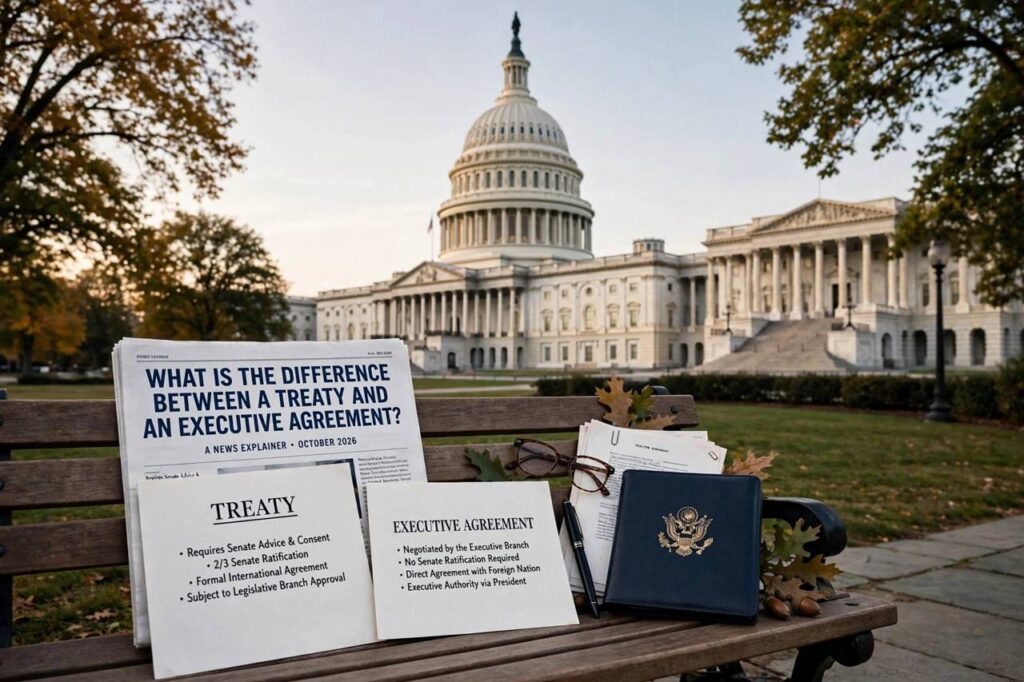
The short version: a treaty is an international agreement made with the advice and consent of the Senate (a two-thirds vote), as described in the Constitution. An executive agreement is an international agreement made by the president without submitting it to the Senate — based either on the president’s own constitutional authority or on authority Congress already granted. Both are binding under international law. The fight, such as it is, is about domestic process and democratic legitimacy.
What Is a Treaty?
Article II of the U.S. Constitution gives the president power “by and with the Advice and Consent of the Senate, to make Treaties, provided two thirds of the Senators present concur.” In practice: the president (through diplomats) negotiates the agreement, signs it, then sends it to the Senate. The Senate Foreign Relations Committee holds hearings, the full Senate debates, and if two-thirds of senators present vote yes, the treaty is ratified and becomes, in the Constitution’s words, part of the “supreme Law of the Land.”
That two-thirds bar is deliberately high — the founders wanted major international commitments to have broad support, not bare-majority support. Famous examples include the Treaty of Paris ending the Revolutionary War, the NATO treaty, and nuclear arms agreements. But the high bar is also why treaties have become rare: getting 67 senators to agree on anything significant is genuinely difficult, so presidents look for alternatives.
What Is an Executive Agreement?
An executive agreement is any international agreement the president makes without the Senate’s two-thirds approval. There are three main flavors. Sole executive agreements rest on the president’s own constitutional powers — as commander in chief and chief diplomat — and typically cover matters squarely within presidential authority, like recognizing foreign governments or settling claims. Congressional-executive agreements rest on authority Congress granted in advance through legislation (very common in trade). And agreements pursuant to an existing treaty implement details of a treaty the Senate already approved.
The key point: executive agreements aren’t some modern workaround invented to dodge the Senate. They’ve been used since the earliest days of the republic, and today they vastly outnumber treaties — by some counts, over 90 percent of U.S. international agreements take this form. They’re the normal way most international business gets done.
What Is the Difference Between a Treaty and an Executive Agreement?
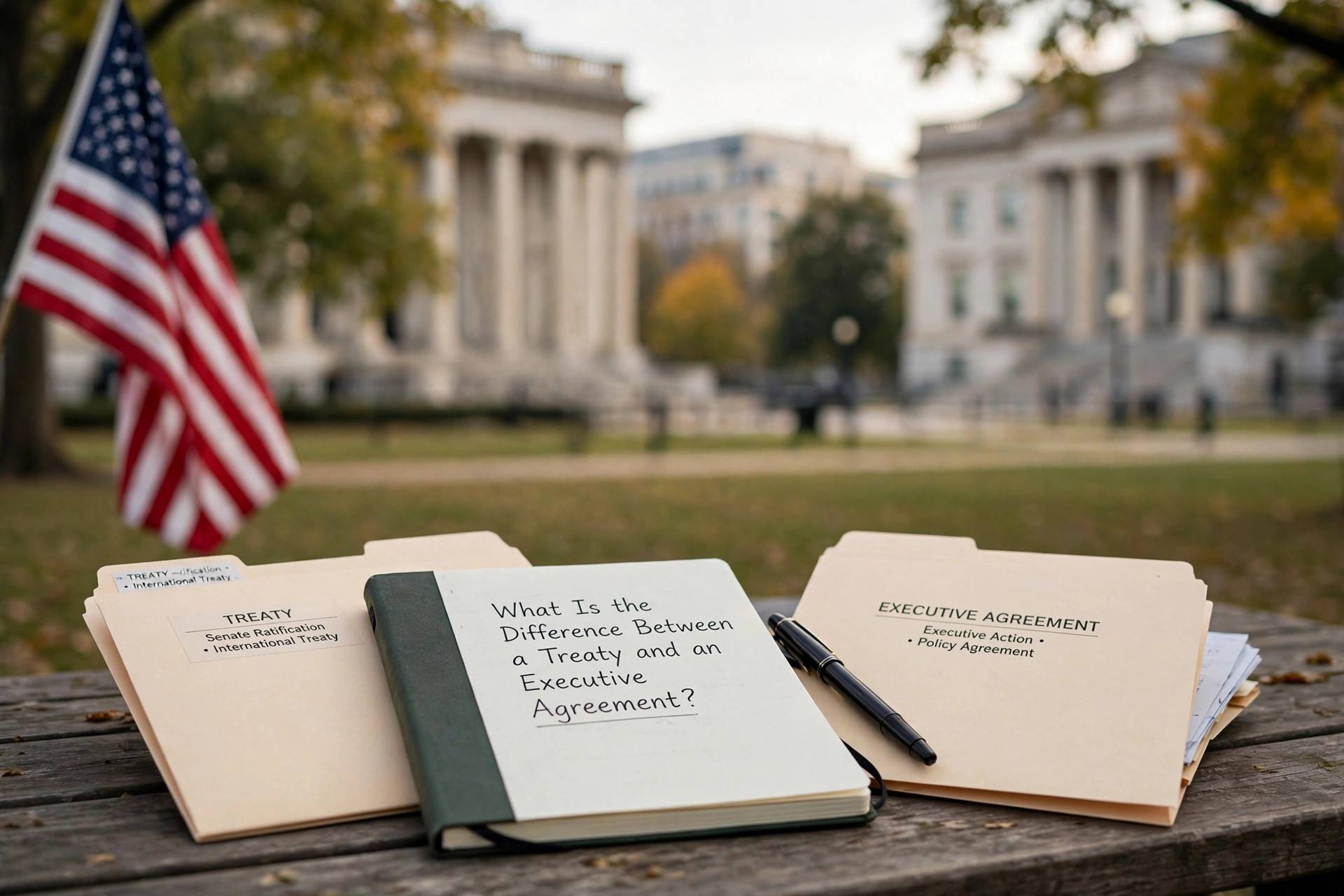
The core differences come down to process, durability, and scope. Process: treaties require Senate supermajority approval; executive agreements don’t (though congressional-executive agreements need Congress’s prior authorization, passed like normal legislation). Durability: treaties are harder to undo — a future president can withdraw, but the political and legal friction is higher. Executive agreements, especially sole executive agreements, can generally be reversed by the next president with a pen stroke, which is why major policies sometimes whiplash between administrations.
Scope: in theory, the most solemn commitments — alliances, territorial changes, major arms control — go the treaty route, while routine, administrative, or time-sensitive matters go by executive agreement. In practice, the line has blurred considerably, and presidents of both parties have used executive agreements for significant commitments. Legal status: under international law, both bind the United States equally — other countries don’t distinguish. Domestically, both can have the force of law, though the exact hierarchy in conflicts with federal statutes gets complicated and is genuinely debated by scholars.
Why Do Presidents Prefer Executive Agreements?
Simple arithmetic. Rounding up 67 Senate votes for a controversial agreement is often impossible, while an executive agreement needs no Senate vote at all. When the choice is between an executive agreement and no agreement, presidents choose the agreement — and Congress, which could push back by legislating, often doesn’t, because the agreement is popular or because fighting it costs political capital.
This has created a long-running tension. Senators periodically complain that the treaty clause is being hollowed out; presidents reply that the modern world moves too fast for 18th-century procedures. Both have a point. The trend is decades old and bipartisan — it’s structural, not personal to any one president. Reforms get proposed (like requiring congressional approval for major executive agreements), but the underlying incentive — speed and certainty versus deliberation — doesn’t go away.
Can Congress or Courts Check Executive Agreements?
Yes, in principle. Congress can pass legislation overriding or constraining an executive agreement’s domestic effects (subject to presidential veto, which creates its own standoff). It controls the funding that many agreements depend on — an agreement without appropriations is often an agreement without teeth. And it can simply refuse to grant the advance authority that congressional-executive agreements rely on.
Courts generally stay out of the political fight over which instrument a president chose, treating it as a question for the political branches. But courts do interpret what agreements mean once made, and they’ll enforce the domestic legal effects. The practical check, most of the time, is political rather than legal: the next election, congressional pressure, and the judgment of other countries about whether America’s word will outlast its president.

How Other Countries Handle This
The U.S. system is unusual in giving a legislative supermajority this much direct power over international agreements. In parliamentary systems like the UK, the executive (the prime minister and cabinet) generally makes treaties with Parliament playing a much smaller formal role — though Parliament must pass any domestic laws needed to implement them. France’s president negotiates and ratifies with varying parliamentary involvement depending on the treaty’s subject. The American insistence on Senate supermajorities reflects the founders’ specific fear of concentrated power — and it produces the specific American pattern of treaty gridlock plus executive-agreement workarounds.
This comparative angle matters for understanding news coverage: when commentators say an agreement “isn’t really binding” because it wasn’t a treaty, they’re usually making a domestic-politics point, not an international-law point. The other signatories consider it binding. The question is always about American follow-through, not about whether the deal counts.
Famous Examples From History
A few landmarks make the abstract concrete. The Treaty of Paris (1783), which ended the Revolutionary War, went through the full Senate process the founders envisioned. NATO’s founding treaty committed the U.S. to collective defense — the kind of solemn, long-term promise the treaty route was designed for. On the executive-agreement side, the 1940 Destroyers-for-Bases deal (trading old U.S. destroyers for British base rights) was done by executive agreement and was hugely consequential — arguably as significant as many treaties.
More recently, the Paris Climate Agreement was structured as an executive agreement, which is precisely why one administration could join, the next could withdraw, and the following one could rejoin — the whiplash pattern that critics of the executive-agreement trend point to. The Iran nuclear deal (JCPOA) followed a similar path. Whether you see that flexibility as a feature or a bug probably depends on which reversals you agreed with — but the structural point stands: the instrument shapes the durability.
The Debate Over the Treaty Clause Today
Legal scholars have argued for decades about whether the shift toward executive agreements has effectively amended the Constitution without saying so. Defenders of the practice note that Congress participates heavily — authorizing agreements in advance, funding them, and retaining the power to override — so democratic input exists, just not in the founders’ exact form. Critics reply that a congressional majority’s acquiescence isn’t the same as the supermajority deliberation the treaty clause demands, especially for commitments meant to last generations.
Reform proposals surface regularly: requiring congressional approval for “significant” executive agreements, sunsetting sole executive agreements after a set period, or creating a fast-track approval process modeled on trade legislation. None has passed, because the underlying politics cut both ways — today’s majority likes executive freedom when its president wields it and fears it when the other party does. Until that changes, expect the pattern to continue: treaties for the truly uncontroversial, executive agreements for everything else.
Frequently Asked Questions
What is the difference between a treaty and an executive agreement?
A treaty requires the approval of two-thirds of the Senate under the Constitution’s treaty clause; an executive agreement is made by the president without Senate supermajority approval, based on presidential authority or prior congressional authorization. Both are binding under international law, but treaties are politically harder to reverse.
Is an executive agreement legally binding?
Yes — under international law, executive agreements bind the United States just as treaties do. Domestically, their legal force depends on their basis (presidential authority, congressional authorization, or an existing treaty), but they are genuine legal commitments, not informal handshakes.
Why doesn’t the president just use treaties for everything?
The Senate’s two-thirds requirement makes treaties very difficult to ratify on anything controversial. Executive agreements let the government act quickly and with certainty, which is why over 90 percent of U.S. international agreements now take that form.
Can a new president cancel an executive agreement?
Generally yes, especially sole executive agreements — a new president can typically withdraw with the same ease the agreement was made. This is a key difference from treaties, which carry more political and legal friction to exit, and it explains why some policies reverse when administrations change.
Does Congress have any say over executive agreements?
Congress authorizes many of them in advance (congressional-executive agreements), controls the funding agreements depend on, and can pass legislation affecting their domestic implementation. But Congress has no formal vote on sole executive agreements the way the Senate does on treaties.
Do other countries distinguish between U.S. treaties and executive agreements?
No — under international law, both are binding commitments of the United States. Foreign governments may privately weigh how durable an agreement is likely to be (treaties signal broader domestic support), but legally, America’s word is America’s word either way.