What Is a Referendum? Meaning, Types & Examples

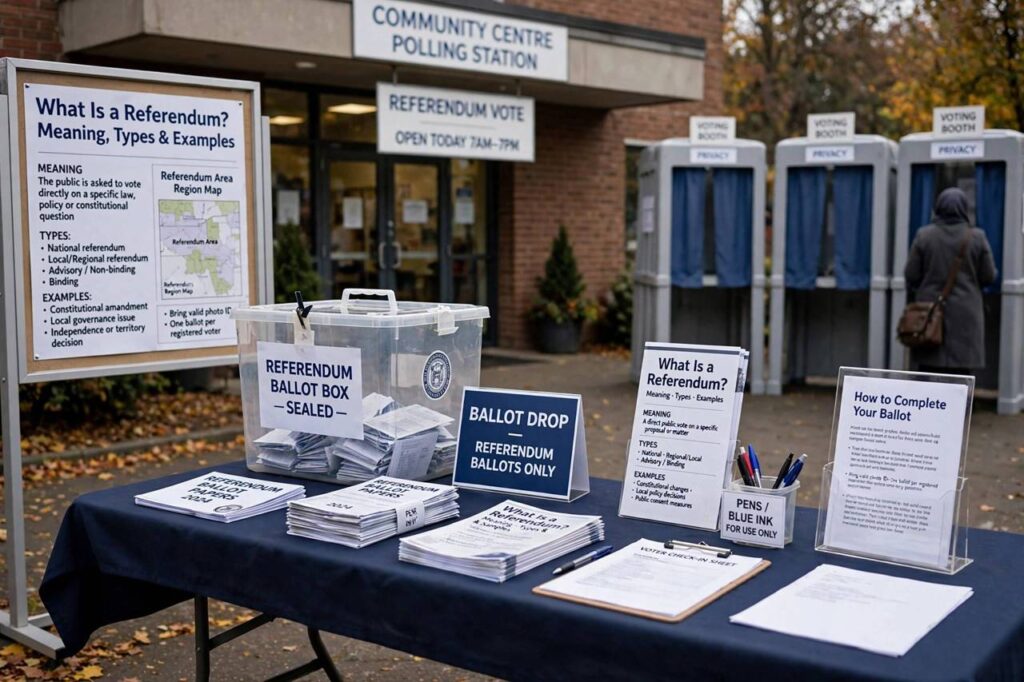
Every few years, somewhere in the world, voters are asked to decide a single question directly — independence, a constitutional change, membership in a union — and the result reshapes a country’s future overnight. What is a referendum exactly, and how is it different from a regular election? At its simplest, a referendum is a direct vote by the electorate on a specific proposal or question, rather than a vote to choose representatives. This guide explains how they work, the main types, and why they remain one of the most debated tools in democratic politics.
Referendum vs. Election: The Key Difference
In an election, you choose people — representatives, presidents, parliamentarians — who then make decisions on your behalf. In a referendum, you decide the issue itself. The question is put to you directly: “Should the country do X?” and your vote, aggregated with millions of others, answers it.
This distinction matters because the two tools do different jobs. Elections bundle thousands of issues into a choice of candidate; referendums isolate one question for a yes-or-no verdict. Supporters argue this gives the decision special legitimacy — the people spoke directly. Critics argue that complex issues rarely reduce to yes-or-no without losing essential nuance.
The Main Types of Referendums
Mandatory (obligatory) referendums. Some constitutions require certain decisions — often constitutional amendments — to be approved by referendum. The government has no choice; the vote must happen. Switzerland and Ireland use this model extensively.
Optional (facultative) referendums. Citizens can force a vote on a law passed by parliament by collecting enough signatures. This is a check on legislative power — if enough voters object to a new law, they can demand the final say.
Government-initiated referendums. A government chooses to put a question to voters, often on major issues like constitutional reform, territorial changes, or international treaties. These are the most politically charged, because the government calling the vote usually has a preferred outcome.
Advisory vs. binding. A binding referendum’s result has legal force — the government must implement it. An advisory (consultative) referendum formally only advises, though in practice governments almost always follow the result, since ignoring a direct vote carries enormous political cost.
How a Referendum Works in Practice
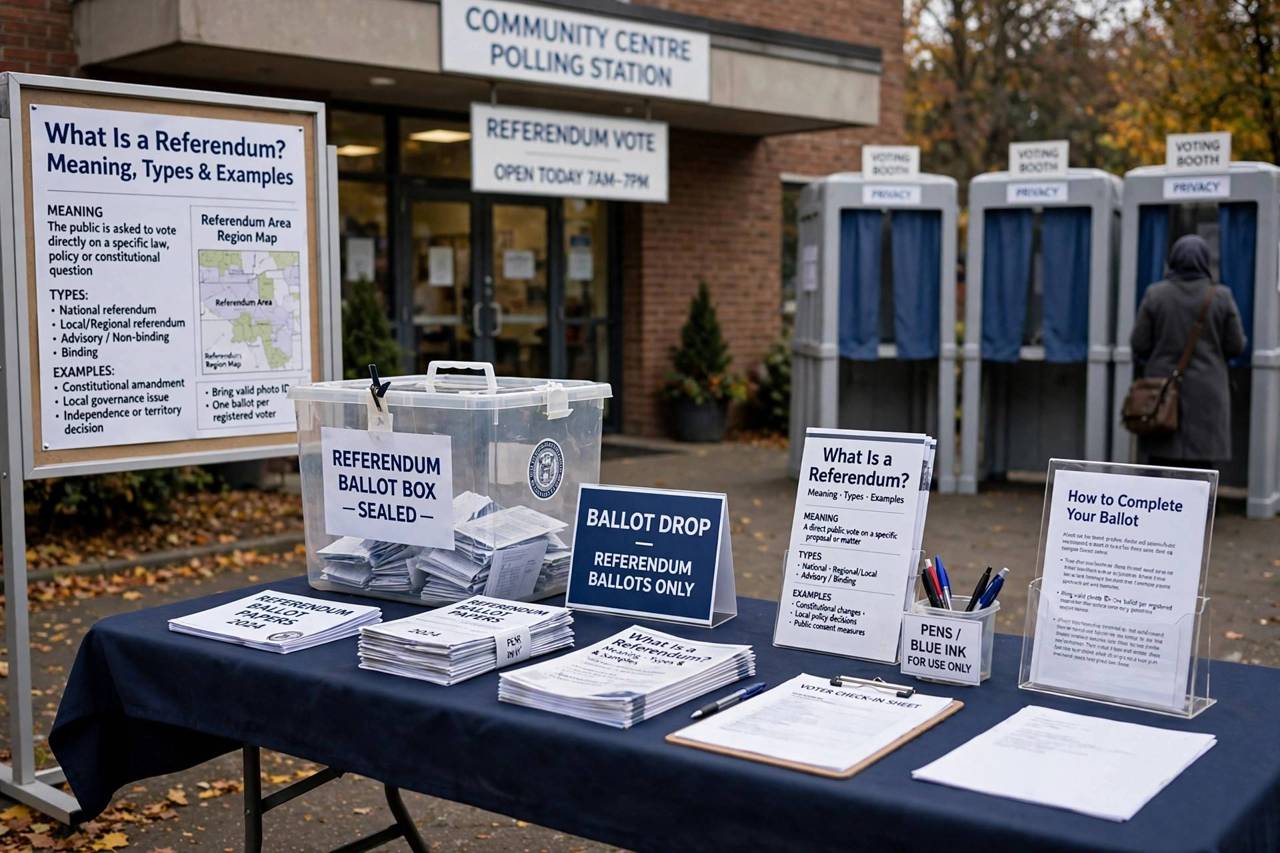
The mechanics resemble an election: a question is formulated (the exact wording is often contested, since phrasing shapes outcomes), a campaign period follows with official campaigns on each side, and voters cast ballots at polling stations or by mail. Turnout thresholds sometimes apply — some jurisdictions require a minimum percentage of eligible voters to participate for the result to count.
The campaign phase is where referendums get complicated. Unlike candidate elections, where parties have established platforms, referendum campaigns are often run by temporary cross-party coalitions. Voters must evaluate a single complex proposal, frequently involving economics, law, and international relations — and studies of referendum behavior consistently show that many voters decide based on broader feelings about the government or the status quo rather than the proposal’s details.
Famous Examples
Brexit (UK, 2016). The United Kingdom voted 52% to 48% to leave the European Union — a government-initiated, advisory-but-treated-as-binding referendum whose implementation dominated British politics for years afterward. It remains the most studied modern example of how a simple question can produce extraordinarily complex consequences.
Scottish independence (2014). Scotland voted 55% to 45% to remain in the United Kingdom. The losing side’s continued campaigning afterward illustrates another referendum pattern: a “decisive” vote rarely settles the underlying question permanently.
Swiss referendums. Switzerland holds multiple referendums per year on everything from infrastructure to social policy, making it the world’s most practiced direct democracy. The Swiss experience suggests referendums work best as a routine habit rather than a rare dramatic event.
Same-sex marriage (Ireland, 2015; Australia, 2017). Both countries used nationwide votes to decide marriage equality — Ireland’s binding constitutional referendum and Australia’s advisory postal survey — showing how referendums can be used to resolve socially significant questions with direct democratic legitimacy.
The Debate: Are Referendums Good Democracy?
The arguments on both sides are well-established and worth understanding neutrally.
The case for: direct legitimacy — some decisions are too fundamental to delegate; a check on unresponsive governments; and increased civic engagement, since single-issue votes draw attention to questions elections bury.
The case against: complexity reduction — voters decide multifaceted issues on limited information; vulnerability to emotional campaigning and misinformation; the “tyranny of the majority” risk for minority rights; and implementation problems, since a yes-or-no vote does not specify how to do the thing.
Most political scientists land in the middle: referendums are a legitimate democratic tool that works best with clear questions, honest campaigns, and legal frameworks that specify what happens after each outcome. The tool is not the problem; the design around it usually is.
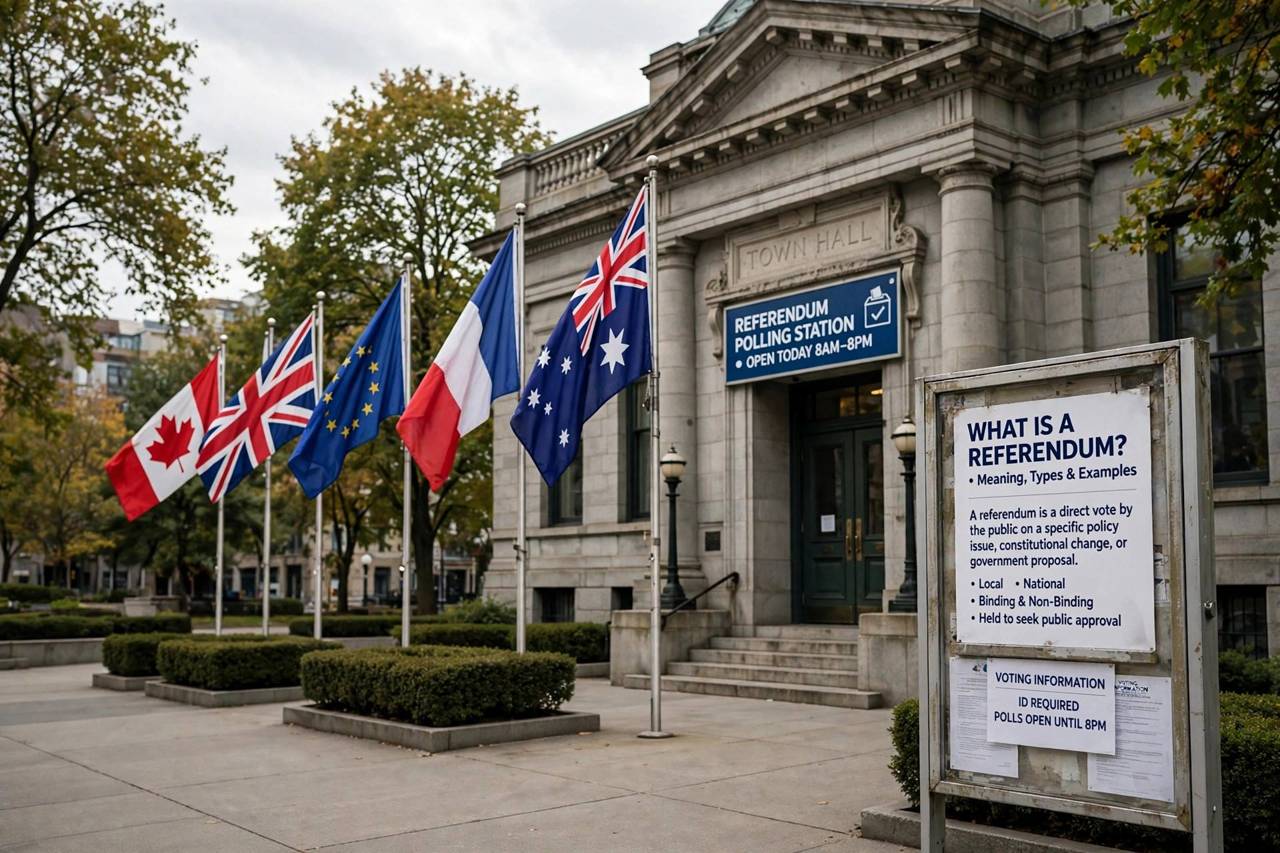
What Is a Referendum: Key Points
Definition: a direct vote by the electorate on a specific proposal, rather than a vote for representatives. Types: mandatory (constitutionally required), optional (citizen-triggered by petition), and government-initiated; results may be binding or advisory. How it works: a question is formulated, campaigns run on each side, voters cast ballots, and the outcome is implemented — with turnout thresholds applying in some jurisdictions. The debate: supporters cite direct democratic legitimacy; critics cite oversimplification of complex issues and vulnerability to emotional campaigning. Most practiced user: Switzerland, with multiple referendums per year.
Referendums in the United States
The US has no national referendum mechanism — there is no federal provision for a countrywide popular vote on an issue. But direct democracy thrives at the state level. About half the states allow ballot initiatives (citizens proposing laws by petition) and popular referendums (citizens voting to approve or repeal laws passed by the legislature). California’s proposition system is the most famous, deciding everything from tax policy to criminal justice reform.
American ballot measures function much like referendums elsewhere, with the same dynamics: concentrated campaigns, heavy spending, and voters deciding complex policy in a yes-or-no format. They have legalized marijuana, raised minimum wages, and redrawn political maps — often moving faster than legislatures would. The US experience is a useful case study in both the power and the pitfalls of direct democracy at scale.
Anatomy of a Referendum Campaign
Referendum campaigns differ from candidate campaigns in instructive ways. There are no personalities to vote for, so campaigns must sell an outcome — a future state of the world — which is abstract and easy to caricature. Official “yes” and “no” campaigns form, often as strange cross-party coalitions. Spending can be enormous relative to the question’s size, because the stakes are concentrated.
The information environment is the critical variable. Voters face a single complex proposal with no party shortcut to lean on, which makes clear, honest public information unusually important — and makes misinformation unusually effective. The campaigns that win are usually the ones that define the question in the simplest emotional terms. Understanding this dynamic is the best defense against being manipulated by it: when a referendum campaign makes you feel strongly, ask what the feeling is standing in for.
Why Wording Matters: The Question Is the Campaign
The exact phrasing of a referendum question can move results by meaningful margins — political scientists have documented this repeatedly. “Should the country remain in the union?” and “Should the country leave the union?” ask the same thing but frame opposite defaults, and voters respond to the frame. This is why question wording is often contested in courts before the vote: whoever controls the phrasing has a head start. Neutral electoral commissions in many countries now review and approve wording, but perfect neutrality is elusive — every question emphasizes something. When you vote in a referendum, read the question twice and ask yourself what it assumes.
Notable Referendums That Failed
Defeats are as instructive as victories. The 1995 Quebec independence referendum failed by less than one percentage point — 50.58% to 49.42% — the narrowest margin in modern referendum history, and it settled nothing; the question still simmers. Australia’s 1999 republic referendum failed despite polls showing republican sentiment, largely because supporters split over which republic model to adopt — a reminder that the “yes” side needs a unified alternative, not just opposition to the status quo. Chile’s 2022 constitutional referendum rejected a proposed new constitution by a wide margin after an initially popular reform process lost public confidence. The pattern: referendum defeats usually come not from love of the status quo but from distrust of the specific alternative on offer.
Referendums and the News Cycle: Reading Coverage Critically
When a referendum is in the news, coverage tends to follow a predictable arc: early process stories (the question, the date), then polling drama, then a frantic final week, then stunned analysis of a result half the commentators didn’t predict. Read it accordingly. Polls on binary referendum questions are volatile and often wrong — undecided voters break late and unevenly. Campaign claims deserve the most skepticism in the final stretch, when both sides optimize for emotion over accuracy. And post-result analysis that declares “what the voters really meant” is usually projection; a yes-or-no vote compresses millions of different motivations into one number. The healthiest way to follow a referendum: read the actual proposal, ignore the horse race, and vote on the text rather than the vibes.
Frequently Asked Questions
What is a referendum in simple terms?
A referendum is a direct vote in which the electorate decides a specific question or proposal — such as a constitutional change or independence — rather than voting to choose representatives.
What is the difference between a referendum and a plebiscite?
The terms are often used interchangeably. Where a distinction is made, “plebiscite” sometimes refers specifically to a vote on sovereignty or territorial questions, while “referendum” covers votes on laws and constitutional matters. In practice, most sources treat them as synonyms.
Are referendum results legally binding?
It depends on the jurisdiction and the type. Some referendums are legally binding; others are formally advisory. In practice, governments almost always implement the result even of advisory votes, because ignoring a direct popular vote is politically untenable.
What was the Brexit referendum?
The 2016 UK referendum in which voters chose by 52% to 48% to leave the European Union. It was technically advisory under UK law but was treated as binding, and its implementation shaped British politics for years.
Which country uses referendums the most?
Switzerland, by a wide margin. Swiss voters decide multiple referendums each year at federal, cantonal, and municipal levels, covering everything from tax policy to infrastructure projects.