What Time Is It in Different Time Zones? (And How to Convert Like a Pro)

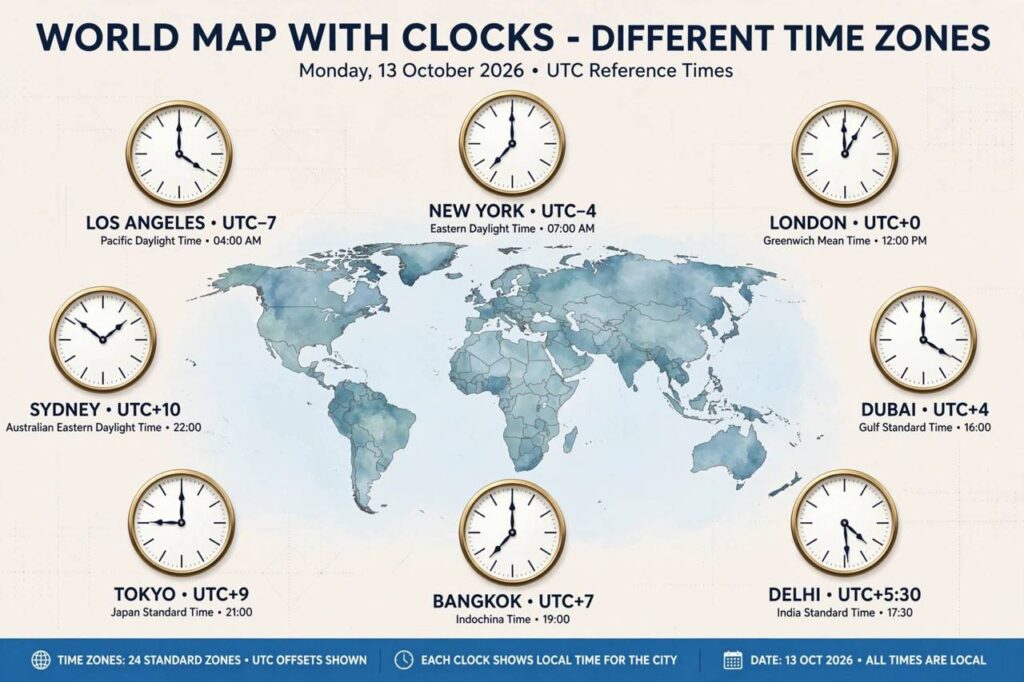
It’s 3 PM where you are — but is it breakfast time in Tokyo, midnight in London, or yesterday in Sydney? Whether you’re scheduling a call with colleagues across the globe, video-chatting family abroad, or just satisfying your curiosity, figuring out the time in different time zones is one of those small modern skills that makes life noticeably easier. Here’s everything you need to know: how time zones work, how to convert between them without a headache, and the tools that do the math for you. Here’s how to answer “what time is it in different time zones” in seconds — and convert between zones without the headache.
How Time Zones Actually Work
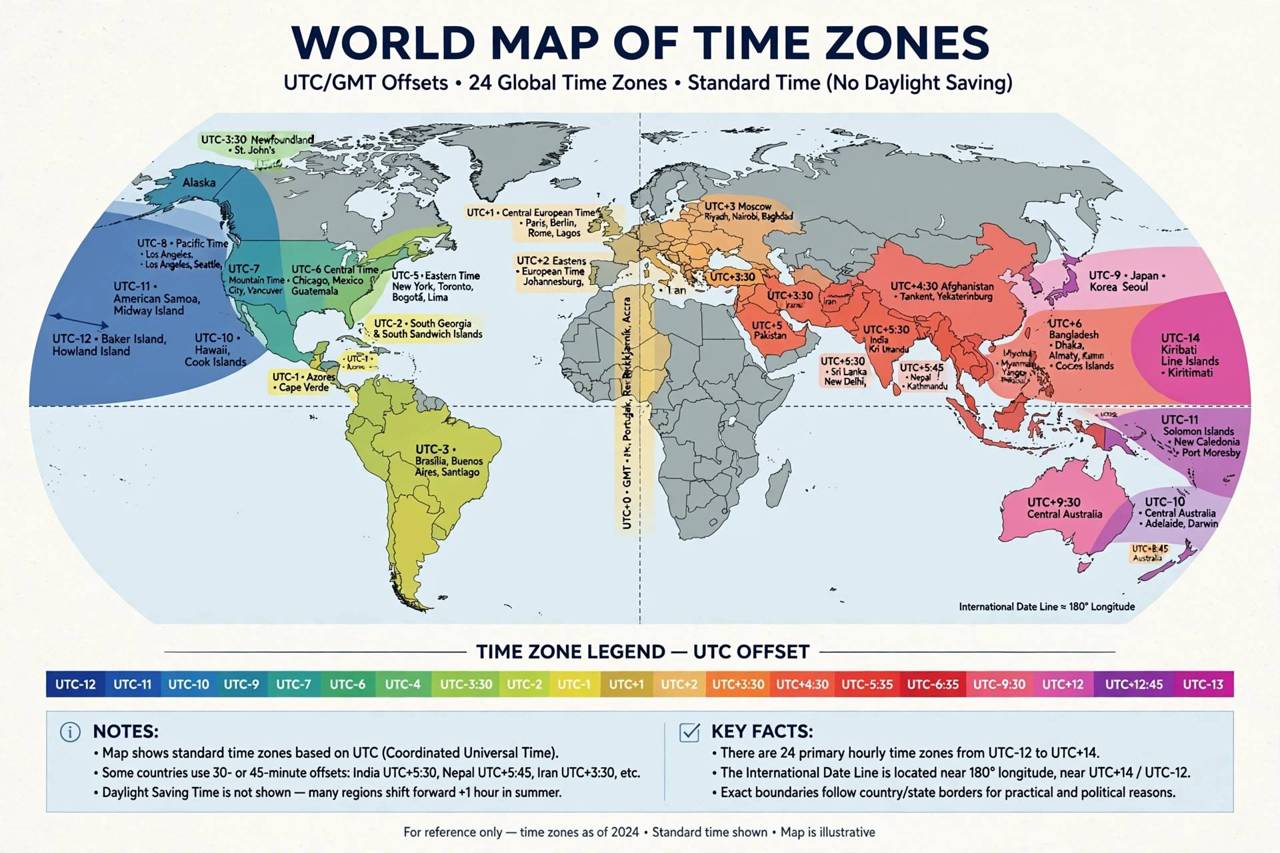
The Earth is divided into 24 main time zones, roughly one for each hour of the day, centered on the Prime Meridian (0° longitude) in Greenwich, London. As you travel east, time moves forward; travel west, and it moves back. The whole system exists because the planet rotates — when it’s noon in London, the sun is in a completely different position over New York, so the clock reads differently.
Times are expressed relative to Coordinated Universal Time (UTC). So when you see “UTC+5” for Pakistan or “UTC-5” for New York in winter, that tells you exactly how far ahead or behind Greenwich that zone sits. This UTC offset is the key to every time zone conversion you’ll ever do: find both offsets, subtract, and you have your answer.
A few quirks worth knowing: not every zone differs by a full hour. India runs at UTC+5:30, Nepal at UTC+5:45, and parts of Australia at UTC+8:45. These half- and quarter-hour offsets trip people up constantly — always double-check rather than assuming whole hours.
The Quick Way: Converting Time Zones in Your Head
Here’s the simple method I use all the time:
- Find the UTC offset for both places. (Your phone’s world clock shows these, or just search “current time in [city].”)
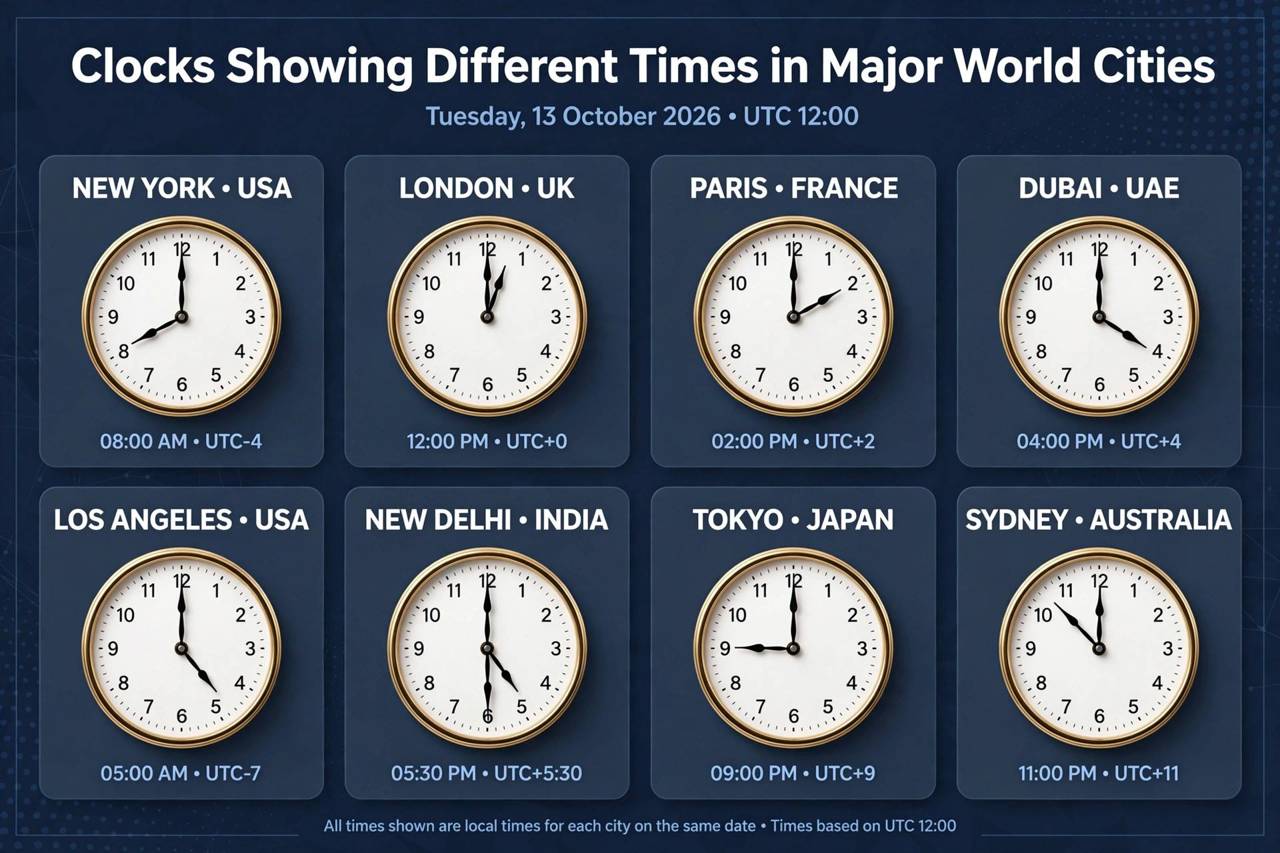
- Subtract to find the difference. If you’re in Pakistan (UTC+5) and calling London (UTC+0 in winter), the difference is 5 hours — London is 5 hours behind.
- Add or subtract from your local time. 3 PM in Lahore = 10 AM in London.
The tricky part is crossing midnight or the International Date Line. If it’s 9 PM Tuesday in Los Angeles (UTC-8) and you add 16 hours to reach Sydney (UTC+11 in summer), you land at 1 PM — but on Wednesday, not Tuesday. Always track the date, not just the hour. This is where most scheduling mistakes happen: the time math is right, but the day is wrong.
My honest advice: for anything important — job interviews, flights, deadlines — don’t do it in your head. Use a tool. Mental math is fine for curiosity; it’s risky for commitments.
Daylight Saving Time: The Complication Nobody Asked For
Daylight saving time (DST) is the reason time zone math sometimes changes depending on the month. Many regions — most of North America, Europe, and parts of Australia and South America — shift their clocks forward an hour in spring and back in autumn. Many others, including most of Asia and Africa, don’t observe it at all.
This creates two classic headaches:
- The difference between two cities changes. New York and London are 5 hours apart in winter but only 4 in summer, because their DST transitions happen on different dates. If you have a recurring international meeting, verify the time twice a year.
- The transition weekends are chaos. In spring, there’s an hour that doesn’t exist; in autumn, an hour that happens twice. Scheduling anything across those weekends deserves extra care.
The good news: every decent world clock tool and calendar app handles DST automatically. The bad news: humans doing mental math don’t. When in doubt, let the tool do it.
What Time Is It in Different Time Zones? The Best Tools to Check
Your phone’s built-in world clock. Both iPhone (Clock app → World Clock) and Android (Clock app → World clock) let you add cities and see all their times at a glance. It’s the fastest way to answer “what time is it there right now?” — add the cities you care about once, and the answer is always two taps away.
Google search. Typing “time in Tokyo” or “current time in Sydney” into Google gives you an instant, accurate answer with the date. It’s the quickest option when you’re at a computer.
Time zone converter websites. For planning across multiple zones — say, finding a meeting time that works for colleagues in four cities — dedicated converter sites let you line up several zones side by side and slide through the hours visually. Far easier than juggling offsets in your head.
Your calendar app. Google Calendar, Outlook, and Apple Calendar all handle time zones intelligently: create an event with a time zone attached, and it displays correctly for everyone invited, wherever they are. For recurring international meetings, this is the gold standard — set it once with time zones specified, and DST transitions are handled automatically.

Common Time Zone Scenarios (With Examples)
Scheduling a work call across continents. Say you’re in Lahore (UTC+5) coordinating with New York (UTC-5/UTC-4) and London (UTC+0/UTC+1). The overlap window where everyone’s in reasonable working hours is narrow — typically late afternoon Pakistan time, which catches London midday and New York morning. Propose two or three specific options with the time stated in each participant’s zone (“3 PM Lahore / 11 AM London / 6 AM New York”) to eliminate ambiguity.
Calling family abroad. Add their city to your phone’s world clock and glance at it before dialing. The number of 3 AM accidental wake-up calls this prevents is enormous. If you call regularly, find your standing window — “Sunday mornings my time is Sunday evening their time” — and stick to it.
Travel planning. When you land, your body is on home time but the world has moved on. Knowing the offset in advance helps you plan sleep, meals, and that first day’s schedule. If you’re heading abroad, a little prep goes a long way — check out what to pack for international travel and don’t forget a travel adapter so your devices (and their world clocks) survive the trip.
Following live events. Sports matches, product launches, rocket launches — global events are usually announced in one time zone. Convert it once, add it to your calendar with the correct zone, and set an alert. Future you will be grateful.
Time Zone Etiquette for a Connected World
A few unwritten rules that make you a good global citizen:
- Always specify the zone. “Let’s meet at 3” is meaningless internationally. “3 PM Pakistan time (UTC+5)” is clear. Even better, give it in the other person’s zone too.
- Rotate the inconvenience. If you meet regularly across zones, don’t always make the same person take the 6 AM slot. Share the pain — it builds enormous goodwill.
- Respect local norms. Lunch hours, weekends, and holidays differ by culture. A Friday afternoon meeting might run into someone’s weekend depending on where they are.
- Confirm the day, not just the time. “Tuesday 9 AM your time” beats “9 AM” every time, because Tuesday in one place might be Monday in another.
- Use UTC for anything critical. Pilots, engineers, and international teams often coordinate in UTC to eliminate all ambiguity. “1400 UTC” means the same moment everywhere on Earth.
Fun Time Zone Facts Worth Knowing
- China uses a single time zone (UTC+8) across the entire country, despite spanning five geographical zones. Sunrise in western China can be as “late” as 10 AM on the clock.
- The International Date Line means you can celebrate New Year’s Eve twice — or skip a day entirely flying west across the Pacific.
- Samoa skipped a day in 2011 — the entire country jumped from Thursday straight to Saturday to align with Asian trading partners.
- Spain is in the “wrong” time zone — geographically it should match London, but it uses Central European Time for historical reasons, which is why Spanish dinner at 10 PM makes perfect sense locally.
- The South Pole has no official time zone — research stations just pick one, usually New Zealand time or UTC.
Time zones are one of those invisible systems that quietly shape modern life — from when you call your grandmother to when the stock market opens to when your favorite show drops new episodes. Understanding them takes ten minutes and pays off every single week. Add those world clock cities to your phone today. The next time someone asks what time is it in different time zones, you’ll have the answer in two taps — and you’ll never accidentally schedule a midnight meeting again.
FAQ
How do I quickly find the time in another country?
The fastest way: search “time in [city]” on Google, or add the city to your phone’s world clock app (iPhone: Clock → World Clock; Android: Clock → World clock). Both give you the current time and date instantly, with daylight saving handled automatically.
Why do some time zones differ by 30 or 45 minutes?
Countries choose their offsets for practical and political reasons, not strict geography. India uses UTC+5:30, Nepal uses UTC+5:45, and parts of Australia use UTC+8:45. Always verify the exact offset rather than assuming whole hours.
What is UTC and how is it different from GMT?
UTC (Coordinated Universal Time) is the modern global time standard, based on atomic clocks. GMT (Greenwich Mean Time) is the older astronomical standard. For everyday purposes they’re effectively the same — UTC+0 equals GMT — but UTC is the technically precise standard used worldwide.
How do I schedule meetings across multiple time zones?
Use a time zone converter to find overlapping reasonable hours, propose specific times stated in each participant’s local zone, and create the calendar event with time zones attached so apps handle DST automatically. Rotate inconvenient early/late slots fairly among participants.
Does every country observe daylight saving time?
No — most of Asia, Africa, and South America don’t observe it at all, while North America, Europe, and parts of Australia do. This means the time difference between two cities can change depending on the time of year, so always verify rather than relying on a remembered offset.