What Is Tire Rotation? Why It Matters and When to Do It

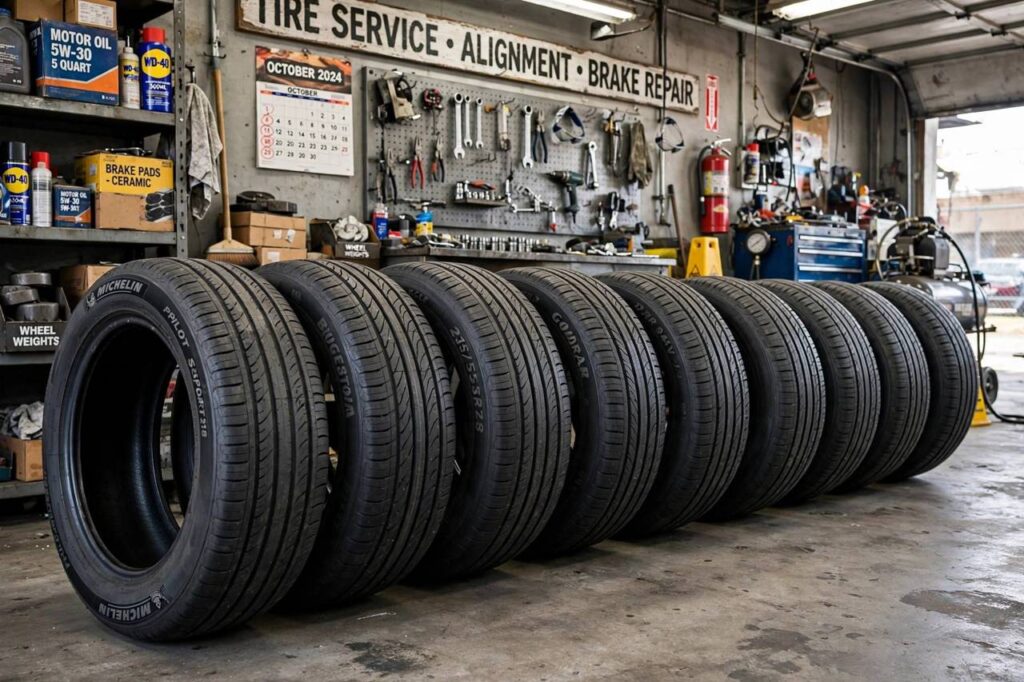
Your tires are the only part of your car that touches the road, all four patches roughly the size of your hand holding up two tons of metal at highway speed. And yet most drivers never think about them until something goes wrong. But what is tire rotation, exactly? It is one of the simplest, cheapest maintenance jobs you can do, and skipping it quietly costs you money and safety. Here is what tire rotation actually is, why it matters, and exactly when to get it done.
What Is Tire Rotation, Exactly?
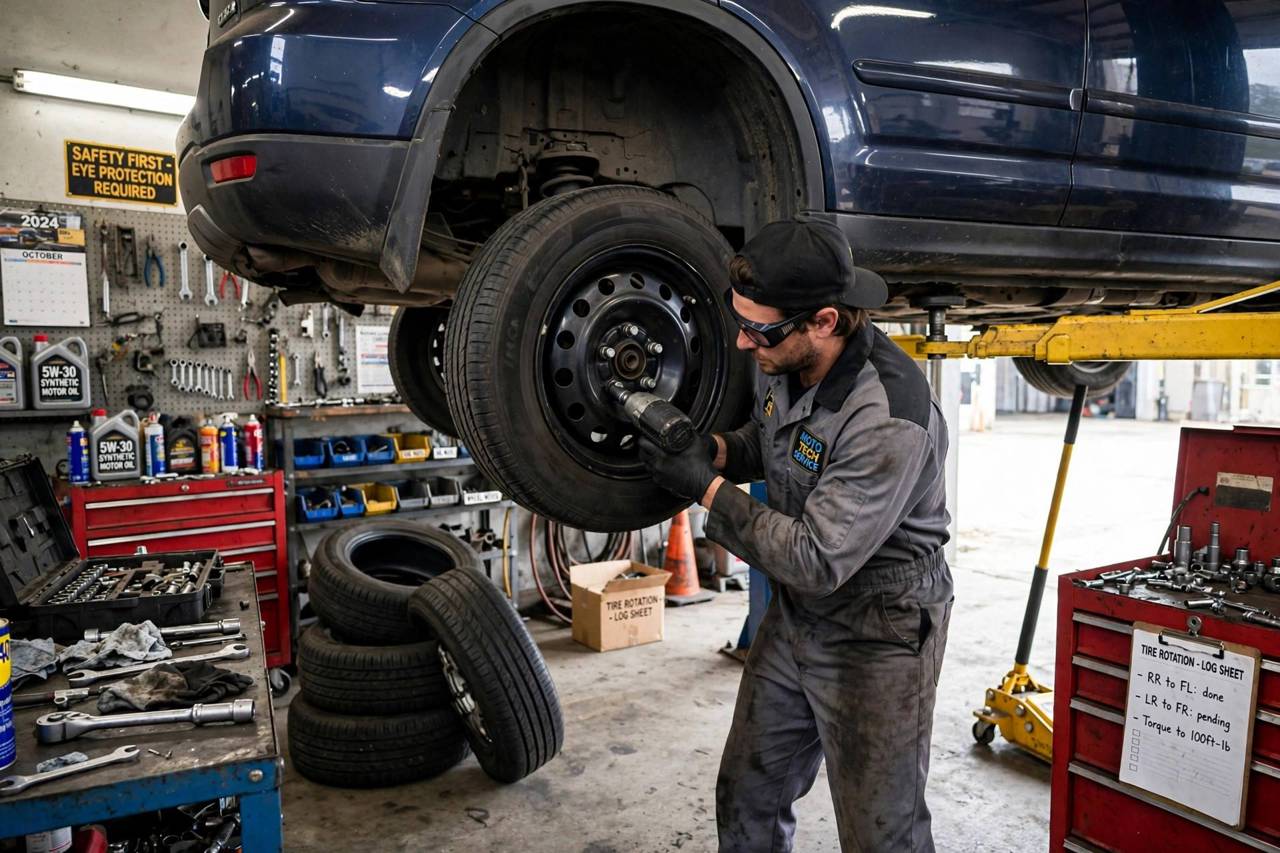
Tire rotation means moving each tire to a different position on your car, front to back, side to side, following a specific pattern. The goal is simple: tires wear differently depending on where they sit, so rotating them evens out the wear and extends the life of the whole set.
On most cars, the front tires do the heavy lifting. They handle steering, most of the braking force, and on front-wheel-drive cars, all of the engine’s power. That means front tires typically wear 2 to 3 times faster than rears. Without rotation, you would replace front tires twice as often while the rears still have life left. Rotation keeps all four wearing at roughly the same pace, so you replace them as a matched set, which is also safer.
Why Tire Rotation Matters: The Real Benefits
Longer tire life. This is the big one. Regular rotation can extend tire life by thousands of miles. A $60 rotation that gets you an extra year from a $800 set of tires is arithmetic anyone can love.
Even traction and handling. Unevenly worn tires grip differently, especially in rain. A car with bald fronts and fresh rears (or vice versa) handles unpredictably when it matters most. Matched wear means predictable grip.
Quieter, smoother ride. Uneven wear creates noise and vibration that gets worse over time. Rotated tires wear evenly and stay quiet longer.
Warranty protection. Many tire manufacturers require documented rotation to honor treadwear warranties. Skip rotations and you may void the mileage warranty on your tires.
Early problem detection. Every rotation is a chance to spot uneven wear patterns that signal alignment or suspension issues. Catching a bad alignment early saves both tires and fuel. If you want to understand what those patterns mean, our guide to tire wear patterns and misalignment is the perfect companion read.
How Often Should You Rotate Your Tires?
The standard answer: every 5,000 to 8,000 miles, or roughly every other oil change. Many shops recommend pairing rotation with oil changes so neither gets forgotten. Check your owner’s manual first, though; some manufacturers specify exact intervals, and performance cars or EVs can differ.
Certain situations call for more frequent rotation. Aggressive drivers, frequent towing or heavy loads, and lots of city driving with hard cornering all accelerate uneven wear. If you notice the fronts looking visibly more worn than the rears, do not wait for the mileage mark.
One important exception: some performance cars run staggered setups, wider tires in the rear than the front. These cannot be rotated front-to-back at all, only side-to-side if the tires are non-directional. Directional tires (marked with a rotation arrow) can only move front-to-back on the same side. Your tire sidewall tells you what you are working with.
Tire Rotation Patterns Explained
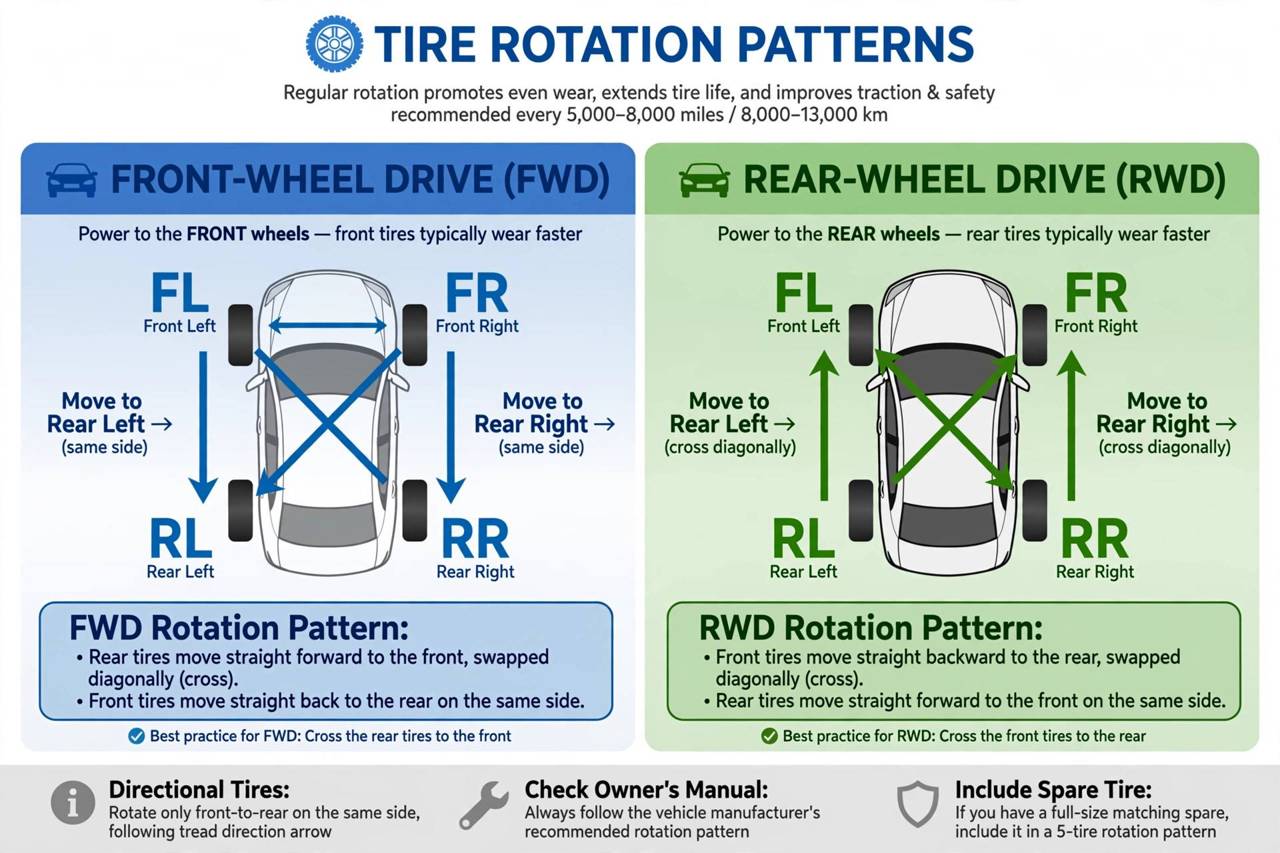
The pattern depends on your drivetrain and tire type:
Front-wheel drive (most common): the forward cross. Front tires move straight back; rear tires cross to the opposite front positions. This counteracts the heavy front wear typical of FWD cars.
Rear-wheel and all-wheel drive: the rearward cross. Rear tires move straight forward; front tires cross to the opposite rear positions.
Same-size, non-directional tires: the X pattern, every tire moves diagonally, works as a universal option.
Directional tires: front-to-back on the same side only. The rotation arrow must always point forward.
Staggered or different sizes: side-to-side only, and only if non-directional. Many staggered setups cannot be rotated at all.
You do not need to memorize these; any tire shop knows them cold. But understanding the pattern helps you verify the work was actually done and done right.
What Does Tire Rotation Cost?
Standalone, a rotation typically costs $30 to $60 at an independent shop, a bit more at dealerships. But here is the insider tip: many shops include free rotations with tire purchase, and plenty offer free rotation with any other service. Oil change chains frequently bundle it. Ask before you pay full price.
Some drivers rotate tires themselves with a jack and jack stands. It is doable if you are comfortable and careful, torque the lug nuts to spec with a torque wrench, and follow the pattern. But honestly, for $40 at a shop that also checks your pressures and inspects the brakes while the wheels are off, professional rotation is one of the best maintenance values in car ownership.
Speaking of pressure: rotation day is the perfect time to check it. Incorrect pressure accelerates uneven wear and costs you fuel. Our step-by-step guide on how to check tire pressure takes five minutes and pays for itself.
Tire Rotation vs. Alignment vs. Balancing
These three get confused constantly, so let us separate them. Rotation moves tires to even out wear; needed regularly. Balancing evens out the weight distribution of each wheel; needed when you feel vibration at speed or when new tires are mounted. Alignment adjusts the angles of the wheels themselves; needed when the car pulls to one side, the steering wheel is off-center, or wear patterns show feathering or one-sided wear.
Rotation does not fix alignment problems. If your tires show uneven wear, rotating them just moves the problem around. Get the alignment checked, fix the cause, then rotate. For the full comparison, see our breakdown of 4-wheel vs. 2-wheel alignment.
Signs You Need a Rotation Right Now
Do not wait for the odometer if you notice: front tires visibly more worn than rears, uneven wear across a single tire’s tread, new noise or vibration that was not there before, or decreased wet-weather grip. Also, if you cannot remember your last rotation, that is itself a sign. When in doubt, most shops will check tread depth across all four tires for free and tell you straight whether rotation is due.

Special Cases: EVs, AWD, Spares, and Winter Tires
Electric vehicles. EVs are heavier than gas cars and deliver instant torque, both of which chew through tires faster. Many EV owners are surprised by how quickly tires wear. More frequent rotation, every 5,000 miles rather than 7,500, plus religious pressure checks, keeps EV tire costs under control. Also note that many EVs use specific low-rolling-resistance tires; replace with equivalents to protect your range.
All-wheel drive. AWD systems are sensitive to differences in tire circumference. Running mismatched tread depths can stress differentials and even trigger warning lights. This makes rotation more important on AWD vehicles, not less, and it means replacing tires in full sets of four when the time comes. Never replace just one tire on an AWD vehicle unless the others are nearly new.
The spare tire. Full-size matching spares can join the rotation on some vehicles (a five-tire rotation pattern exists for exactly this), which extends the life of all five. Space-saver donuts cannot be rotated in; they are emergency-only. Check your spare’s pressure twice a year regardless. A flat spare is a special kind of disappointment.
Winter/summer tire swaps. If you run dedicated winter tires, each seasonal swap is a natural rotation opportunity. Mark each tire’s position when you remove them (chalk on the sidewall: LF, RF, LR, RR) so you can rotate positions when remounting. Store off-season tires cool, dark, and dry, stacked flat, to prevent flat-spotting and rubber degradation.
These edge cases share one principle: the more specialized your setup, the more rotation discipline matters. Standard cars forgive neglect; performance EVs and AWD systems bill you for it.
How to Check Tread Depth at Home
Between rotations, monitor wear yourself with the penny test. Insert a penny into the tread groove with Lincoln’s head upside down. If you can see the top of his head, tread is below 2/32 of an inch and the tire is legally worn out in most places. Check several grooves across each tire, inner, center, and outer, because uneven readings reveal alignment or pressure problems. A $10 tread depth gauge from any auto parts store gives precise numbers and removes all guesswork. Check quarterly; it takes two minutes and tells you whether your rotation schedule is working. Tires with adequate tread stop shorter, grip better in rain, and resist hydroplaning, so this tiny habit is genuinely a safety measure, not just maintenance trivia. Make it a habit starting today.
Key Takeaways
Tire rotation moves each tire to a different position to even out wear, since front tires typically wear much faster than rears. Rotate every 5,000 to 8,000 miles following the pattern for your drivetrain and tire type. It extends tire life, keeps handling predictable, protects your treadwear warranty, and costs $30-60, often free with other services. Pair it with pressure checks and do not confuse it with alignment or balancing. Four small patches of rubber do all the work; take care of them and they will take care of you.
FAQ
What is tire rotation in simple terms?
Moving each tire to a different wheel position on a schedule, so all four wear evenly. Front tires wear faster than rears, and rotation balances that out to extend tire life.
How often should tires be rotated?
Every 5,000 to 8,000 miles, or about every other oil change. Check your owner’s manual for your specific vehicle’s recommendation.
How much does tire rotation cost?
Typically $30-60 as a standalone service. Many shops include free rotations with tire purchases or bundle them with oil changes, so always ask.
Can you rotate tires yourself?
Yes, with a jack, jack stands, and a torque wrench, following the correct pattern for your drivetrain. But professional rotation is inexpensive and usually includes pressure checks and a brake inspection.
What happens if you never rotate your tires?
Front tires wear out much faster, you replace tires in mismatched pairs (worse handling), ride quality degrades, and you may void the manufacturer’s treadwear warranty.