How Often Should You Rotate Tires? A Car Guy’s Honest Guide

Here’s a question I get at every backyard barbecue: “Marcus, how often should you rotate tires, really? Or is that just something shops say to get me in the door?” Fair question. And I’ll give it to you straight — tire rotation is one of those maintenance items that actually earns its keep. Skip it, and you’re buying new tires months earlier than you should be.
Let me walk you through the real answer — the mileage rule, the exceptions, the patterns, and the warning signs that you’re overdue.
The Short Answer: How Often Should You Rotate Tires?
For most drivers, rotate your tires every 5,000 to 7,500 miles — roughly every other oil change if you’re on a conventional oil schedule, or every oil change if you run full synthetic. That’s the sweet spot for the vast majority of cars, trucks, and SUVs on the road.
But “most drivers” isn’t everyone. Here’s how to dial it in for your situation:
- Check your owner’s manual first. Some manufacturers call for rotation every 5,000 miles; others say 7,500 or even 10,000. Your car’s engineers know your car’s weight distribution, so their number beats any rule of thumb.
- Front-wheel-drive cars wear fronts faster. If you drive a FWD sedan or crossover — which most of us do — your front tires do the steering, most of the braking, and all of the accelerating. They wear noticeably faster, so sticking to the 5,000-mile end of the range pays off.
- Performance and staggered setups are special. If your car runs wider tires in back (common on sports cars), you can’t do a simple front-to-back swap. Rotation options are limited, and sometimes rotation isn’t recommended at all.
- Aggressive drivers rotate more often. Hard cornering, fast launches, and heavy braking all chew through tread unevenly. If you drive with enthusiasm, shorten the interval.
Bottom line: if you can’t remember the last time you rotated, you’re probably overdue.

Why Tire Rotation Actually Matters
Your four tires don’t share the workload equally. The front tires on a front-wheel-drive car handle steering, most braking force, and all engine power. On a rear-wheel-drive car, the rears push while the fronts steer. Either way, some tires work harder than others — and harder-working tires wear faster.
Rotation moves each tire to a different position on a schedule, so all four wear down at roughly the same rate. That gives you three real benefits:
- Longer tire life. Even wear means you replace all four at once, on schedule — not one pair early while the other pair still has life.
- Better traction. Evenly worn tires grip more predictably, especially in rain. Uneven wear can leave one axle with far less grip than the other, which is exactly how a car surprises you in a corner.
- Smoother, quieter ride. Unevenly worn tires get noisy. Ever heard that droning hum that gets louder with speed? That’s often cupped or feathered tread from skipped rotations.
Signs You’re Overdue for a Rotation
Your tires will tell you when they’ve been neglected. Run your hand across the tread (carefully — check for anything sharp first). Here’s what to look and feel for:
- Front tires visibly more worn than rears. Compare the tread blocks. If the fronts look rounded and shallow while the rears still look chunky, you’ve waited too long.
- Uneven wear on a single tire. One edge worn smooth while the other edge still has tread is a red flag. This is also a sign you may need an alignment — worn tire wear patterns tell a story if you know how to read them.
- Vibration or humming at highway speed. A new vibration through the steering wheel or a hum that rises with speed often traces back to uneven tread wear.
- The penny test fails on one axle. Stick a penny upside down into the tread grooves. If Lincoln’s head is fully visible on the fronts but covered on the rears, the fronts are wearing faster and rotation is past due.
If you spot any of these, don’t just rotate and forget — have the alignment checked too. Rotation fixes uneven position wear; it doesn’t fix wear caused by bad geometry. That’s the difference between wheel alignment vs. wheel balancing, and it’s worth knowing.
Tire Rotation Patterns Explained
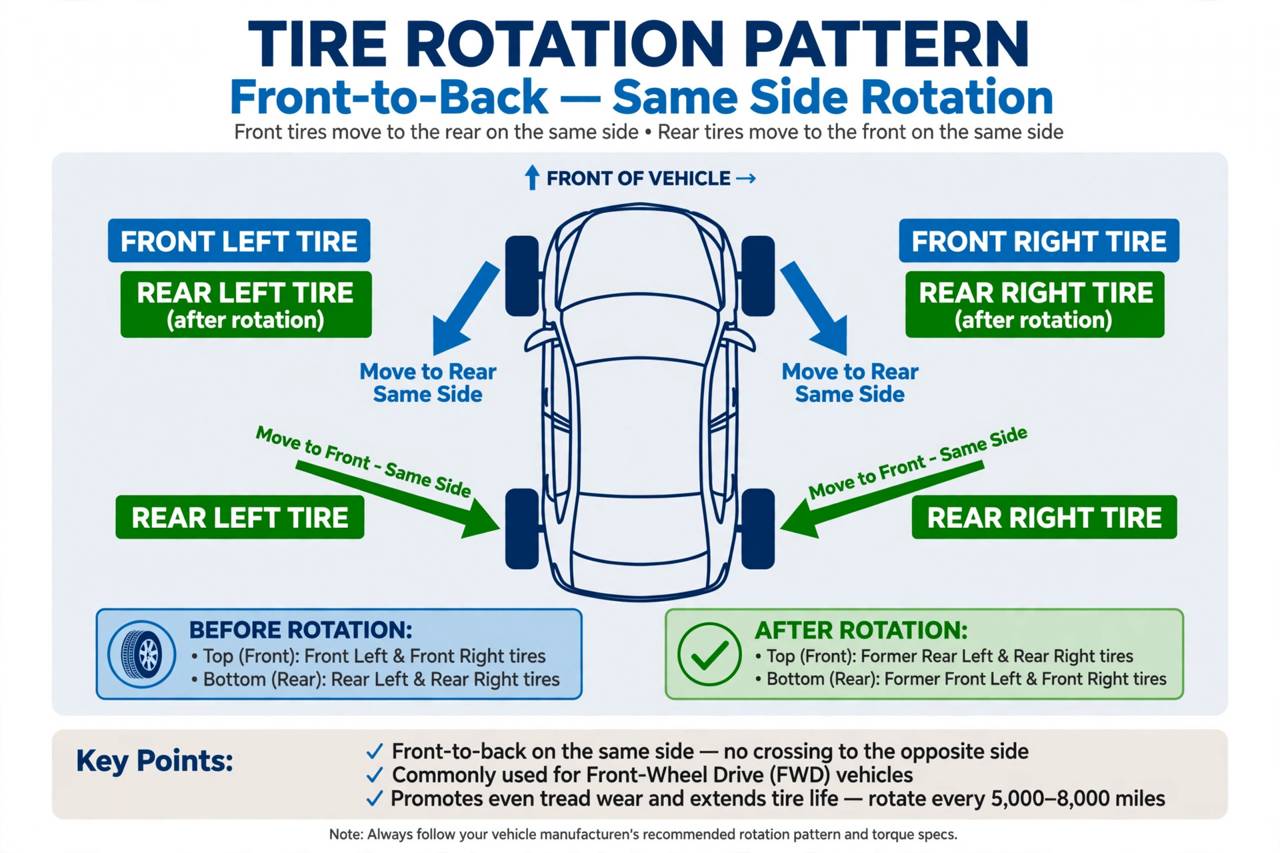
Rotation isn’t random — there’s a method, and it depends on your drivetrain and tire type. Here are the patterns shops actually use:
- Forward cross (front-wheel drive): Front tires move straight back; rear tires cross to the opposite front corners. This is the most common pattern in America.
- Rearward cross (rear-wheel drive / AWD): The mirror image — rear tires move straight forward, fronts cross to the opposite rears.
- X-pattern: All four tires swap diagonally. Simple and effective for older vehicles with non-directional tires.
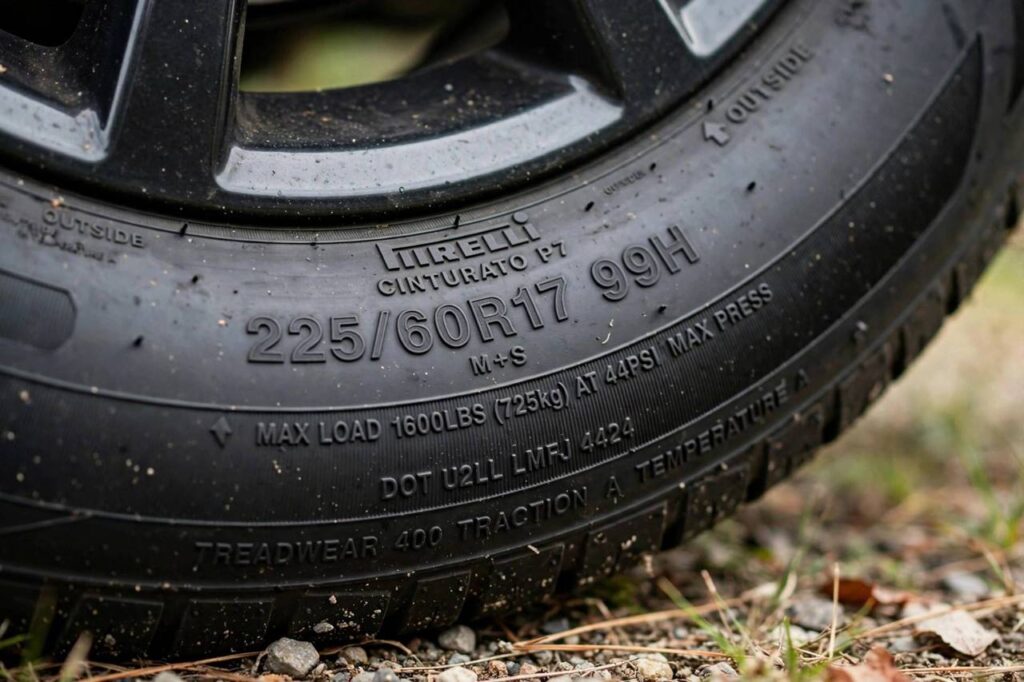
- Front-to-back (directional tires): Tires with a directional tread pattern (look for the rotation arrow on the sidewall) can only move front-to-back on the same side. Never cross them — flipping a directional tire reverses its tread design and kills wet-weather grip.
- Side-to-side (staggered setups): If your rear tires are wider than your fronts, the only move available is left-to-right on the same axle — and only if the tires aren’t directional.
Not sure which pattern fits your car? Your owner’s manual usually has a diagram. When in doubt, front-to-back on the same side is safe for directional tires, and the forward cross works for most everything else with non-directional rubber.
Can You Rotate Tires Yourself?
Absolutely — it’s one of the most satisfying DIY jobs. You need a jack, jack stands (never work under a car supported only by a jack), a lug wrench or breaker bar, and a torque wrench. The whole job takes about 30 to 45 minutes once you’ve done it a couple of times.
The critical step most DIYers skip: torquing the lug nuts to spec. Over-tightened lugs warp brake rotors; under-tightened lugs are a genuine safety hazard. Look up your car’s torque spec — it’s in the manual — and use a torque wrench, not vibes.
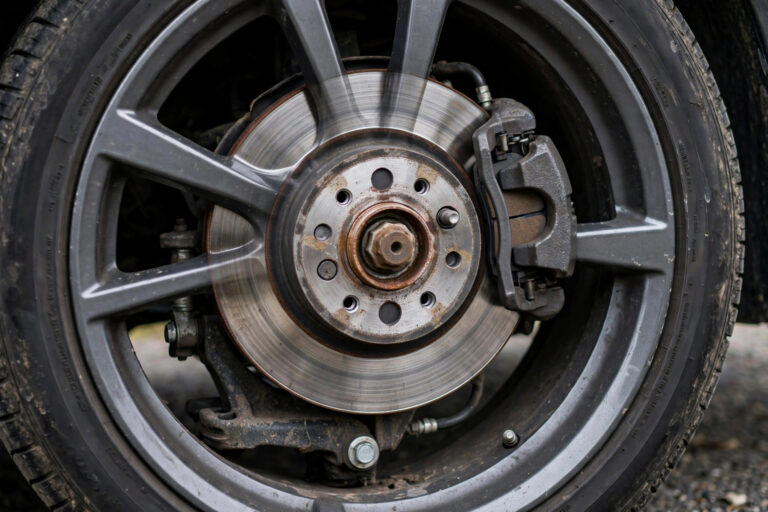
While the wheels are off, it’s the perfect time to check brake pad thickness and peek at your suspension. And since you’re already thinking about tire health, make it a habit to check pressure monthly too — here’s how to check your tire pressure with a gauge if you’re not sure of the technique.
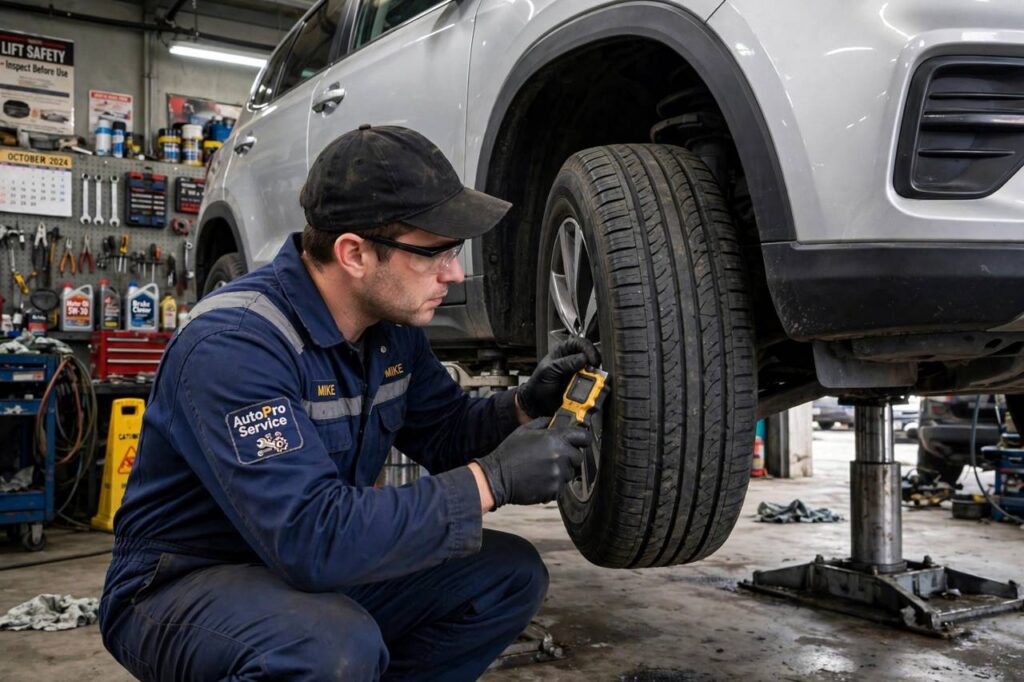
If you’d rather not wrestle with a floor jack, most tire shops will rotate for a modest fee — and many do it free if you bought the tires there. Just ask for the pattern they used and the torque spec they tightened to. A good shop will tell you without blinking.
What About the Spare?
Quick word on full-size spares: some rotation schedules include the spare in a five-tire rotation. This keeps all five tires at similar wear levels, which matters for AWD vehicles where mismatched tire diameters can stress the drivetrain. If your car has a full-size matching spare, ask your shop about a five-tire pattern. If it’s a donut or a space-saver, leave it out of the rotation entirely.
Tire Rotation and Your Warranty
Here’s something most drivers don’t realize: skipping rotations can cost you warranty coverage. Most major tire manufacturers include treadwear warranties — often 50,000 to 80,000 miles — but that coverage usually comes with a condition: documented regular rotations.
If you file a warranty claim for premature wear and can’t show rotation records, the manufacturer can deny it. That turns a free or prorated replacement into a full-price purchase. Keep your receipts. If a shop does the rotation, the invoice is your proof. If you DIY it, jot the date and mileage in your maintenance log or even just a notes app on your phone.
The same logic applies to your vehicle’s warranty in some cases. While tire rotation itself rarely voids anything, neglecting basic maintenance gives a dealer an easy excuse to push back on related claims. A five-minute log entry protects a thousand-dollar argument.
How to Actually Remember Your Rotation Schedule
The best maintenance schedule in the world is useless if you forget it. Here are the tricks that actually work for real people with busy lives:
- Tie it to your oil change. If you run full synthetic with 7,500-mile intervals, rotate every oil change. Conventional oil at 5,000 miles? Rotate every other change. One appointment, two jobs done.
- Use the seasons as your cue. In climates with real winters, many drivers rotate when they swap between winter and all-season tires. Two rotations a year, handled automatically.
- Set an odometer reminder. Most modern cars let you set maintenance reminders in the dashboard menu. Set one for tire rotation at your chosen interval and let the car nag you.
- Mark it on the tire. Old-school mechanics write the mileage and position on the inside sidewall with a paint pen at each rotation. Next time the wheels come off, the history is right there.
Pick whichever method fits your life. The “perfect” interval you forget is worse than the “good enough” interval you actually follow.
FAQ
How often should you rotate tires on an AWD vehicle?
Stick to every 5,000 to 6,000 miles for AWD. All-wheel-drive systems are sensitive to differences in tire circumference — uneven wear between axles can overwork the center differential. Regular rotation keeps all four tires wearing evenly, which your AWD system will thank you for.
Is tire rotation really necessary?
It’s not legally required, but it’s one of the highest-value maintenance items you can do. Tires are expensive, and rotation meaningfully extends their life while keeping handling predictable. Skipping it is a false economy — you’ll pay for it in early tire replacement.
How much does a tire rotation cost?
Most shops charge a modest fee for a standalone rotation, and many include it free with an oil change or if you bought your tires from them. Call ahead — prices vary by region, but it’s consistently one of the cheapest services on the menu.
Can rotating tires fix uneven wear?
Rotation evens out future wear, but it can’t undo damage already done. If a tire is badly cupped or feathered, rotating it just moves the noise to a new corner. Catch uneven wear early, rotate on schedule, and check alignment when wear looks abnormal.
Do I need an alignment with every rotation?
No. Alignment and rotation are different services. Rotate on schedule; get an alignment when you notice uneven wear, the car pulls to one side, or after hitting a serious pothole. If your wear patterns look odd, that’s your cue to check both.