How to Play Chess for Beginners: Rules, Pieces, First Wins

Chess has a reputation for being impossibly complicated, and I am here to tell you that reputation is overblown. Here is the truth about how to play chess for beginners: you can learn every rule in about thirty minutes, play your first real game today, and spend the rest of your life getting better at it. That combination — easy to start, endless to master — is exactly why this 1,500-year-old game still hooks new players every single day.
I learned chess the messy way, losing about twenty games in a row to a friend who showed no mercy. But each loss taught me something, and within a couple of months I was winning games and genuinely loving the process. This guide compresses that learning curve: the board, every piece, the special moves, what checkmate actually means, and the five principles that will make your first games competitive instead of chaotic.
How to Play Chess for Beginners: Setting Up the Board
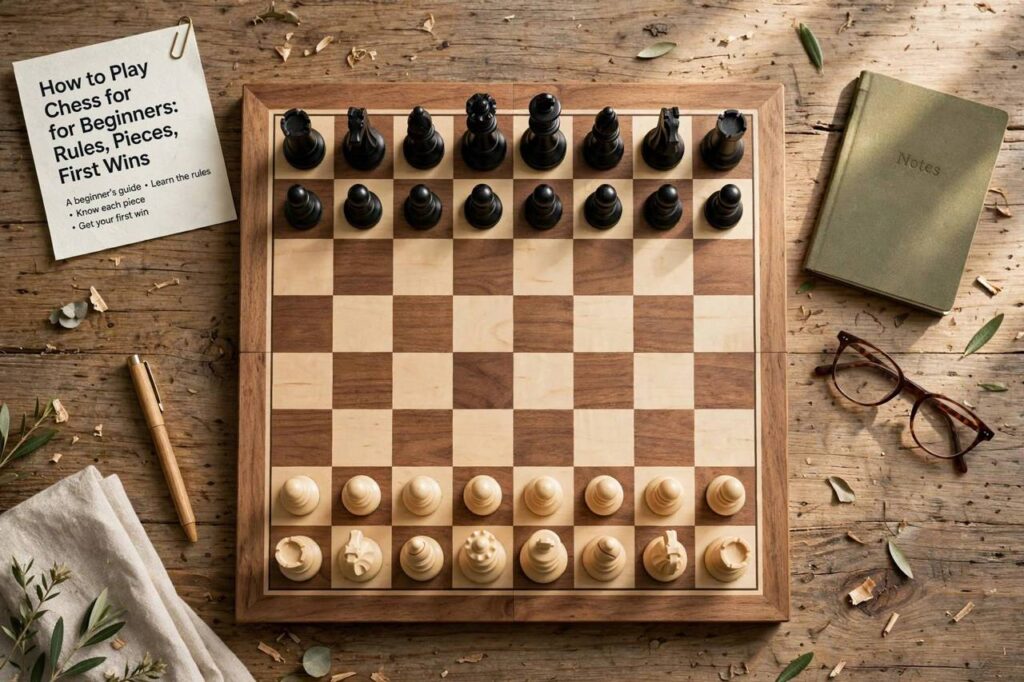
Before anything moves, the board has to be right. Two rules handle this. First, orient the board so each player has a light-colored square in the bottom-right corner — “white on right” is the mnemonic. Second, arrange the back rank (the row closest to you) in this order from the corner: rook, knight, bishop, queen, king, bishop, knight, rook. Your eight pawns fill the entire second rank.
One detail trips up every beginner: the queen goes on her own color. The white queen starts on a light square, the black queen on a dark square. Get that right and the kings and queens will face each other correctly across the board.
White always moves first. That is a small but real advantage, which is why players alternate colors in serious matches.
How Each Piece Moves
There are six piece types, and each moves differently. Learn these and you know 80 percent of chess:
The pawn moves forward one square, but captures diagonally one square. On its very first move, a pawn may advance two squares. Pawns never move backward — which makes every pawn push a small commitment. When a pawn reaches the far end of the board, it promotes: you swap it for a queen, rook, bishop, or knight (almost always a queen).
The rook moves in straight lines — horizontally or vertically — any number of squares. It is the straightforward powerhouse, especially strong once the board opens up.
The knight moves in an L-shape: two squares in one direction, then one square perpendicular. It is the only piece that jumps over others, which makes it tricky and wonderful in crowded positions.
The bishop moves diagonally any number of squares, staying on its starting color for the entire game. You begin with one light-squared and one dark-squared bishop, and together they cover the whole board.
The queen combines the rook and bishop: any number of squares horizontally, vertically, or diagonally. She is the strongest piece on the board, which is exactly why beginners tend to bring her out too early and get her trapped — more on that mistake later.
The king moves one square in any direction. He is the most important piece and the most limited — the entire game revolves around his safety.
The Three Special Moves Everyone Forgets
Beyond basic movement, three special rules complete the picture:
Castling. Once per game (per side), you can move your king two squares toward a rook, then hop the rook to the other side of the king. It is the only move where two pieces move at once, and its purpose is getting your king to safety while activating your rook. You cannot castle if the king or that rook has already moved, if any pieces sit between them, or if the king is in check or would pass through check.
En passant. If an enemy pawn advances two squares from its starting position and lands beside your pawn, you may capture it as if it had moved only one square — but only on your very next move. This is the rule that causes the most arguments among beginners, so learn it now and look knowledgeable later.
Promotion. As mentioned, a pawn reaching the far rank transforms into any piece except a king. Promoting to a queen is standard; occasionally a knight promotion wins games with a sneaky check.
Check, Checkmate, and Stalemate: How Games Actually End
The goal of chess is not capturing the king — it is trapping him. When your king is under attack, that is check, and you must get out of it on your move: move the king, capture the attacker, or block the attack. You cannot make a move that leaves your own king in check.
Checkmate is check with no escape — the king is attacked and no legal move removes the threat. That ends the game immediately. You win. All the strategy in chess is ultimately about building toward this moment while preventing it from happening to you.
Beginners should also know about stalemate: if it is your turn and you have no legal moves but your king is not in check, the game is a draw. This heartbreak happens constantly in beginner games — a player about to win accidentally stalemates instead of checkmating. When you are winning, always give the enemy king at least one legal square until you are ready to deliver mate.
Games can also end by agreement, by resignation (perfectly respectable — no one enjoys a hopeless position), by threefold repetition of the same position, or by the fifty-move rule. In casual play, checkmate and resignation cover nearly everything.
The Five Opening Principles That Win Beginner Games
Openings have endless theory, but beginners need principles, not memorization. Follow these five and you will reach playable middlegames against anyone near your level:
1. Control the center. Place pawns and pieces so they influence the four central squares. Central control gives your pieces maximum mobility. The classic first moves — advancing a central pawn two squares — do exactly this.
2. Develop your pieces. Get your knights and bishops off the back rank and into the game. Every move in the opening should ideally bring a new piece into play. Moving the same piece three times while the rest sleep is the classic beginner error.
3. Castle early. Tuck your king behind a wall of pawns, usually kingside, within your first ten moves. A king stuck in the center is a target; a castled king is a fortress.
4. Do not bring the queen out early. She looks powerful, and she is — which is why opponents love attacking her with lesser pieces, gaining free development while you retreat. Let the minor pieces lead.
5. Do not give away material for nothing. Before every move, ask: is anything of mine hanging (undefended and capturable)? Before every capture, ask: what defends that piece? This single habit will save more games than any tactic you learn this month.
Your First Games: A Survival Guide
Your first ten games will be messy, and that is exactly how it should be. Play them anyway — ideally against real people, where the social pressure makes the lessons stick. Here is how to make those early games productive instead of painful:
Play slow enough to think. Even thirty seconds per move transforms beginner chess, because most early losses come from one-move blunders — hanging a piece, walking into check — that a moment’s thought prevents. Before each move, scan: what did my opponent just threaten, and what am I leaving undefended?
Review every loss, briefly. You do not need engine analysis; just ask what the turning point was. Was there a moment your position collapsed? Nine times out of ten you will spot a single bad move, and recognizing it once makes you less likely to repeat it.
Learn one basic checkmate pattern: checkmating with a queen and king against a lone king. It comes up constantly in beginner endgames, and knowing it turns dozens of “winning but fiddly” positions into clean wins. Practice it against a friend or a free online trainer until it feels automatic.
And embrace losing. Every strong player has a graveyard of thousands of losses behind them. Each one deposited a lesson. The beginners who improve fastest are not the most talented — they are the ones who keep playing.
Common Beginner Mistakes (and Their Fixes)
Bringing the queen out on move two. She gets chased around while your opponent develops. Fix: knights and bishops first, queen later.
Neglecting king safety. Leaving the king in the center while the position sharpens. Fix: castle by move ten as a habit.
Trading without thinking. Swapping pieces just because you can, often helping the opponent. Fix: ask what each trade accomplishes before making it.
Playing too fast. Blitz is fun but teaches bad habits early. Fix: play longer games while learning, and use your time.
Chasing material greedily. Grabbing a pawn while walking into a trap. Fix: when something looks free, look twice — free things in chess are usually bait.
How to Keep Improving After the Basics
Once the rules feel natural, improvement comes from three habits. Play regularly — even a few games a week builds pattern recognition that no amount of reading replaces. Solve simple tactics — short puzzles where you find the winning move train the exact skill that decides beginner games. Fifteen minutes a day compounds remarkably. Learn one opening per color — not twenty moves deep, just the ideas: where the pieces go and what the plans are.
Watching better players helps enormously, especially commentators who explain their thinking rather than just showing brilliant moves. And find a community — a local club, an online group, a friend at your level. Chess is a social game wearing a solitary disguise, and it is far more fun shared.
The beautiful thing about learning how to play chess for beginners is that the journey never really ends. The rules took you thirty minutes; the game will happily occupy the rest of your life. Your move.
Frequently Asked Questions
How long does it take to learn chess?
The complete rules take about 30 minutes to learn, and you can play a real game the same day. Reaching a casual-competitive level — where you stop hanging pieces and understand basic strategy — typically takes a few months of regular play.
What is the best first move in chess?
There is no single best move, but the most popular and principled first moves advance a central pawn: moving the king’s pawn two squares forward. It controls the center and opens lines for the queen and bishop. Any standard developing move is fine for beginners.
Can a pawn move backward in chess?
No — pawns only move forward and never retreat. This is what makes pawn moves committal: once pushed, a pawn cannot come back. Think carefully before advancing pawns near your king, since the squares they leave behind become permanently weaker.
What happens if you forget to say “check”?
In casual and official play, you are not required to announce check — it is a courtesy, not a rule. The obligation is on the player in check to get out of it. Forgetting to say it changes nothing about the position.
Is chess good for your brain?
Chess exercises planning, pattern recognition, and decision-making under pressure, and regular players often report improved concentration. Like any mentally engaging hobby, its main benefit is that it keeps you thinking — the joy of the game itself is reason enough to play.