How Do Bees Make Honey? The Step-by-Step Story

Next time you drizzle honey on toast, pause for a moment and consider what you are holding. That golden spoonful is the end product of one of nature’s most remarkable manufacturing processes — a weeks-long collaboration involving thousands of insects, precise chemistry, and an engineering solution so elegant that humans still admire it. The question of how do bees make honey sounds simple, but the full answer involves foraging expeditions, enzymatic alchemy, and climate control inside a living factory.
Let us follow a single drop of nectar from flower to jar, step by step, and meet the cast of characters that makes it happen. By the end, you will never look at a honey jar the same way again.
How Do Bees Make Honey? Meet the Workforce First
A honeybee colony is a society of three castes, and only one of them makes honey. The queen — one per hive — lays eggs, up to a couple thousand a day in peak season. The drones are males whose sole role is mating; they do not forage, do not make honey, and do not even have stingers. And then there are the workers: tens of thousands of females who do literally everything else — nursing the young, guarding the entrance, building comb, foraging, and every step of honey production.
Worker bees change jobs as they age, which is one of the most charming details in all of biology. Young workers start as nurses and cleaners inside the hive; middle-aged workers become builders and food processors; and the oldest workers — the veterans with the most worn-out wings — take on the most dangerous job of all: flying out to forage. The foragers you see on flowers are the hive’s senior citizens, in the final weeks of their lives.
Step 1: The Foraging Expedition
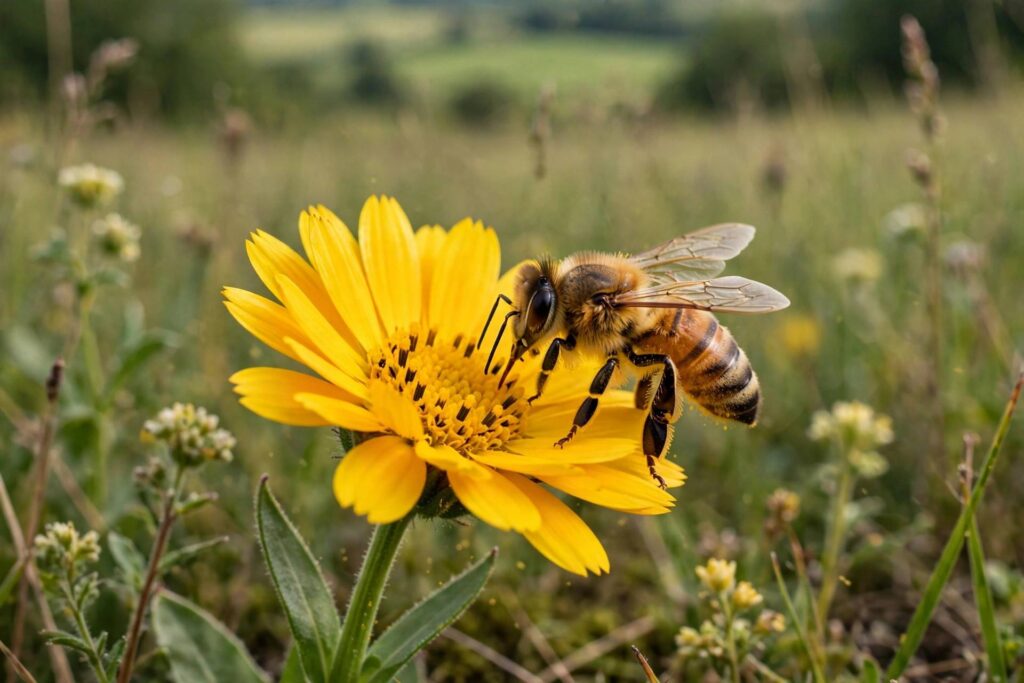
Honey begins as nectar, the sugary liquid flowers produce to attract pollinators. When a forager bee finds a rewarding patch of flowers, she extends her long, straw-like tongue (called a proboscis) and sucks the nectar up — not into her stomach for digestion, but into a special honey stomach (more properly the crop), a separate storage sac just for transport.
A single forager visits an extraordinary number of flowers per trip — dozens to over a hundred — before her honey stomach is full and she heads home. She navigates back using the sun, landmarks, and an internal sense of direction that scientists are still studying with admiration. If she found an especially rich source, she will perform the famous waggle dance on the comb: a figure-eight shimmy whose angle and duration encode the direction and distance of the flowers, recruiting nestmates to the find. It is a symbolic language — one of the few known outside humans.
Step 2: The Handoff and the Enzyme Magic
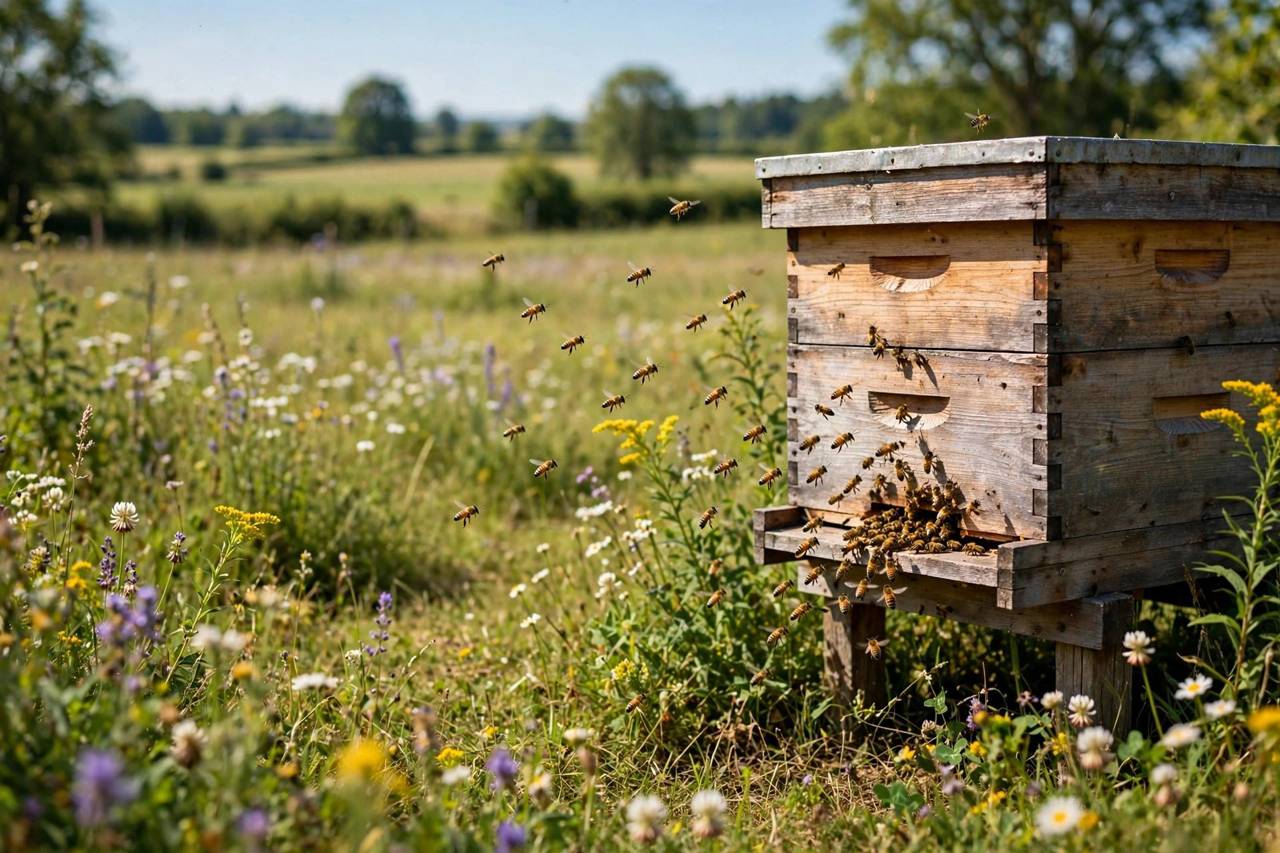
Back at the hive, the forager does not deposit her nectar directly into the comb. Instead, she regurgitates it — mouth to mouth — to a younger house bee, who may pass it to another, and another. This chain of transfers, called trophallaxis, looks unglamorous but serves a critical purpose: with every handoff, the bees add enzymes from glands in their heads.
The star enzyme is invertase, which begins breaking the nectar’s complex sugars down into simpler ones — mainly glucose and fructose. This is the first chemical transformation on the road to honey, and it starts the moment the nectar enters a bee’s mouth. Another enzyme, glucose oxidase, produces tiny amounts of hydrogen peroxide, which later helps honey resist spoiling.
So by the time the nectar reaches the comb, it is no longer really nectar. It is an enzyme-rich, partially converted liquid — honey in its infancy.
Step 3: Fanning Away the Water
Fresh nectar is mostly water — often around 70 to 80 percent — and watery syrup would ferment and spoil. Honey, by contrast, is only about 17 to 18 percent water, which is far too dry for microbes to grow in. Closing that gap is the colony’s great engineering project.
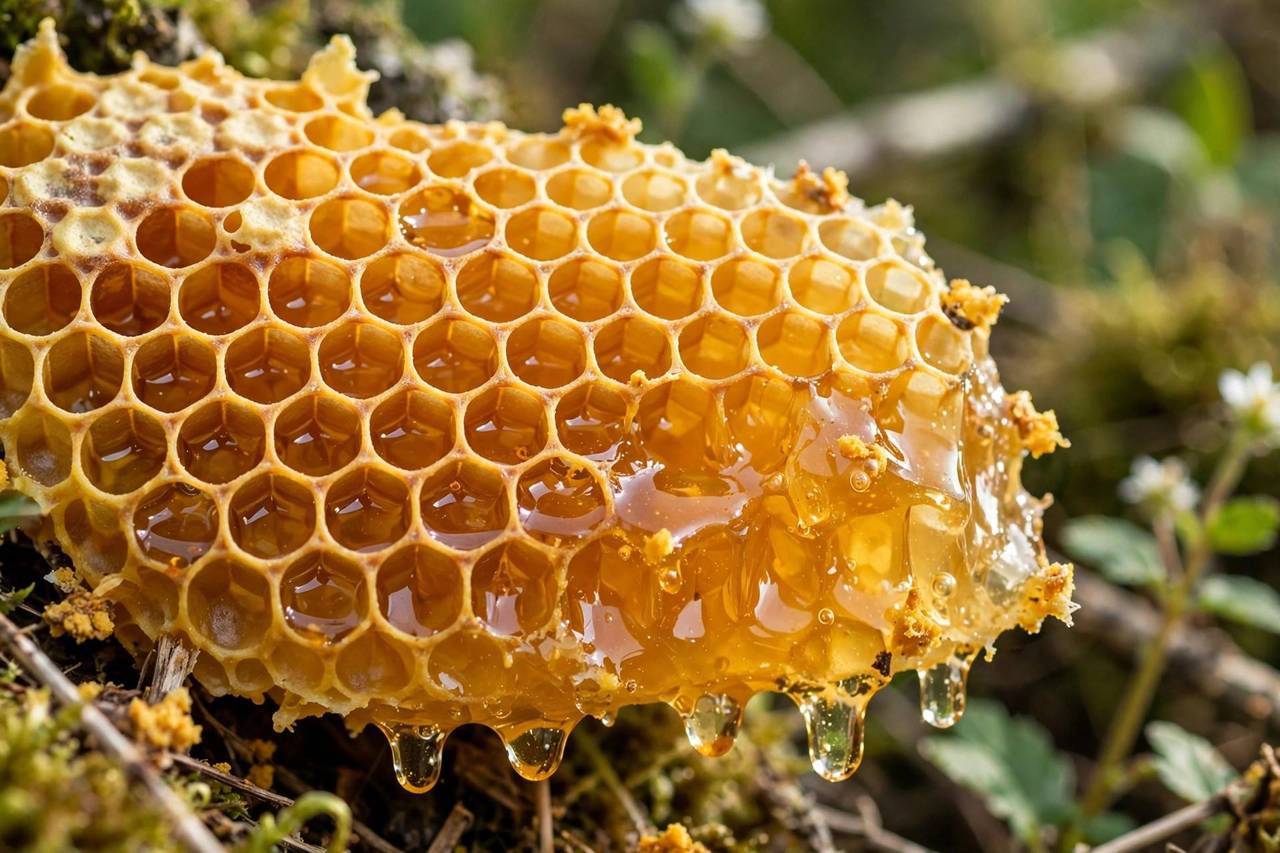
House bees deposit droplets of the processed nectar into the hexagonal honeycomb cells, spreading it thin to maximize surface area. Then comes the fanning: workers line up and beat their wings furiously, creating airflow through the hive that evaporates the water. On a warm day you can hear the hum change pitch as fanning shifts kick in — the hive is literally air-conditioning its honey into existence.
Bees also manage the hive’s temperature with remarkable precision, keeping the brood area near a steady warmth regardless of the weather outside. This climate control matters for honey production too, because evaporation works best in warm, moving air. The colony is not just making honey; it is running a dehydrating facility.
Step 4: Capping and Storage
Bees test the honey’s readiness — they can tell when the water content is right — and when a cell’s contents are properly ripened, workers seal it with a thin cap of beeswax. That wax cap is the “done” stamp: capped honey is finished honey, stable and ready for long-term storage.
The colony builds these stores as its winter pantry. A hive needs an enormous reserve to survive the cold months when no flowers bloom — the bees cluster together for warmth and live off the honey all winter. Beekeepers harvest only the surplus above what the colony needs, which is why responsible beekeeping leaves the hive’s winter supply intact.
The hexagonal comb itself deserves a moment of appreciation. Hexagons pack together with no wasted space and use minimal wax for maximum strength — a geometry so efficient that mathematicians took centuries to formally prove what bees build by instinct.
Why Honey Almost Never Spoils
Archaeologists have tasted honey from ancient Egyptian tombs and found it still edible after thousands of years. That legendary shelf life comes from the same properties the bees engineered in: very low water content (microbes cannot grow without available water), natural acidity, and those trace enzymatic compounds that discourage bacteria. Honey is essentially a food designed by evolution to last.
It can crystallize over time — turning grainy or solid — which alarms first-time honey owners but is completely natural and reversible with gentle warming. Crystallization is actually a sign of minimally processed honey; the ultra-smooth supermarket kind is often heated and filtered to delay it.
The Scale of the Work
Here is the part that stops people in their tracks. A single jar of honey on your shelf represents the combined lifetime effort of a staggering number of bees — each forager visiting flower after flower, trip after trip, for weeks, to produce a tiny fraction of a teaspoon each. The colony’s annual surplus, the part beekeepers can harvest, is the distilled labor of tens of thousands of workers across an entire flowering season.
It reframes the economics completely. Honey is not expensive because it is rare; it is inexpensive considering what it costs the bees to make. Every spoonful is a small monument to collective effort — tens of thousands of individuals, each doing a tiny job, producing something no single bee could make alone.
From Hive to Jar: How Beekeepers Harvest
Knowing how bees make honey raises the natural follow-up: how does it get from the comb into the jar without wrecking the hive? The answer is gentler than most people imagine. Beekeepers use a little smoke — which masks the bees’ alarm pheromones and prompts them to gorge on honey and grow calm — to open the hive peacefully. They remove only frames of fully capped honey, the surplus the colony does not need.
Back at the honey house, the wax caps are sliced off with a heated knife, and the frames go into a centrifugal extractor — essentially a large spinner that flings the honey out of the comb without destroying it. The emptied frames go straight back into the hive, where the bees clean, repair, and refill them. Nothing is wasted: the comb, which cost the bees enormous energy to build, gets reused again and again.
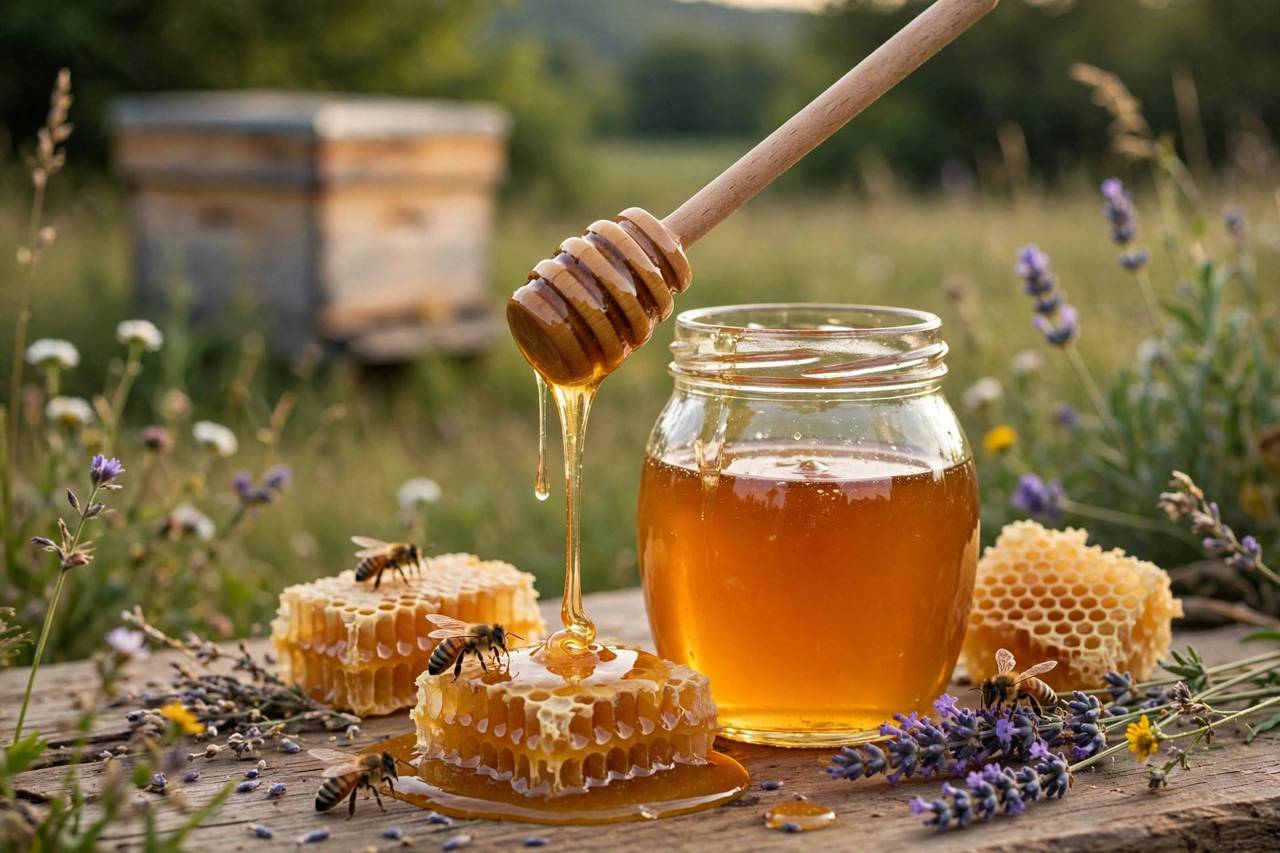
The extracted honey is strained to remove wax bits and then jarred. Raw honey skips heating and fine filtering, which is why it may crystallize faster and often tastes more complex — it is closer to what is actually in the hive. Whether raw or lightly processed, the jar on your shelf is the end of a chain that started with a forager’s waggle dance in the dark of the hive.
Frequently Asked Questions
Do bees eat the honey they make?
Yes — honey is the colony’s winter food store, and bees live on it during cold months when flowers are unavailable. They also consume it year-round for energy. Beekeepers harvest only the surplus beyond what the hive needs to survive.
How long does it take bees to make honey?
From nectar collection to capped, finished honey takes roughly one to three weeks depending on conditions — nectar flow, humidity, and colony strength all matter. A strong hive in a good flowering season can produce and ripen honey remarkably fast.
Is honey bee vomit?
Not exactly, though the internet loves the phrase. Nectar is stored in the honey stomach (crop), which is separate from the digestive stomach, and it is transformed by enzymes before being deposited. “Regurgitated and enzymatically transformed nectar” is accurate; “vomit” is technically wrong and needlessly unappetizing.
Why do bees make hexagonal honeycomb?
Hexagons tile a flat surface with no gaps while using the least wax for the most storage volume and strength. It is the most material-efficient shape for the job — an elegant solution the bees arrive at by instinct.
Can vegans eat honey?
Most vegans avoid honey since it is produced by bees and harvesting it involves managing the colony. Some beekeepers argue that responsible beekeeping supports bee populations, but the standard vegan position treats honey as an animal product. It is a personal ethical decision with good-faith arguments on multiple sides.
Do all bees make honey?
No — only honeybees make true honey in harvestable quantities. Bumblebees make tiny amounts for their own short-lived colonies, and most of the world’s 20,000-plus bee species are solitary and make no honey at all. The honeybee’s large, perennial colonies are what make surplus honey possible.