What Is Gerrymandering? How Voting Maps Get Drawn

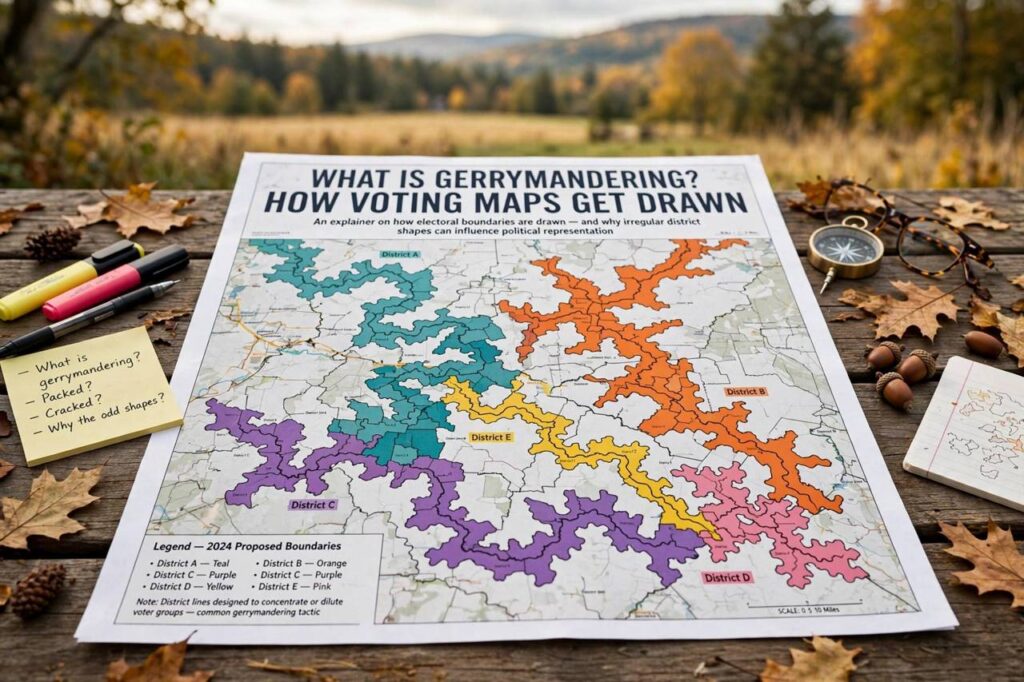
Every ten years, after the census, someone in every American state sits down with a map and draws the lines that decide who votes where. Those lines determine which neighborhoods vote together, which communities get split apart, and — very often — which party wins. What is gerrymandering? It is the manipulation of those district boundaries to give one party or group an unfair advantage, and it is one of the most consequential and least understood forces in democratic politics.
This is not a partisan issue in the way people assume — both major American parties have practiced it enthusiastically when given the chance. This guide explains how the lines get drawn, the two classic techniques, why it matters for representation, and what reformers have tried to do about it. No polemics, just the mechanics — and what ordinary citizens can do about them.
What Is Gerrymandering? The Definition
What is gerrymandering? At its core, it is drawing electoral district boundaries to benefit a particular party, incumbent, or demographic group rather than to represent communities fairly. The name itself is a piece of political history: in 1812, Massachusetts governor Elbridge Gerry approved a district so tortuously shaped that critics said it resembled a salamander — the “Gerry-mander” was born, and the term stuck.
To understand why the lines matter so much, you need the basic mechanics. In the United States, most elections use single-member districts: the country (or state) is divided into geographic districts, each electing one representative, and whoever gets the most votes in a district wins that seat. Crucially, in most of these races, only the winner matters — coming second with 49 percent of the vote earns exactly as many seats as coming second with 5 percent. That winner-take-all feature is what makes the drawing of the lines so powerful: where you place the boundaries determines how votes translate into seats.
How It Works: Packing and Cracking
Map-drawers who want to tilt the outcome have two fundamental moves, and every gerrymander in history is some combination of them.
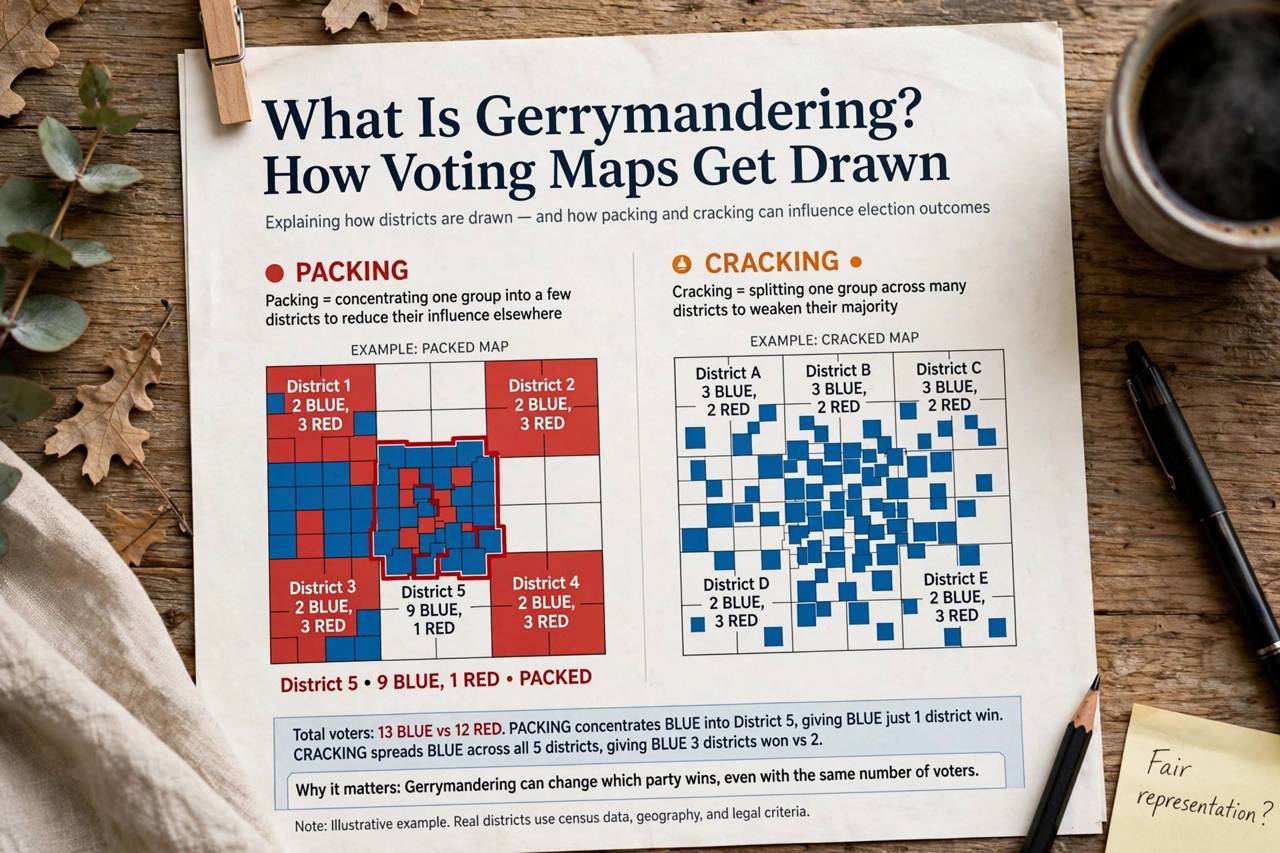
Packing means cramming as many of your opponents’ voters as possible into a small number of districts. Those districts become ultra-safe for the opposition — they win them by enormous margins — but all those surplus votes are “wasted”: they pile up in districts their party was going to win anyway, instead of helping in competitive races elsewhere.
Cracking is the mirror image: splitting your opponents’ voters across many districts so they form a losing minority in each one. A community that could easily elect its preferred candidate if kept together gets divided three or four ways, and loses everywhere.
Used together, these techniques let a party win a comfortable majority of seats with a minority of votes — or turn a narrow statewide advantage into a dominant legislative majority. The voters did not change. Only the lines did.
A Simple Example That Makes It Click
Imagine a state with 50 voters — 30 support Party A, 20 support Party B — divided into 5 districts of 10 voters each. Drawn neutrally, Party A (with 60 percent of voters) would likely win 3 of the 5 seats. That is roughly proportional.
Now suppose Party B draws the lines. It packs 18 Party A voters into 2 districts (which Party A wins overwhelmingly), then cracks the remaining 12 Party A voters across the other 3 districts, where Party B’s voters outnumber them in each. Result: Party B wins 3 of 5 seats — a majority of representation — with only 40 percent of the vote.
This is not a hypothetical trick; it is the arithmetic underlying real redistricting fights. And it works in reverse just as well — whichever party holds the pen holds the advantage.
Who Draws the Lines (and Why That Is the Whole Game)
In most US states, district lines are drawn by the state legislature — meaning the very politicians whose careers depend on the outcome get to choose their voters, rather than voters choosing them. Critics call this the fox guarding the henhouse, and it is the structural reason gerrymandering persists: the beneficiaries of the practice are the ones who would have to vote to end it.
The process runs on a ten-year cycle. After each census, states redraw congressional and state legislative districts to reflect population changes. That redistricting year concentrates enormous political power into a few months of map-drawing — which is why control of state legislatures in census years is fought over so fiercely by both parties.
A growing number of states have moved line-drawing to independent or bipartisan commissions, precisely to remove the conflict of interest. The results are debated — commissions can still be influenced, and “fair” maps are genuinely hard to define — but the direction of reform is clear: take the pen out of the interested party’s hand.
Why Gerrymandering Matters for Ordinary Voters
The effects go far beyond which party holds a majority. Heavily gerrymandered districts are usually uncompetitive, and uncompetitive districts change how representatives behave. When the only real threat is a primary challenge from your own party’s flank, the incentive is to cater to the base rather than the middle — a dynamic many analysts link to increasing polarization.
It also affects whose voice counts. Cracking can dilute the voting power of racial minorities, rural communities, or urban neighborhoods — which is why the Voting Rights Act places legal limits on certain kinds of line-drawing. And at the most basic level, it affects whether your vote feels meaningful: voters in pre-decided districts participate at lower rates, feeding the cycle of disengagement.
None of this requires fraud or illegal behavior. That is what makes gerrymandering so durable — it operates entirely within the rules, by exploiting the gap between “legal” and “fair.”
How Do You Detect a Gerrymander?
Two kinds of evidence get cited. The first is shape: districts that sprawl across the map in bizarre tentacles, connecting distant areas while splitting natural communities, are visually suspicious. But odd shapes alone do not prove manipulation — geography, coastlines, and legal requirements can all produce strange-looking districts.
The more rigorous evidence is mathematical. Researchers have developed measures that compare a party’s share of votes to its share of seats, and that test whether a map is an extreme outlier compared to thousands of computer-generated neutral alternatives. When a map produces results far outside what neutral line-drawing would produce, that is strong evidence of intent. Courts have increasingly engaged with this kind of analysis, though the legal standards remain contested.
The practical takeaway for citizens: if your district looks like abstract art and your elections are never competitive, it is worth asking who drew the lines and why. Competitive districts are not just fairer — they produce representatives who have to listen, because every vote might be the one that decides.
What Reform Looks Like
Reform efforts cluster around a few approaches. Independent redistricting commissions take map-drawing from legislatures; several states now use them with varying designs. Clear legal criteria — requiring compactness, respect for community boundaries, and partisan fairness — give courts standards to enforce. Some reformers advocate different electoral systems entirely, such as ranked-choice voting or multi-member districts, which reduce the power of line-drawing by design.
Progress has been uneven, and the courts have sent mixed signals about how far they will go in policing partisan map-drawing. But public awareness has grown enormously: redistricting, once an obscure bureaucratic exercise, is now covered as the high-stakes political battle it always was. Sunlight, as ever, is the first reform.
Gerrymandering Beyond the United States
While the term was born in America, the underlying game is played wherever district boundaries meet political power. In the United Kingdom, parliamentary constituency boundaries are drawn by independent boundary commissions — a design explicitly meant to keep partisan hands off the pen, though the reviews remain politically contentious. Canada uses independent commissions in each province for federal ridings, a system often cited by American reformers as a working model.
Other democracies sidestep the problem structurally. Countries using proportional representation — where parties win seats in proportion to their vote share — make district boundaries far less consequential, since the lines cannot manufacture a seat majority out of a vote minority the way winner-take-all districts can. The vulnerability to gerrymandering is largely a product of single-member, winner-take-all design, which is why the fiercest battles over it happen in countries that use that system.
The international lesson is instructive: gerrymandering is not an inevitable feature of democracy but a consequence of specific institutional choices — who draws the lines, and what the lines are allowed to decide. Change those choices, and the game changes with them.
Frequently Asked Questions
Is gerrymandering illegal?
It depends on the type. Racial gerrymandering — diluting minority voting power — is illegal under the Voting Rights Act and the Constitution. Partisan gerrymandering (favoring a party) occupies murkier legal territory; courts have struggled to define a workable standard for when partisanship in map-drawing goes too far.
Do both parties gerrymander?
Yes. Whichever party controls the redistricting process in a state has historically used it to its advantage. The practice is a structural feature of letting legislators draw their own districts, not a tactic unique to one side.
What is the difference between packing and cracking?
Packing concentrates the opposing party’s voters into a few districts they win overwhelmingly, wasting their surplus votes. Cracking spreads them thinly across many districts so they lose narrowly in each. Both convert the opponent’s votes into fewer seats.
Can gerrymandering be fixed?
Reformers point to independent commissions, clear fairness criteria, and alternative voting systems as solutions, and several states have adopted them. But lasting reform requires changing who holds the pen — and incumbents rarely volunteer to give up an advantage.
Does gerrymandering affect presidential elections?
Mostly indirectly. Presidents are chosen by the Electoral College at the state level, not by congressional districts (with two small exceptions), so district lines do not directly pick the president. But gerrymandered state legislatures shape voting laws and election administration, which absolutely affects presidential races — from polling place placement to the rules governing mail ballots.