What Is Copyright Infringement? Plain-English Explainer

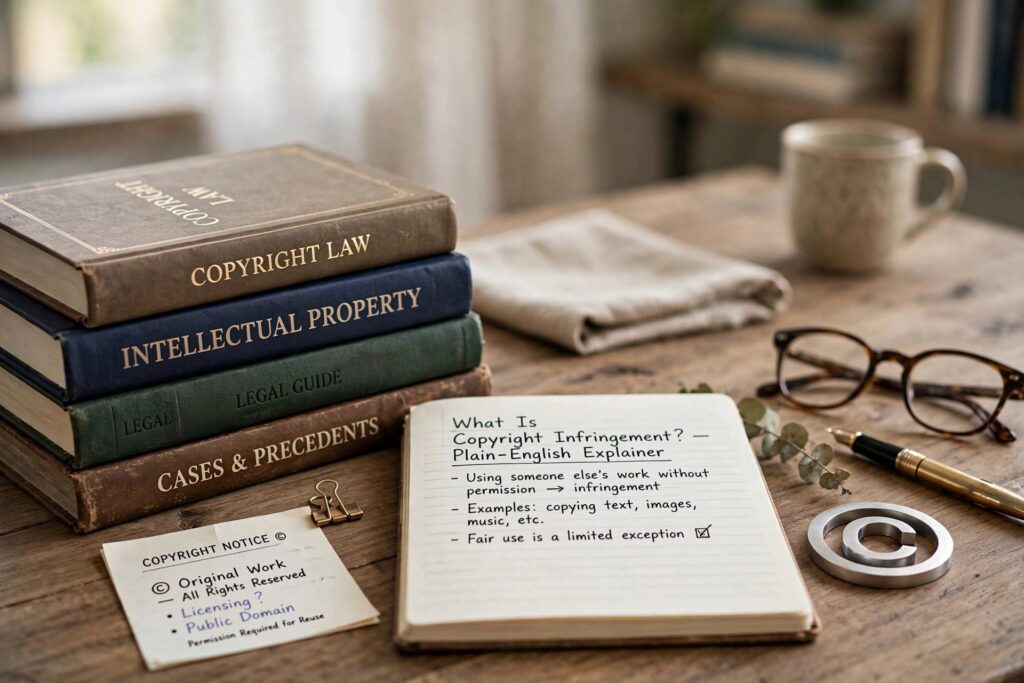
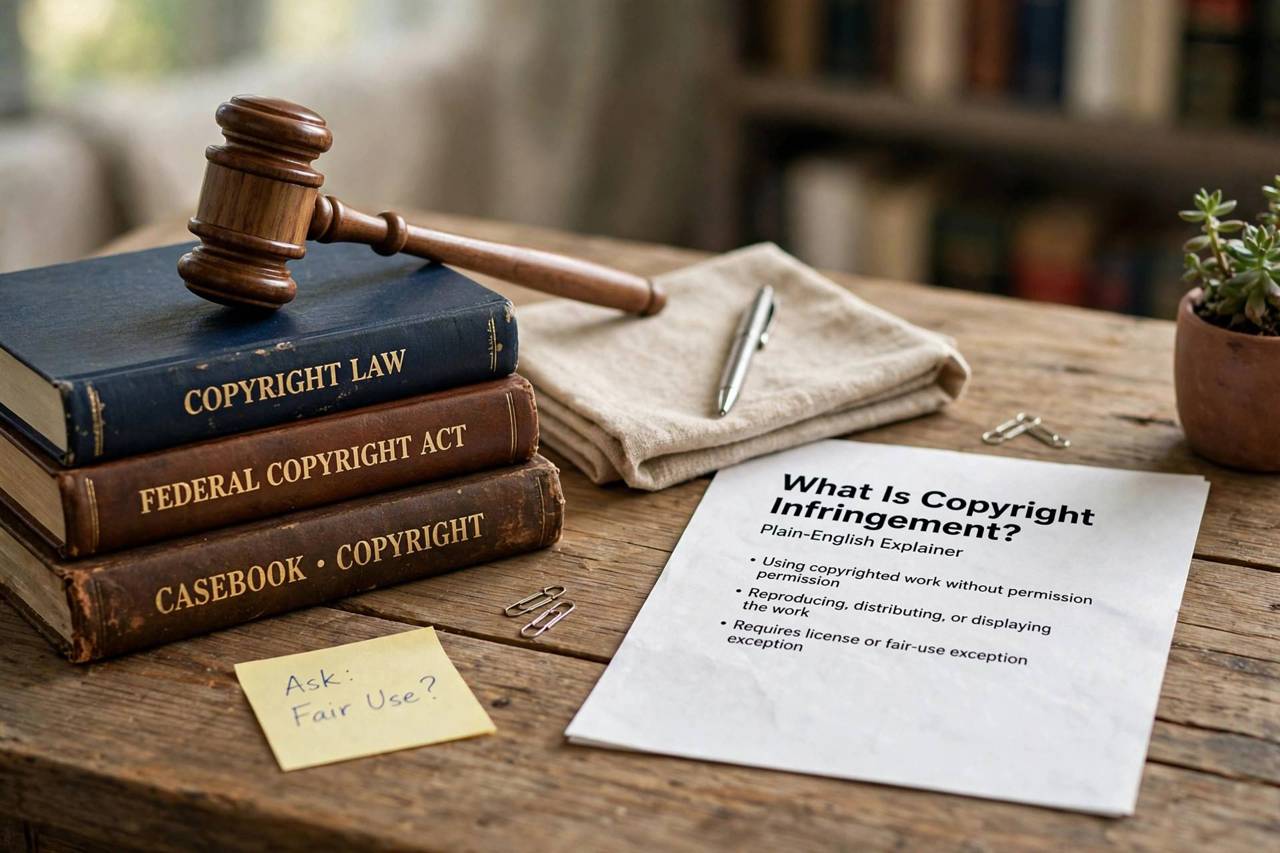
What is copyright infringement? In plain English, it is using someone else’s creative work in a way the law reserves for the creator — copying it, distributing it, displaying it publicly, or building on it — without permission. You do not have to be running a piracy website to infringe; everyday actions like uploading a song you do not own, printing someone’s photo on merchandise, or copying a blog’s article onto your site can all qualify.
I am not a lawyer, and this article is general information, not legal advice — but you do not need a law degree to understand the framework. Copyright law is built on a handful of clear concepts, and once you see them, most infringement questions answer themselves. Let us walk through what the law protects, what counts as infringement, what does not, and the famous gray area called fair use — so you can create and share with confidence.
What Copyright Actually Protects
Copyright protects original works of authorship fixed in a tangible form. That is the legal mouthful; here is what it means in practice. It covers books, articles, songs, recordings, films, photographs, paintings, software code, architectural designs, and much more. “Fixed in a tangible form” simply means it has to be written down, recorded, saved, or otherwise captured — an idea in your head is not protected, but the moment you write it out or record it, it is.
Protection is automatic. In the United States and most of the world, you own the copyright to your work the instant you create it — no registration, no copyright symbol, no paperwork required. Registration with the Copyright Office does give you extra legal advantages if you ever need to sue, but the rights themselves exist from the moment of creation.
What copyright does not protect is equally important: ideas, facts, procedures, and methods are not copyrightable. You cannot copyright the idea of a cooking blog, but you can copyright the specific recipes and photos you publish on it. Two people can independently create similar works without infringing, as long as neither copied the other.
What Is Copyright Infringement? The Core Concept
Copyright gives creators a bundle of exclusive rights: the right to reproduce the work, distribute copies, display or perform it publicly, and create derivative works (adaptations, translations, remixes). What is copyright infringement? It is exercising any of those rights without the owner’s permission, outside of a legal exception.
Notice what infringement does not require: intent to steal, commercial profit, or even knowledge that you were infringing. Copying a photo from a Google image search onto your business website is infringement even if you did not know better and made no money from it. “I found it online” and “I gave credit” are not defenses — crediting the creator is polite, but it is not permission.
Infringement also does not require copying a whole work. Using a substantial, recognizable portion can be enough — the legal test looks at quality as much as quantity. Taking the heart of a work, even briefly, can infringe, while copying a trivial fragment might not. There is no magic percentage or word count that makes copying safe, despite what you may have heard.
Everyday Examples: What Infringement Looks Like
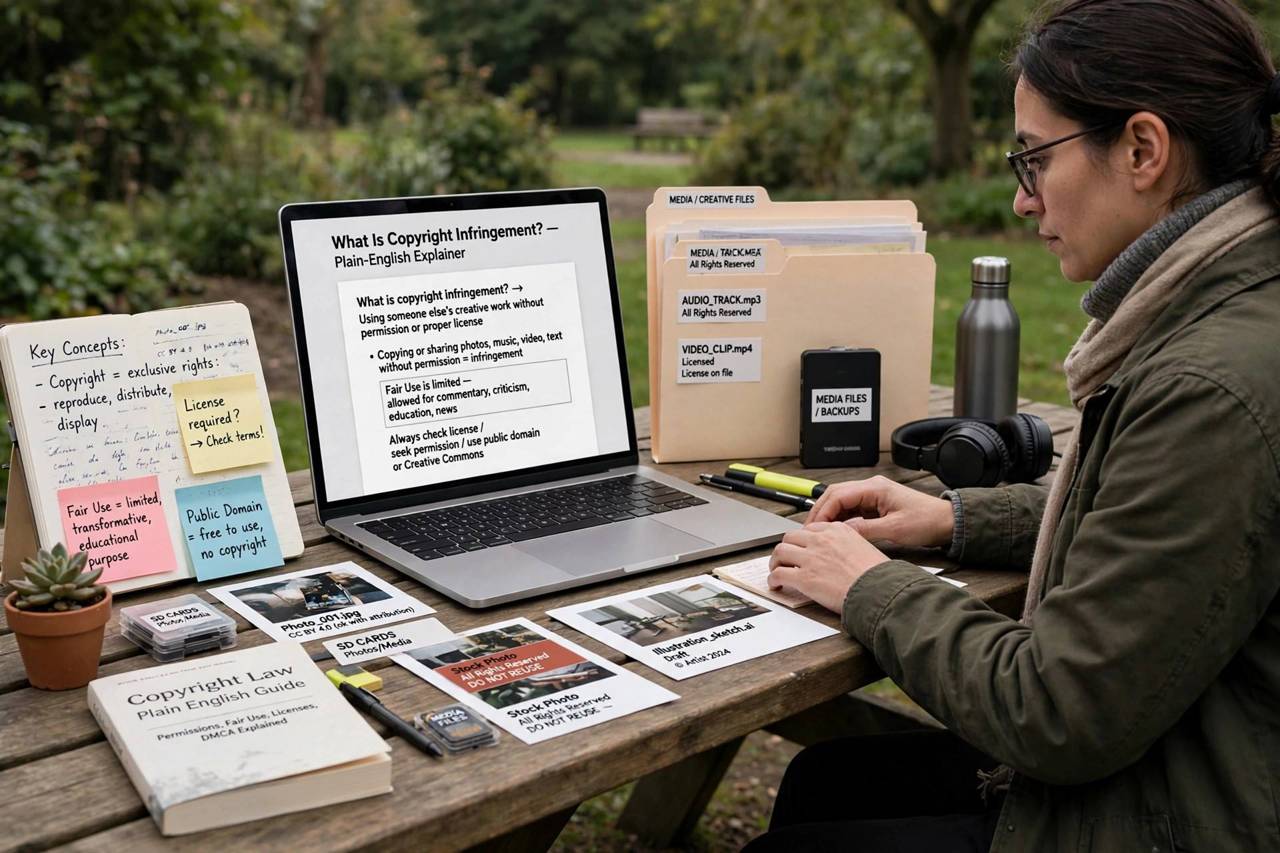
Abstract rules are forgettable; examples stick. Common real-world infringement includes:
- Uploading music you do not own to videos, streams, or social posts — the most frequent infringement ordinary people commit.
- Using someone’s photograph on your website, ad, or product without a license, even if you found it through a search engine.
- Copying articles or blog posts onto your own site, with or without credit. Summarizing in your own words is fine; reproducing the text is not.
- Sharing pirated movies, software, or ebooks — downloading and uploading both count.
- Selling merchandise with characters, logos, or artwork you did not create or license.
- Performing or screening works publicly without the proper license — playing a streaming service in your café, for instance, is a public performance.
The pattern: if you are reproducing or distributing someone else’s creative expression without permission or a valid exception, you are in infringement territory.
What Is NOT Infringement
The boundaries matter as much as the rules. These generally do not infringe: being inspired by someone’s style or idea and creating your own original expression of it; stating facts or data (facts are not copyrightable); quoting briefly for purposes like criticism or commentary under fair use; using works whose copyright has expired and entered the public domain; and using works explicitly offered under open licenses like Creative Commons, within the license’s terms.
The public domain point surprises people. Copyright eventually expires — in the US, generally the author’s life plus 70 years for individual works — after which anyone can use the work freely. That is why publishers can print Shakespeare and filmmakers can adapt Jane Austen without permission. But “old” is not the test; only actual expiration (or deliberate dedication) puts a work in the public domain.
Fair Use: The Famous Gray Area
Fair use is the doctrine that lets people use copyrighted material without permission in certain circumstances — and it is the most misunderstood concept in copyright law. It is not a fixed rule but a case-by-case analysis courts perform using four factors:
1. Purpose and character of the use. Nonprofit, educational, and transformative uses (commentary, criticism, parody, scholarship) favor fair use. Straight commercial copying does not. “Transformative” is the key word — does your use add new meaning or purpose?
2. Nature of the copyrighted work. Using factual works favors fair use more than using highly creative ones.
3. Amount used. Smaller, less central portions favor fair use — though taking “the heart” of a work can defeat this factor even in small amounts.
4. Effect on the market. If your use substitutes for the original and harms its market, fair use is unlikely. This factor often carries the most weight.
No single factor decides it, and fair use is ultimately a defense — meaning it is argued in court after a claim is made, not a permission slip you stamp on your own use. The practical lesson: fair use protects genuine commentary, criticism, and parody far more reliably than it protects “I only used a little” or “it was for school.”
The AI era has added a new frontier to these questions. If you are curious how copyright applies to machine-generated art, this explainer on AI art and copyright walks through who owns what when an algorithm does the creating.
Myths That Get People in Trouble
“If there’s no © symbol, it’s free to use.” False. Protection is automatic; the symbol is optional and its absence means nothing.
“Giving credit is enough.” False. Attribution is not permission. It may reduce hard feelings, but it does not change the legal analysis.
“I didn’t make money from it.” Mostly false. Noncommercial use can still infringe; it just sometimes helps a fair-use argument.
“I only used 10 seconds / 30 words.” False as a rule. There is no safe percentage. Short uses can infringe and long uses can be fair — it depends on the four factors.
“It’s on the internet, so it’s public domain.” False, and the most expensive myth on this list. “Publicly available” and “public domain” are completely different things.
“I changed it by 20 percent.” False. There is no percentage-of-change rule anywhere in copyright law. Derivative works based on someone else’s creation generally need permission regardless of how much you altered.
If Your Work Is Infringed — or You Are Accused
If someone is using your work without permission, the typical escalation is: document everything (screenshots, dates, URLs), contact the person directly with a clear takedown request, and if that fails, file a DMCA takedown notice with the platform hosting the content — most major platforms have a formal process for this. Registration of your copyright strengthens any further action considerably.
If you receive an infringement claim, take it seriously: do not ignore it, preserve relevant records, remove or disable the disputed content while you assess, and consult an attorney before responding substantively. Many disputes resolve with a simple takedown or licensing conversation. What escalates them is usually silence or defiance, not the original mistake.
For creators, the best protection is partly legal and partly practical: register important works, use clear licensing terms, watermark where appropriate, and keep records of your creation process. Proof of independent creation defeats most claims before they start.
Frequently Asked Questions
Can I use copyrighted images if I give credit?
No — credit is not permission. You need a license, the owner’s consent, or a valid exception like fair use. For website images, use licensed stock photos, Creative Commons images within their license terms, or your own photography. When a site offers an image under a Creative Commons license, read the specific terms: some require attribution, some forbid commercial use, and some forbid modifications.
How long does copyright last?
In the US, for works by individuals, generally the author’s life plus 70 years. Corporate works and works for hire have different terms (typically 95 years from publication). Rules vary by country, so check local law for works outside the US.
Is it infringement if I did not know it was copyrighted?
Generally, yes — infringement does not require intent or knowledge, though innocent infringement can sometimes reduce damages. “I didn’t know” is not a defense to liability itself, which is why checking before you use is the safe habit.
Can I get in trouble for sharing memes?
Memes live in a practical gray zone: most rights holders tolerate them as harmless, and many memes have plausible fair-use arguments as commentary or parody. Enforcement against individual meme-sharers is rare. Commercial use of someone else’s meme content is riskier than casual sharing.
What should I do if I receive a DMCA takedown notice?
Do not ignore it. Review the claim, remove or disable access to the disputed material while you investigate, preserve your records, and consider consulting an attorney — especially if you believe you have a valid defense like fair use or a license. If the claim is mistaken, the law provides a counter-notification process.