How to Change Your Name Legally: The Complete Step-by-Step Guide


When clients ask me how to change your name legally, they are usually surprised by two things: how straightforward the process actually is, and how many small steps it involves after the court says yes. The court order is the headline, but the real work is the paperwork marathon that follows — Social Security, driver’s license, passport, bank, and about a dozen other places that all need to agree on who you are now.
I am a lawyer, not your lawyer — so treat this as a clear map of the process, not legal advice for your specific situation. Laws vary by state and country, and a local attorney or your county court clerk can confirm the details. That said, the overall shape of the process is remarkably consistent, and this guide will take you through every stage.
The Court Petition Process, Step by Step
For an adult changing their name for personal reasons — not through marriage or divorce — the standard path is a court petition. Here is how it typically unfolds:
Step 1: File a petition with your local court
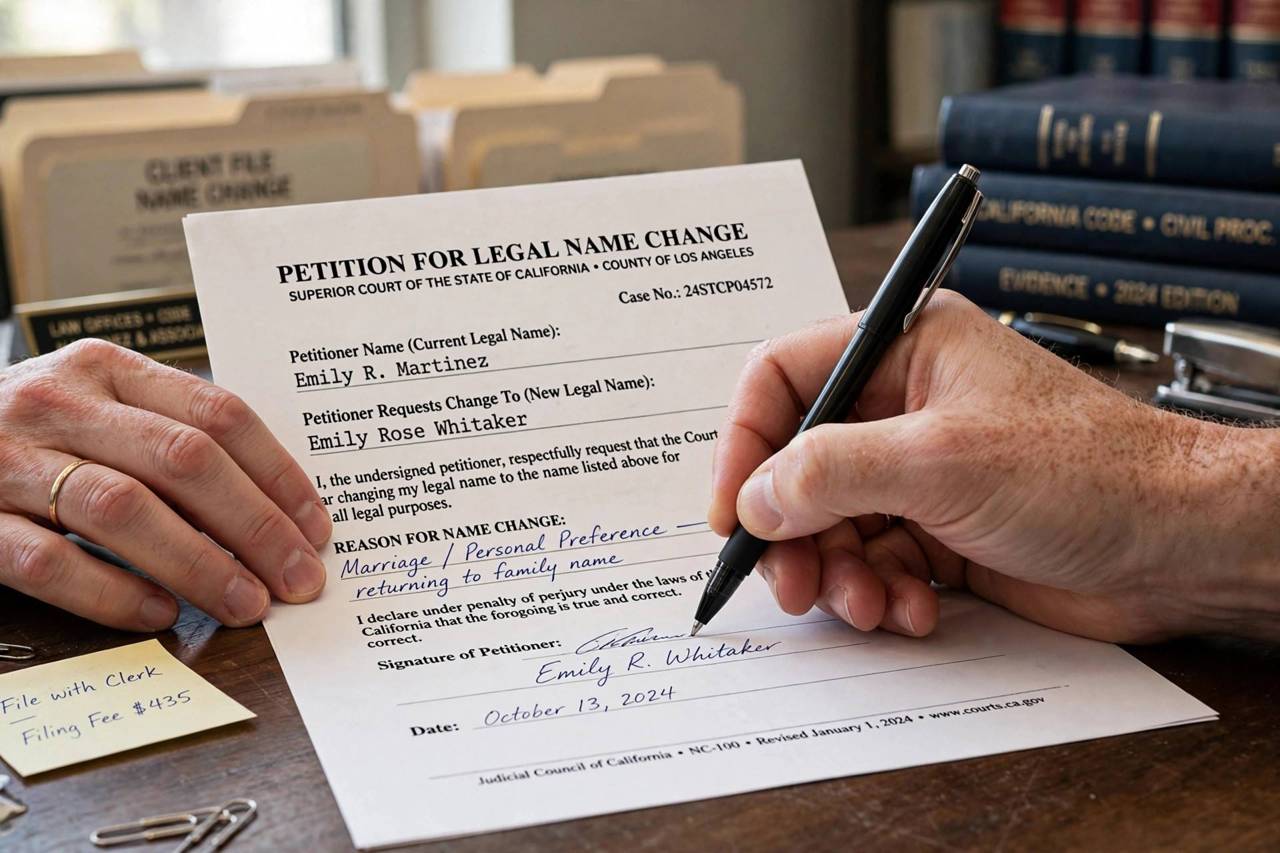
You file a name-change petition (sometimes called an application or complaint) with the civil court in the county where you live. The form asks for your current legal name, the name you want, your date of birth, address, and the reason for the change. Reasons like “personal preference” or “I have always gone by this name” are generally fine. Courts mainly want to confirm you are not changing your name to commit fraud, dodge debts, or evade law enforcement.
Step 2: Background check and fingerprints
Many jurisdictions require a criminal background check or fingerprinting as part of the petition. This is the fraud-prevention layer — the court wants to know who you are before it lets you become someone else on paper. Budget a few weeks for this to come back.
Step 3: Publish notice (in many states)
A surprising number of places still require you to publish your intended name change in a local newspaper for several weeks. The historical purpose was to alert creditors; today it is mostly ritual, but it is mandatory where required. Some states waive publication for safety reasons (domestic violence survivors, for example) — ask the court clerk about waivers if publication would put you at risk. Publication usually costs $50–$200.
Step 4: The hearing
Many name changes are approved without you ever seeing a judge — the paperwork goes through administratively. If a hearing is scheduled, it is typically brief: the judge confirms your identity, asks your reason, and grants the order unless something is off. Bring ID and any supporting documents. Dress like you respect the court’s time, because you should.
Step 5: Get certified copies of the court order
This is the golden ticket. Order several certified copies (usually $5–$15 each) — you will need originals or certified copies for nearly every agency below, and running back to the courthouse is nobody’s idea of fun. I tell clients to get at least five.
What It Costs
Total costs vary widely by location, but a realistic U.S. budget looks like this:
- Court filing fee: $150–$400 depending on the county
- Newspaper publication: $50–$200 (where required)
- Background check/fingerprints: $25–$75
- Certified copies: $25–$75 for a batch
- Attorney (optional): $500–$1,500 if you hire one; most adult name changes do not require a lawyer
All in, most straightforward adult name changes cost $250–$700 without a lawyer. Fee waivers exist in many courts for those who cannot afford the filing fee — ask the clerk; there is no shame in it and the forms are routine.
The Easier Paths: Marriage and Divorce
Here is what surprises people most: if you are getting married or divorced, you can usually skip the entire petition process.
Marriage: In most U.S. states, you can adopt your spouse’s surname (or hyphenate) simply by writing the new name on the marriage license application. The marriage certificate then serves as your legal name-change document — no court petition, no publication, no hearing. Note the limits: this path generally covers surname changes only, and rules about middle names or entirely new first names vary. Same-sex couples have the same rights here.
Divorce: Most states let you request restoration of a former name (typically a maiden name) as part of the divorce decree. Ask for it during the proceedings — it costs nothing extra and the decree becomes your legal document. If you forget, you can usually go back and amend, but it is simpler to handle it in the original decree.
If marriage or divorce is already on your horizon, timing your name change to ride along with it saves hundreds of dollars and months of process. It is the single most useful piece of practical advice in this entire guide.
After the Court Order: The Paperwork Marathon
The court order changes your name in law. These steps change it in practice. Do them in roughly this order, because each agency wants to see the previous one’s updated document:
- Social Security. First stop in the U.S. — everything else keys off this record. Bring the court order and ID; the updated card arrives by mail in a couple of weeks.
- Driver’s license / state ID. Bring the court order and your new Social Security card. Most states require this within 30 days of the change.
- Passport. Apply for a new passport with the court order. If your current passport is less than a year old, the correction may be free.
- Bank accounts and credit cards. Visit in person with the court order and new ID. Update debit cards, checks, and online profiles.
- Employer and tax records. HR needs the new name for payroll and tax withholding — mismatches between your name and Social Security records cause real tax headaches.
- Voter registration. Update it, or risk confusion at the polls.
- Insurance, utilities, leases, memberships. The long tail. Work through bills and accounts over a few weeks.
- Professional licenses and degrees. If you hold licenses (nursing, teaching, law) or want your diploma reissued, contact each issuing body — procedures vary.
Keep a checklist and a folder with your certified copies. The whole marathon typically takes one to three months of calendar time, mostly waiting on mail.
Special Cases Worth Knowing
- Minor children: changing a child’s name generally requires the consent of both legal parents or a court finding. Courts apply a “best interests of the child” standard, and the process has extra safeguards. Do not assume the adult process applies.
- Gender transition: many jurisdictions have streamlined processes, and a growing number allow gender marker changes alongside name changes. Advocacy organizations publish state-by-state guides that are more current than any general article.
- Common-law name use: in some places you can simply start using a new name socially without any court process — but banks, governments, and employers will still demand the court order. Social use and legal change are different things.
- What courts reject: names chosen to commit fraud, names with numerals or symbols most registries cannot process, and in some places deliberately confusing or offensive names. “Because I like it” is fine; “to dodge my creditors” is not.
How to Change Your Name Legally Without a Lawyer
Most adult name changes do not need an attorney — the process is designed for self-filing. Here is how to handle it yourself competently, and where the DIY line sits.
Get the packet from the court clerk. This is step zero and the most important one. Call or visit the civil court clerk in your county and ask for the adult name-change packet. It contains the exact local forms, the filing fee, publication requirements, and any county-specific quirks. Do not download generic forms from the internet — counties reject wrong forms, and the clerk’s packet is free. While you are there, ask three questions: the total filing fee, whether a hearing is typically required, and the publication rule. Write down the answers.
Fill out the forms meticulously. Name-change petitions get rejected for dumb reasons: mismatched dates, missing middle names, addresses that do not match your ID. Fill out every field, double-check spellings (your new name must be spelled identically everywhere), and make copies of everything before filing. If the form asks for your reason, a simple honest sentence suffices — “I have used this name socially for years and wish to make it legal” is perfectly acceptable in most jurisdictions.
Handle publication yourself. Where publication is required, the court usually provides a list of approved newspapers. Call two or three and ask for the legal-notice rate — prices vary, and the cheapest qualifying paper is fine. You will need to publish once a week for the required number of weeks (often 4), then file the publisher’s affidavit of publication with the court. Calendar every date; missing a week restarts the clock in some jurisdictions.
At the hearing (if there is one): arrive early, dress respectfully, bring your ID, the filed petition, the publication affidavit, and the background check results. The judge will typically ask you to confirm your identity and state your reason. Answer briefly and honestly. Most hearings last under ten minutes. Then request your certified copies of the order before you leave the courthouse — this is the easiest moment to get them.
When you DO need a lawyer: contested situations (the other parent objects to a child’s name change), name changes intersecting with immigration status, a criminal record that complicates the background check, or any case where the court has questions you cannot answer confidently. For everything else, the clerk’s packet plus careful paperwork gets you there — thousands of people do it every year.
Frequently Asked Questions
How long does a legal name change take?
The court process typically takes 2–6 months from filing to order, depending on your jurisdiction’s backlog and whether publication is required. The post-order paperwork marathon adds another 1–3 months. Plan for up to half a year end to end, though many people finish faster.
Do I need a lawyer to change my name?
For a straightforward adult name change, usually not — the forms are designed for self-filing and court clerks answer procedural questions. Consider a lawyer if your situation is complicated: contested child name changes, immigration intersections, or a criminal record that might complicate the background check.
Can I change my first name, or only my last name?
You can change your first name, middle name, last name, or all three through a court petition. The marriage/divorce shortcut typically covers surnames only, which is why people wanting a new first name usually need the full petition process.
Will a name change affect my credit history?
Your credit history follows you — it is tied to your Social Security number, not your name. After the change, notify the credit bureaus so your file reflects the new name; your history, good or bad, transfers with you. A name change does not erase debts or reset credit.
Do I have to publish my name change in a newspaper?
It depends on your state — many still require it, some do not, and most allow waivers for safety concerns. Your court clerk will tell you the local rule. Where required, the court usually designates which publications qualify, and legal-notice rates are standardized.
Start With the Clerk’s Office
The single most useful step: call or visit your county court clerk and ask for the name-change packet. It contains the exact local forms, fees, and publication rules — everything in this guide made specific to you. The process of learning how to change your name legally is mostly a matter of following local instructions carefully and then working the post-order checklist with patience. Thousands of people do it every year without lawyers and without drama. You can too.
Disclaimer: This article is general information, not legal advice. Laws differ by jurisdiction and change over time — confirm details with your local court or a licensed attorney.