What Is a Vision Board and Does It Work? What Research Says

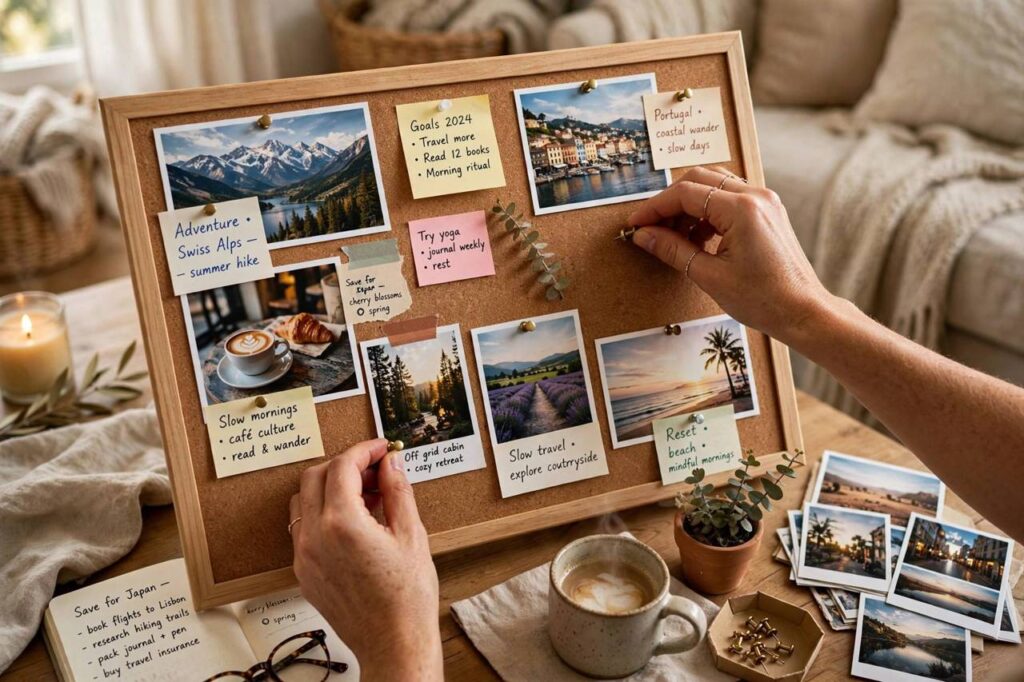
When people ask what is a vision board and does it work, they are usually asking two different questions: what is this collage thing everyone posts about, and is it real or just wishful thinking with glue sticks? I have made several over the years — some that genuinely shifted my life, and one spectacularly pretty board that changed absolutely nothing. The difference taught me everything. Let me give you the honest version: what vision boards are, what the research actually says, and how to make one that works instead of one that decorates.
First, the definition, plainly: a vision board is a collage of images, words, and symbols representing your goals and the life you want — typically assembled on a poster board or digitally, then placed where you will see it daily. The idea is that regular visual exposure keeps your goals present in your mind, shaping the small daily choices that compound into big outcomes. That is the theory. Now let us see how much of it holds up.
What the Research Actually Says
Here is where I part ways with the manifestation influencers: there is no evidence that looking at pictures magically attracts outcomes. The universe does not deliver promotions to people with nice collages. But — and this matters — there IS evidence for the psychological mechanisms underneath, when the board is built correctly:
- Visualization works, with a catch. Sports psychology has decades of evidence that mental rehearsal improves performance. The catch, from researcher Gabriele Oettingen’s work: visualizing the outcome alone can actually reduce motivation (your brain feels like it already achieved it). What works is visualizing the outcome AND the process — the steps, the obstacles, the effort. A board of pure dream imagery can backfire; a board that includes the work does not.
- Goal salience matters. Goals you see daily stay active in your decision-making; goals you write once and forget do not. A vision board is, at minimum, a persistent reminder system — and reminder systems have solid evidence behind them. This is the least glamorous and most real mechanism.
- Selective attention is real. When your goals are mentally active, you notice relevant opportunities — the course, the introduction, the job posting — that you would otherwise filter out. Psychologists call this priming. It is not magic; it is your reticular activating system doing its job once you tell it what to look for.
- Identity reinforcement. A board depicting the person you are becoming strengthens that identity, and identity drives behavior more reliably than willpower. “I am someone who writes daily” beats “I should write more” every time.
The honest summary: vision boards do not manifest outcomes, but they can effectively program attention, motivation, and identity — if built around process and action rather than pure fantasy. The research supports a vision board done right and debunks one done wrong. So let us do it right.
How to Make a Vision Board That Actually Works
Forget the aesthetic-first approach. Build yours like a behavioral tool:
Step 1: Get specific about goals
“Abundance” is not a goal. “Save $10,000 for a house deposit by December” is. Write 3–5 concrete goals first — the board illustrates them, it does not substitute for defining them. Vague boards produce vague results because they give your brain nothing to act on.
Step 2: Add process images, not just outcome images
This is the critical correction from the research. For every dream image (the house, the graduation), add an image representing the work: the early morning, the study desk, the running shoes, the savings chart. Your board should depict the journey, not just the destination — because the journey is what you control.
Step 3: Include words that instruct
Single evocative words (“freedom,” “strong”) are fine, but add at least a few that direct action: “write 500 words daily,” “call one client,” “save $200 weekly.” The board should tell future-you what to do, not just how to feel.
Step 4: Make it unavoidable
A board in a closet is decoration. Put it where your eyes land daily — bedroom wall, office, phone wallpaper (photograph the physical board). Daily exposure is the entire mechanism; without it, you have made art, not a tool.
Step 5: Review and update quarterly
Goals evolve. A board that no longer matches your life becomes invisible — your brain filters out stale stimuli. Every three months, remove what is done or irrelevant, add what is new. The maintenance ritual is itself a goal review, which is valuable independently.

Physical vs Digital: Which Is Better?
Physical boards (poster, corkboard, magazine cutouts) have a tactile, ritual quality — the act of making one is itself a commitment exercise, and a large board on your wall is genuinely hard to ignore. Digital boards (Pinterest, Canva, phone wallpaper) are portable and endlessly editable. The research does not crown a winner; the best format is the one you will actually look at daily. My suggestion: make the physical one for the ritual, photograph it, and set the photo as your phone wallpaper for the portability. Both mechanisms, one effort.
Common Ways Vision Boards Fail
- Fantasy-only content. A board of yachts and mansions with no connection to your actions is a daydream, not a plan. The research is clear: outcome-only visualization can reduce the drive to act.
- Too many goals. A board with thirty aspirations is a board with zero priorities. Three to five goals maximum — focus is the feature.
- Made once, never seen again. The number one failure mode. If it is not in your daily visual field, it is not doing anything.
- Substituting for action. The darkest trap: the good feeling of making the board replaces the effort of pursuing the goals. If board-making feels productive enough to skip the actual work, the board is harming you. The board is the map, not the journey.
If you want a structured walkthrough of the craft itself, our guide on how to make a vision board covers materials, layout, and digital options step by step — pair it with the evidence-based approach above.
What Is a Vision Board and Does It Work for Career Goals
Vision boards get associated with lifestyle dreams — the house, the travel, the aesthetic. But the most evidence-aligned use of a vision board is the least glamorous one: career goals. Here is why career boards work better than lifestyle boards, and how to build one.
Careers have clearer processes. The research-backed formula — visualize the outcome AND the process — is easier with careers because the process is concrete: the certification to earn, the portfolio to build, the people to meet, the applications to send. A career board naturally includes process imagery (the desk, the course, the conference) alongside outcome imagery (the role, the company, the salary milestone). Lifestyle boards drift into pure fantasy; career boards stay anchored to steps.
Build it around the next role, not the dream job. The most effective career board depicts the next achievable step, not the ten-year fantasy. “Senior designer by Q3” with images of the portfolio pieces to create and the skills to learn beats “famous creative director” with a mansion. Proximal goals drive action; distant fantasies drive daydreaming. You can always make a new board when you arrive.
Include the uncomfortable process images. The networking events you dread. The difficult conversation with your manager about promotion. The 6 a.m. study sessions for the certification. These are the images that actually change behavior — because they prime you for the hard parts instead of just the rewards. A career board of pure corner offices is decoration; a career board with the hard parts is a plan.
Pair it with a quarterly review ritual. Every three months, sit with the board and audit: what moved, what stalled, what is no longer relevant. Update it. This ritual is arguably more valuable than the board itself — it forces the regular goal review that busy professionals otherwise skip. The board is the excuse; the review is the mechanism.
None of this manifests a promotion. But a career board that keeps your next step visible daily, depicts the work honestly, and triggers a quarterly review will quietly outperform every colleague who set goals in January and forgot them by March. That is not magic. It is just a system that works — which, as I have argued throughout, is the only kind worth having.
Frequently Asked Questions
Do vision boards really work, scientifically?
There is no evidence for manifestation — images do not attract outcomes. There is good evidence for the underlying mechanisms when boards are built well: visualization of process (not just outcomes), goal salience through daily exposure, selective attention/priming, and identity reinforcement. A well-built board is a legitimate behavioral tool; a fantasy collage is decoration.
How long does it take for a vision board to work?
It does not “work” on a timeline — it supports goals that have their own timelines. Think of it as a daily reminder system, not a manifestation device. Review it quarterly; expect the goals themselves to take the time goals take. Anyone promising results in 30 days is selling something.
What should I put on my vision board?
Three to five specific goals, depicted with both outcome images (what you are working toward) and process images (the work itself), plus a few action-directing words. Keep it focused — every element should connect to a real goal and a real next step.
Are digital vision boards as effective as physical ones?
Effectiveness comes from daily visibility and the quality of the goals, not the medium. A phone wallpaper you see fifty times a day beats a poster in a spare room. That said, the physical act of making a board has ritual value — consider doing both: make it physical, then digitize it for daily exposure.
What is the difference between a vision board and a dream board?
Mostly terminology — “dream board” tends to emphasize wishes, “vision board” tends to emphasize goals. The distinction that actually matters is not the name but the content: process plus outcomes (effective) versus fantasy alone (counterproductive). Call it whatever you like; build it around action.
The Honest Answer
So what is a vision board and does it work? It is a visual goal-reminder system — and it works to exactly the extent that it keeps real goals present in your mind, depicts the process as well as the prize, and sits where you cannot ignore it. It will not manifest your dreams. But it might just keep you pointed at them long enough to build them yourself. And that, honestly, is better than magic.