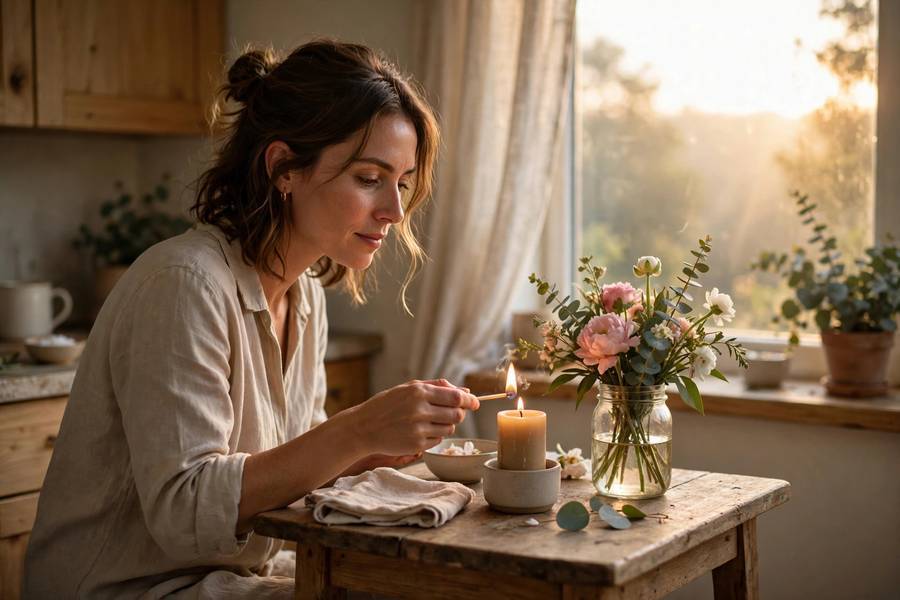
The phrase gets thrown around a lot on social media — candles, slow mornings, linen aprons — and it’s easy to roll your eyes at it. I did, at first. But strip away the aesthetic performance and there’s something genuinely worthwhile underneath: learning how to romanticize your life just means deciding that ordinary days deserve your attention. Not someday, when life is bigger or better, but on this Tuesday, with this laundry.
It’s not about buying things or becoming a different person. It’s about noticing what you’re already living, and giving it a little ceremony.
Table of Contents
- What “Romanticizing Your Life” Actually Means
- Start With Your Mornings
- Turn Daily Chores Into Rituals
- Dress for the Day You Actually Have
- Make Room for Beauty You Didn’t Buy
- Slow Down Your Evenings
- The Mindset Shift That Makes It Stick
- Frequently Asked Questions

What “Romanticizing Your Life” Actually Means
At its simplest, to romanticize your life is to treat your everyday as if it mattered — because it does. Most of us are living in the middle of the “before” picture: waiting for the new job, the trip, the house, the version of ourselves that’s supposed to be more worth celebrating. Romanticizing life refuses that bargain. It says the coffee you’re making right now is already the good part.
This isn’t denial. Your problems don’t vanish because you lit a candle. But your attention shapes your experience more than you think. Psychologists call this savoring — the practice of noticing and prolonging positive moments — and there’s real research behind it: people who deliberately savor small pleasures report higher life satisfaction than people who only enjoy the big events.
So this isn’t fluff. It’s a small, practical skill. And like any skill, it starts with a few deliberate changes.
What it is not
- It isn’t spending money to look like you have a certain life.
- It isn’t posting it — the moment you stage your life for an audience, you’ve left the practice behind.
- It isn’t perfection. A romanticized life still has burnt toast and bills on the counter. The romance is in how you move through it.
Start With Your Mornings
Mornings set the tone, and they’re the easiest place to start because you already own them. Nobody else needs to cooperate.
For years, I woke up and immediately reached for my phone — checking headlines and messages before my feet touched the floor. The day started as a reaction. Changing that one habit changed more than I expected. Now there’s a rule: no phone for the first thirty minutes. In its place: water, light, something warm to drink.
There’s a physiological reason the benefits of drinking water in the morning are real — you wake up dehydrated, and rehydration clears the fog. But there’s a psychological layer too. That first glass of water, drunk slowly by the window instead of gulped in a rush, is a small signal to yourself: we’re not sprinting today.
A few small upgrades that cost nothing:
- Open a window or curtains first thing. Light tells your body the day has started and tells your brain something pleasant is happening.
- Make the bed — badly is fine. A made bed is the cheapest visual reset a room can get. It takes ninety seconds.
- Eat breakfast sitting down. Not standing over the sink, not at your desk. Sit. Use a plate. This is the single smallest luxury on this list, and one of the most powerful.
- Play music you actually love. Not a focus playlist. The songs that make you feel like the main character of something. That’s allowed.
You don’t need a two-hour morning routine. You need ten unhurried minutes that belong to you.
Turn Daily Chores Into Rituals
The word “ritual” sounds grand, but a ritual is just a habit performed with attention. Washing dishes can be a chore you resent or a quiet, warm, meditative pause — the only difference is where your mind goes.
I started with tea. I bought a small teapot — nothing fancy — and began making a proper pot in the afternoon instead of a bag in a mug. The whole process takes six minutes. Boiling the kettle, warming the pot, waiting. It forced a pause into a day that had none, and it became the anchor of my afternoons. That pause is what romanticizing your daily life looks like in practice: a small ceremony that interrupts the blur.
Other chores that convert well:
- Folding laundry with a podcast or an album you love, on the floor in a patch of sun.
- Wiping down the kitchen at night with a candle lit nearby. Yes, really. The counter doesn’t care, but you will.
- Grocery shopping with a list written in pen and one treat included — the good cheese, the ripe peaches. Grocery stores are underrated sources of small joy if you stop treating them as errands.
The Danish have a whole philosophy for this kind of thing. The hygge lifestyle is essentially romanticizing ordinary life with a Nordic accent — warmth, simplicity, presence. If you want a cultural precedent, it’s a good one to borrow from.
Dress for the Day You Actually Have
This one surprised me. During a long stretch of working from home, I lived in the same rotation of faded joggers and stretched-out t-shirts. Nothing wrong with comfort — but I noticed I treated myself like someone on standby, not someone living her life. So I changed one thing: I started dressing each morning as if the day ahead deserved a real person in it.
That didn’t mean uncomfortable clothes. It meant clean, intentional, put-together versions of comfortable. A soft sweater instead of the stained hoodie. Earrings, even with no plans. Building a capsule wardrobe made this easier — fewer choices, everything fits, everything goes together. When getting dressed takes three minutes and always works, there’s no excuse for the standby uniform.
This isn’t about vanity. It’s about the message you send yourself before anyone else sees you: today counts. The woman who bothers with the earrings is, unconsciously, a woman who bothers about other things too. Small dignities compound.
Make Room for Beauty You Didn’t Buy
A big misconception: romanticizing your life requires spending. The most romantic things in any life are free — you just have to make room for them.
- Fresh air with no agenda. A walk without a podcast, without a step goal. Look at the sky. Notice which trees are changing. This sounds like nothing and delivers a lot.
- Flowers from the grocery store, split into small jars. One $8 bunch becomes four little arrangements. Put one by your bed, one in the kitchen, one on your desk. It feels absurdly luxurious for almost no money.
- Library books. A stack of borrowed books on the nightstand feels like abundance without a receipt.
- Handwritten anything. Notes to friends, lists in a paper notebook, letters you’ll never send. Handwriting slows thought down, and slower thought is more generous thought.
- One beautiful free thing per week: the library, a museum’s free day, a sunset from a hill, a farmers market just to look. Mark it on your calendar like an appointment, because it is one.
The point is curation of attention, not curation of stuff. A person who notices the light coming through the window at 4 p.m. is living a more romantic life than a person with an expensive couch who never looks up.
Slow Down Your Evenings
Evenings are where romanticizing life pays off most visibly, because evenings are where most of us collapse into scrolling. The phone eats the hours between dinner and sleep, and they vanish without a trace — you can’t remember what you looked at, but you know you looked.
An evening ritual doesn’t have to be elaborate. Mine is this: dishes done, kitchen wiped, phone on the charger in another room, tea or cocoa, book or journal, lamp on. It takes the same two hours I’d otherwise spend scrolling, and I remember them. I go to sleep with a sentence I liked in my head instead of a headline I wish I hadn’t seen.
Some practical evening anchors:
- The shutdown walk. Ten minutes after dinner, around the block, no phone. It digests the food and the day.
- The journal line. Not a whole entry — one line. “Today, the good thing was…” One line a day becomes a remarkable record by December.
- The ready-for-morning kitchen. Clean counters, coffee set up, bag packed. Your morning self will feel taken care of by your evening self, and that’s a strange, lovely kind of romance — kindness across time, from you to you.
The Mindset Shift That Makes It Stick
All of the above is mechanics. The shift underneath is this: stop narrating your life as the waiting room. The waiting room is a story — “when I get the promotion, when I move, when I’m fitter, then I’ll enjoy things.” It’s a story with no ending, because the goalposts move every time you arrive.
Romanticizing your life is the opposite story: this is already it. The apartment, the commute, the Tuesday. You’re not waiting anymore — you’re paying attention. And attention, it turns out, was the thing that was missing all along.
Start small. Pick one ritual — the morning water, the afternoon tea, the phone-free evening — and do it for a week. Don’t post it. Don’t announce it. Just live it a little more deliberately than before. That’s the whole practice. It was never about the candles. Well — not only about the candles.

Frequently Asked Questions
Romanticizing your life means treating your ordinary days with attention and intention — slowing down, adding small rituals, and noticing the pleasures already present in your everyday routine instead of waiting for a bigger, better future to enjoy things.
No. The most effective parts of the practice are free: drinking water slowly by the window, eating breakfast sitting down, walks without a phone, library books, fresh air, and a phone-free evening. Small purchases like grocery-store flowers or a teapot help, but they’re optional, not the point.
Attach rituals to things you already do. Drink your coffee sitting down instead of standing. Light a candle while you do the evening dishes. Walk ten minutes after dinner. You don’t need extra hours — you need to bring attention to the hours you already have.
No — that’s the social-media version, and it misses the point. The real practice is internal: savoring small moments, building small rituals, and shifting your mindset from “waiting for life to start” to paying attention to the life you’re already living. The moment it becomes about how it looks to others, it stops working.
No phone for the first thirty minutes of the day. Replace it with water, light, and something warm to drink. It’s one rule, it costs nothing, and it changes the texture of your entire morning — which tends to change the texture of the whole day.
The practice is closely related to “savoring,” a well-researched concept in positive psychology: people who deliberately notice and prolong small positive moments report higher life satisfaction. It won’t fix serious problems, but it reliably improves how you experience ordinary days.