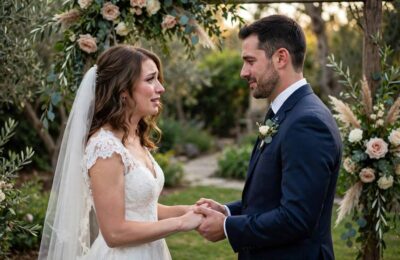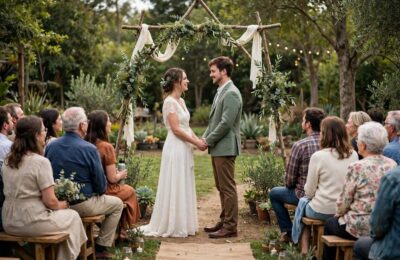

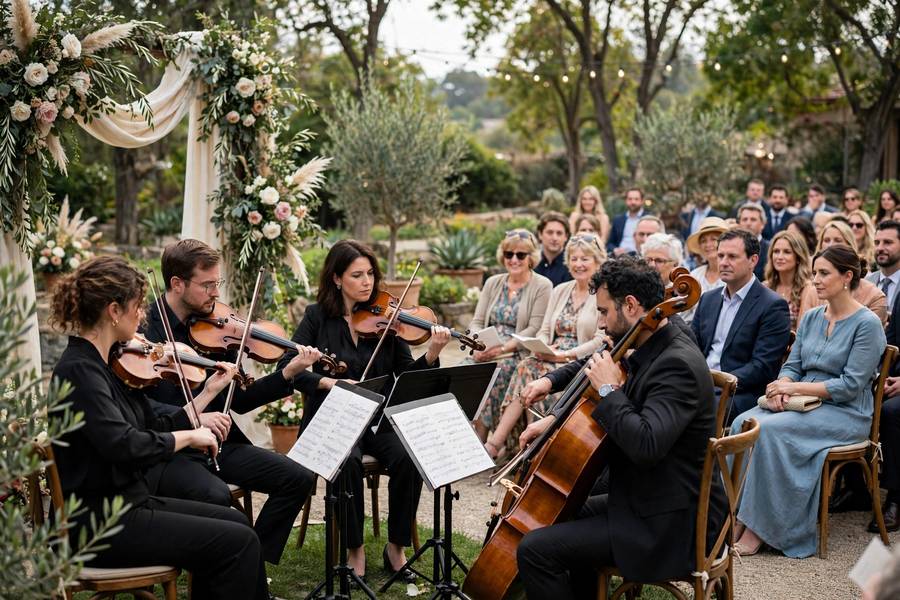
Music is the invisible architecture of your wedding day. It tells guests when to sit, when to stand, when to cry, and when to lose their minds on the dance floor. Get it right and nobody notices — they just feel like the day flowed perfectly. Get it wrong and the whole day feels off in a way nobody can quite name.
I’ve coordinated hundreds of weddings, and music is the vendor decision couples overthink the most and plan the least. Here’s how to choose wedding music for every moment — ceremony, cocktail hour, dinner, and reception — including the DJ vs. band question, real budgets, and the timeline mistakes I see constantly.
Table of Contents
- Start With the Feeling, Not the Songs
- Every Moment That Needs Music
- Ceremony Music: The Breakdown
- Cocktail Hour and Dinner Music
- Reception Music: The Main Event
- DJ vs. Band vs. Playlist: Honest Comparison
- Real Budget Numbers
- How to Brief Your Musicians
- Timing Mistakes I See Constantly
- Frequently Asked Questions
Start With the Feeling, Not the Songs
Couples usually start with “what songs do we like?” — wrong starting point. Start with: how do you want each part of the day to feel?
- Ceremony: reverent? joyful? intimate?
- Cocktail hour: elegant background? fun and upbeat?
- Dinner: conversational and warm?
- Reception: non-stop party? mixed ages dancing together? late-night club energy?
Write one word for each segment. Then choose music that creates that feeling. A couple who wants an “elegant, emotional” ceremony and a “wild, euphoric” reception needs completely different music for each — and that’s normal. The wedding day has movements, like a symphony. Let each one have its own sound.
Second principle: consider your guests’ ears, not just yours. Your wedding music is hospitality. A death-metal ceremony might be authentically you, but if 80% of your guests are miserable, you’ve failed at hosting. Find the overlap between your taste and your crowd’s comfort — it’s bigger than you think.
Every Moment That Needs Music
Most couples forget how many moments need music. Here’s the full list — check each one off:
Ceremony:
– Prelude (guests arriving and seating — 20–30 minutes)
– Processional (wedding party entrance)
– Bride’s entrance
– Ceremony interludes (unity candle, sand ceremony — if applicable)
– Recessional (the big exit — joyful!)
Cocktail hour: 60–90 minutes of background music
Reception:
– Wedding party + couple entrance
– First dance
– Parent dances
– Dinner background (60–90 minutes)
– Open dancing (2–4 hours)
– Last dance
– Exit music
That’s 10+ distinct music needs. The good news: your DJ or bandleader handles transitions between all of them — you just need to make the key decisions (entrance songs, first dance, parent dances, must-plays) and give direction on the rest.
Ceremony Music: The Breakdown
Prelude (20–30 min before): This sets the tone as guests arrive. Classical, acoustic, jazz, or lo-fi — something that says “something meaningful is about to happen.” Many couples use a playlist here even with live ceremony musicians, to save money.
Processional: The wedding party’s entrance — pick something beautiful but not YOUR song. Save the showstopper.
Bride’s entrance: The most important 60 seconds of music in the entire day. Choose the song that gives you chills. Traditional (Pachelbel’s Canon, Wagner’s Bridal Chorus), modern (acoustic covers of meaningful songs), or completely personal. Time it: most entrances take 45–90 seconds. Have your musician ready to loop or fade.
Interludes: Only if your ceremony has a unity ritual. Keep it short and wordless — lyrics compete with the moment.
Recessional: JOYFUL. You just got married! This should be celebratory — uptempo, triumphant, fun. “Signed, Sealed, Delivered,” “All You Need Is Love,” “Happy” — whatever makes you want to dance down the aisle. Too many couples pick something somber and the energy dies at the exact moment it should explode.
My biggest ceremony music tip: Do a walk-through with your musicians or DJ before the wedding day. I insist on this. The number of brides who’ve entered to silence because the DJ was in the bathroom is not zero.
Cocktail Hour and Dinner Music
This is background music — its job is to fill silence without demanding attention. The mistake I see: couples either ignore it entirely (awkward silence between ceremony and reception) or overthink it (a 4-hour custom playlist).
What works: Jazz standards, bossa nova, acoustic covers, classical guitar, French café music, lo-fi. Keep it at conversation volume — if guests have to raise their voices, it’s too loud.
The easy solution: A curated 2-hour playlist on a speaker. Spotify and Apple Music both have excellent “wedding cocktail hour” and “wedding dinner jazz” playlists. This is the one music segment where DIY is genuinely fine — it just needs to exist and sound pleasant.
The upgrade: A live musician for cocktail hour — guitarist, harpist, jazz trio. Costs $300–$800 for the hour and elevates the whole event disproportionately. If your budget has one splurge in the music category, many of my couples say this was it.

Reception Music: The Main Event
The reception is where music makes or breaks the night. Three phases:
Entrances + first dances (30–45 min): High energy for entrances, emotional for first dance and parent dances. These are YOUR songs — choose them personally.
Some couples go a step further and try writing your own lyrics for a first-dance song that is entirely theirs.
Dinner (60–90 min): Background music, same rules as cocktail hour. This is when the DJ earns their money by NOT playing bangers — dinner is for conversation and toasts.
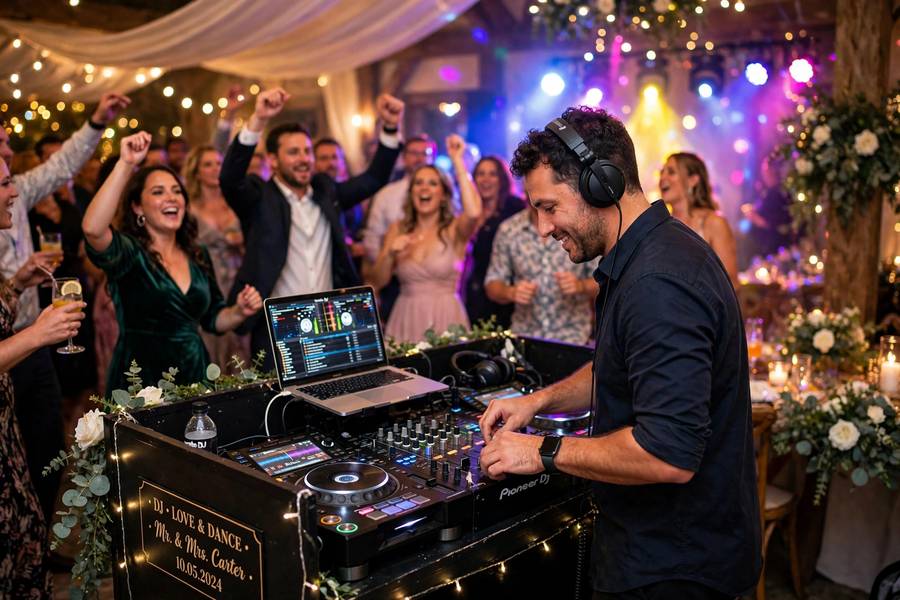
Open dancing (2–4 hours): This is the product. A great dance set has dynamics: build energy, peak, breathe (slow song), build again, peak higher, last song. It shouldn’t be 3 hours of maximum intensity — that’s exhausting. The best DJs I’ve worked with think in 20-minute arcs.
Your job for the dance set: must-plays (10–15), vibe direction (“we want Motown and 2000s hip-hop, not EDM”), do-not-plays (5–10 max), and then TRUST YOUR DJ. Micromanaging the dance set song-by-song is how you get a technically perfect playlist and an empty floor — because you can’t read a room from the sweetheart table.
DJ vs. Band vs. Playlist: Honest Comparison
DJ ($1,000–$3,000):
Pros: unlimited song library, takes requests, reads the room, handles announcements, compact setup, lower cost. Cons: quality varies enormously — a bad DJ is the single fastest way to ruin a reception.
Best for: most weddings. A great DJ beats a mediocre band every time.
Live band ($3,000–$10,000+):
Pros: unmatched energy, visual spectacle, guests remember it for years. Cons: expensive, limited repertoire, needs breaks (what plays during breaks?), large footprint, volume can overwhelm conversation.
Best for: couples who prioritize the party above all and have the budget. A 10-piece band with a horn section is a religious experience.
Playlist/laptop ($0–$200):
Pros: free, total control. Cons: no MC, no room-reading, no announcements, technical failures with no backup, someone has to manage it all night.
Best for: very small, casual weddings under 40 guests. For anything bigger, the absence of an MC alone makes this a false economy.
My honest recommendation for most couples: Hire the best DJ you can afford. Interview three. Ask: “How do you handle a dying dance floor?” “What’s your announcement style?” “Can I hear a live mix?” The answers tell you everything. A DJ who talks about “reading the room” and “energy arcs” is a professional. A DJ who talks about their light show is selling you equipment.
The hybrid: DJ + live musician (saxophonist, percussionist, or violinist playing over DJ tracks). Costs $500–$1,500 extra and gives you 80% of the band energy at 30% of the band price. Hugely popular right now, and genuinely effective.
Real Budget Numbers
What my couples actually spend on wedding music:
- Ceremony musicians (string duo/trio): $400–$1,200
- Ceremony + cocktail hour musician: $600–$1,500
- DJ (4–6 hours): $1,000–$3,000 (budget $1,500+ for quality in most markets)
- Live band: $3,000–$10,000+ (tribute-quality bands start around $5,000)
- DJ + live musician hybrid: $2,000–$4,500
Where to save: Ceremony prelude and cocktail hour (playlist instead of live), shorter band sets, off-peak dates.
Where not to save: The reception DJ/band. This is the vendor your guests interact with for 4+ hours. The difference between a $800 DJ and a $2,000 DJ is the difference between a good party and the party people talk about for years.
Total music budget guideline: 8–10% of your wedding budget. On a $30,000 wedding, that’s $2,400–$3,000 — enough for ceremony musicians and a solid DJ.
How to Brief Your Musicians
Two to four weeks before the wedding, send every music vendor:
- The timeline — ceremony start time, cocktail hour, entrances, first dance, dinner, dancing, last song, exit. Exact times.
- Key songs in writing — titles AND artists AND versions. “Can’t Help Falling in Love” has a dozen versions. Specify.
- Must-plays and do-not-plays — short lists, as discussed.
- Vibe direction — 2–3 sentences on the feeling you want per segment.
- Pronunciations — wedding party names, especially for introductions. Write them phonetically.
- The backup contact — someone other than you who can make music decisions day-of. Put their number in your wedding day emergency kit checklist.
Then have a 15-minute call to walk through it. This call prevents 90% of day-of music disasters.
Timing Mistakes I See Constantly
- No music during the prelude. Guests arrive to silence and immediately feel like something’s wrong. Music starts 30 minutes before the ceremony. Non-negotiable.
- The gap between ceremony and cocktail hour. Guests migrate, musicians pack up, and there’s 15 minutes of dead air. Plan the transition — playlist on a speaker covers it.
- Dinner music too loud. If the DJ treats dinner like the dance set, toasts become shouting matches. Specify: background volume until dancing starts.
- Starting the dance floor too late. Open dancing should start no later than 9 PM at most weddings. Every 15 minutes of delay after dinner loses you dancers.
- No last song planned. The DJ asks “what’s the last song?” at 11:45 PM and the couple panics. Decide it weeks ahead.
- Forgetting the exit music. After the last dance, as guests leave — have something playing. It avoids the jarring silence-to-parking-lot transition.

Frequently Asked Questions
Plan five moments: prelude (20–30 min of background as guests arrive), processional, bride’s entrance (your showstopper — 45–90 seconds), any interludes, and a joyful recessional. Do a walk-through with your musicians beforehand so entrances are timed to the music.
A great DJ beats a mediocre band every time. DJs ($1,000–$3,000) offer unlimited songs, requests, and announcements; bands ($3,000–$10,000+) bring unmatched energy but cost more and need breaks. For most weddings, hire the best DJ you can afford — or try the popular DJ + live musician hybrid.
Budget 8–10% of your total wedding budget for music. Typical costs: ceremony musicians $400–$1,200, DJ $1,000–$3,000, live band $3,000–$10,000+. Don’t cut corners on the reception DJ or band — it’s the vendor your guests experience for 4+ hours.
9–12 months out for popular dates — the best DJs and bands book early, especially for Saturdays in peak season. Interview at least three, ask how they handle a dying dance floor, and get your key songs and timeline to them in writing 2–4 weeks before the wedding.
Background music at conversation volume: jazz standards, bossa nova, acoustic covers, or classical guitar. A curated 2-hour playlist works fine — this is the easiest music to DIY. For a splurge, a live guitarist or jazz trio ($300–$800) elevates cocktail hour enormously.
10–15 must-plays, plus 20–30 “play if it fits” songs organized by vibe, your key-moment songs (first dance, parent dances, last song), and a do-not-play list of 5–10 max. Then trust your DJ to read the room — micromanaging the dance set from the sweetheart table kills the floor.
Music is hospitality — it’s how you take care of your guests’ experience without saying a word. Choose it with intention, brief your vendors well, and then dance. For more planning help, from wedding seating chart ideas to day-of timelines, see our latest guides.