
Your dipstick is a two-dollar part that tells you more about your engine than every dashboard light combined. Ninety seconds, zero tools — and it’s the difference between catching a problem early and buying an engine. I’m Marcus, and I’ve seen engines die — seized, scrap-metal die — because nobody checked the oil for a year. Every one was preventable in ninety seconds.
Here’s how to do it right, because there are wrong ways that give false readings, and most people are doing one of them.
Table of Contents
- Why It Matters More Than You Think
- The Correct Procedure, Step by Step
- Hot vs Cold: When to Check
- How to Read the Dipstick
- What the Oil’s Condition Tells You
- What to Do If the Level Is Low
- Mistakes That Give False Readings
- Frequently Asked Questions
Why It Matters More Than You Think
Your dash has an oil pressure light, not an oil level gauge. By the time that red light comes on, damage is already happening — pressure dropped because the pump is sucking air. You’re not “due for a top-up”; you’re in emergency territory.
Low oil starves the pump, parts that ride on a pressurized film start touching, and wear accelerates exponentially — bearings, camshafts, timing chains. Run it low long enough and the engine seizes: a $4,000–$8,000 replacement. The check that catches it costs nothing.
Want the full picture? Read our guide to how long car batteries last.
“But my car is new / I just changed the oil / it doesn’t leak.” From the shop years:
- New cars consume oil too. Some modern turbo engines use a quart every 1,000–2,000 miles by design. The manual calls it normal — and assumes you’re checking.
- Fresh changes don’t prevent later leaks. A drain plug can weep; a filter gasket can seep. They start small.
- Consumption isn’t always a leak. Engines burn small amounts past rings and valve seals with age. No driveway puddle, but the level drops. The dipstick is the only witness.
The dipstick doesn’t lie. Ninety seconds, once a month. That’s the whole religion.
The Correct Procedure, Step by Step
1. Park on level ground. The most-skipped step and the top cause of false readings. Oil pools to the low side — a sloped driveway can throw the reading off half a quart or more. Flat ground. Non-negotiable.
2. Shut off and wait 5–10 minutes. Oil up in the valvetrain needs to drain back to the pan where the stick measures. Check immediately after shutdown and it reads falsely low. (Exception: some manufacturers, famously Honda, specify checking hot — your manual wins. Check it once.)
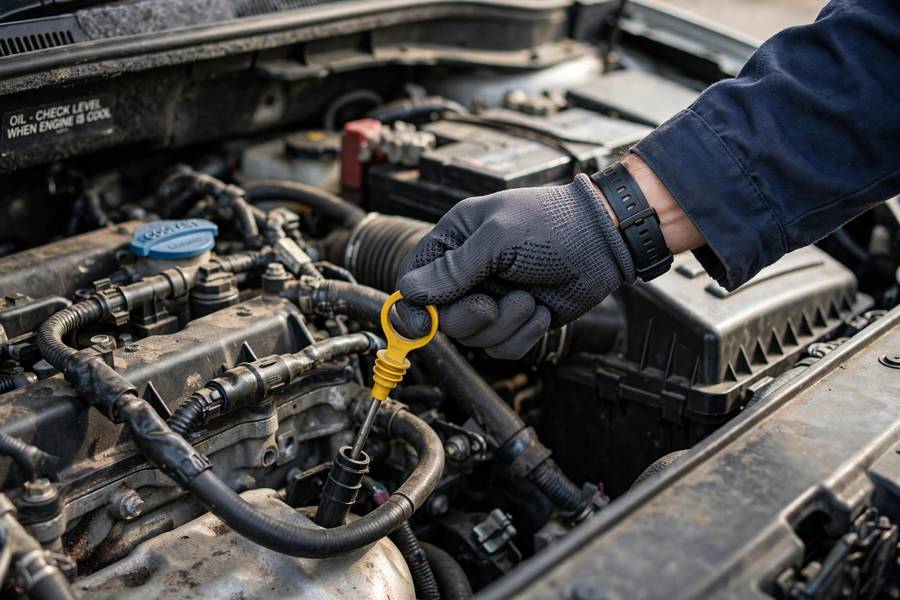
3. Find the dipstick. The yellow/orange loop or T-handle on the engine block. Don’t confuse it with the transmission dipstick (most modern cars don’t have one — sealed units). The manual has a diagram of your bay.
4. Pull, wipe clean. The first pull is splash contamination. Wipe fully with a lint-free rag or paper towel.
5. Reinsert fully, pull again. Push it all the way in — a half-seated stick reads falsely low — then pull straight out and read immediately, held horizontally.
6. Read the level (below), reseat the stick fully, close up. A loose dipstick can weep oil and even trigger a check-engine light on some cars.
First time, give yourself five minutes to find everything. After that: ninety seconds.
Hot vs Cold: When to Check
Cold check (morning, before starting): all oil is in the pan — the most stable, consistent reading. My preferred method: same conditions every time lets you spot consumption trends.
Warm check (run, shut off, wait 5–10 minutes): also accurate, and what most manuals describe. The wait lets oil drain back.
What doesn’t work: checking with the engine running (oil circulating — artificially low, splashing, unreadable) or immediately after shutdown (reads falsely low).
Pick one method and stick with it. I do cold mornings. If your manual specifies (some Hondas: hot, minutes after shutdown), follow it — the stick was marked for that condition. Ambient temperature barely affects the reading; drain-back time and level ground are what matter.
How to Read the Dipstick
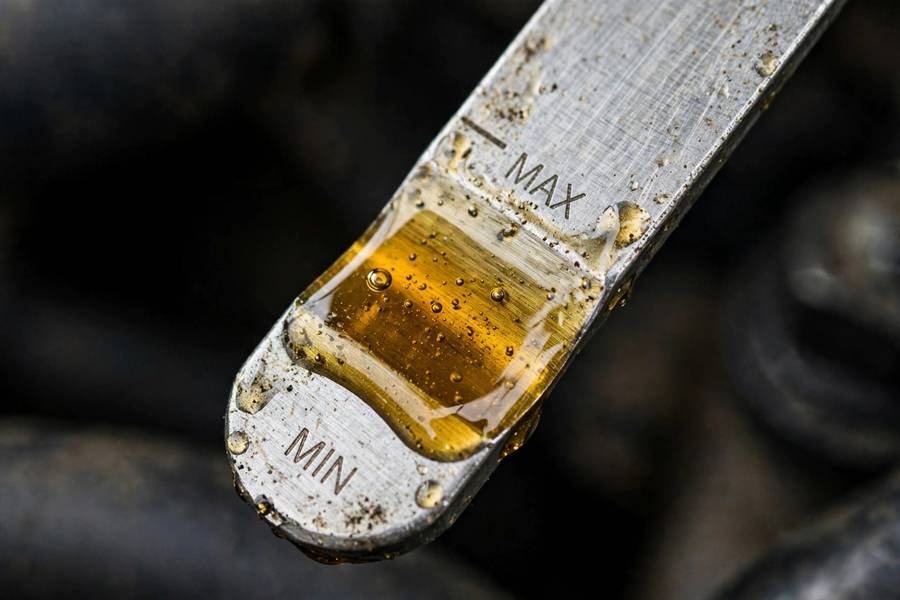
Markings are two dots, two lines, or a crosshatch zone labeled MIN/MAX (or L/F, ADD/FULL):
Between the marks: Good. Anywhere in the zone is fine — it needn’t sit exactly at MAX. Halfway is roughly half a quart low on most cars. Normal, not urgent.
At or below MIN: Add oil — you’re about a quart low (the MIN–MAX span is ~1 quart on most cars; your manual confirms). Not an emergency, but don’t ignore it.
Above MAX: Overfilled. A few millimeters is harmless; half a quart or more is a real problem — the crankshaft whips excess oil into foam, which doesn’t lubricate or pump properly. “Extra oil is extra protection” is not a thing. Drain some out.
Nothing on the stick: Stop. Don’t start it — or shut it off if running. You’re 1.5–2+ quarts low. Add the correct oil until it reads, then find where it went. Running with no oil on the stick is how engines die.
Reading tip: fresh amber oil is translucent and hard to see — tilt the stick to catch light and find where the wet sheen ends. Dark oil reads easier. Can’t see it? Wipe and re-dip; the second pull is usually clearer.
What the Oil’s Condition Tells You
The dipstick is a free oil analysis — look at the oil, not just the level:
Amber/translucent: Fresh or healthy. Normal.
Dark brown/black: Normal with miles — oil darkens doing its job suspending contaminants. Judge by miles since the change, not color.
Milky/creamy (coffee with too much cream): Coolant mixing with oil — likely head gasket, cracked head, or failed oil cooler. Serious. Drive only to a shop. Catching it on the stick beats catching it via a seized engine.
Gritty: Rub a drop between fingers. Grit means wear debris or heavy contamination — change oil soon and consider what’s wearing.
Strong fuel smell + rising level: Fuel dilution — common mildly on direct-injection engines with short trips, but a strong smell with the level rising between checks needs diagnosis.
Thick/sludgy: Overdue for a change. If it pours like honey off the stick, you’re past due.
What to Do If the Level Is Low
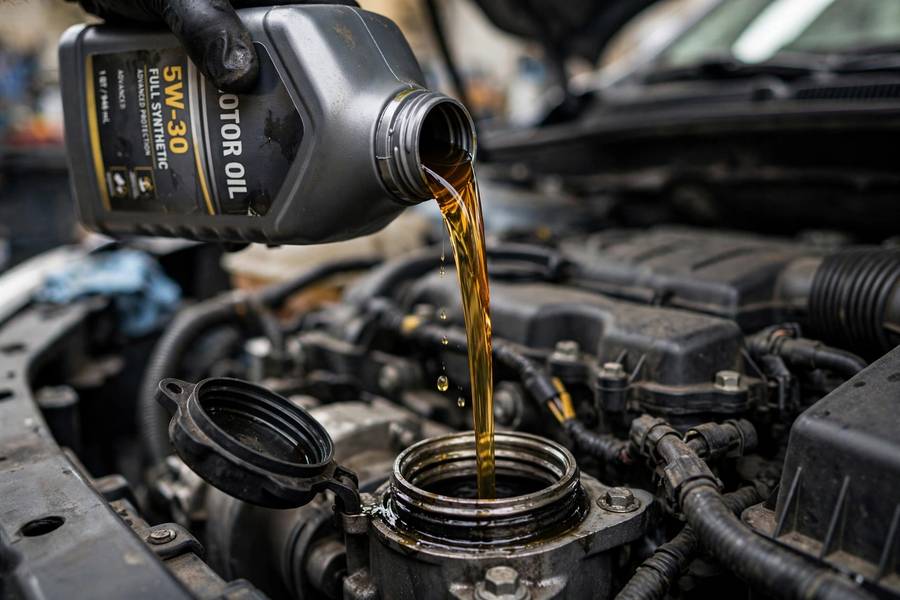
Use the right oil. The manual’s viscosity (e.g., 5W-30) and spec (e.g., API SP). Wrong viscosity is worse than half a quart low. The oil cap often states it.
Add half a quart at a time. Filler cap off, funnel in, pour half a quart, wait a minute, recheck. Repeat into the zone. Easy to add more; annoying to drain excess.
Track consumption. Note date and mileage. A quart every 1,000 miles deserves investigation (rings, valve seals, PCV, hidden leak). A quart every 5,000 on a 150,000-mile engine is just age — top up and carry a quart in the trunk.
Investigate sudden drops. Level doesn’t fall fast without reason: new driveway spots, blue smoke on startup (valve seals) or acceleration (rings), oily underside. Right after an oil change? Check the drain plug and filter gasket immediately — those can empty a pan fast.
Mistakes That Give False Readings
- Checking on a slope. The most common error. Level ground only.
- Not waiting after shutdown. Half a quart can still be upstairs. Wait 5–10 minutes.
- Reading the first pull. Always wipe and re-dip.
- Not seating the stick fully. Push until it stops.
- Checking with the engine running. Just don’t.
- Ignoring the manual’s procedure. Most cars: the method above. Some: hot check. A few (some BMWs, newer Audis): no dipstick at all — electronic sensor in the infotainment. If that’s you, the dash menu is your dipstick; check warm on level ground per the manual.
On electronic sensors: convenient and generally accurate, but they can’t show oil condition, and sensors fail. If your car has both, trust the stick. (And if a sensor-equipped car cranks slowly, remember a weak battery causes sensor weirdness — see how to jump start a car before assuming the worst.)
How often: monthly, minimum — tie it to something you’ll remember. Every fill-up for high-mileage or oil-consuming engines. Before any long trip — a thousand highway miles on low oil is how road trips end on flatbeds. And after every oil change, check it in the parking lot. Shops underfill and overfill more than anyone admits.
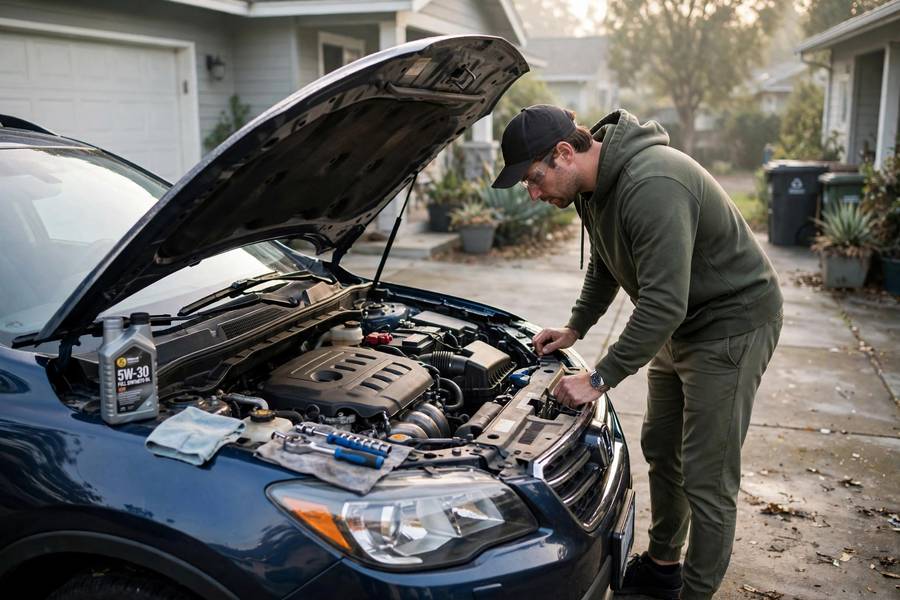
My kit: a $3 funnel and a quart of the correct oil in the trunk. The most expensive car problem is the one you didn’t see coming — the dipstick is how you see it coming.
Frequently Asked Questions
Park on level ground, shut off the engine and wait 5-10 minutes. Pull the dipstick, wipe it clean, reinsert it fully, then pull it out and read the level between the MIN and MAX marks. Check monthly, always on level ground.
Either works if done correctly. A cold morning check gives the most consistent reading since all oil has drained to the pan. A warm check is accurate if you wait 5-10 minutes after shutdown. Never check with the engine running, and follow your manual if it specifies a method.
You are roughly a quart low, since the MIN-to-MAX range is about one quart on most cars. Add the correct viscosity oil in half-quart increments until the level is back in the zone. If the stick shows no oil at all, do not drive, add oil and investigate.
Monthly at minimum, every fill-up for high-mileage or oil-consuming engines, before any long road trip, and right after every oil change to verify the shop filled it correctly. It takes ninety seconds and is the cheapest engine insurance available.
Milky or creamy oil means coolant is mixing with the engine oil, usually from a failed head gasket, cracked head, or bad oil cooler. This is serious: do not drive except to a repair shop, as coolant destroys the oil’s ability to lubricate bearings.
No. Oil pools to the low side on a slope, throwing the reading off by half a quart or more. Always park on level ground, wait for oil to drain back, wipe and re-dip the stick, and make sure it is fully seated.