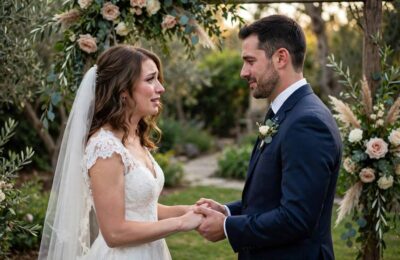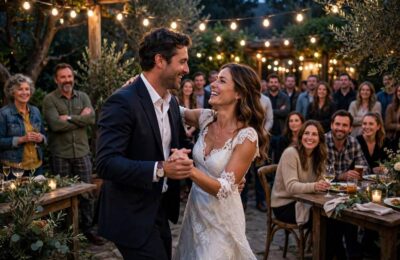

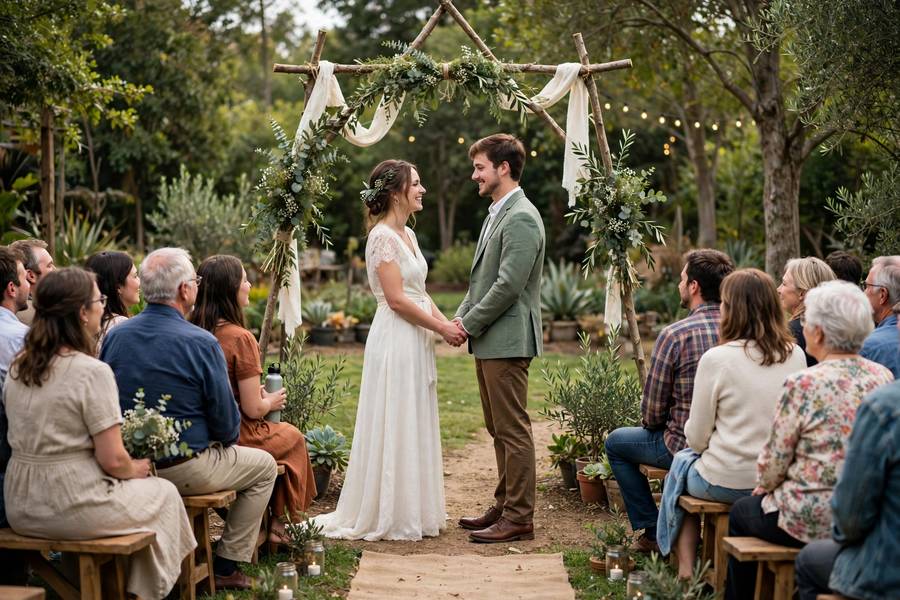
Here’s what the wedding industry doesn’t want you to know: the weddings guests remember most fondly are almost never the most expensive ones. They’re the personal ones — the backyard ceremony with the incredible food, the small restaurant wedding where everyone actually talked to each other.
I’m Jessica, a wedding planner, and I’ve produced stunning weddings on $8,000 and forgettable ones on $80,000. The difference was never the budget. Here are 35 affordable wedding ideas that prove it.
Table of Contents
- Venue Ideas That Save Thousands
- Decor on a Budget
- Food & Drink Without the Markup
- Flowers, Photos & Music
- Attire & Beauty
- Guest Experience Upgrades (Cheap)
- Real Budget Breakdown: What $10,000 Looks Like
- Free Resources Worth Knowing
- Frequently Asked Questions
The Mindset: Spend on Experience, Cut on Objects
Before the tactics, the principle: guests remember how your wedding felt, not what it cost. They remember the food, the music, whether they had fun — not the chair sashes, the favor boxes, or the upgraded linens.
Every saving below follows one rule: cut things guests won’t notice or remember, protect things they will. A $200 cut to flowers nobody photographs is smart. A $200 cut that leaves guests hungry is a disaster you’ll hear about for years.
Venue Ideas That Save Thousands
The venue is typically the biggest expense — which makes it the biggest opportunity.
- Get married on a Friday or Sunday. Saturday venues charge 20–40% more for the same space. Friday evening weddings feel just as special.
- Consider the off-season. November through March (excluding holidays) brings deep discounts in most regions.
- Public parks and gardens. Many rent for a few hundred dollars — gorgeous, and the landscaping is done for you.
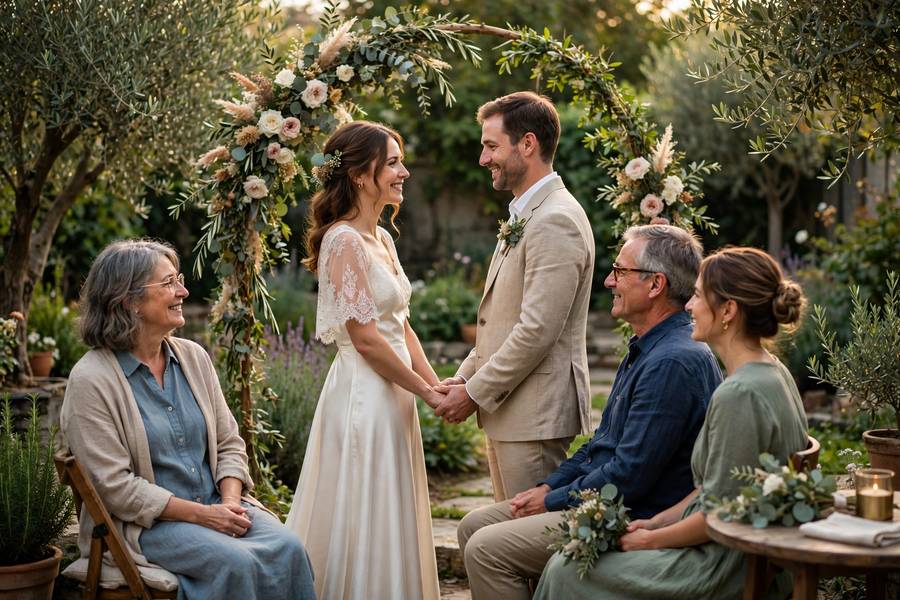
- Backyard wedding — yours, a parent’s, a generous friend’s. The most personal venue is free.
- Restaurants with private rooms. No venue fee, no catering markup — you just pay for the meal. Intimate and delicious.
- Community halls, art galleries, libraries. Non-traditional venues cost a fraction of wedding-specific spaces.
- Morning or brunch wedding. Daytime venue rates are lower, and brunch food costs far less than dinner.
- All-in-one venue. Ceremony and reception in the same place eliminates transport costs and venue-hopping logistics.
Negotiate the package, not just the price. Ask what’s not included that other venues include — then ask them to match it. Venues negotiate far more than they admit, especially for off-peak dates.
Guest List: The Multiplier
- Understand the math. Every guest costs $100–$250+ in catering, rentals, and favors. Cutting 20 guests saves $2,000–$5,000 — more than almost any other single decision.
- Cut in circles, not individuals. Invite friend groups wholly or not at all; plus-ones for established couples only. Partial cuts create drama; clean circles don’t.
- Adults-only. Kids’ meals, space, and logistics add up — and many venues charge per head regardless of age. (Communicate this kindly and early.)
- Livestream for the extended circle. A good livestream lets distant relatives and acquaintances attend virtually — they feel included, you save thousands. Post-2020, nobody finds this strange.
Vendor Negotiation Tactics
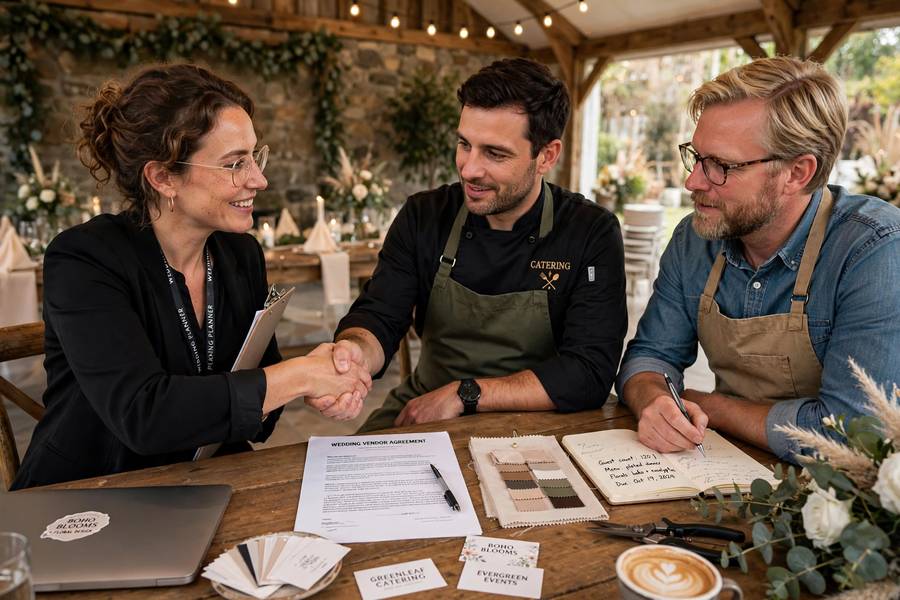
- Always get three quotes. For every major vendor. Prices vary wildly, and quotes are leverage.
- Ask “what’s your off-peak rate?” — then ask what they’d need to make your date work at that rate. Many vendors would rather discount than sit idle.
- Trade scope for price. Can’t afford the photographer’s full package? Ask about 6 hours instead of 10, or digital-only delivery. Vendors prefer smaller bookings to no bookings.
- Book emerging talent. A photographer or planner building their portfolio charges half the established rate — and is often hungrier and more creative. Vet their work carefully, but don’t dismiss them.
- Bundle services. Some vendors discount for combined bookings (photo + video from one studio, DJ + lighting from one company).
- Pay cash / avoid credit card fees. Some vendors offer 2–3% off for bank transfer or check — the card processing fee they’d otherwise eat.
- Read every contract for auto-gratuities and service charges. A 22% “service charge” is not a tip — it’s revenue. Know what you’re paying before you negotiate the rest.
Decor on a Budget
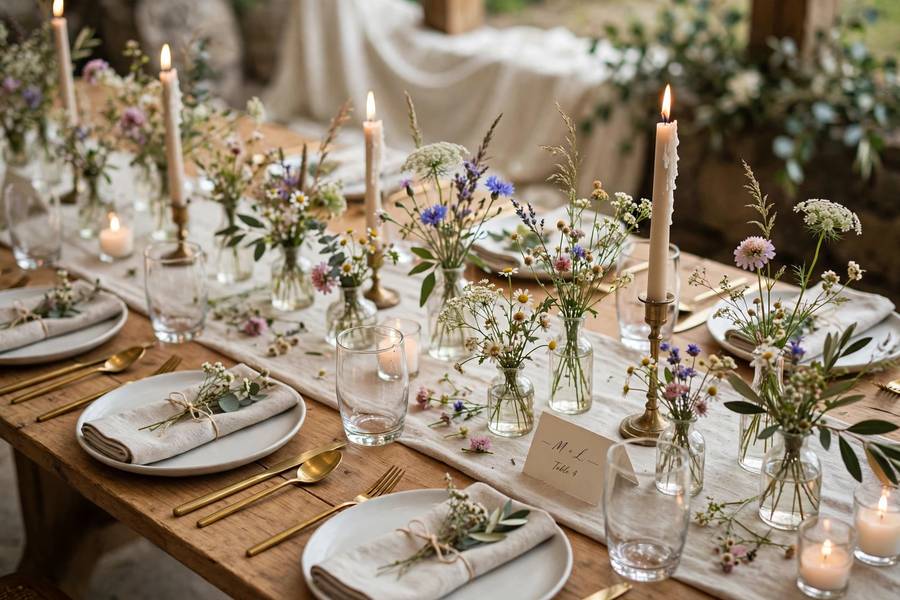
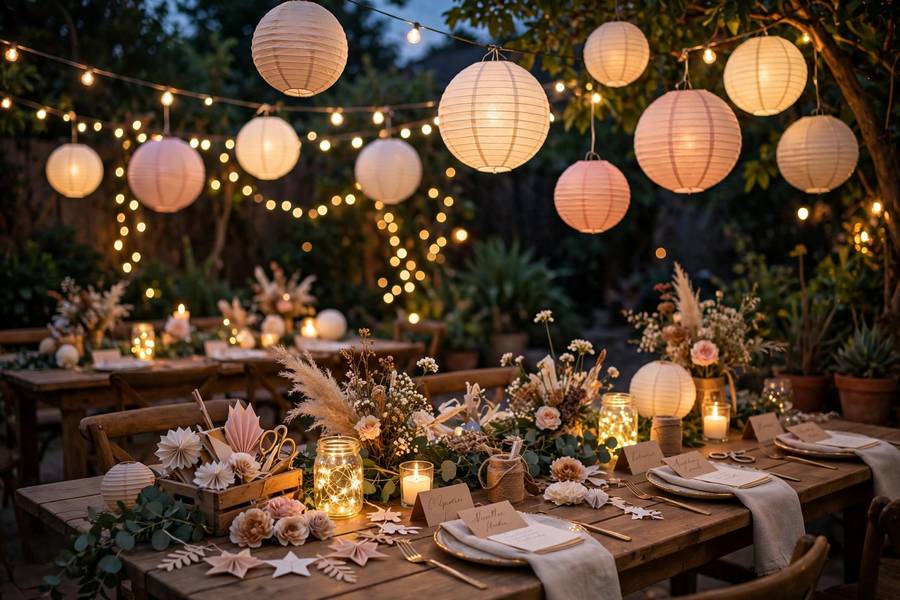
- Candles, candles, candles. Nothing transforms a space like candlelight, and it’s dirt cheap. Pillar candles in bulk + simple holders = instant romance.
- Fairy lights and string lights. A $30 investment that makes any evening venue magical.
- Single-variety flowers in bulk. Ten vases of one flower type (baby’s breath, carnations, wildflowers) look intentional and chic — mixed arrangements cost far more.
- Potted plants as centerpieces — guests take them home as favors. Two birds, one budget.
- Fabric draping. Cheap tulle or linen transforms ugly ceilings and walls. The highest-impact decor dollar there is.
- DIY signage. A chalkboard, a steady hand, and nice lettering — welcome signs, seating charts, and bar menus for the cost of chalk.
- Borrow, don’t buy. Vases, candle holders, cake stands — ask recently-married friends. The wedding underground economy is real.
Repurpose everything. Ceremony arch becomes the reception backdrop; bridesmaid bouquets become table centerpieces. Buy once, use twice.
Food & Drink Without the Markup
- Brunch or lunch reception. Half the cost of dinner, and mimosas are cheaper than an open bar.
- Food trucks. Fun, memorable, and often half the price of traditional catering. Guests love the novelty.
- Family-style or buffet instead of plated dinner — significantly cheaper per head.
- Beer, wine, and one signature cocktail instead of a full open bar. The bar tab is where budgets go to die.
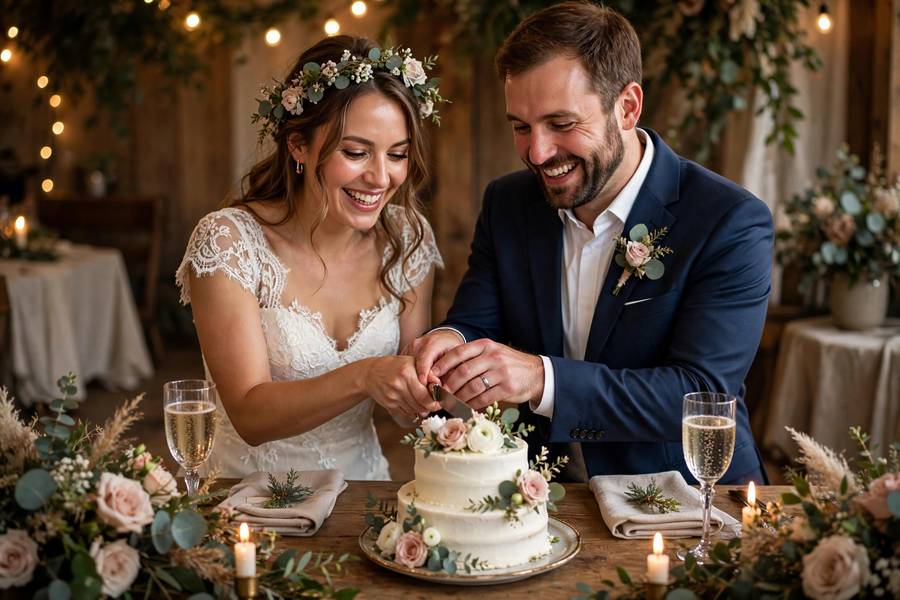
- Sheet cake in the back. Display a small beautiful cake for photos and cutting; serve guests from an identical sheet cake from the same bakery. Nobody knows, everybody’s happy.
- Dessert bar instead of cake. Donuts, pies, cookies — cheaper, more fun, and guests actually eat it all.
Skip the champagne toast. Most guests don’t drink it — sparkling wine for toasts that go untouched is money poured down the drain, literally. And consider this trade: a $200 late-night pizza delivery delights guests more than an $800 dessert display.
Flowers, Photos & Music
- In-season, local flowers only. Peonies in December cost a fortune; whatever’s blooming locally is affordable and fresher.
- Repurpose ceremony flowers for the reception — move the arch arrangements to the head table during cocktail hour.
- Hire a talented student or emerging photographer for getting-ready and ceremony, not 10 hours. Or hire a pro for 4 hours instead of 8 — the key moments, not the filler.
- A great playlist + good speakers instead of a DJ. If dancing matters to you, hire the DJ; if it doesn’t, a curated playlist is free.
- A talented friend as officiant. Personal, meaningful, and free (they’ll need to get ordained online, which takes minutes).
Attire & Beauty
- Sample sales and off-the-rack. Bridal salons’ sample sales offer designer dresses at 50–70% off. You just need to be roughly the sample size.
- Pre-owned wedding sites. Once-worn dresses at a fraction of retail — professionally cleaned and often indistinguishable from new.
- Non-bridal dresses. A beautiful white or ivory evening dress from a regular retailer costs hundreds, not thousands.
- Rent the tux/suit. Nobody needs to own a tuxedo. Rental looks identical in photos.
- DIY hair and makeup — or hire a talented cosmetology student. Trial runs matter more than the price tag.
Guest Experience Upgrades (Cheap)
- Handwritten notes at each place setting. Costs nothing, means everything. Guests keep these for years.
- A thoughtful seating chart — free to make, and good seating is the difference between a fun reception and an awkward one.
- Late-night snack. Pizza delivery at 10 PM costs little and makes you a legend.
- A wedding-day emergency kit — safety pins, stain remover, painkillers, tissues. Assemble it yourself with this wedding day emergency kit checklist instead of buying a pre-made one.
What Never to Cut
Saving money is smart; these cuts backfire:
- Photography you trust. You can’t re-shoot a wedding. A bad photographer is the most expensive mistake — the money’s gone and so are the memories.
- Enough food. Guests forgive simple food; they never forgive insufficient food. Order for 5–10% over your count.
- A day-of coordinator. Even a budget wedding needs one person (not you, not your mom) running the timeline. This is the highest-leverage hire in the industry.
- Your own comfort. Shoes you can stand in, a meal you actually eat, 15 minutes alone together. The wedding is yours — don’t optimize yourself out of enjoying it.
And whatever you cut, keep the logistics tight — a clear seating chart costs nothing and prevents the most common reception chaos, and a self-assembled emergency kit beats any crisis.
Real Budget Breakdown: What $15,000 Looks Like
Here’s how the strategies above combine into a real plan — 80 guests, Saturday in shoulder season, mid-size US city:
| Category | Cost | Strategy used |
|---|---|---|
| Venue (vineyard, off-peak) | $2,500 | Shoulder-season Friday discount |
| Catering (family-style) | $4,800 | $60/head vs. $95 plated |
| Bar (beer/wine/signature) | $1,200 | Limited bar vs. $2,800 full open |
| Photography (6 hrs) | $1,800 | Emerging pro, scoped hours |
| Flowers & decor | $900 | In-season bulk + candles + repurposing |
| Music (DJ, 4 hrs) | $800 | Shorter booking, off-peak rate |
| Attire | $700 | Pre-owned dress + rented suit |
| Cake + late-night pizza | $400 | Display + sheet cake strategy |
| Invitations (digital + print) | $150 | Digital save-the-dates |
| Day-of coordinator | $900 | Non-negotiable |
| Contingency (10%) | $900 | — |
| Total | $15,000 | — |
Compare: the same wedding with peak-Saturday venue, plated dinner, full bar, and 10-hour photo coverage runs $30,000+. The guests’ experience? Nearly identical. The difference is structural choices, not joy.
One final note: track spending in a shared spreadsheet from day one — every deposit, every balance due date. Budget overruns don’t come from big decisions; they come from twenty $200 “oh, why not” additions nobody tracked. The spreadsheet is the cheapest wedding vendor you’ll ever hire.
Real Budget Breakdown: What $10,000 Looks Like
Abstract advice is nice; numbers are better. Here’s how a real $10,000 wedding for 60 guests can allocate:
| Category | Budget | How |
|---|---|---|
| Venue | $1,500 | Public garden or restaurant private room, off-peak Friday |
| Food & drink | $3,000 | Brunch reception or food truck + beer/wine/signature cocktail |
| Photography | $1,500 | Talented emerging photographer, 5-hour coverage |
| Attire | $800 | Off-the-rack or pre-owned dress + rented suit |
| Flowers & decor | $700 | In-season bulk flowers, candles, DIY signage |
| Music | $400 | Curated playlist + rented speakers (or DJ for 3 hours) |
| Cake/dessert | $300 | Small display cake + sheet cake |
| Invitations | $100 | Digital save-the-dates + simple printed invites |
| Coordinator | $800 | Day-of coordinator (non-negotiable, remember?) |
| Buffer | $900 | The 10% contingency every budget needs |
Total: $10,000. Is it the $80,000 ballroom wedding? No. Will your guests eat well, hear great music, see you genuinely happy, and remember it fondly? Absolutely — because you spent on experience, not objects.
Adjust the ratios to your priorities: food-obsessed? Shift $500 from decor to catering. Photo-obsessed? Take from attire. The framework holds at any budget — it’s the proportions that matter, not the total.
Free Resources Worth Knowing
Beyond the ideas above, these free resources stretch budgets further:
Buy-nothing and wedding resale groups. Local Facebook groups and community boards are full of couples selling or giving away wedding decor — often barely used. Vases, arches, signage, candle holders: the post-wedding resale market is enormous and kind to buyers.
Your public library. Many libraries lend more than books: cake pans, projectors, even event equipment. Some have “libraries of things” with exactly the odd items weddings need once.
Community talent. Know a friend who’s a decent photographer, baker, or musician? Hiring friends at “friend rates” (with clear expectations in writing) beats stranger rates — and the personal connection shows in the results. Just be explicit about what’s expected; money and friendship need clarity.
Parks departments and community centers. Beyond the venue itself, many offer affordable add-ons: extra tables, chairs, and sound equipment at municipal prices that undercut every rental company.
The ultimate free resource: other couples’ experience. Ask recently married friends what they’d skip if they did it again. Their answers — almost always “the favors,” “the videographer we never watch,” “the upgraded linens” — are a cheat sheet for your own cuts.
Frequently Asked Questions
Focus spending on what guests actually experience (food, music, atmosphere) and cut what they won’t notice (favors, elaborate invitations, chair covers). Venue choice is the biggest lever — non-traditional venues, off-peak days, and brunch timing each save thousands.
Beautiful weddings happen at every budget — $5,000–$15,000 is a common “affordable” range in the US, with backyard and restaurant weddings at the lower end. The key is allocating to priorities (usually venue, food, photos) and cutting ruthlessly elsewhere.
Full open bars, Saturday peak-season venues, elaborate favors guests leave behind, chair covers and linens upgrades, and over-ordering flowers. Each can cost thousands with minimal impact on guest experience.
Usually yes — you eliminate the venue fee entirely. But budget for rentals you’ll need: tents (weather backup), tables, chairs, restrooms for large groups, and possibly generators. A backyard wedding for 100+ guests still needs real infrastructure.
Use in-season local flowers, stick to one or two varieties bought in bulk, repurpose ceremony arrangements at the reception, and use candles and greenery to fill space. Potted plants as centerpieces double as guest favors.
Absolutely. The formula: non-traditional or free venue, off-peak timing, simplified food (brunch, food truck, or buffet), limited bar, and DIY or borrowed decor. Many couples do it — the weddings guests love most are personal, not expensive.
Opinions vary by region and crowd. A widely accepted middle ground: host beer, wine, and a signature cocktail, and let guests buy spirits if they want them. Most guests find this perfectly gracious.
All-in costs typically run $100–$250+ per guest for catering, rentals, favors, and their share of fixed costs. Use this math when deciding the guest list — it’s the clearest way to see what each invitation costs.
Yes — especially for off-peak dates. Get three quotes for leverage, ask about off-peak rates, trade scope for price (fewer hours, digital-only delivery), and ask about cash discounts. Vendors prefer discounted bookings to empty dates.