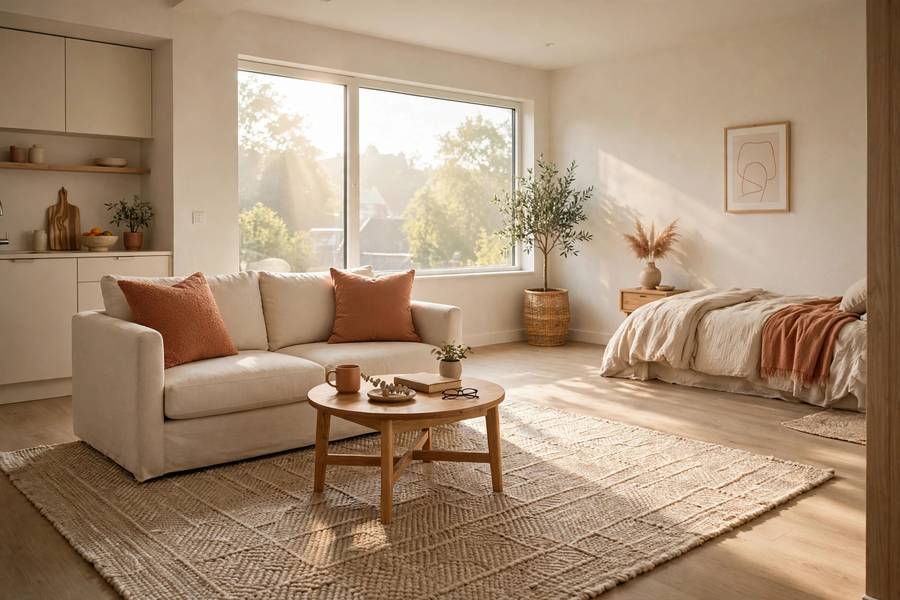
A small apartment and a studio apartment are not the same problem. A small apartment gives you rooms, just smaller ones — a bedroom door you can close, a kitchen you can leave a mess in. A studio gives you one room. One room that has to be your bedroom at night, your living room in the evening, your dining room when friends come over, and your office when Monday arrives. The challenge isn’t really decorating. It’s giving one room more than one mood.
If you came from our piece on small apartment decorating ideas, welcome back — this is the studio-only companion. Same care, different problem. Everything here is about the single room: how to separate sleep from living without building walls, how to hide storage in plain sight, and how to make the whole place feel calm instead of crowded.
Table of Contents
- The Real Difference Between a Studio and a Small Apartment
- 1. Zone It Without Walls
- 2. Give Sleep Its Own Place
- 3. Furniture That Works Double Shifts
- 4. Light and Color: The Cheapest Remodel
- 5. Storage That Disappears Into the Room
- 6. The Kitchen Corner: Open Shelving Without the Clutter Look
- 7. A Nook of Your Own
- 8. Small Habits That Keep One Room Calm
- Frequently Asked Questions
- One Room, Done Well
The Real Difference Between a Studio and a Small Apartment
In a studio, there is nowhere to escape from your own mess. Leave a pile of laundry on the “dining” chair and it is also the bedroom chair and the office chair, because it is all the same chair. So decorating a studio is less about style and more about rhythm. You need the room to shift gears — morning mode, work mode, evening mode, sleep mode — the way rooms used to do it for you with doors.
1. Zone It Without Walls
Zoning is the single most important studio skill: give your eye small signals that say “this corner is for rest” and “this corner is for living.” Two or three zones are plenty — more than that and the room starts to feel fussy.
Rugs Are Your Floor Plan
A rug is the cheapest, gentlest way to draw a room inside a room. Lay a rug under the sofa and coffee table and suddenly that patch of floor reads as “the living room,” even though your bed is ten feet away. Choose a rug for the bed area too — something soft underfoot when you get up in the morning — and now your body learns the boundary even when your eyes don’t.
Curtains and Screens as Retractable Walls
Sometimes you need an actual, physical “do not disturb.” A ceiling-mounted curtain track around the bed area is the classic studio move: linen or cotton panels pull closed at night and disappear against the wall in the morning.
If drilling into the ceiling isn’t allowed, a folding screen does nearly the same job — wood, rattan, or fabric, whatever echoes your palette. The key word is retractable: anything that divides the room should be able to vanish when you want the whole space open.
2. Give Sleep Its Own Place
The studio question that matters most: where does the bed go during the day? Sleeping ten feet from your sofa is fine; staring at your unmade bed while you eat dinner is not.
The Murphy Bed (and Its Cousins)
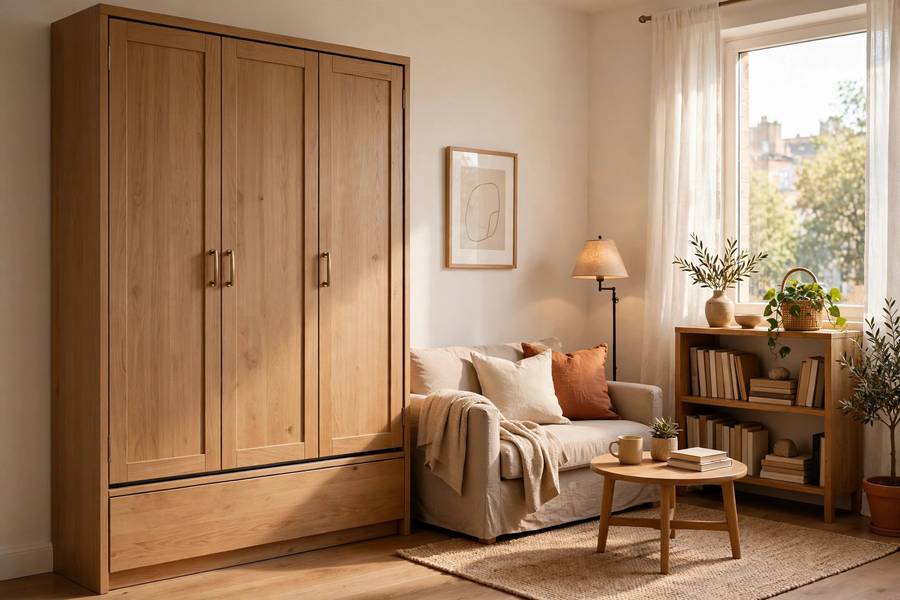
A Murphy bed — the one that folds up into the wall — is the closest thing a studio has to a magic trick. Bed at night, a handsome wall cabinet by day.
If a full wall unit is too much, there are gentler cousins: a daybed that reads as a sofa, a sleeper sofa you’d actually sleep on, or a loft bed with a desk underneath if your ceilings are generous. The principle is the same: sleeping should be something the room does, not something the room is.
If the Bed Has to Stay Visible
Most of us keep a regular bed, and that’s perfectly fine — it just needs a job description. Style it like a daybed: a proper headboard, throw pillows in the morning, a folded throw at the foot. A bed dressed like a sofa stops shouting “bedroom” at your dinner guests.
Tuck it into the farthest corner from the door.
3. Furniture That Works Double Shifts
In a studio, every piece of furniture should earn its floor space twice. An ottoman with storage inside can be a footrest, an extra seat, a coffee table with a tray on top, and the place where your spare bedding lives. A drop-leaf dining table seats two most days and six when it matters. A console table behind the sofa can be your desk, your entryway catch-all, and your bar cart, depending on the hour.
Choose fewer, better pieces over many small ones — full-size, hardworking pieces make a studio feel like a real home, not a dollhouse. And go leggy where you can: furniture raised on legs lets the eye travel underneath, which reads as more space.
Even a rolled-up mat and two dumbbells need a home — a corner that doubles as your small home gym setup keeps the gear from colonizing your living zone.
4. Light and Color: The Cheapest Remodel
Before you buy a single thing, consider this: light and color will do more for your studio than any furniture ever will, and they cost almost nothing. A studio with one palette and several kinds of light feels twice its size. A studio with clashing colors and one sad ceiling fixture feels like a storage unit.
One Palette, Carried Through
Pick a base — warm white, soft greige, pale sage, whatever calms you — and let it flow across walls, bedding, and the bigger furniture. Then choose one accent color and repeat it in small doses everywhere: the rug in the living zone, the throw on the bed, a print above the desk.
Layered Light, Not One Sad Ceiling Lamp
Every zone deserves its own light source. A floor lamp by the reading chair, a small lamp on the desk, warm bulbs flanking the bed, under-cabinet strips in the kitchen corner. In the evening you turn on only the zone you’re in — and the rest of the room gently recedes. That’s how a studio learns to have moods.
Swap cool white bulbs for warm ones (2700K is the sweet spot) and watch the whole place exhale.
5. Storage That Disappears Into the Room
Studio storage has one rule: it cannot look like storage. The trick is to let storage become furniture, architecture, or decor — anything but “the place where stuff is crammed.”
Up the Walls, Not Into Them
Floor space is precious; wall space is free. A tall, narrow bookshelf in a dead corner holds an absurd amount. Floating shelves above the desk turn clutter into a styled display. The space above kitchen cabinets, the strip of wall beside the door, the inside of a closet door — studios are full of vertical real estate that apartments with big closets never needed.
Open shelving deserves a word of caution: it’s beautiful when curated, chaotic when it’s just “where things ended up.” Keep open shelves to things you’d be happy to look at — books, a plant, two or three pretty objects — and put everything else behind closed doors. Baskets are your friend here; a row of matching baskets on a shelf reads as texture, not mess. For the full system, our guide on how to organize a small apartment goes deeper on the habits behind the hiding places.
6. The Kitchen Corner: Open Shelving Without the Clutter Look
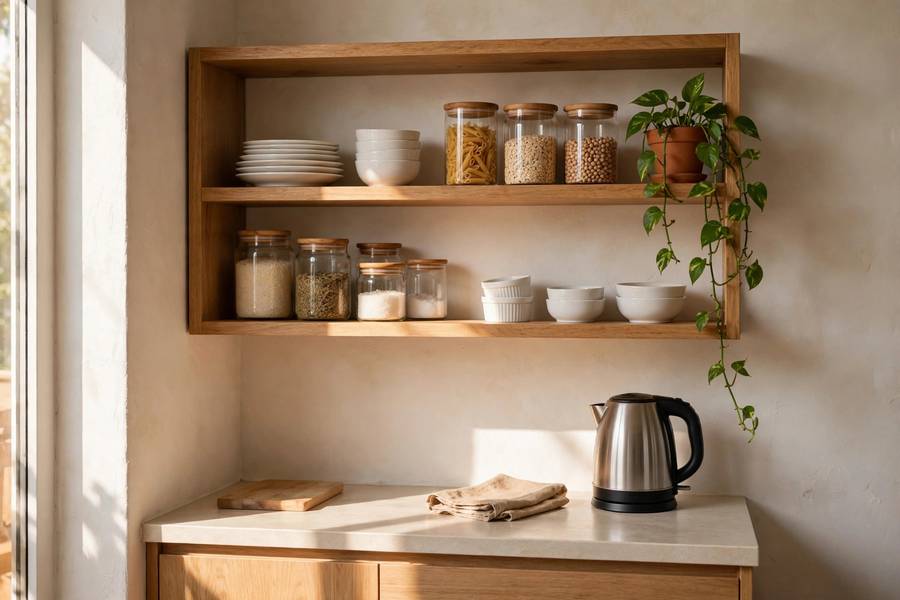
Most studios don’t have a kitchen; they have a kitchen corner. A single run of open shelving with matching dishes, a few glass jars for dry goods, and one trailing plant can make a galley strip feel like the prettiest part of the room instead of the most apologetic.
Keep the counter as clear as a desk: only the kettle, maybe a wooden board leaning against the backsplash.
7. A Nook of Your Own
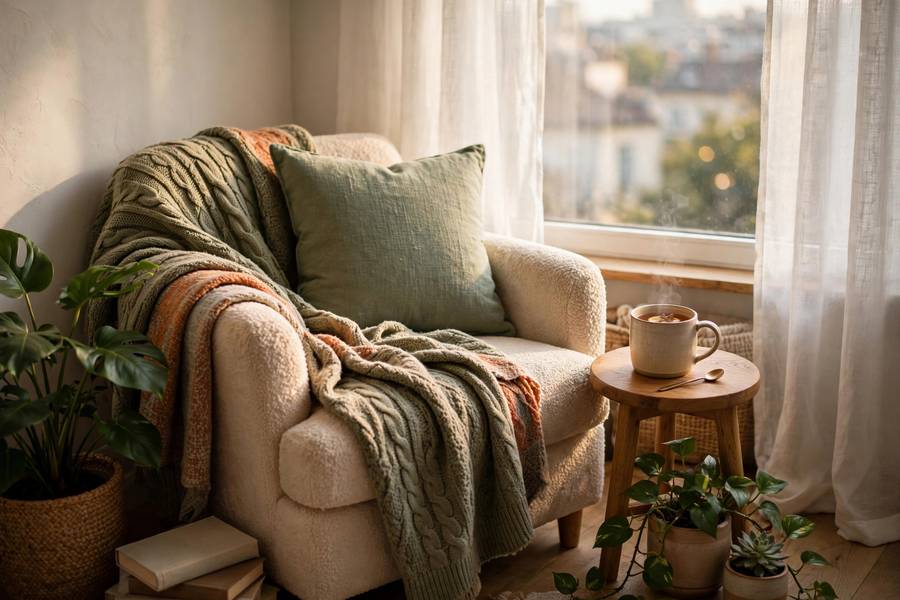
Every studio needs one spot that exists for no productive reason at all. A chair by the window. A cushion, a throw, a small side table for tea. This is the corner where you read — and it might be the most important square footage in the apartment.
Place it where the light is best and give it something alive: a plant, a small vase of whatever’s in season. This is where a little hygge lifestyle thinking earns its keep — candlelight, soft textures, warmth without effort. In a one-room home, a nook isn’t a luxury. It’s the room’s way of telling you that rest is allowed here.
8. Small Habits That Keep One Room Calm
I’ll be honest with you: no decorating idea survives a studio without habits to back it up. The room is too small to absorb neglect. But the habits are small too, and they compound quietly.
Make the bed — an unmade bed in a studio is a whole-home problem, not a bedroom one. Give everything a home, because in one room, “I’ll put it away later” means “I’ll look at it all evening.” And do a five-minute reset when you get home: shoes away, mail sorted, surfaces cleared. A studio doesn’t stay calm because it’s decorated well. It stays calm because it’s tended well.
Frequently Asked Questions
Stick to one light, cohesive color palette, use mirrors opposite windows to bounce light, and choose leggy furniture that shows floor underneath. Rugs that define zones also help — the eye reads organized areas as more spacious than one undifferentiated room.
Use a ceiling-mounted curtain track with linen panels, a folding screen, an open-backed bookshelf as a divider, or a large rug to mark the sleeping zone. Styling the bed like a daybed with pillows and a throw also helps it blend in during the day.
Start with what costs nothing: rearrange for better zones, declutter ruthlessly, and switch to warm light bulbs. Then add one large rug, curtains, and a few plants — these three purchases transform a studio more than any furniture swap. Thrift stores are goldmines for solid wood pieces suited to small spaces.
If you can afford one, yes — a Murphy bed reclaims the most floor space of any single purchase, turning your sleeping area into living space by day. If the budget doesn’t stretch, a quality daybed or a well-styled regular bed tucked in the farthest corner achieves much of the same effect.
Go vertical with tall shelves and wall-mounted storage, choose furniture with hidden storage like ottomans and storage beds, and use matching baskets to make open shelving look intentional. Keep only display-worthy items visible; everything else belongs behind closed doors.
One Room, Done Well
A studio asks something of you that bigger homes never do: it asks you to be deliberate. Every object has to justify itself, every corner has to pull its weight, and the room has to change its mind with you from morning to night. That’s not a limitation. It’s an invitation to live more intentionally than most people ever get to.
Start with one zone — the bed, probably — and build from there. Before long, you’ll stop noticing it’s one room at all. It’ll just be home.