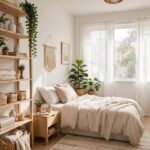

I have lived in apartments where the living room, dining room, and office were the same six square meters of floor. You know what I learned there? A small space doesn’t need to be fixed. It needs to be understood. Once you stop fighting the size and start working with it, a little apartment can feel like the most intentional place you’ve ever lived.
These aren’t showroom tricks. They’re the small, doable choices I’ve seen — in my own flats and in friends’ — that quietly make a tight space feel calmer, bigger, and more like yours.
Table of Contents
- Start With Light, Not Furniture
- Give Every Corner a Job
- Furniture That Earns Its Floor Space
- Go Up, Not Out
- Textiles: The Fastest Transformation
- Mirrors and the Illusion of Space
- Plants, But Keep It Honest
- A Small Kitchen That Works Hard
- The Entryway Deserves Attention Too
- Keep the Calm: Editing as a Habit
- Frequently Asked Questions
Start With Light, Not Furniture
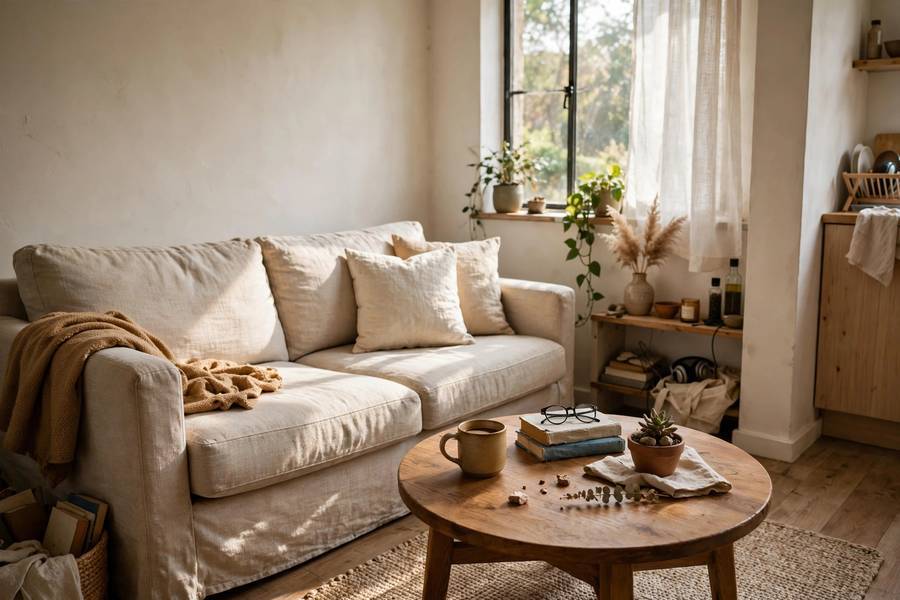
Before you buy a single thing, look at your light. In a small apartment, light does more visual work than any piece of furniture ever will.
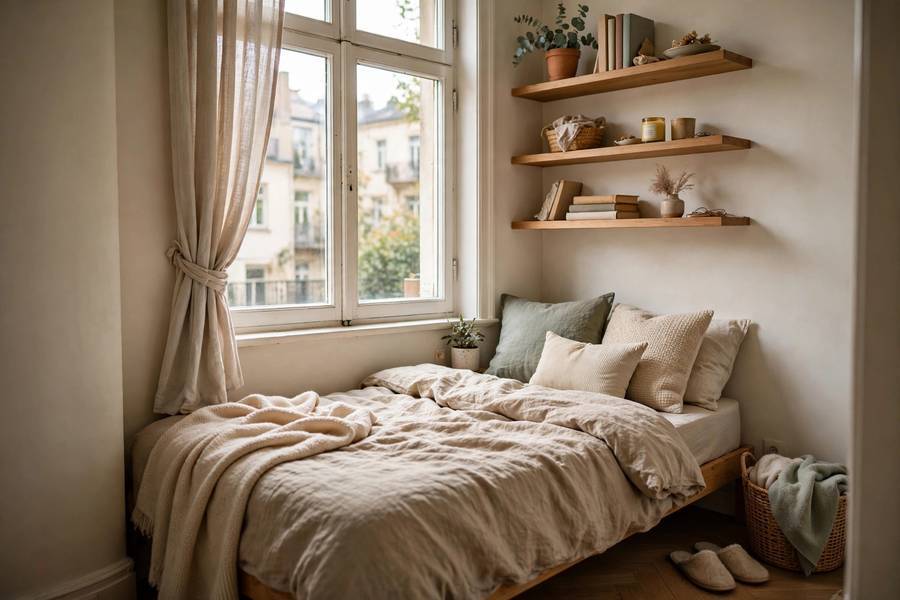
Sheer curtains instead of heavy drapes let daylight reach the walls, and walls that catch light feel farther away. If your windows face a brick wall or another building — mine did for years — lean into warm lamps instead. A floor lamp in a dark corner doesn’t just brighten it; it erases the corner, and erased corners mean a bigger-feeling room.
One practical habit: swap cool-white bulbs for warm ones (2700K or so). Cool light in a small space feels like an office. Warm light feels like evening, even at noon. It costs almost nothing and changes everything.
Give Every Corner a Job
In a big house, rooms have jobs. In a small apartment, corners do. A chair by the window becomes the reading spot. The end of the kitchen counter becomes the desk. A rug under the sofa quietly announces “this is the living room now.”
Rugs are the gentlest way to create zones without walls. You don’t need doors between activities — you need signals. A rug, a different lamp, a shelf turned sideways: each one tells your brain that this patch of floor has a purpose, and purposeful space feels larger than undifferentiated space.
I once watched a friend turn a hallway alcove into a “library” with two floating shelves and a floor cushion. It took an afternoon. She sat there every evening for a year.
Furniture That Earns Its Floor Space
Every piece in a small apartment should do at least two things, or it should be beautiful enough that you forgive it. My rules:
- A sofa with storage underneath or a daybed with drawers beats a beautiful sofa with dead space beneath it.
- A drop-leaf or extendable table is a desk on weekdays and a dinner table on Saturdays.
- Nesting side tables pull apart when guests come and tuck away when they leave.
- An ottoman with a lid is a footrest, a coffee table, and a hiding place for the throw blankets.
And be honest about scale. That oversized armchair you love might be the reason the room feels cramped. Furniture with visible legs — where you can see floor continuing underneath — reads as lighter than blocky pieces that sit flat on the ground. Your eye needs to see floor to believe there’s space.
Go Up, Not Out
When floor space is fixed, the walls are your extra rooms. Tall, narrow bookshelves. Floating shelves above the desk, above the bed, in that weird gap beside the fridge. Hooks on the back of every door.
A pegboard in the kitchen or entryway is one of my favorite small-space moves — it holds keys, bags, scissors, headphones, whatever your life actually contains, and it looks intentional rather than cluttered. The trick is to hang only what you use weekly. Anything else goes in a box.
High shelves have one rule: what’s up there must be worth the climb. Seasonal things, spare linens, the good luggage. If you need it monthly or more, it lives lower.
Textiles: The Fastest Transformation
If I had one afternoon and a small budget to change a rental, I’d spend it on textiles. A new duvet cover, two cushion covers in a color you actually like, a throw that feels good on your shoulders, and curtains that let light through — done. The whole room reads differently.
Renters, take note: you usually can’t change the floors or the cabinets, but nobody can stop you from laying a big rug over an ugly floor. Rugs are the renter’s superpower. One large rug (bigger than you think — let the furniture sit on it) unifies a room in a way five small rugs never will.
Washable matters more than perfect in a small space, because everything gets used hard. Choose fabrics you can throw in the machine without a second thought.
Mirrors and the Illusion of Space
Yes, mirrors make rooms feel bigger — but placement is everything. A mirror opposite a window doubles your daylight and gives you a view you didn’t have. A mirror reflecting a blank wall just gives you a bigger blank wall.
Lean a tall mirror against the wall in a dark hallway or behind a plant, and suddenly there’s depth where there was none. In a tiny bathroom, a large mirror over the sink does more than any renovation short of knocking down a wall.
One caution: don’t scatter small mirrors everywhere hoping for magic. One good-sized mirror, thoughtfully placed, beats five decorative ones.
Plants, But Keep It Honest
Plants make small spaces feel alive — literally. But I’ve killed enough of them to give you the honest version: buy plants for the light you have, not the light you wish you had.
Low-light survivors for dim apartments: pothos, snake plants, ZZ plants. They forgive forgetful watering and dark corners. If you have one good sunny windowsill, that’s where the herbs go — basil, mint, chives — and they’ll earn their spot in your cooking too.
Hang plants from the ceiling or put them on high shelves when the surfaces are full. A trailing pothos on top of a bookshelf softens the whole room. And if every plant you’ve ever owned has died, good dried stems in a vase — eucalyptus, pampas grass — give you the shape and softness with zero watering.
A Small Kitchen That Works Hard
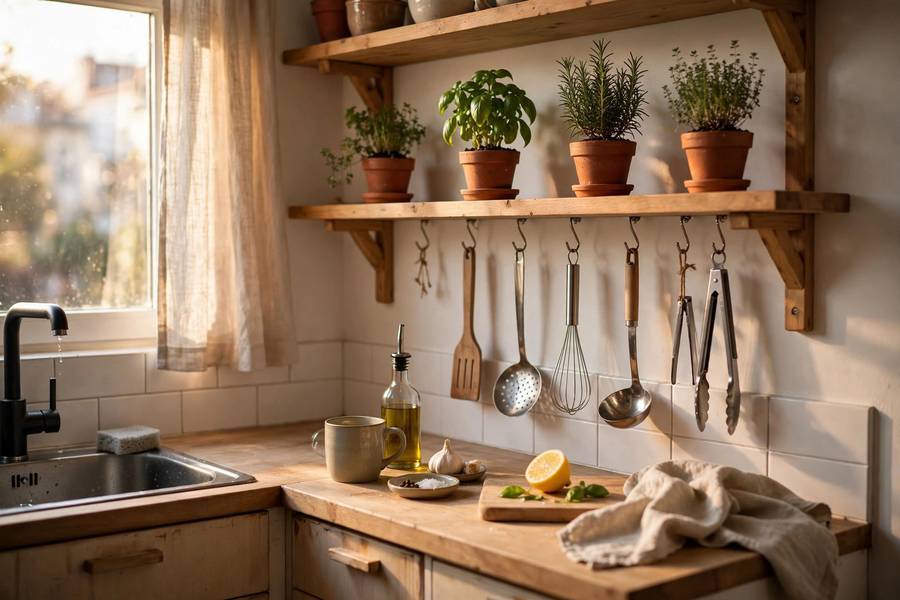
Small kitchens punish clutter more than any other room, because you feel every centimeter when you’re cooking. A few moves that genuinely help:
- Open shelving for daily dishes — but only for what you use daily. Everything else behind closed doors.
- A rail with hooks under the cabinets for utensils, mugs, or a small pan. It frees a whole drawer.
- One good cutting board that lives on the counter permanently. It becomes extra prep space and it looks fine sitting there.
- Decant the visual noise. Matching jars for flour, rice, and coffee won’t cook better, but a row of mismatched packaging makes a small kitchen feel chaotic. Decant the three or four things you reach for most.
And keep the counters as clear as you can stand. In a small kitchen, an empty counter isn’t wasted space — it’s breathing room.
The Entryway Deserves Attention Too
Most small apartments have an entryway that’s really just a door and a wall. Give it fifteen minutes: a hook for your keys and bag, a small tray for the things in your pockets, and somewhere to sit — even a sturdy stool — to put on shoes.
This tiny ritual station does something psychological. When you come home and everything has a landing spot, the whole apartment feels more orderly, even if the bedroom is a mess. First impressions count, including the one you give yourself.
If you’re still working through what to keep and what to let go of, my guide on how to declutter your closet pairs well with this — the entryway is much easier to organize once the closet behind it isn’t overflowing.
Keep the Calm: Editing as a Habit
Here’s the part nobody puts on a mood board: a small apartment only stays feeling good if you keep editing it. Not a dramatic yearly purge — just the quiet habit of noticing.
The one-in-one-out rule works: something new comes home, something old leaves. A ten-minute weekly reset — walk through with a basket, return things to their spots, notice what’s accumulating. It sounds small because it is small. That’s the point. Small habits fit small spaces.
If you find yourself constantly fighting your wardrobe for space, the capsule wardrobe guide might be the deeper fix — fewer, better clothes that all work together take up less room and cause less morning friction.
And when the space feels right — warm light, clear surfaces, your favorite chair by the window — protect that feeling. That’s the hygge lifestyle in practice: not a design trend, just the deliberate choice to make home feel like shelter.
A small apartment will never be a big house, and that’s not a failure. It’s an invitation to be deliberate — to choose each thing, each corner, each ray of light on purpose. Done well, a small space doesn’t feel like less. It feels like exactly enough.

Frequently Asked Questions
Light is the biggest lever: sheer curtains, warm bulbs, and a mirror placed opposite a window all create a sense of depth. Choose furniture with visible legs so you can see floor underneath, use one large rug instead of several small ones, and keep surfaces mostly clear — visual clutter shrinks a room faster than its actual dimensions do.
Light, warm neutrals — soft whites, warm greys, pale warm beiges — reflect light and make walls feel farther away. That doesn’t mean everything must be white: one deeper accent color on cushions, a throw, or a single wall adds character without closing the space in. The key is keeping the overall palette limited so the eye isn’t bouncing between competing colors.
Start with textiles — new cushion covers, a throw, and curtains transform a room for very little money. Thrift stores are excellent for small-space finds like mirrors, lamps, and side tables. A large rug over an ugly rental floor, warm light bulbs, and a few low-maintenance plants round out the biggest visual wins without a big spend.
Choose pieces that do double duty: a daybed with storage drawers, a drop-leaf table that works as both desk and dining table, nesting side tables, and an ottoman with hidden storage. Keep furniture scaled to the room — oversized pieces crowd a studio — and prefer pieces with visible legs, which read as lighter and let you see more floor.
Use visual signals instead of barriers: a rug defines the living area, a bookshelf turned sideways creates a soft divider, different lamps mark different activities, and even the arrangement of furniture — a sofa facing away from the bed — tells your brain where one zone ends and another begins. Each zone just needs a clear purpose, not a door.
Build editing into your routine rather than doing occasional big purges. The one-in-one-out rule keeps volume stable, a weekly ten-minute reset returns stray items to their homes, and giving everything a designated spot means clutter has nowhere to accumulate. In a small space, clear surfaces aren’t empty — they’re breathing room.