
Living in a small apartment isn’t a problem to solve — it’s a design constraint that can make your home better. Some of the most beautiful, functional homes I’ve seen are tiny. Small spaces force intention: everything has a place, everything earns its square footage, and nothing hides in a forgotten spare room.
I lived in a 400-square-foot studio for three years, and it taught me more about organization than any book. The lessons were simple: vertical space is gold, multi-use everything, and clutter is the enemy in a way it just isn’t in bigger homes.
Here’s how to make a small apartment feel spacious, calm, and completely yours.
Table of Contents
- The Mindset: Less, But Better
- Declutter First (Non-Negotiable)
- Think Vertical: Walls Are Storage
- Multi-Use Furniture Wins
- Room-by-Room: The Kitchen
- Room-by-Room: The Bedroom & Closet
- Room-by-Room: The Living Area
- Room-by-Room: The Bathroom
- Hidden Storage Spots You’re Ignoring
- Keeping It That Way
- Frequently Asked Questions
The Mindset: Less, But Better
Small-space living starts with a philosophy: own less, love more. Every item in a small apartment is visible, so every item should earn its place — by being useful, beautiful, or genuinely loved. Ideally all three.
This isn’t about minimalism as an aesthetic competition. It’s practical: fewer things means less to clean, less to organize, less visual noise. In a small space, ten unused items create chaos; in a large house, they’re invisible. The constraint is actually a gift — it forces the curation that makes homes feel peaceful.
Declutter First (Non-Negotiable)
Do not buy a single organizer until you’ve decluttered. Organizing clutter is just rearranging the problem expensively.
Go room by room with three boxes: keep, donate, trash. Be honest about the “someday” items — someday never comes, and it’s renting your square footage. For clothes specifically, decluttering your closet first makes everything else easier, and a capsule wardrobe guide helps you keep only what you actually wear.
The rule for small apartments: if you haven’t used it in a year and it has no deep sentimental value, it goes. Your space is too precious for maybes.
Think Vertical: Walls Are Storage
Floor space is finite; wall space is abundant. This is the single biggest unlock for small apartments:
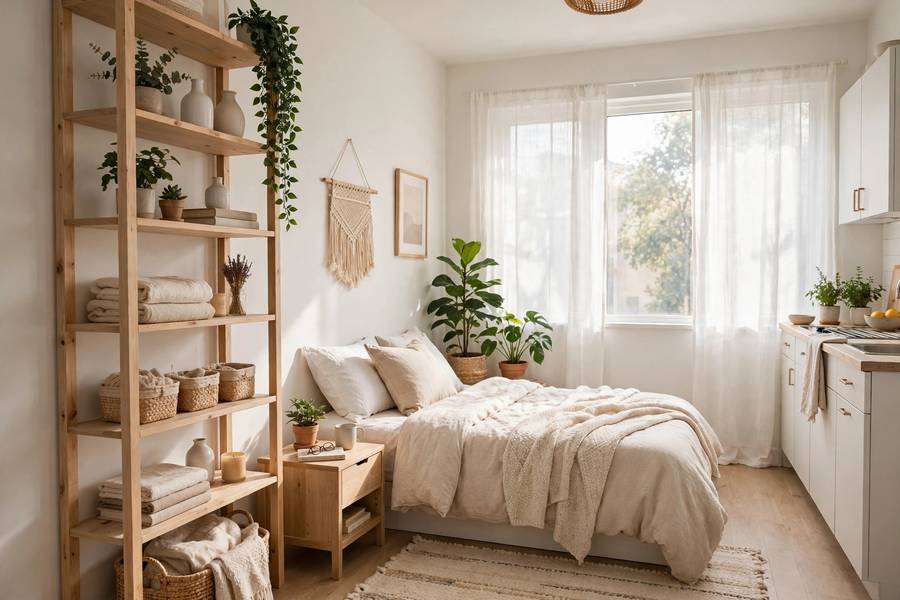
- Tall shelving instead of wide bookcases — go up, not out
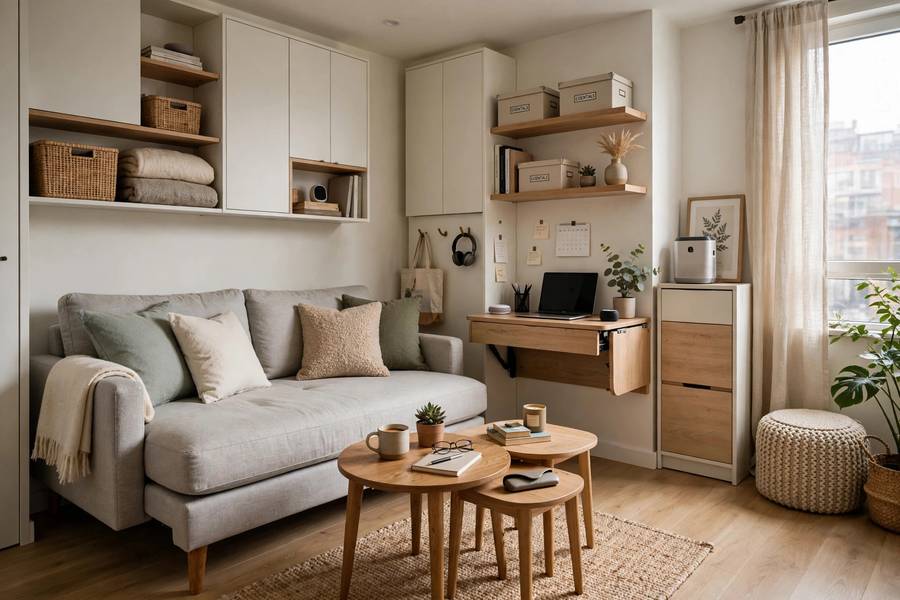
- Wall-mounted desks that fold away when not in use
- Pegboards in kitchens, offices, and craft areas — endlessly reconfigurable
- Over-door organizers for shoes, cleaning supplies, pantry items
- High shelves near the ceiling for rarely-used items (luggage, seasonal gear)
- Magnetic strips for knives, tools, spice jars
Walk through your apartment and look at every blank wall as potential storage. It’s transformative — most small apartments have more usable wall space than floor space.
Multi-Use Furniture Wins
In a small apartment, every piece of furniture should do at least two jobs:
- Storage ottoman — seating + hidden storage
- Sofa bed or daybed — living room by day, guest room by night
- Drop-leaf or extendable table — daily compact, expands for dinner parties
- Bed with drawers — an entire dresser’s worth of storage you already own
- Nesting tables — expand surface area only when needed
- Room divider shelving — defines zones while storing things
Before buying anything new, ask: “What two things will this do?” Single-purpose furniture is a luxury small spaces can’t afford.
Room-by-Room: The Kitchen
Small kitchens need ruthless efficiency:
- Purge duplicates. One good chef’s knife beats five mediocre ones. One pot, one pan, one baking sheet cover 90% of cooking.
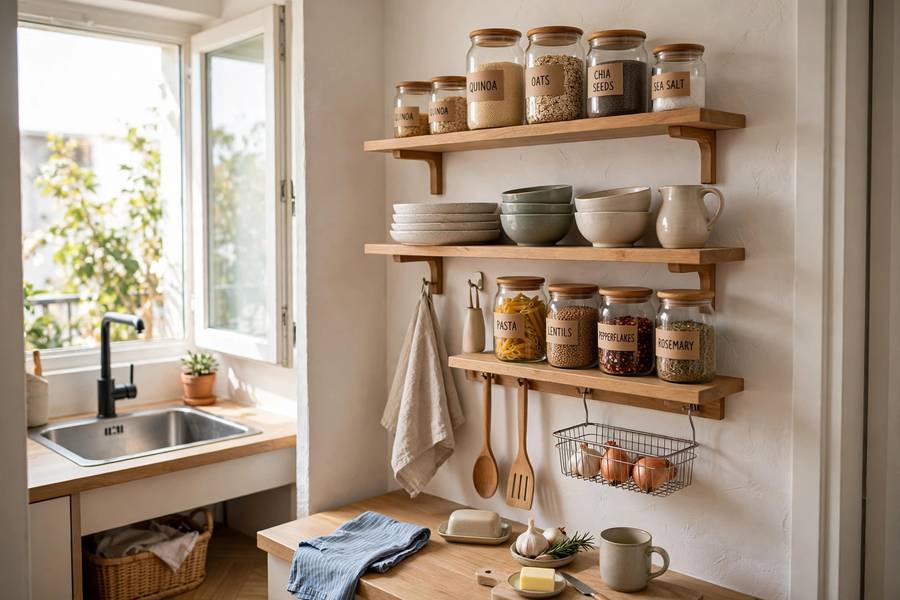
- Use the walls: magnetic knife strip, hanging pot rail, wall-mounted spice racks.
- Inside cabinet doors: mount racks for lids, wraps, and spices.
- Above cabinets: baskets for rarely-used items (holiday dishes, bulk supplies).
- Counter rule: if it’s not used daily, it doesn’t live on the counter. Clear counters make kitchens feel twice as big.
Room-by-Room: The Bedroom & Closet
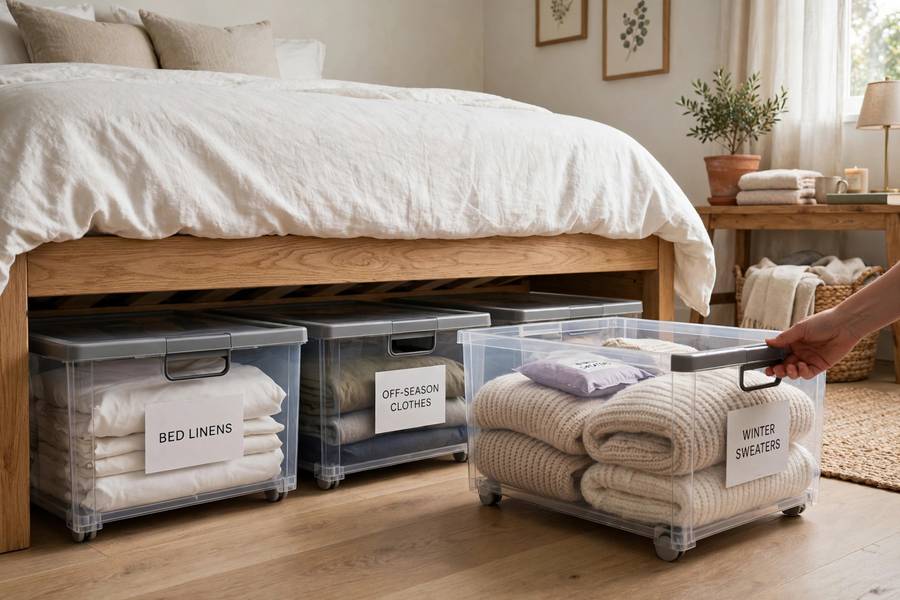
- Under-bed storage — shallow bins or drawers for off-season clothes, shoes, linens. This is found square footage.
- Closet: go vertical — double-hang rods (two levels of hanging), shelf dividers, over-door shoe organizers.
- Nightstand with drawers instead of a table — every surface should store.
- One-in-one-out rule for clothes. Small closets stay manageable only with discipline at the inflow.
Room-by-Room: The Living Area
- Define zones with rugs and lighting — a studio feels bigger with distinct “rooms” even without walls.
- Furniture with legs — seeing floor underneath makes spaces feel larger (visual trick, genuinely effective).
- Mirrors opposite windows double light and depth perception.
- Cord management — visible cables create visual chaos disproportionate to their size. A $10 cable box transforms a desk area.
- One statement piece per zone, calm everything else. Visual rest matters in small spaces.
Room-by-Room: The Bathroom
- Over-toilet shelving — the most underused storage in small apartments.
- Shower caddy or corner shelves — get products off the tub edge.
- Medicine cabinet instead of a mirror — same footprint, triple the function.
- Towel ladder or hooks instead of a bulky rack.
- Under-sink organizers — tiered shelves turn the cabinet void into usable storage.
Hidden Storage Spots You’re Ignoring
- Behind doors (hooks, racks, organizers)
- Under beds and sofas (flat bins)
- Above doorframes (a single shelf for rarely-used items)
- Inside ottomans, benches, and coffee tables (buy storage versions)
- Stairwell walls (if you have them)
- The backs of closet doors
- Under the kitchen sink (with proper organizers)
- Suitcases (store off-season clothes inside luggage you’re not using)
Keeping It That Way
Organization decays without maintenance. The systems that last:
- Five-minute nightly reset. Everything back to its place before bed. Non-negotiable, transformative.
- One-in-one-out. New item arrives, old item leaves. This single rule prevents 90% of re-clutter.
- Weekly 15-minute tidy of one zone (rotate through rooms).
- Seasonal purge. Every season change, one bag out the door.
Small apartments reward these habits enormously — five minutes in a studio equals an hour in a house. The maintenance is light because the space is small. That’s the quiet advantage nobody mentions.
The Entryway: Your Apartment’s First Impression
In small apartments, the entryway is often a few square feet — but it sets the tone and handles enormous traffic. Make it work:
- Wall hooks for coats and bags (one per person, no more)
- A small tray or bowl for keys, wallet, sunglasses — the “landing strip” that prevents lost-item panic
- A shoe solution — a narrow rack or a single row. Shoes multiply in entryways; contain them.
- A mirror — for last checks and for bouncing light into the space
Five minutes setting up an entryway saves five minutes of searching every single day. Small systems, big returns.
The “Landing Strip” Concept
Every small apartment needs a landing strip — the spot where daily essentials live: keys, wallet, sunglasses, reusable bags. Without one, these items migrate across every surface, creating the visual chaos that makes small spaces feel smaller.
Set yours up by the door: a small tray, a few hooks, a basket for bags. The rule is absolute — these items live here, always. It takes two weeks to become automatic, and it eliminates the daily “where are my keys” panic permanently.
Extend the concept: a charging station (all devices in one spot, not scattered), a mail station (inbox tray, reviewed weekly), a launch pad for tomorrow (bag packed, clothes ready). Each station removes dozens of micro-decisions and keeps surfaces clear — and clear surfaces are what make small apartments feel spacious. Start with just the landing strip; add stations one at a time as the habit settles.
Frequently Asked Questions
Declutter first, then think vertical (walls are storage), choose multi-use furniture, and use hidden spots like under-bed and over-door space. Every item should earn its place in a small home.
Light colors, mirrors opposite windows, furniture with visible legs, clear counters and surfaces, good lighting, and minimal visual clutter. Defined zones with rugs also make studios feel larger.
Multi-use pieces: storage ottomans, sofa beds, extendable tables, beds with drawers, and nesting tables. Every piece should do at least two jobs in a small space.
Use garment racks, under-bed bins, over-door organizers, tall bookshelves with baskets, and wall hooks. A small wardrobe armoire replaces a closet affordably.
Five-minute nightly reset (everything back in place), one-in-one-out for new purchases, and a weekly 15-minute zone tidy. Small spaces stay clean with tiny consistent habits.