How to Write a Will Without a Lawyer: When DIY Works (and When Not)


The question of how to write a will without a lawyer comes up in my work more than almost any other. Usually it sounds like this: “My situation is simple — do I really need to pay a lawyer for this?” Sometimes the answer is no. A straightforward will, done carefully, is absolutely something an ordinary person can prepare. But “simple” is doing a lot of work in that sentence, and the line between a fine DIY will and a costly mistake is thinner than most people think. Let me give you the honest version: when DIY is fine, when it is not, and the validity checklist that makes the difference.
One important note before we start: I am explaining general legal information here, not giving legal advice about your situation. Wills are governed by state law, and the rules vary — sometimes significantly — from one state to another. Everything below is educational. If anything about your situation feels complicated, that feeling is data; act on it.
How to Write a Will Without a Lawyer: When DIY Is Fine
Most people overestimate how complicated their estate is and underestimate how precise the formalities are. Here is when doing it yourself is genuinely reasonable.
Your situation is truly simple. You want everything to go to your spouse, then your kids equally. You are naming a guardian for minor children and an executor you trust. No businesses, no property in multiple states, no estranged family members you are disinheriting, no special-needs beneficiaries. This covers a large share of young families, and a careful DIY will handles it well.
You understand your state’s formalities and will follow them exactly. This is the real test. DIY does not mean casual — it means you become your own meticulous paralegal. If you are the kind of person who reads instructions twice, you can do this. If you are the kind who skims, hire the lawyer.
You will revisit it. A will is not a one-time document. Marriage, divorce, births, deaths, moves to a new state, major asset changes — all of these can require updates. DIY works when you commit to reviewing the will every few years and after every major life event. A stale will can be worse than no will in some situations, because it confidently directs assets to people you no longer intend.
When You Need a Lawyer (No Exceptions I Would Defend)
Blended families. Second marriages, stepchildren, children from prior relationships — the competing claims here are exactly where DIY wills blow up. A lawyer structures provisions so your wishes survive the family dynamics.
Significant assets or tax exposure. If your estate is large enough that estate taxes are a real consideration, or you own a business, the will is the wrong tool to do alone. Tax-aware estate planning pays for itself many times over.
A beneficiary with special needs. Leaving assets directly to someone receiving government benefits can disqualify them. Special-needs trusts exist for exactly this reason, and they are not DIY territory.
Disinheriting someone. Cutting out a spouse or child invites a will contest, and the formalities for doing it effectively are state-specific and unforgiving. Do not freelance this.
Property in multiple states or countries. Each jurisdiction has its own rules, and a will valid in one place may fail in another. Cross-border estates need professional coordination.
You own a business. Succession, valuation, buy-sell provisions — a will alone rarely handles business transition well, and getting it wrong can destroy the company’s value for your heirs.
My rule of thumb: if your situation has more than one “but…” — “I want everything to go to my wife, but the house is in my name from before the marriage” — that “but” is the lawyer’s fee justifying itself.

The Validity Checklist: What Makes a Will Legally Work
A will is not valid because it sounds official. It is valid because it satisfies your state’s formal requirements. Miss one and the document can fail entirely. Here is the checklist, in the order that matters.
1. Testamentary capacity. You must be of legal age (18 in most states) and of “sound mind” — meaning you understand what a will is, what you own, and who your natural heirs are. Capacity is assessed at the time of signing. This is rarely an issue for DIY wills, but it is the ground most will contests are fought on, so sign while you are clearly well.
2. Written document. Nearly every state requires the will to be in writing. Some states recognize handwritten (“holographic”) wills with relaxed formalities, but most do not — and even where they do, they are litigation magnets. Type it. Print it. Do not rely on a video will or a voice memo; those are not valid wills in the vast majority of jurisdictions.
3. Clear testamentary intent. The document must clearly state that it is your will and express your wishes about your property. Vague language invites disputes. Name beneficiaries precisely (full legal names, relationships), describe bequests specifically, and include a residuary clause — the provision that sweeps up everything you did not specifically mention. Wills without residuary clauses are a classic DIY failure: the specific gifts work, and everything else falls into intestacy.
4. Proper signatures. You must sign the will, generally at the end of the document. Requirements about signing each page vary by state — when in doubt, initial every page and sign the last. Use your full legal signature, the one on your ID.
5. Witnesses. This is where most DIY wills die. Most states require two disinterested witnesses — adults who are not beneficiaries under the will and ideally not related to beneficiaries — who watch you sign and then sign themselves, in your presence and (in many states) in each other’s presence. “Disinterested” matters: a beneficiary who witnesses the will can void their own bequest in some states, or void the whole will in a few. Get two neutral adults. Neighbors, coworkers — anyone competent and uninvolved.
6. Notarization (the self-proving affidavit). A will does not generally require notarization to be valid. But most states allow a “self-proving affidavit” — a notarized statement, signed by you and the witnesses, that lets the will be admitted to probate without tracking down the witnesses later to testify. It is optional and enormously practical. Do it if your state offers it.
How to Actually Write It: Structure and Wording
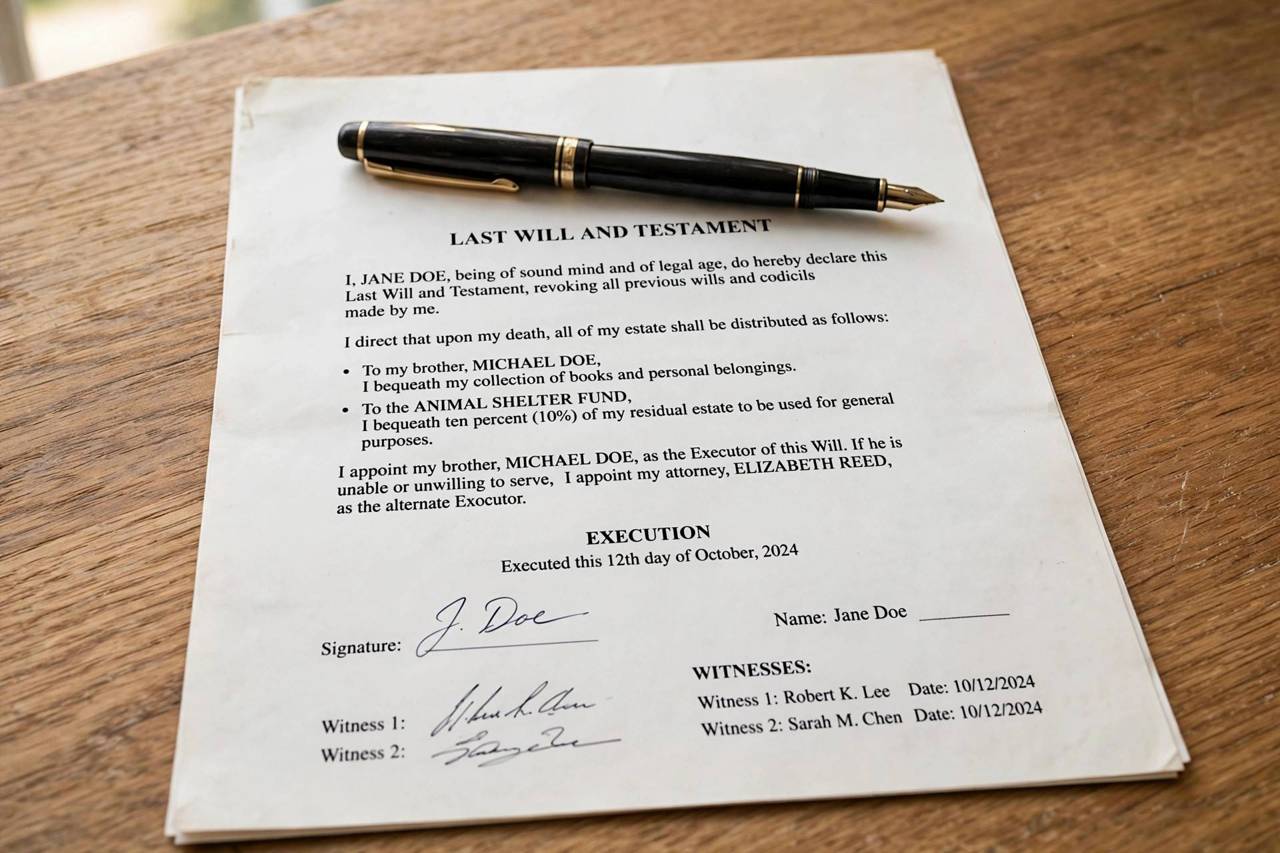
A basic will follows a standard structure. Opening declaration: your full legal name, address, a statement that this is your last will and testament, and a revocation of all prior wills. Executor appointment: name your executor and an alternate. Guardianship: if you have minor children, name a guardian and an alternate — for many parents this is the single most important clause in the document. Bequests: specific gifts first (“my wedding ring to my daughter Anna”), then the residuary clause for everything else. Signatures: yours, the witnesses’, and the notary for the self-proving affidavit.
Use plain, precise language. “I leave my house at 123 Oak Street to my wife, Jane Marie Doe” beats any attempt at legal-sounding flourish. The fancier the language, the more room for ambiguity — and ambiguity is what lawyers’ children’s college funds are made of.
As for templates and online will services: a reputable template is a fine starting point, but it is a starting point. Read every clause, delete what does not apply, and verify the witness and signature requirements against your current state’s law — templates go stale, and a template written for another state’s formalities is a trap.
Mistakes That Invalidate a Will
Wrong witnesses. One witness when the state requires two. A beneficiary as witness. Witnesses who did not actually see you sign. This single category accounts for more failed DIY wills than everything else combined.
Only one copy with conflicting versions. If you make changes, execute a brand-new will (or a formal amendment called a codicil, with the same formalities). Crossing things out and initialing works in almost no state and creates exactly the ambiguity a contest needs.
Storing it where nobody can find it. A will in a safe deposit box that nobody can open without probate — which requires the will — is a cruel joke. Tell your executor where the original is. A fireproof home safe, with the executor informed, works for most people.
Forgetting non-probate assets. Retirement accounts, life insurance, and jointly owned property pass by beneficiary designation or title, not through your will. Your will can say anything it likes about your 401(k); the beneficiary form controls. Review those designations — they override the will, and stale designations (ex-spouses, deceased parents) are a notorious source of misery.
Moving states without updating. A will valid where you signed it is usually honored elsewhere, but “usually” is doing heavy lifting, and some provisions (like executor qualifications) vary. A move is an automatic trigger to have the will reviewed.
Frequently Asked Questions
Is a handwritten will legally valid?
In some states, yes — these are called holographic wills — but the rules are narrow and they are frequently challenged. A typed will with proper witnesses is valid in every state and far harder to dispute. Handwriting your will is legal minimalism with maximum risk.
Do I need to notarize my will?
Notarization is not generally required for validity, but a notarized self-proving affidavit (where your state allows it) makes probate much smoother by eliminating the need to locate witnesses later. It is optional and highly recommended.
Can I write my own will for free?
Yes — a will you type yourself, properly witnessed and signed according to your state’s law, costs nothing but care. Online templates range from free to modest fees. The cost is never the paper; it is the precision.
What happens if I die without a will?
Your state’s intestacy laws decide who gets what, in a fixed order of relatives. The court appoints an administrator and a guardian for minor children. It works, but it is slower, more expensive, and it follows a formula rather than your wishes.
How often should I update my will?
Review it every three to five years and after every major life event: marriage, divorce, births, deaths, significant asset changes, or moving to a new state. An outdated will can actively work against your current intentions.
The Bottom Line
How to write a will without a lawyer comes down to this: simple situation, exact formalities, two disinterested witnesses, a self-proving affidavit, and a commitment to keep it current. Get those right and a DIY will is a perfectly respectable document. Get any of them wrong and you have an expensive illusion. Know which side of that line you are on — and when in doubt, the lawyer’s fee is the cheapest insurance your family will ever buy.