How to Write a College Application Essay: The One-Small-Story Method


Every fall, I watch brilliant students freeze in front of the same blank document. They have the grades, the activities, the story — and then the essay prompt appears and suddenly they are writing like a committee. If you are wondering how to write a college application essay that actually sounds like you, here is what fifteen years of reading these (and coaching students through them) has taught me: the best essays are not about impressive things. They are about small things, noticed closely, that reveal how a mind works. One small story, told well, beats a resume in paragraph form every single time.
Admissions officers read thousands of essays. Thousands. The ones they remember are not the ones with the biggest accomplishments — they are the ones where a real person’s voice comes through in the first three sentences. Your job is not to impress them. Your job is to make them feel like they have met you. Everything below serves that goal: the one-small-story method, a decoder for the Common App prompts, and the openings that actually work.
How to Write a College Application Essay: The One-Small-Story Method
Forget “tell us about yourself.” Instead, pick one specific moment — ideally under ten minutes of real time — and stay inside it. The burnt pancakes you made for your grandmother the morning after your grandfather’s funeral. The twenty minutes you spent trying to fix a customer’s order at your after-school job and what it taught you about pride. The argument with your best friend about a book that changed how you read everything after.
Why small works: a small moment forces specificity, and specificity is what makes writing feel true. You cannot hide behind abstractions when you are describing the exact sound of a smoke alarm at 6 AM. And specificity is memorable — the admissions officer who reads forty essays about “leadership” will remember the one about the pancakes. The moment is the vehicle; what it reveals about how you think, what you value, how you handle difficulty — that is the cargo. The essay is never really about the pancakes.
Here is the method, step by step. Brainstorm ten moments, not two — the first ideas are always the clichés (the big game, the mission trip, the immigrant-parents tribute). Those topics are not forbidden, but they are crowded, and your tenth idea is usually more yours than your first. Pick the one you cannot stop thinking about — the one with unresolved feeling in it. Write it as a scene first: dialogue, sensory detail, present tense if it helps you stay inside it. Then zoom out in the final third: what did this change about how you see things? The reflection should feel earned by the scene, not stapled on. If your last paragraph could be attached to any essay, it is not specific enough.
The test I give every student: could anyone else have written this essay? If the answer is yes — if swapping your name for another student’s would still work — go smaller, go more specific, go more honest. The essay only works when the answer is no.

The Common App Prompt Decoder
The prompts look different, but they are all asking the same thing in different costumes: show us how you think. Here is what each one is really fishing for.
Background/identity: not a demographic summary — a story about how some part of your world shaped your lens. The best answers pick one thread, not the whole tapestry.
Obstacle/challenge: they want the response, not the suffering. Spend 30% of the essay on what happened and 70% on what you did, thought and became. Essays that wallow in the obstacle without showing agency fall flat.
Questioning a belief: intellectual honesty on display. Pick a belief you actually held and genuinely revised — the smaller and more specific, the more believable. “I used to think X about my town/school/family; this moment changed it” is a perfect engine.
Gratitude: the trap is writing about the person instead of yourself. The essay should reveal you — what their influence unlocked in your thinking or behavior. Make them the catalyst, not the subject.
Growth/accomplishment: accomplishment is the least interesting part. What did pursuing it cost you, and what did it teach you about yourself? The most compelling versions include something that went wrong.
Topic of your choice: freedom — which means the topic matters less than the execution. If none of the prompts fit your story, this is your door. Use it confidently.
Notice: every prompt rewards the one-small-story method. The prompts are just different doors into the same room.
Openings That Work (and the Ones That Do Not)
Admissions officers decide whether to lean in within the first paragraph. Here is what earns that lean.
In medias res: drop into the scene mid-action. “The smoke alarm went off at 6:12 AM, and I was holding a spatula covered in what used to be pancakes.” No throat-clearing, no “throughout my life.” You are in it.
The surprising specific: open with a detail that creates curiosity. “I have strong opinions about grocery store lighting.” The reader has to keep going — why does this person care about that?
Quiet confidence: a simple declarative sentence in a strong voice. “I am the person my friends call when something breaks.” Then prove it with the story.
And the openings to retire: dictionary definitions (“Webster’s defines courage as…” — readers have seen this ten thousand times), grand philosophical pronouncements (“Since the dawn of time, humans have struggled with…”), apologies (“I’m not a very good writer, but…” — never apologize in an essay), and resume summaries (“As captain, volunteer, and honor student…” — that is what the activities section is for).
Voice: Sounding Like You on Your Best Day
The most common feedback I give is some version of “this does not sound like you.” Students adopt an Essay Voice — formal, distant, stuffed with words they would never say aloud. The fix is embarrassingly simple: read every draft out loud. Any sentence you would not say to a friend needs rewriting. Your essay voice should be you on your best day — thoughtful, specific, a little wry if that is who you are — not you in a tuxedo.
A few voice rules that never fail: short sentences are brave — they create rhythm and confidence. Specific nouns beat adjectives — “the dented blue thermos” beats “my beloved container.” Humor is welcome but never forced — one genuine funny line beats five attempted ones. And do not perform vulnerability — real reflection is quiet; melodrama is loud. If you are manufacturing emotion, the reader feels the manufacturing, not the emotion.
On getting help: have a trusted teacher or counselor read for clarity, and a parent read for “does this sound like you.” But the words must be yours. Admissions officers can smell adult-polished essays from across the room — the vocabulary jumps, the voice flattens — and nothing sinks an essay faster than the suspicion that it was not written by the applicant.
The Revision Process (Where Essays Are Actually Made)
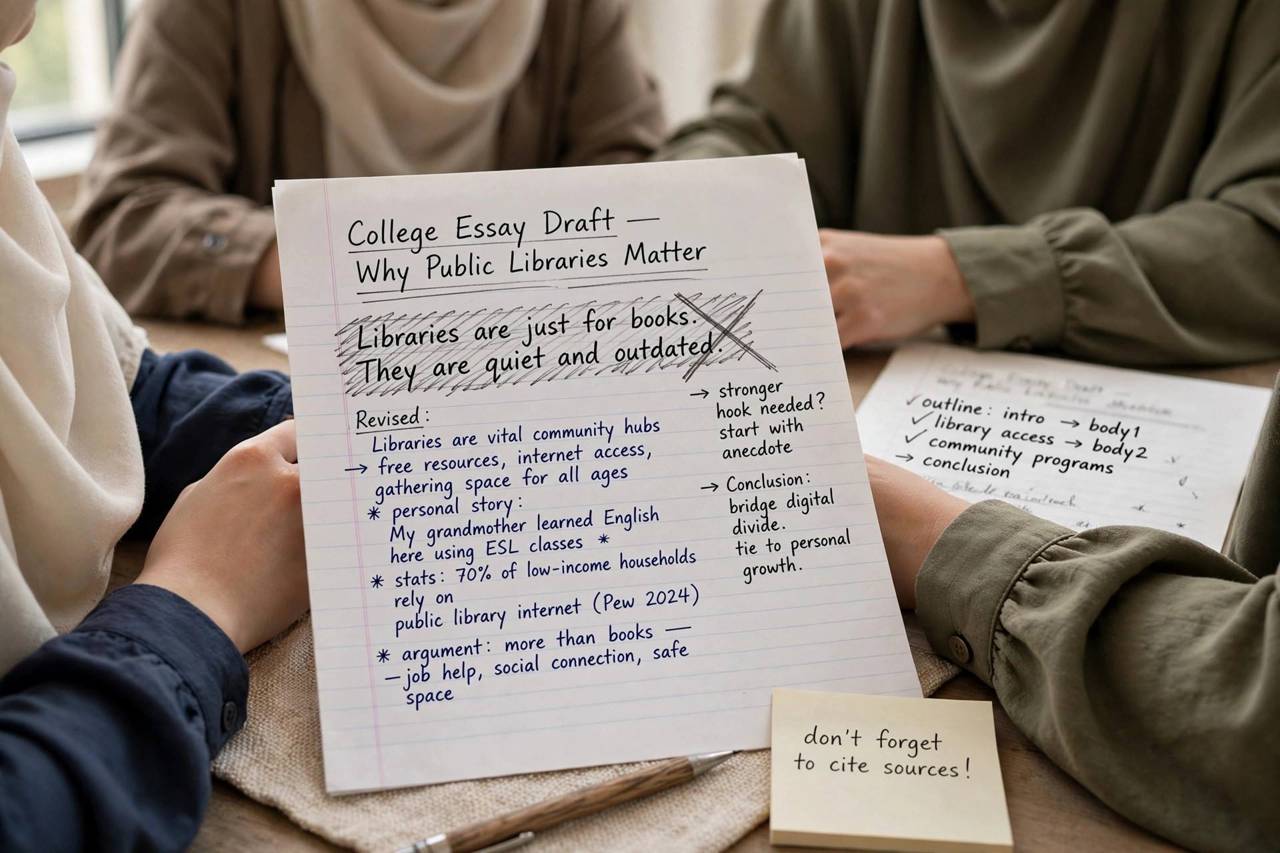
First drafts are for discovery; essays are made in revision. My recommended cycle: draft fast (get the story down without self-editing), rest 48 hours (you cannot see your own essay clearly while you are inside it), cut 20% (every essay has a fifth that is throat-clearing — find it and kill it), read aloud (the voice test), check the prompt (does it actually answer what was asked?), and proofread last (typos in a 650-word essay suggest carelessness; read it backwards, sentence by sentence, to catch them).
Start early enough for this cycle to breathe — August for November deadlines is comfortable; October is survivable; the night before is how good students submit essays that do not sound like them. And remember the essay is one piece of a larger application: if you are still getting oriented, understanding how college applications work overall keeps the essay in its proper place — important, but not the whole story. The same storytelling muscles also serve you well when writing a scholarship essay, where the audience is different but the principles are identical.
Do Not Neglect the Supplements
The personal statement gets the glory, but supplemental essays — the “why this college” and short-answer prompts — are where applications are often won. They are also where generic writing goes to die: “your beautiful campus and renowned faculty” could describe fifty schools. The fix is the same specificity the main essay demands: name the professor, the lab, the course, the tradition. One concrete detail per supplement beats a paragraph of flattery. Write them with the same voice, revise them with the same care, and never reuse a “why us” essay between schools without a full rewrite — admissions officers can tell, and nothing says “you are my safety school” like an essay that forgot which school it is for.
Frequently Asked Questions
How long should a college application essay be?
The Common App personal statement allows up to 650 words — aim for 600–650. Shorter supplements have their own limits; respect every word count exactly. An essay that uses the full space thoughtfully beats one that stops at 400 words with more to say.
Can I write about the same topic as other students?
Common topics (sports, service trips, family background) are fine — what matters is your specific angle and voice. The “could anyone else have written this” test is the real filter, not the topic’s popularity.
Should my essay be funny or serious?
Be yourself. Genuine humor is a strength; forced humor is a liability. Serious topics handled with quiet reflection are just as compelling as light ones. The tone should match the story, not a strategy.
How personal is too personal for a college essay?
Write about what genuinely shaped you, but maintain boundaries you are comfortable with — admissions officers are strangers, and you cannot control who reads the essay. Focus on your growth and reflection rather than graphic detail, and never write anything you would regret a stranger knowing.
Do admissions officers actually read every essay?
At most selective schools, yes — often two readers. At very large public universities with tens of thousands of applications, essays may receive lighter review or matter less in formula-driven processes. The essay matters most where admission is holistic and competitive.
The Bottom Line
How to write a college application essay: one small story, told specifically, in your real voice, revised until no one else could have written it. Not a resume, not a performance — a meeting. Make the reader feel they have met you, and the rest of the application gets to be the supporting evidence.