How to Apply for a Scholarship: A Step-by-Step Guide


Figuring out how to apply for a scholarship can feel like a second college application hiding inside the first one. Deadlines overlap, essays pile up, and every award seems to want slightly different paperwork. But the process is learnable, and students who treat it like a project — with a system, a calendar, and reusable materials — consistently win more funding than students who apply randomly. This guide breaks the whole process into clear steps: finding the right scholarships, preparing your materials, writing essays that stand out, and submitting without the last-minute panic.
One mindset shift first: scholarships are not lottery tickets. Committees award them to applicants who match their criteria and present themselves well. Your job is to find the awards where you’re a strong match and make that match obvious. A focused application to ten well-chosen scholarships beats a scattershot application to fifty.
How to Apply for a Scholarship: The Big Picture
The process has five phases: research (finding awards you qualify for), preparation (gathering documents and recommenders), writing (essays and personal statements), submission (applications, deadlines, follow-through), and follow-up (thank-yous, renewals, reporting). Most students spend too little time on research and too much time panicking in submission. Flip that ratio and everything gets easier.
Start early — ideally 6 to 12 months before you need the money. Many major scholarships have fall deadlines for the following academic year, and recommendation letters take weeks to arrange. A student starting in spring for fall funding is already behind; a student starting the previous summer is right on time.
Step 1: Find Scholarships That Fit You
Cast a wide net across four sources. Your school’s counseling or financial aid office keeps lists of local awards with smaller applicant pools — these are gold. Scholarship search databases let you filter by major, background, interests, and location. Community organizations, employers (yours and your parents’), religious groups, and professional associations all run awards most students never hear about. And the colleges you’re applying to offer merit aid — sometimes automatically, sometimes by separate application.
Track everything in a spreadsheet: scholarship name, amount, deadline, requirements, essay prompts, recommendation needs, and submission method. This sheet becomes your command center. Color-code by deadline urgency. When students tell me they “missed” a deadline, what they really missed was having a system.
Step 2: Check Eligibility Carefully
Read eligibility criteria like a contract, because that’s what they are. GPA minimums, enrollment status, field of study, residency, financial need, demographics — committees filter ruthlessly on these. Applying to an award you don’t qualify for wastes hours and, worse, can get you flagged if you misrepresent anything.
Also note the fine print: is the award renewable, and what does renewal require? Can it be combined with other aid, or does your school reduce other aid when you win outside scholarships? A $5,000 award that displaces $5,000 of existing aid nets you nothing — ask your financial aid office about their displacement policy before you celebrate.
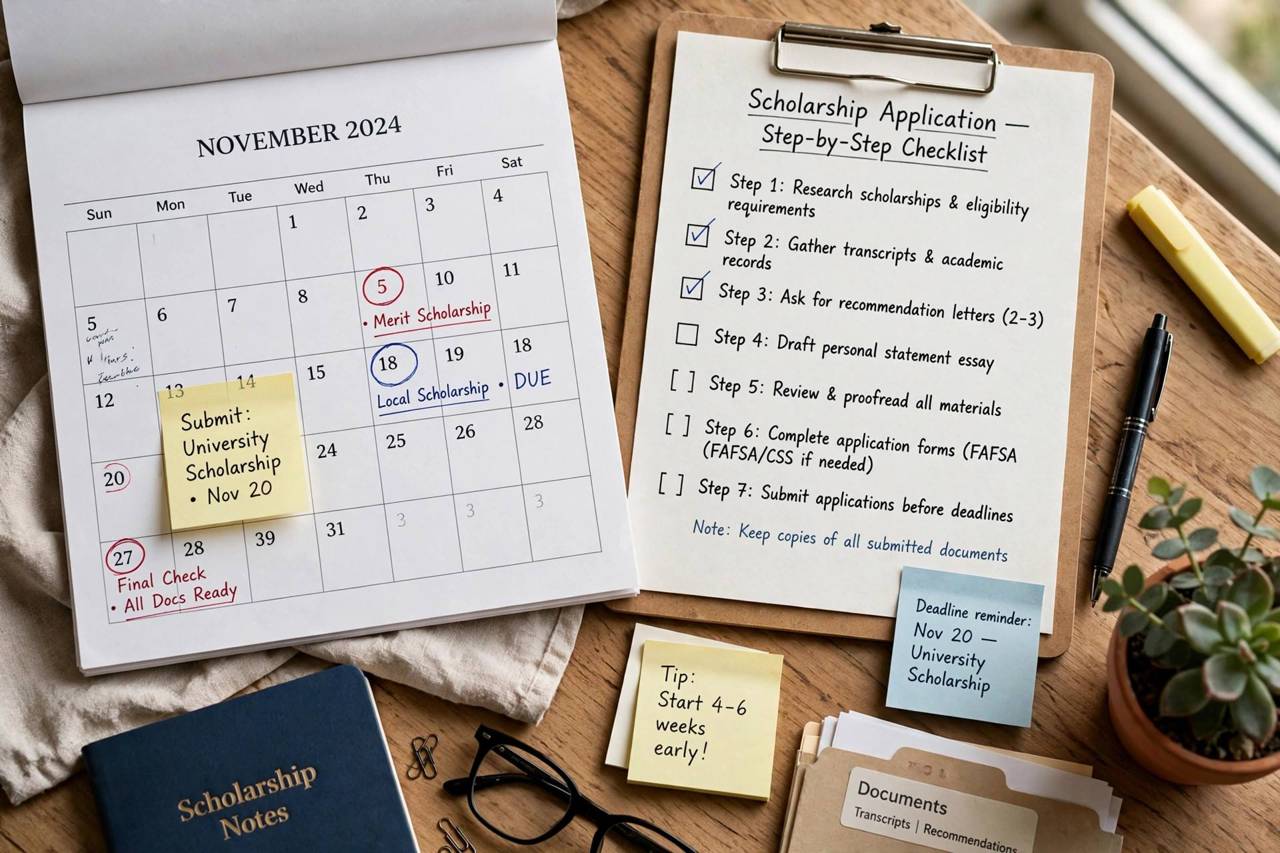
Step 3: Gather Your Documents
Nearly every application wants some combination of: transcripts, test scores (where still required), a resume or activities list, financial documents (FAFSA confirmation, tax forms for need-based awards), and proof of enrollment or acceptance. Assemble these once into a master folder — digital and physical — and you’ll stop scrambling.
Build a one-page activities resume even if it’s not required. Listing your activities, work, volunteering, and honors in one clean document forces you to see your own story clearly, and that clarity feeds directly into your essays. Update it every semester; future-you will be grateful.
Step 4: Line Up Recommendation Letters
Ask recommenders at least a month before the first deadline — six weeks is better. Choose people who know you well and can speak to specific qualities: a teacher who saw you struggle and improve beats a famous name who barely knows you. Provide each recommender a packet: your resume, the scholarship’s criteria, the deadline, submission instructions, and two or three bullet points about what you’d love them to highlight.
Waive your right to view the letters (committees trust confidential letters more), then follow up politely one week before the deadline. Afterward, tell your recommenders the outcome and thank them — they’re investing in you, and you’ll need them again for future applications.
Step 5: Write Essays That Actually Stand Out
Scholarship essays fail in predictable ways: they restate the resume, they answer the wrong prompt, or they sound like they were written by a committee of anxious adults. The essays that win do three things: answer the actual question asked, show rather than tell (one vivid specific story beats five adjectives about yourself), and connect your past to your future plans in a way that makes the scholarship feel like an investment, not a gift.
Write one strong core personal statement — 500 to 750 words about who you are and where you’re headed — then adapt it per prompt instead of starting from zero each time. Committees can tell when an essay was clearly written for a different award; spend your customization energy on the opening and closing paragraphs, where the fit is most visible. For detailed technique, our guide on writing a strong scholarship essay walks through structure, openings, and revision.
Step 6: Submit Cleanly and Confirm
Treat submission like a checklist, not a hope. Every required field filled, every document attached in the requested format, essays within word limits, application previewed before final submit. Then confirm: screenshot the confirmation page, save confirmation emails, and for mailed applications, use tracking. A shocking number of “lost” applications were never actually submitted — the student closed the tab one click early.
After submitting, log the date and set a reminder for the decision timeline. Some awards notify in weeks, others in months. Don’t email committees asking for updates unless the stated timeline has clearly passed.

Common Mistakes That Sink Applications
Missing the deadline is the obvious one, but the quiet killers are subtler: essays that ignore the prompt, recommendation letters from people who clearly don’t know the student, sloppy proofreading (spell the organization’s name right — every time), and applying to awards you’re not eligible for. Another frequent mistake: writing what you think the committee wants to hear instead of what’s true. Committees read thousands of essays; authenticity is rarer and more memorable than perfection.
And never pay to apply. Legitimate scholarships don’t charge application fees. Any “scholarship” asking for payment, bank details, or a “processing fee” is a scam — report it and move on.
Keep Your Materials Fresh Every Semester
Your scholarship system isn’t a one-time setup — it’s a living file. Each semester, update your activities resume with new roles and hours, refresh your core essay with what you’ve learned, and ask one new professor or supervisor if they’d serve as a recommender down the line. Ten minutes of maintenance per month beats a frantic rebuild every application season, and returning applicants with polished, current materials stand out immediately to committees reviewing repeat candidates.
After You Win (or Don’t)
If you win: send a thank-you note immediately, find out about renewal requirements and disbursement timing, and check whether you need to report the award to your school’s financial aid office (usually yes). If you don’t win: ask for feedback where it’s offered, reuse the materials for the next application, and keep going. Scholarship hunting is a numbers game played with quality applications — most winners applied to many awards before their first yes.
Remember that scholarships are one piece of the funding picture. Understanding how college applications and admissions timelines work helps you sequence everything — applications first, then aid, then outside scholarships — instead of juggling all three in a panic.
Scholarships Beyond Freshman Year
Most scholarship advice targets high school seniors, but the money doesn’t stop after freshman year — and competition often drops, because fewer students keep applying. Sophomores, juniors, and seniors should check their department offices every semester: academic departments frequently control awards that go unclaimed for lack of applicants. Your major’s professional association likely runs scholarships too, and these come with networking side benefits that outlast the check.
Transfer students and returning adult students have dedicated awards as well — search specifically for “transfer scholarships” and “nontraditional student scholarships” rather than wading through freshman-focused lists. Community college students should ask about foundation scholarships at their current school before transferring; many are designed to fund the transition itself. And graduate students: assistantships, fellowships, and departmental grants often dwarf undergraduate awards, but they have earlier deadlines and expect a more professional application package. The system you built for undergrad applications — the spreadsheet, the master folder, the core essay — ports directly over.
Frequently Asked Questions
When should I start applying for scholarships?
Start 6 to 12 months before you need the funding. Many major awards have fall deadlines for the following academic year, and gathering transcripts, recommendations, and essays takes longer than students expect. Starting the summer before your senior year of high school (or earlier in college) puts you in a strong position.
How many scholarships should I apply for?
Quality beats quantity, but volume still matters. A good target is 10 to 20 well-matched applications rather than 50 scattershot ones. Prioritize awards where you clearly meet the criteria and the applicant pool is smaller, such as local and community scholarships.
Do I need perfect grades to win scholarships?
No. Many scholarships reward specific talents, backgrounds, intended majors, community service, or financial need rather than GPA alone. Plenty of awards have modest GPA minimums (often 2.5–3.0) or none at all. Read each award’s criteria — you’ll find many where grades are only one factor.
Can I apply for scholarships as a college student, not just a high school senior?
Absolutely. Many scholarships are specifically for current undergraduates, transfer students, and graduate students. Your college’s financial aid office and departmental offices are the best sources — departments often have awards that go unclaimed for lack of applicants.
Are scholarship application fees legitimate?
No. Legitimate scholarships never charge you to apply. Any award requesting an application fee, processing fee, or bank account details is a scam. Real scholarships give money; they don’t ask for it.
What happens to my financial aid if I win an outside scholarship?
It depends on your school’s policy. Some schools reduce other aid (called displacement) when outside scholarships arrive, which can cancel out the win. Ask your financial aid office about their displacement policy before counting on the full value of an award.