


Every year I watch capable students turn the college application process into a source of dread far beyond what it deserves. The system looks opaque from the outside — portals, platforms, essays with cryptic prompts, deadlines with Latin-sounding names. But once you see the machinery, it’s just a sequence of steps. Understandable steps, doable steps.
Here’s how college applications actually work, from building your list to hitting submit to reading your decisions — with the practical advice I give my own students at each stage.
Table of Contents
- The Timeline: When Everything Happens
- Building Your College List
- The Application Platforms
- How Do College Applications Work: The Pieces of an Application
- Deadlines: Early Decision, Early Action, Regular
- Financial Aid and Scholarships
- After You Submit: Decisions and Choosing
- Frequently Asked Questions

The Timeline: When Everything Happens
For a student starting college the fall after high school graduation, the process runs roughly like this:
- Junior year spring: Research colleges, visit campuses if possible, take standardized tests (SAT/ACT) if your target schools want them, ask teachers for recommendation letters before summer.
- Summer before senior year: Draft your personal statement. This is the single highest-leverage use of summer — an essay written in August beats one written in a November panic every time.
- Senior year fall: Finalize your college list, complete applications, submit by deadlines (mostly November–January), file financial aid forms.
- Senior year winter/spring: Decisions arrive (typically March–April). Compare offers, visit admitted-student days, commit by May 1.
- Summer: Orientation, housing forms, placement tests, and the paperwork avalanche.
The students who struggle are almost always the ones who start in October of senior year. The students who sail through started in spring of junior year. The work is the same; the stress is not.
If your coursework includes research papers, nailing the research paper introduction sets up everything that follows.
Building Your College List
Before any application exists, you need a list. Here’s how to build one that won’t leave you with bad options in April:
Start with fit, not prestige. The right college is the one where you’ll thrive academically, afford the cost, and be happy for four years. Consider: size (2,000 vs. 40,000 students is a different universe), location (distance from home matters more than 17-year-olds think), available majors, campus culture, and — critically — net cost after aid.
Use the reach–match–safety structure. Apply to a mix: 2–3 “reach” schools where admission is a long shot, 3–4 “match” schools where your stats align with admitted students, and 2–3 “safety” schools where you’re very likely admitted and would genuinely be happy to attend. The safety schools are the ones people neglect — a safety you hate is not a safety, it’s a trap.
Research beyond the rankings. Rankings measure things that may not matter to you (alumni giving rates, peer reputation surveys). Better sources: the college’s own published data (graduation rates, average class sizes, career outcomes), student newspapers, campus visits, and conversations with current students. Sit in on a class if you can — an hour in a real lecture tells you more than a glossy brochure.
Keep it to 6–10 schools. Each application costs time (supplemental essays multiply fast) and money ($50–$90 per application, though fee waivers are widely available). Ten thoughtful applications beat fifteen rushed ones.
The Application Platforms
You don’t apply to each college through its own separate universe — mostly. The main platforms:
- The Common Application (Common App): Used by 1,000+ colleges. One application, one personal statement, sent to multiple schools. Each college can add its own supplemental questions. If your schools accept it, this is your primary tool.
- The Coalition Application: Similar concept, fewer schools, with an emphasis on access for underrepresented students.
- School-specific applications: Some large public university systems (like the UCs or Texas’s ApplyTexas) run their own portals with their own essay prompts.
- Direct applications: A few colleges only accept applications through their own websites.
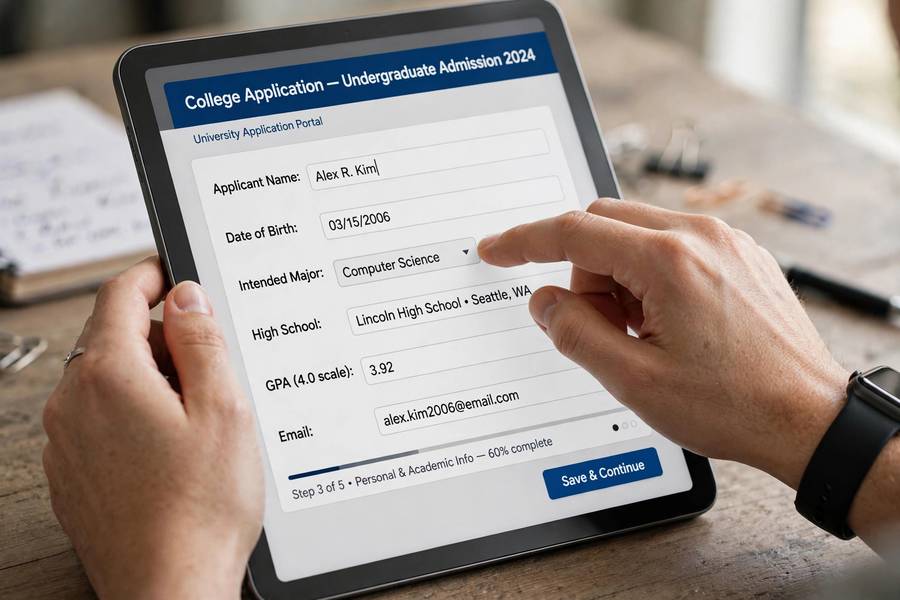
Practical tip: create your Common App account in the summer before senior year and fill in the boring parts (demographics, family info, activities list) early. It’s tedious, and tedium done early doesn’t become panic later.

How Do College Applications Work: The Pieces of an Application
A complete application typically includes:
The personal statement. Usually 650 words (Common App) responding to one of several prompts. This is not an essay about your achievements — it’s the one place the application shows who you are. The best ones I’ve read share a pattern: a specific moment, honest reflection, and a voice that sounds like a real 17-year-old rather than a press release. Start early, write badly first, revise ruthlessly. Nobody’s first draft is good; everybody’s fifth draft is better.
The same skill that powers a great thesis statement will sharpen your personal statement too.
Supplemental essays. Many colleges add short essays: “Why this school?” (the most common), “describe a community you belong to,” quirky prompts at some schools. These matter more than students think — a generic “why us” essay that could apply to any college actively hurts you. Research each school and name specifics: a professor, a program, a lab, a tradition.
Transcript and test scores. Your school sends your transcript; you send SAT/ACT scores if required. Note that many colleges are now test-optional — check each school’s current policy rather than assuming. Your grades in challenging courses remain the single most important academic factor, and the study skills that built them matter far beyond admissions.
Letters of recommendation. Usually one from a counselor and one or two from teachers — ideally teachers from junior year core subjects who know you well. Ask in spring of junior year (teachers get flooded in fall), ask in person, and give them a “brag sheet”: your activities, interests, and anything you’d like them to mention. Then thank them. Seriously — a handwritten thank-you note.
Activities list. Ten slots on the Common App for extracurriculars, with brief descriptions. Depth beats breadth: three years of commitment to two things beats one year of ten things. Leadership, initiative, and genuine interest read clearly; résumé-padding reads clearly too.
Application fee or waiver. Typically $50–$90 per school. Fee waivers are available for students with financial need — through the Common App, your counselor, or programs like NACAC. Never let fees stop you from applying; the waivers exist for exactly this reason.
Deadlines: Early Decision, Early Action, Regular
The deadline alphabet soup, decoded:
- Early Decision (ED): Binding — if admitted, you must attend (and withdraw other applications). Deadline typically November 1 or 15. Apply ED only to a clear first choice where you’ve run the net-price calculator and can afford it, because you’re giving up the ability to compare aid offers. ED acceptance rates are higher, but the applicant pool is also stronger and wealthier — read the statistics carefully.
- Early Action (EA): Non-binding — you apply early, hear back early (usually December–January), but don’t have to commit until May 1. All upside, no downside, except that you must be ready earlier. Apply EA wherever it’s offered.
- Regular Decision (RD): The standard pool, deadlines typically January 1–15, decisions in March–April.
- Rolling admission: Some schools review applications as they arrive and respond within weeks. Apply early in the cycle for the best shot at both admission and aid.
My standard advice: apply Early Action everywhere it’s offered, consider Early Decision only for a true first choice you can afford, and treat Regular Decision deadlines as the backstop, not the plan.
Financial Aid and Scholarships
This section deserves your full attention, because the sticker price of college is fictional for most families:
The FAFSA (Free Application for Federal Student Aid) is the gateway to federal aid — grants, work-study, and federal loans. It opens October 1 of senior year. File it as early as possible; some aid is first-come, first-served. It’s free — any site charging you to file is a scam.
The CSS Profile is a second, more detailed form required by many private colleges for their own institutional aid. Check whether your schools require it.
Net price calculators: Every college website has one. Run it before you fall in love with a school — it estimates what you’d actually pay after aid. The difference between sticker price and net price can be $40,000+ a year.
Merit scholarships are awarded by colleges for academics, talent, or other criteria — some automatic based on stats, some requiring separate applications. Private scholarships (local rotary clubs, employers, foundations) are worth pursuing but treat them as supplement, not plan — the big money is institutional aid.
Compare aid offers apples to apples. In April, you’ll receive award letters with different formats. Convert each to the same terms: total cost of attendance minus grants/scholarships (free money) equals what you actually pay. Loans are not aid — they’re debt with a delay. A school offering “$30,000 in aid” that’s mostly loans is worse than one offering $20,000 in grants.
One honest note: never take on more total debt than your expected first-year salary after graduation. It’s the simplest guardrail in all of college finance, and ignoring it is how people end up with payments that eat their twenties.
After You Submit: Decisions and Choosing
Decisions arrive in waves — EA/ED in December–January, RD in March–April. Possible outcomes: admitted, denied, waitlisted, or deferred (ED/EA pushed to the RD pool).
If waitlisted: Accept the spot if you want it, send a brief letter of continued interest, and move on emotionally — waitlist admit rates are low and unpredictable. Fall in love with a school that said yes.
Choosing: Revisit your finalists. Compare net costs (not sticker prices), graduation rates, and — the factor students underweight — where you can picture yourself happy on a random Tuesday in February. Attend admitted-student days. Talk to current students, not just tour guides. Then commit by May 1 with your deposit.
After committing: Notify the other schools (frees up waitlist spots — good karma), complete housing and orientation forms, take any placement tests, and send your final transcript. If your senior-year grades collapse, colleges can rescind admission — senioritis has real consequences, so finish reasonably strong.
And remember: the application process feels like the whole world in senior year, but it’s really just the doorway. What matters is what you do once you’re through it — the curiosity, the work ethic, the willingness to be challenged. Those are the same qualities that carry people all the way from freshman orientation to, for some, the far end of academia — I’ve watched students go from stressing over the Common App to one day tackling something as formidable as a doctoral dissertation. It starts here, with one application done well.
Frequently Asked Questions
Start researching in spring of junior year and drafting your personal statement the summer before senior year. Applications are typically due November through January, with financial aid forms opening October 1.
Early Decision is binding — if admitted, you must attend and withdraw other applications. Early Action is non-binding: you apply and hear back early but can wait until May 1 to decide. Only apply ED to a clear first choice you can afford.
Six to ten is the sweet spot for most students: 2–3 reach schools, 3–4 matches, and 2–3 genuine safeties. More than that usually means rushed, lower-quality applications.
Many colleges are now test-optional, but policies vary by school — check each college’s current requirements. Grades in challenging courses remain the most important academic factor regardless.
The FAFSA (Free Application for Federal Student Aid) is the form that determines your eligibility for federal grants, work-study, and loans. It opens October 1 of senior year — file early, as some aid is first-come, first-served.
Convert each offer to the same terms: total cost of attendance minus grants and scholarships equals your actual cost. Treat loans as debt, not aid — a bigger “award” made mostly of loans is worse than a smaller one made of grants.