
Golf has its own language, and golfers love it. Your playing partners will say things like “nice up and down,” “that’s a breakfast ball,” or “I skulled my chip” — and nod like it all makes sense. This glossary is your decoder ring.
I’m Ryan. Learn these terms and you’ll follow any golf conversation, broadcast, or round without the deer-in-headlights look I wore for my first year.
Table of Contents
- Scoring Terms
- Shot Terms
- Course Terms
- Equipment Terms
- Etiquette & Culture Terms
- Betting & Game Format Terms
- Commentator Phrases Decoded
- Frequently Asked Questions

Scoring Terms
Par — The expected number of strokes for a hole (usually 3, 4, or 5), based on its length and difficulty. Par for a full 18-hole course is typically 72.
Birdie — One stroke under par on a hole. The word every golfer chases.
Eagle — Two under par. Rare for amateurs, routine highlight-reel material for pros.
Albatross (double eagle) — Three under par. So rare most golfers never see one in person.
Bogey — One over par. The most common score in amateur golf, and nothing to be ashamed of.
Double bogey — Two over par. Triple bogey — three over. We don’t talk about what comes after.
Hole-in-one (ace) — Tee shot goes directly in the hole. About 12,500-to-1 odds for an amateur. Buy drinks for the clubhouse if you make one — it’s tradition.
Under par / over par — Your total score relative to the course par. “Two under” means two strokes better than par.
Handicap — A number representing your skill level; it lets players of different abilities compete fairly. A 0 handicap (“scratch golfer”) plays to par; a 20 handicap typically shoots about 20 over.
Scratch golfer — A player with a 0 handicap. The benchmark of serious amateur golf.
Mulligan — An unofficial do-over. Not in the rules — a casual courtesy, usually limited to the first tee. (“Breakfast ball” is a mulligan specifically on the first tee.)
Gimme — A very short putt your partners concede without making you putt it. Also unofficial, also universal in casual play.
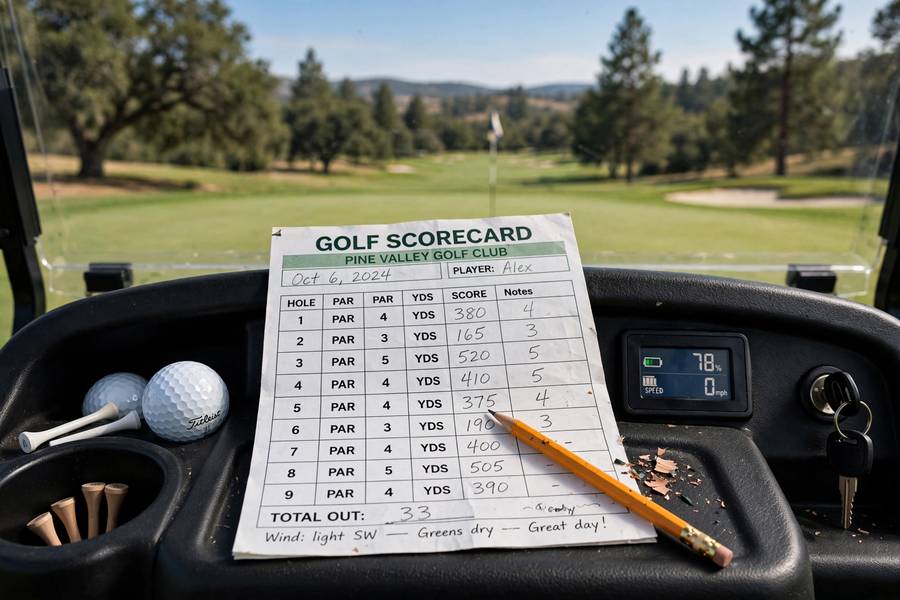
For the full mechanics of how scores are actually counted and compared, see this explainer on golf scoring.
Shot Terms
Drive — The long tee shot to start a hole, usually with a driver.
Approach — A shot hit toward the green, typically with an iron.
Chip — A short, low shot from near the green. Pitch — a short, higher shot. Flop — a very high, soft short shot (the crowd-pleaser).
Putt — A shot on the green, rolling the ball toward the hole.
Fade — A shot that curves gently left-to-right (for a right-hander). Draw — curves right-to-left. Controlled versions are skills; uncontrolled versions are…
Slice — An exaggerated, usually accidental fade. The beginner’s curse.
Hook — An exaggerated, usually accidental draw. The other beginner’s curse.
Shank — Hitting the ball with the hosel (the club’s neck), sending it violently sideways. The most feared word in golf — some players won’t even say it aloud.
Skull / blade — Hitting the ball with the leading edge of the club, sending it screaming low across the green. Opposite of…
Chunk / duff — Hitting the ground before the ball; the ball goes nowhere. Everyone does it. Everyone hates it.
Up and down — Getting the ball in the hole in two shots from off the green (e.g., chip + one putt). A key skill.
Lay up — Deliberately hitting short of a hazard instead of going for the green. Smart, unglamorous, correct.
Punch shot — A low, controlled shot, often used to escape trouble or play under wind/trees.
Stinger — Tiger Woods’ famous low, piercing long-iron shot. Extremely cool, extremely difficult.
Course Terms
Fairway — The mown strip between tee and green. Where you want to be.
Rough — The longer grass bordering the fairway. Where you usually are.
Green — The closely mown area containing the hole. Fringe/apron — the slightly longer grass ring around the green.
Tee box / teeing ground — Where each hole starts. Different tee markers (colors) indicate different distances — play the tees that match your ability.
Bunker (sand trap) — A depression filled with sand. Rake it after you escape.
Hazard — Water, or areas marked with red/yellow stakes. Penalty areas, in modern rules language.
Dogleg — A hole that bends left or right. Dogleg left/right.
Out of bounds (OB) — Marked by white stakes; hitting there costs stroke and distance.
Divot — The chunk of turf displaced by an iron shot. Replace it — that’s basic courtesy every golfer owes the course.
Ball mark (pitch mark) — The dent your ball leaves on the green. Repair it.
Pin / flagstick — The pole marking the hole. Front/middle/back pin — the hole’s position on the green that day.
The turn — The halfway point (after 9 holes). Time for a snack.
19th hole — The clubhouse bar. The most important hole on the course.
Equipment Terms
Driver (1-wood) — The longest club, used off the tee. Also called the “big dog.”
Woods — Long-distance clubs (driver, 3-wood, 5-wood). Mostly metal now, despite the name.
Irons — Numbered 3–9, for approach shots. Lower numbers = longer distance.
Wedges — High-loft short-game clubs: pitching wedge, sand wedge, gap wedge, lob wedge.
Putter — For the green. The most personal club in the bag.
Hybrid — A cross between a wood and an iron; easier to hit than long irons.
Loft — The angle of the clubface; more loft = higher, shorter shots.
Lie — (1) How your ball sits (“a good lie in the fairway”), or (2) the angle of the clubhead relative to the shaft.
Grip — How you hold the club (overlapping, interlocking, or ten-finger), and also the rubber handle itself.
Etiquette & Culture Terms
Fore! — The warning shout when your ball threatens other players. Yell it loud and immediately.
Honor — The player with the best previous-hole score tees off first.
Ready golf — Whoever’s ready plays next, regardless of order. Speeds up casual rounds enormously.
Through the green — Everywhere on the course except tees, greens, and hazards (rules term).
Provisional ball — A second ball played when your first might be lost or OB, to save walking back.
Breakfast ball — A mulligan on the first tee only.
Sandbagger — Someone who deliberately keeps their handicap artificially high to win bets. The lowest insult in golf.
Betting & Game Format Terms
Nassau — The classic golf bet: separate wagers on the front nine, back nine, and overall 18.
Skins — Each hole is worth a “skin”; win a hole outright to take it, ties carry over.
Match play — Holes won/lost rather than total strokes. (This is the Ryder Cup format.)
Stroke play — Total strokes counted. The standard tournament format.
Scramble — Team format where everyone hits, the team takes the best shot, and repeats. Perfect for beginners and charity events — low pressure, high fun.
Best ball — Each player plays their own ball; the team’s best score on each hole counts.
Closest to the pin — A side bet on par 3s for whose tee shot lands nearest the hole.
Commentator Phrases Decoded
Beyond the official terms, golf broadcasts have their own poetry. Here’s what the commentators actually mean:
- “That’s inside the leather” — The putt is within the length of a putter grip (very close). Usually conceded in match play.
- “He’s got that going right at it” — The shot is on a perfect line toward the flag. (Famous last words — it often isn’t.)
- “Dancing with the flagstick” — The ball finished very close to the hole.
- “Mashed potatoes!” — A fan’s traditional (and now slightly tired) shout after a big drive. You’ll hear it; you don’t need to say it.
- “In the hunt” — In contention to win the tournament.
- “Moving day” — Saturday of a four-round tournament, when players make their charge up the leaderboard.
- “The cut” — After two rounds, the lowest-scoring ~65 players continue; everyone else goes home.
- “A real birdie putt” vs “an outside chance” — Commentator code for “likely” vs. “don’t hold your breath.”
- “He never looked comfortable over that one” — Polite way of saying the player was clearly going to miss.
Keep reading: if this helped, you’ll also like offside rule in soccer — I wrote them in the same plain-English style.

Frequently Asked Questions
A birdie is scoring one stroke under par on a hole — e.g., 3 strokes on a par 4. An eagle is two under par, and a bogey is one over par.
A mulligan is an unofficial do-over — replaying a bad shot without penalty. It’s not in the official rules; it’s a casual courtesy between playing partners, often limited to one per round or just the first tee (“breakfast ball”).
A handicap is a number representing a golfer’s skill level, used to level competition between players of different abilities. A scratch golfer (0 handicap) plays to par; higher numbers indicate less skilled players.
“Fore!” is shouted to warn nearby players that a golf ball is heading their way. It’s a safety rule — yell it immediately and loudly whenever your shot might endanger others.
A chip is a short, low-running shot from just off the green; a pitch is a short, higher shot that flies farther and stops quicker. A flop shot is an even higher, softer version.
A scramble is a team format where all players hit each shot, the team selects the best one, and everyone plays from there. It’s the most beginner-friendly format — low pressure and a lot of fun.