


Here’s the thing nobody tells you before your first round of golf: the rules of golf are in a book, but the etiquette of golf is a whole separate education — and breaking etiquette will get you judged far more harshly than breaking a rule. Golf is a game built on courtesy, and the course is a shared space where your behavior affects everyone around you.
I’m Ryan. My first round, I walked across someone’s putting line, talked during a backswing, and wore the wrong shoes. I survived, and you will too — especially with this guide.
Table of Contents
- Why Golf Etiquette Matters So Much
- Pace of Play: The Golden Rule
- On the Tee Box
- On the Fairway
- On the Green
- What to Wear
- Talking, Phones, and Noise
- Cart Etiquette
- After the Round
- Frequently Asked Questions
Why Golf Etiquette Matters So Much
Golf is unusual: you’re sharing a huge outdoor space with strangers, everyone is trying to concentrate, and a round takes four hours. Etiquette is what makes that work. It’s not about snobbery (despite golf’s reputation) — it’s about not ruining someone else’s expensive, hard-earned afternoon.
The core principle is simple: be aware of everyone around you, take care of the course, and keep things moving. Everything below is a variation on that theme.
Pace of Play: The Golden Rule
Slow play is the #1 complaint in golf — by miles. A round should take about 4 hours for a foursome (less for fewer players). If the group behind you is waiting on every shot, you’re too slow.
How to keep pace:
- Be ready when it’s your turn. Have your club selected, glove on, and yardage figured out before it’s your shot — not after.
- Limit practice swings to one or two. You’re not on the range.
- Play “ready golf” in casual rounds: whoever’s ready hits, rather than strictly following honors (farthest from the hole first). This alone saves 30 minutes.
- Keep up with the group ahead, not ahead of the group behind. Your benchmark is the gap in front of you, not the pressure from behind.
- If you can’t find your ball after 3 minutes, it’s lost. Take the penalty and move on. (The rule used to allow 5 minutes; it’s 3 now, and honestly it should feel like 3.)
- Let faster groups play through if there’s an open hole ahead of you and you’re holding people up. Wave them through on a par 3 tee or a wide fairway. It’s not an insult — it’s courtesy.
On the Tee Box
- Honor the order: The player with the best score on the previous hole tees off first (“has the honor”). In casual play, ready golf overrides this.
- Stand still and quiet when someone is teeing off. Stand to the side, never directly behind the player or in their peripheral vision.
- Don’t tee off until the group ahead is out of range. This should be obvious, but impatience causes injuries every year. When in doubt, wait.
- Mark your ball so you can identify it — a personal mark with a Sharpie avoids confusion and lost-ball disputes.
On the Fairway
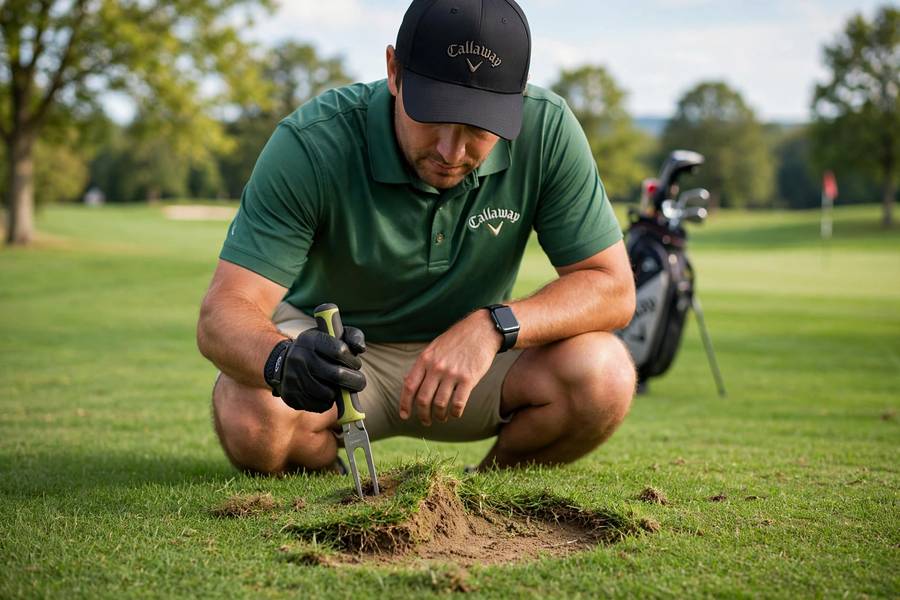
- Replace your divots. That chunk of turf your iron carved out? Pick it up, put it back, press it down. On some courses you’ll use the sand/seed mix provided on carts instead. Either way: fix what you broke.
- Rake bunkers. After hitting from a sand trap, rake your footprints and the shot mark smooth. Leave it like you found it (or better).
- Don’t walk in front of someone about to hit. And never stand in the line of play where a shanked ball might find you — stand to the side and slightly behind.
- Yell “FORE!” if your ball is heading toward other people. Loudly, immediately. This is a safety rule, not a courtesy — golf balls are hard and fast. When you hear “fore,” cover your head; don’t try to spot the ball.
- Cart rules: Follow the course’s cart policy (cart path only vs. 90-degree rule). Keep carts off tees and greens, obviously.

On the Green
The green is where etiquette gets most precise, because putting demands total concentration:
- Never walk on someone’s putting line — the path between their ball and the hole. Step over or around it. This is the rule I broke on day one, and the look I got could have curdled milk.
- Don’t stand where your shadow falls on someone’s line or in their peripheral vision while they putt.
- Repair your ball marks. Your approach shot leaves a dent in the green — fix it with a divot tool or tee (push in from the edges, don’t lift the center). Also fix any others you see; it’s good karma.
- Mark your ball if it’s in someone’s line or might interfere. Use a coin or a proper ball marker, placed directly behind the ball.
- Don’t step on the hole’s edge — it damages the cup for everyone after you.
- Tend the flagstick if asked (hold it for someone’s putt and pull it as the ball arrives), or leave it in — the rules now allow putting with the flagstick in, which most casual players do.
- The player farthest from the hole putts first. And when everyone’s holed out, move off the green quickly to mark scores — don’t do arithmetic standing on the green while the next group waits.
What to Wear
Dress codes vary by course — private clubs are strictest, public courses more relaxed — but the baseline:
- Collared shirt (polo) or a golf-specific mock neck. T-shirts are out at most courses.
- Golf slacks, shorts, or skirts. No jeans, no gym shorts, no cargo shorts at traditional courses.
- Golf shoes (spikeless is now standard) or flat athletic shoes. Metal spikes are banned virtually everywhere now.
- Hats worn forward, obviously. And remove your cap indoors and when shaking hands on the 18th green — old-school respect that still matters.
When in doubt, call the pro shop before your round and ask. They’d rather answer the question than enforce the rule.
Talking, Phones, and Noise
- Silence during swings. Not just your group — if a neighboring fairway’s player is swinging, hold still too. Sound carries.
- Phones on silent. Take calls away from other players, ideally off the course entirely. Nobody wants to hear your business deal on the 7th tee.
- Don’t give swing advice unless asked. Nothing tilts a golfer faster than an unsolicited tip mid-round. (“You’re lifting your head” has ended friendships.)
- Celebrate good shots, commiserate bad ones — golf is social. Just keep the volume reasonable and the schadenfreude to zero.
Cart Etiquette
If you’re riding (and as a beginner, you probably are), carts have their own code:
- The driver manages the cart. Passengers don’t grab the wheel or fidget with controls. The driver parks it; you ride.
- Park on the path or the rough — never on the tee box, the green, or between a bunker and the green (it blocks the next group’s view and damages turf).
- Keep up. The cart’s advantage is speed — use it. Drive to your ball while your partner walks to theirs; meet at whoever’s away.
- The 90-degree rule: Many courses ask you to stay on the path until level with your ball, then turn 90 degrees to it, then return to the path. It protects the fairways.
- Secure the clubs. Nothing ends a round’s good vibes like clubs clattering out on a hill. Strap the bag in properly.
- Don’t drive like you’re escaping. Carts tip on slopes more easily than you’d think, and wet grass is treacherous. Slow, steady, sober.
Walking purists will tell you carts are cheating. They’re wrong — carts are how most beginners learn the game without collapsing on the 14th hole. Walk when you’re ready; ride without guilt until then.
After the Round
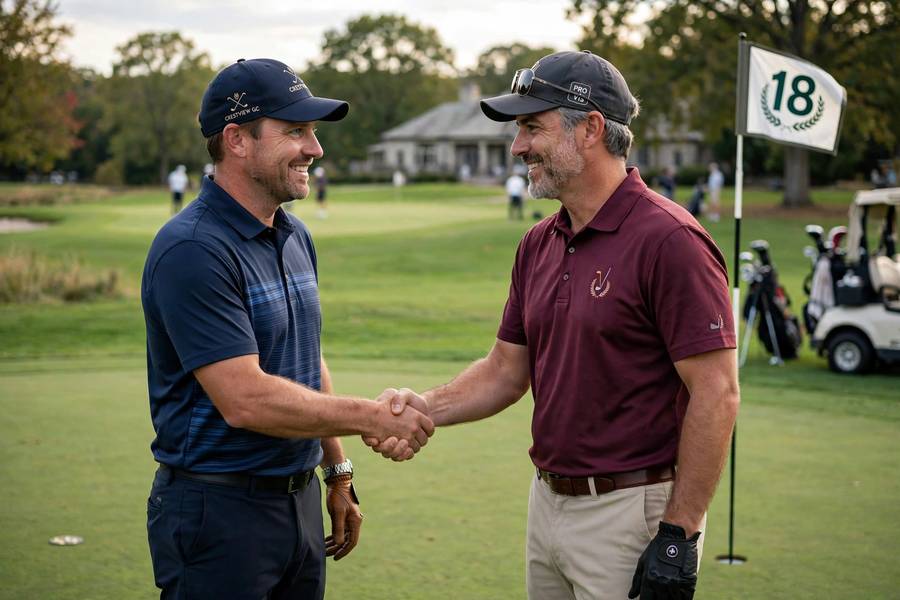
- Shake hands on the 18th green. Win or lose, good round or disaster — you shake hands. It’s the game’s oldest tradition of sportsmanship.
- Remove your hat for the handshake.
- Settle bets gracefully. Golf gambling (a $5 nassau, closest-to-the-pin) is tradition; pay up cheerfully and immediately.
- The 19th hole: Post-round drinks or food with your group is customary — and honestly the best part of the day.
Keep reading: if this helped, you’ll also like golf scoring, how the World Cup works — I wrote them in the same plain-English style.
Frequently Asked Questions
Golf etiquette is the code of courtesy that governs behavior on the course: keep pace of play, stay quiet during swings, repair divots and ball marks, rake bunkers, and never walk on someone’s putting line. It keeps the game enjoyable for everyone sharing the course.
A foursome should finish in about 4 hours; smaller groups should be faster. If the group behind is waiting on every shot, you’re playing too slowly — use ready golf and limit ball searches to 3 minutes.
Most courses prohibit jeans, gym shorts, and t-shirts. Standard golf attire is a collared shirt with slacks, golf shorts, or a golf skirt. When in doubt, call the pro shop before your round.
“Fore!” is shouted to warn other players that a ball is heading their way. If you hear it, cover your head and crouch — don’t try to spot the ball. It’s a safety rule every golfer must follow.
Yes — if there’s an open hole ahead of you and a faster group is waiting behind, wave them through. It’s standard courtesy, not an insult, and it keeps the whole course moving.
Ready golf means whoever is ready hits next, rather than strictly following the traditional order (farthest from the hole first). It’s encouraged in casual play and can save 30+ minutes per round.