Golf Tips for Beginners: What Beginners Learn in Their First 50 Rounds


Golf humbles beginners faster than almost any other sport. Even a strong athlete can walk onto a first course expecting a gentle learning curve, then shoot 118 while a 68-year-old playing partner with a metronome swing quietly shoots 84. The gap is not talent — it is a set of small, learnable decisions, and they are worth writing down.
Fifty rounds in, the pattern is clear: scores fall when the notebook fills with the practical stuff that actually moves the needle for beginners, not with swing theory. Golf is a weird game: the difference between a 110 and a 95 isn’t talent, it’s about fifteen small decisions. Here are the tips that make the biggest difference, in the order a beginner should learn them.
Tip 1: Get Lessons Before You Build Bad Habits
This is the tip beginners resist most, and regret resisting. Three lessons with a local pro cost less than a new driver, and they are worth ten times more. Here’s why: golf is a sequence of precise movements, and once you groove a bad one, unlearning it takes months.
A self-taught slice can survive twenty rounds of practice. A pro can watch two swings, move the lead hand a quarter inch, and fix in four minutes what months of solo practice only groove deeper.
You don’t need a long-term coaching relationship. Three to five lessons, focused on grip, posture, and the basic swing, will save you a year of frustration. Group clinics at municipal courses are cheap and honestly great for beginners.
Tip 2: The Grip Is Everything
If you remember one technical thing from this article, make it this: 90 percent of beginner swing problems trace back to the grip. Slice? Grip. Hook? Grip. Inconsistent contact? Grip.
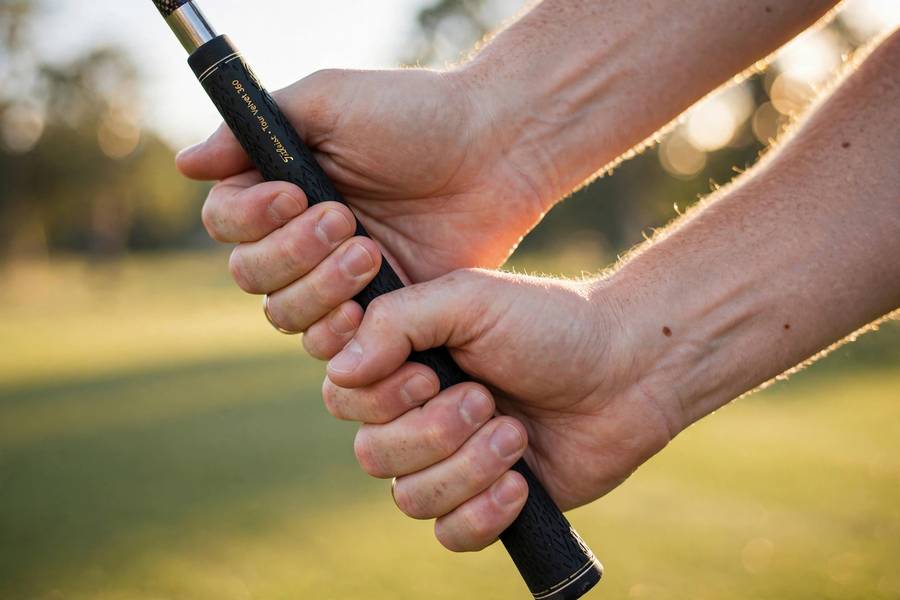
The neutral grip: place the club in your fingers (not your palm) of your lead hand, wrap your trail hand over, and you should see two to three knuckles on your lead hand at address. Your thumbs point down the shaft. Squeeze like you’re holding a tube of toothpaste without squeezing any out — firm enough to control, soft enough to feel.
Practice the grip while watching TV for two weeks and ball striking improves noticeably. It’s the cheapest drill in golf — zero cost, zero range balls, enormous payoff.
Tip 3: Start Every Session With the Short Clubs
The range is full of beginners grabbing the driver and swinging for the fences. It’s fun and it’s useless. Short clubs teach you contact; contact teaches you everything else.
Use this range routine, borrowed from teaching pros: start with a pitching wedge, hit 20 balls at half swing. Move to a 7-iron, 20 balls at three-quarter swing. Only then touch the long clubs. By the time you get to the driver, your body already knows what solid contact feels like.
Track the numbers and they back this up. Note a “clean contact percentage” — shots that felt pure off the clubface — for both warm-up orders. Wedge-first warm-ups produce far more clean contact than driver-first warm-ups. Same golfer, same day, different order.
Tip 4: Half Your Practice Time Goes to Putting
On a par-72 course, 36 of those strokes are allocated to two putts per hole. Half the game is putting. Beginners spend 90 percent of practice on the range and 10 percent on the green. That ratio is backwards.
Spend half of practice time on the putting green, and scores drop faster than at any other point. You don’t need a fancy drill: putt 20 balls from 3 feet (build the confidence), 20 from 10 feet (build the feel), 20 from 25 feet (build the lag). That’s a complete putting session in twenty minutes.
Also: most beginners read greens like they’re reading a mystery novel. Keep it simple. Look at the general slope, pick a target, commit. Indecision putts worse than bad reads.
Tip 5: Learn the Scoring System First
Many beginners play their first rounds without fully understanding scoring. Pars, birdies, bogeys, handicaps — if you don’t know what the numbers mean, you can’t set goals or track progress.
Quick version: each hole has a par (usually 3, 4, or 5) — the number of strokes an expert should take. One over par is a bogey, two over is a double bogey, one under is a birdie. Your total score is strokes, plain and simple. Lower wins.
If you want the full breakdown, a deeper explainer on how golf scoring works covers handicaps, stableford, match play, the works. Learn it early; it makes every round more fun because you’ll know exactly what you’re chasing.
Tip 6: Swing at 70 Percent
Every beginner swings too hard — almost every single one does. Here’s the physics: clubhead speed matters, but centered contact matters more. A smooth 70-percent swing with the ball hitting the sweet spot goes farther and straighter than a violent 100-percent swing that catches the heel.
One classic coaching cue says it best: “Swing like you’re trying to throw the clubhead at the target, not like you’re trying to kill the ball.” Swing easy and contact improves, so the ball flies straighter; swing hard and contact suffers, so the ball finds the trees. The numbers don’t lie — smooth wins.
Test it yourself: hit ten balls at full effort, ten at 70 percent. Measure which group goes farther on average.
Tip 7: One Swing Thought, Maximum
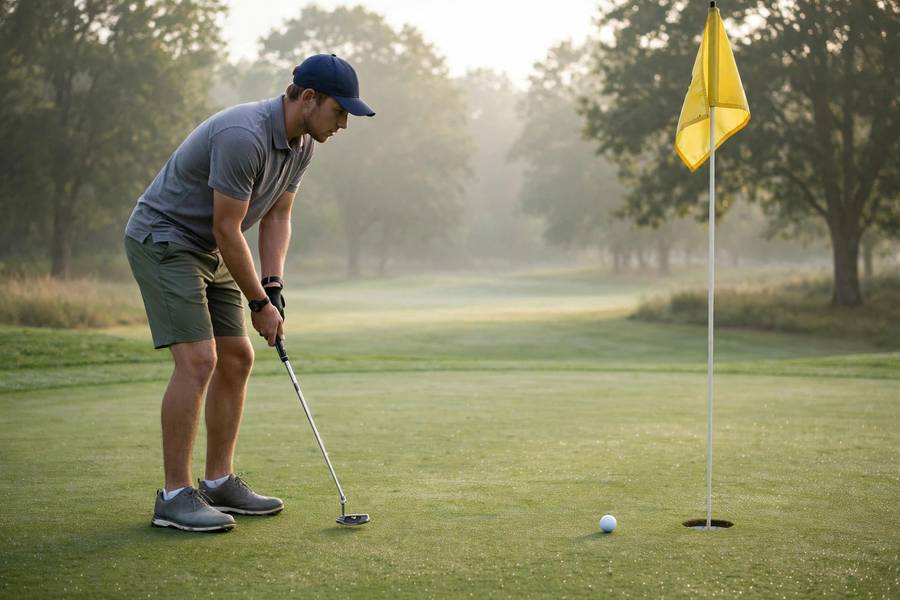
Golf instruction is a firehose: keep your head down, shift your weight, don’t bend the elbow, rotate the hips, follow through. Try to think about all of that during a two-second swing and you’ll freeze like a computer with too many tabs open.
Pick one thought per round. “Slow takeaway.” “Finish the swing.” “Head steady.” That’s it. Limit the round to one cue and consistency jumps immediately — because a relaxed golfer with one thought beats a tense golfer with eight.
Rotate the thought as things improve. Once “slow takeaway” is automatic, pick the next one. Golf improvement is a queue, not a pile.
Tip 8: Etiquette Isn’t Optional
Golf has more unwritten rules than almost any other sport, and beginners who ignore them get the cold shoulder fast. The essentials:
- Pace of play: keep up with the group ahead. If you’re falling behind, let faster players through. Nothing annoys golfers more than a slow group.
- Quiet during swings: when someone’s hitting, you’re a statue. No talking, no moving, phone on silent.
- Repair the course: fix your divots, rake bunkers, repair ball marks on greens. Leave it better than you found it.
- Don’t walk in putting lines: the invisible path between someone’s ball and the hole is sacred ground. Walk around it.
Most of this is usually learned by watching others and by awkward moments on the green. Learn it from this list instead.
Tip 9: Play the Right Tees
Ego is the most expensive club in the bag. Beginners who play from the back tees turn a fun game into a punishment. A 6,800-yard course is a different sport than a 5,800-yard course.
Rule of thumb: play tees where you can reach most par-4 greens in two good shots. For most beginners, that’s the forward or middle tees. There’s zero shame in it — even good players move up when they want to score.
Swallow that pride and move up a tee box, and the score can drop by several strokes in a single round. Several strokes, one decision, zero practice. Best tip on this list by ROI.
Tip 10: Keep the Ball in Play
Beginners lose strokes to penalties, not to bad swings. Out of bounds, water hazards, lost balls — each one costs at least a stroke, often two. The math is brutal: one penalty per hole turns an 85 into a 103.
Play away from trouble. Aim at the wide part of the fairway, not the flag tucked behind a bunker. Take one more club and swing easy instead of forcing a hero shot. Track one stat above all: “penalty strokes per round.” When it’s zero, breaking 90 is within reach. When it’s three or more, it usually isn’t. Boring golf is good golf.
Tip 11: Manage Your Misses
You’re going to miss. Everyone does — pros miss greens, pros miss fairways. The difference is that good players miss in the right places.
Before every shot, ask: “Where’s the bad miss?” If the water is left, aim right. If the bunker guards the front, take enough club to fly it. Golf isn’t about hitting perfect shots; it’s about making your bad shots survivable.
Build a mental “miss map” for any course played regularly — where the misses tend to land on each hole and where it’s safe to miss. It takes about ten rounds to build and saves strokes every round after that. Course management is free strokes.
Tip 12: Track Everything
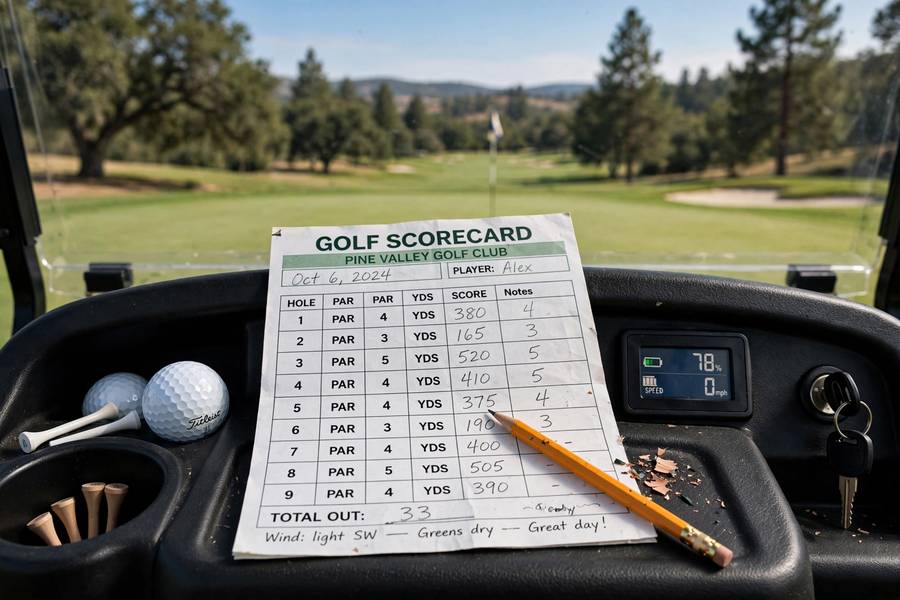
Last tip, and the one that ties everything together: you can’t improve what you don’t measure.
Track these per round: fairways hit, greens in regulation, putts, penalty strokes. That’s four numbers. After ten rounds, patterns scream at you. A common pattern: several strokes a round lost inside 100 yards — a month of wedge practice fixes that. Without the numbers, the driver gets the blame and practice goes to the wrong thing.
A free scorecard app does this automatically. Five seconds per hole. The return on those five seconds is enormous.
Off the course, a little athletic prep goes a long way: bodyweight exercises for a stronger swing build rotation strength, and the best time of day to exercise helps plan range sessions around work.

Frequently Asked Questions
Most beginners break 100 within their first year playing regularly (weekly rounds plus some practice), and break 90 in year two or three. Lessons early on compress this dramatically — golfers who take 3 to 5 lessons in their first month improve roughly twice as fast as self-taught players.
A half set is plenty: driver, hybrid, 7-iron, 9-iron, pitching wedge, sand wedge, and putter. You don’t need a full 14-club set — fewer choices mean fewer bad decisions. Buy used; beginners outgrow or upgrade within two years, so don’t overspend early.
Check your grip first — a weak grip (hands rotated too far left for right-handers) causes most slices. Then check your swing path: an over-the-top, outside-to-in path cuts across the ball. A pro can diagnose both in minutes. Short-term fix: aim left and swing easy; long-term fix: lessons before the slice becomes muscle memory.
Both, in roughly a 50-50 split. The range builds the swing; the course builds scoring, course management, and comfort under pressure. Beginners who only hit the range often fall apart on real holes. Play short courses and par-3 courses early — they’re cheaper, faster, and perfect for learning.
Breaking 120 is a solid first milestone, breaking 110 is genuinely good for a first-year player, and breaking 100 puts you ahead of most casual golfers. Don’t compare yourself to the scratch golfer in your group — compare yourself to your own scores from a month ago.
A used half set runs $150 to $300, lessons $40 to $80 each, and municipal course rounds $25 to $60. Budget around $500 to $800 for a solid first season. It’s not a cheap sport, but municipal and twilight rates keep it reasonable while you’re learning.