How Many Active Volcanoes Are There in the World? Why the Count Depends on Who’s Counting

Here is a question with two correct answers, and understanding why there are two will teach you more than either number alone. Ask the United States Geological Survey how many active volcanoes there are, and the answer is about 1,350 potentially active volcanoes worldwide. Ask the Smithsonian’s Global Volcanism Program, and the answer is 1,214 Holocene volcanoes. Neither body has miscounted. They are counting different things, under different definitions of the word “active” — and once you see the definitions, the disagreement stops looking like an error and starts looking like the most interesting part of the subject.
The Short Answer
The USGS counts about 1,350 potentially active volcanoes worldwide — and that figure explicitly sets aside the continuous belts of volcanoes on the ocean floor at spreading centers like the Mid-Atlantic Ridge, which would inflate any count beyond usefulness. Of those roughly 1,350, about 500 have erupted in historical time. The Global Volcanism Program, working from its database (updated 31 March 2026), counts 1,214 Holocene volcanoes — volcanoes of the current geological epoch, the last roughly ten thousand years and more.
Two honest totals, about 130 apart, produced by two different questions. The USGS asks: which volcanoes could plausibly erupt again? The GVP asks: which volcanoes belong to the Holocene record? Everything in this article follows from that difference.
The Two Counts, Side by Side
| Who is counting | The count | What it means |
|---|---|---|
| USGS | ~1,350 potentially active | Volcanoes considered capable of erupting again (excluding ocean-floor spreading belts) |
| USGS (subset) | ~500 | Of the above, volcanoes that have erupted in historical time |
| Global Volcanism Program | 1,214 Holocene volcanoes | Volcanoes in the Holocene record (database update 31 March 2026) |
| GVP (subset) | 853 | Holocene volcanoes with confirmed eruptions |
| GVP (subset) | 522 | Volcanoes with confirmed eruptions since 1800 |
| GVP (subset) | 333 | Volcanoes with confirmed eruptions since 1960 |
Read the subsets as a funnel, because that is what they are. Start with every volcano the Holocene record holds — 1,214. Require a confirmed eruption, and the count falls to 853. Require the eruption to be recent enough to sit in written records, since 1800, and it falls to 522. Require it within living memory, since 1960: 333. Each step is a stricter definition of “active,” and each produces a smaller, perfectly defensible number.
The GVP’s database tracks eruptions alongside volcanoes, and the same funnel appears there: 11,089 Holocene eruptions on record, of which 9,916 are confirmed. When someone quotes you a count of the world’s active volcanoes, the scholarly response is not to dispute it — it is to ask which shelf of this funnel the number came from.
Why the Counters Disagree
Two choices do most of the damage to any hope of a single total, and the GVP names both candidly. The first is the definition of “active” itself, and the time scale attached to it. A volcano’s quiet intervals between major eruptions can last hundreds to tens of thousands of years — dwarfing the short observational record in many regions. Restrict “active” to what humans have recorded, and you will confidently exclude volcanoes that are merely between eruptions; this is exactly what ‘active’ actually means when the labels are examined closely. The GVP’s solution is to add a precise identifying word — “Holocene volcano” — rather than pretend “active” can carry the weight alone.
The second choice is quieter and just as powerful: what counts as a volcano? Usage has varied widely — the word has been applied to individual vents, to whole volcanic edifices, and to entire volcanic fields. The GVP tends toward the broader definition, viewing the record of a single large plumbing system as a whole. Under that rule, an entire volcanic field — Mexico’s Michoacán-Guanajuato field, for instance, one magmatic system expressed through many individual cones across a broad area — is entered as one volcano. Count its cones separately and the world total leaps; count systems and it settles.
Add new research, new age dates, and revised criteria continually changing the database, and the GVP’s conclusion follows honestly: there is no perfectly accurate count of the world’s volcanoes — but there are at least a thousand identified magma systems, on land alone, likely to erupt in the future. That floor of a thousand-plus systems is the most robust sentence in this whole subject.
Where do they concentrate? A large share of the counted volcanoes — the USGS notes that many of its 1,350 are located along the Pacific Rim — sit on how many of them sit on the Ring of Fire is its own question, with its own count, told in that article.
How Many Are Erupting Right Now?
The counts above are censuses; this one is a snapshot, and the GVP keeps it current. In an average recent year — the average is taken over 2000–2025 — about 72 volcanoes erupt, producing 78 eruptions between them (some volcanoes erupt more than once, and some eruptions outlast the year). And at any given moment, the GVP’s expectation is that at least 20 volcanoes will probably be erupting as you read these words.
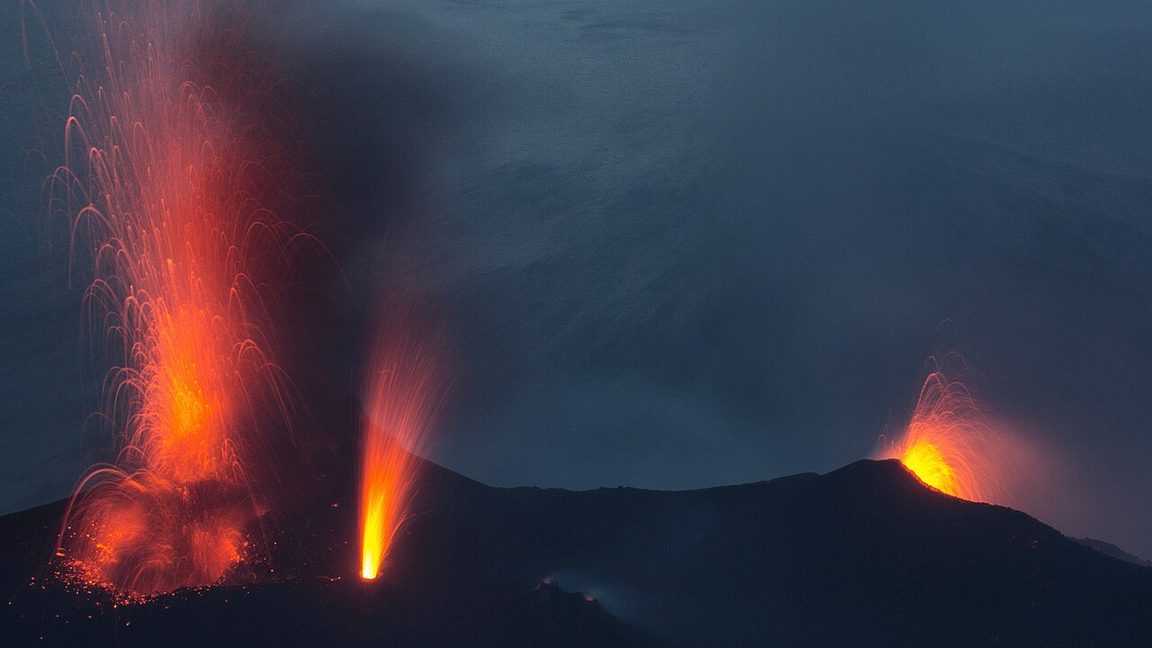
The snapshot is not a fixed roster, either: eruptions begin and end through the year — in the GVP’s recent annual averages, roughly three dozen eruptions start and a similar number end each year, while others simply continue across the calendar boundary, which is how a planet with “only” about 72 erupting volcanoes a year still manages to have a couple of dozen on the go at any moment you care to check.
Let that recalibrate the census numbers for you: of the roughly 1,200–1,350 volcanoes the counters argue about, the planet keeps a couple of dozen in actual eruption at essentially all times. “Active,” as a category, contains multitudes — from the volcano erupting this morning to the one that has been silent for nine thousand years and is counted anyway, correctly, because its silence proves nothing.
The 1,500 Figure You May Have Seen
A third number circulates widely and deserves its hearing rather than a dismissal: over 1,500 active volcanoes. It appears, for example, in BBC Science Focus, citing the British Geological Survey. It is not an error so much as a looser usage of “active” — a rounder, more inclusive count than either the USGS’s “potentially active” (1,350) or the GVP’s Holocene census (1,214).
This article’s position is the one it has taken throughout: the figure is legitimate with its source attached, the way every figure here is. What no honest writer can give you is a single bare number with no definition behind it — because, as the funnel in the table above shows, the definition is doing most of the work. Treat any bare number you meet elsewhere the way this article has taught you to: as the visible tip of a definition you have not been shown yet.
Frequently Asked Questions
If you must have one: about 1,350 potentially active volcanoes, on the USGS’s definition — with the Smithsonian’s count of 1,214 Holocene volcanoes as the other authoritative total. Both exclude the continuous volcanic belts of the ocean floor. The roughly 130-volcano gap between them is definitional, not an error by either body.
About 72 volcanoes, producing about 78 eruptions — the average over 2000–2025 in the Global Volcanism Program’s database. And at any given moment, at least 20 volcanoes are probably erupting somewhere on Earth.
Because they are answering different questions. “Active” can mean potentially able to erupt again (USGS: ~1,350), belonging to the Holocene epoch (GVP: 1,214), having a confirmed eruption (853), or having erupted since 1800 (522) or 1960 (333) — and a looser usage, cited by BBC Science Focus from the British Geological Survey, gives over 1,500. Always ask which definition a number carries.
The count changes, but read the reason carefully: the GVP states that the numbers will change as new research is published, new age dates are acquired, and new criteria are applied. The census moves because our knowledge moves — volcanoes are reclassified, dated more precisely, or recognized for the first time. A rising count is a sign of a better database, not, by itself, of a more volcanic planet.
No — and both headline counts are explicit about it. The USGS’s 1,350 sets aside the continuous belts of volcanoes on the ocean floor at spreading centers; the GVP’s floor estimate is “at least a thousand identified magma systems — on land alone.” The submarine volcanoes are real and numerous, but they are counted, if at all, in separate registers.