Types of Volcanoes: Shield, Composite, Cinder Cone and Lava Dome Compared

Here is the honest starting point, because the textbooks do not all count the same way: geologists generally group volcanoes into four main kinds — cinder cones, composite volcanoes, shield volcanoes, and lava domes. That is the classification this guide uses, and it is the one the United States Geological Survey teaches. You will occasionally see shorter lists that name only three and treat domes and fissure eruptions as separate landforms; the final section of this guide explains those extra names so the two ways of counting stop contradicting each other.
Students ask me why the classification matters, and the answer is practical: the type tells you the volcano’s shape, what it is built from, and how it tends to erupt — before you know anything else about it. A volcano’s type is really a summary of its magma. Runny magma builds one kind of mountain; sticky, gas-rich magma builds another. Learn to read the type, and a photograph of a volcano starts giving you information instead of just scenery.
Each type below follows the same order — shape, material, eruption style, and magma — so you can compare them fairly. If you want the story of where the magma itself comes from, start with how volcanoes form; this guide assumes that story and classifies what it builds.
The 4 Main Types at a Glance
| Shield | Composite (stratovolcano) | Cinder cone | Lava dome | |
|---|---|---|---|---|
| Shape / slope | Broad, gently sloping, domical — like a warrior’s shield | Tall, steep-sided, symmetrical cone | Small circular or oval cone | Bulbous mound, craggy knob, or short steep-sided flow |
| Material | Fluid lava flows, cooling as thin sheets | Alternating layers of lava flows, ash, cinders, blocks, and bombs | Particles and blobs of congealed lava (cinders) piled around one vent | Lava too viscous to flow far, piled over and around its vent |
| Eruption style | Effusive — lava pours out and flows | Explosive eruptions are characteristic | Explosive ejection of gas-charged lava, on a small scale | Slow growth by expansion from within; the hardened surface shatters as it grows |
| Magma | Basaltic — low viscosity, runny | Intermediate (andesitic) — sticky enough to trap gas | Gas-charged lava, blown apart as it erupts | Very viscous lava — the stickiest end of the range |
| Size | Among the largest volcanoes in the world | May rise as much as 8,000 feet above their bases | Rarely more than about 1,000 feet above their surroundings | Relatively small; one famous dome measures 800 feet across and 200 feet high |
| Example | Mauna Loa, Kilauea | Mount Fuji, Mount St. Helens | Parícutin | Novarupta Dome, Lassen Peak |
Two patterns in that table are worth memorizing. First, slope follows viscosity: the runnier the lava, the flatter and wider the volcano, because the lava travels a long way before it cools. Second, eruption style follows the same rule, which is why the table’s magma column quietly predicts why some eruptions explode and others flow. Basaltic magma is the least viscous — it has the least silica, and silica is the thickening agent in magma — so its gas escapes easily and its eruptions flow. Stickier magmas trap their gas, and trapped gas is what makes an eruption explosive.
Shield Volcanoes
How They Form: Runny Lava, Thin Sheets
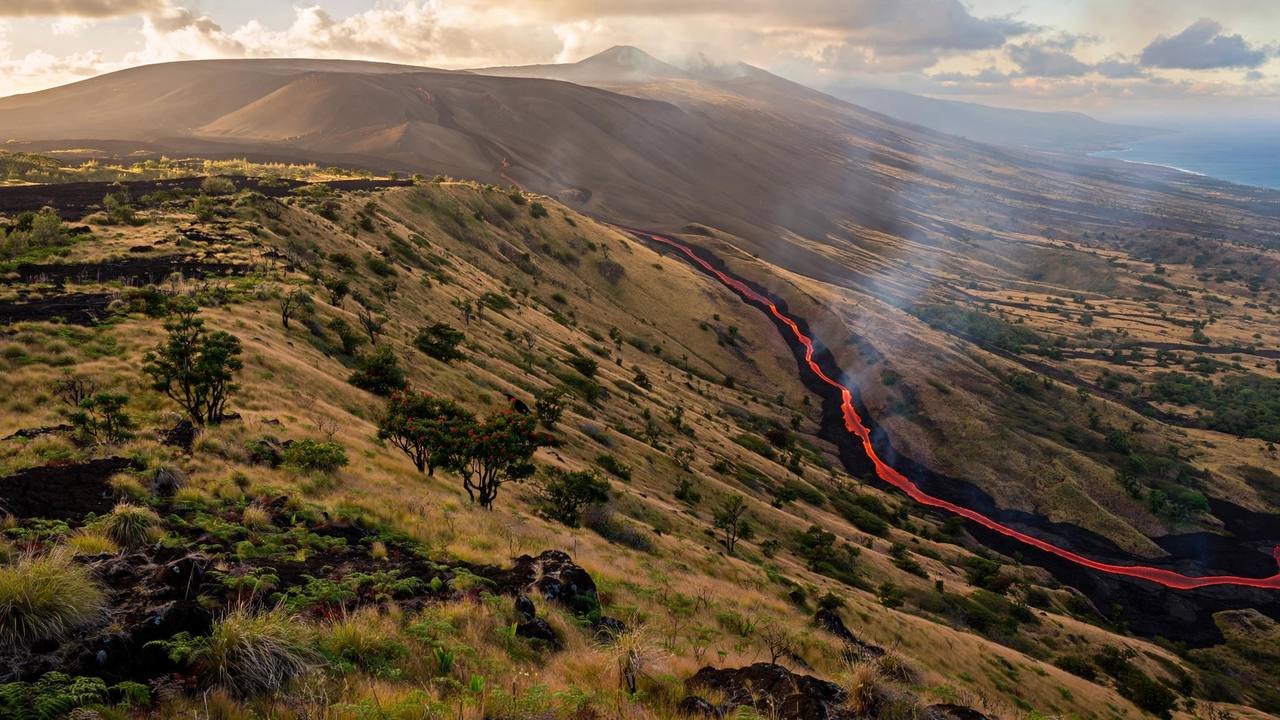
Shield volcanoes are built almost entirely of fluid lava flows. Flow after flow pours out in all directions from a central summit vent, or a group of vents, and each flow spreads widely over a great distance before cooling as a thin, gently dipping sheet. Stack thousands of those sheets and you get the shape that gives the type its name: a broad, gently sloping cone of flat, domical shape, with a profile much like a warrior’s shield.
The magma behind that shape is basaltic lava — highly fluid, low in silica, low in viscosity. Nothing about a shield volcano is steep because nothing about its lava can pile up steeply: it runs downhill first and hardens later. Lava also commonly erupts from vents along fractures, called rift zones, that develop on the flanks of the cone, so a shield grows outward from its sides as well as upward from its summit.
Examples: Mauna Loa and Kilauea
Some of the largest volcanoes in the world are shield volcanoes. In northern California and Oregon, many shield volcanoes have diameters of 3 or 4 miles and heights of 1,500 to 2,000 feet — respectable, but not the ceiling for the type. The Hawaiian Islands are composed of linear chains of shield volcanoes, including Kilauea and Mauna Loa on the island of Hawaii, two of the world’s most active volcanoes.
Mauna Loa shows the true scale. It is the largest of the shield volcanoes and the world’s largest active volcano: it projects 13,677 feet above sea level, and because the ocean floor at the base of the islands is more than 15,000 feet deep, its top stands over 28,000 feet above the deep ocean floor. When students picture a volcano as a neat cone, I show them Mauna Loa: the biggest volcano on Earth is not a cone at all, but a shield so wide that its slope barely registers.
Composite Volcanoes (Stratovolcanoes)
Built From Alternating Layers
Some of the Earth’s grandest mountains are composite volcanoes — sometimes called stratovolcanoes, and the two names mean exactly the same thing. They are typically steep-sided, symmetrical cones of large dimension, built of alternating layers of lava flows, volcanic ash, cinders, blocks, and bombs. That layered recipe is where both names come from: composite, because the mountain is a composite of two materials — fluid lava one eruption, loose fragments the next — and strato-, for the strata, the layers themselves.
The magma behind the layering is stickier than a shield’s basalt. Intermediate, andesitic magma carries more silica, flows reluctantly, and traps gas — so a composite volcano alternates: an eruption violent enough to throw ash and blocks, then a lava flow that seals the pile, then ash again. The result may rise as much as 8,000 feet above its base, with a crater at the summit containing a central vent or a clustered group of vents — the openings that are part of parts of a volcano, explained in our anatomy guide. The essential feature underneath is a conduit system through which magma from a reservoir deep in the Earth’s crust rises to the surface, and the volcano increases in size as lava, cinders, and ash are added to its slopes.
Examples: Fuji, St. Helens, and Rainier
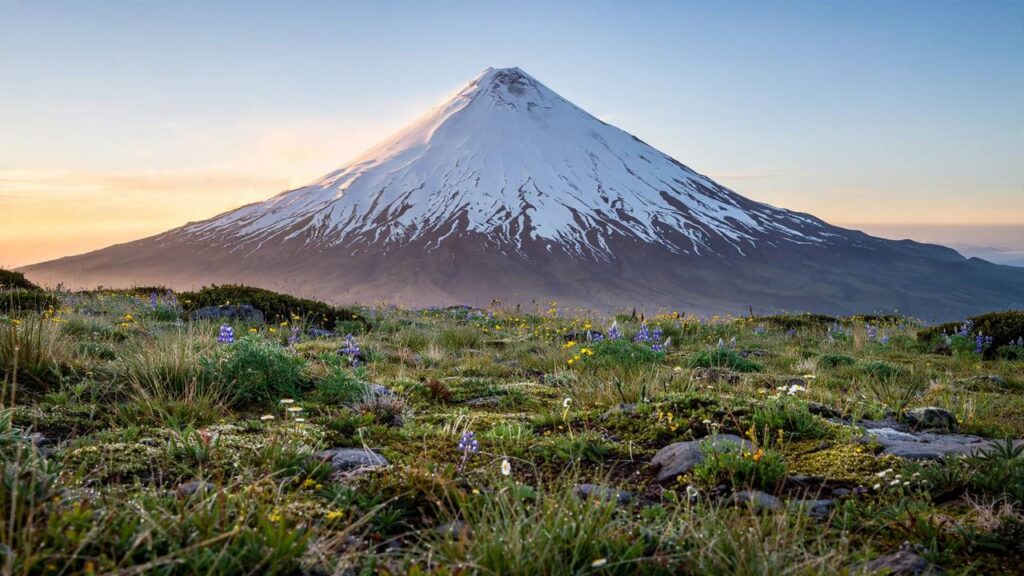
The composite list reads like a poster gallery: Mount Fuji in Japan, Mount Cotopaxi in Ecuador, Mount Shasta in California, Mount Hood in Oregon, and Mount St. Helens and Mount Rainier in Washington. If a famous photograph shows a solitary, snow-capped, steep-sided cone rising on its own, it is almost certainly a composite volcano. Shishaldin Volcano in Alaska’s Aleutian Islands, a composite cone towering 9,372 feet above sea level, is the shape in its purest form — symmetrical, steep, and unmistakably layered in origin.
Cinder Cones
The Simplest and Smallest Type
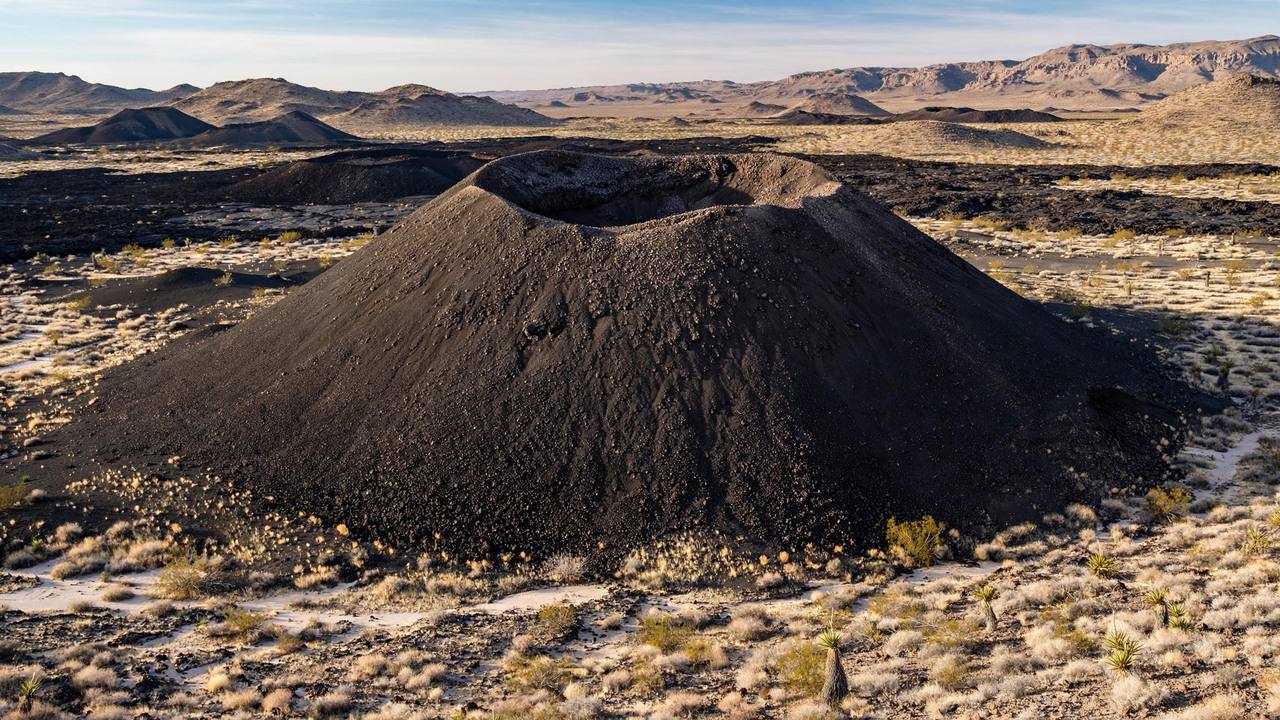
Cinder cones are the simplest type of volcano, and the smallest of the four main kinds. They are built from particles and blobs of congealed lava ejected from a single vent. As the gas-charged lava is blown violently into the air, it breaks into small fragments that solidify and fall as cinders around the vent, forming a circular or oval cone. Most cinder cones have a bowl-shaped crater at the summit, and they rarely rise more than a thousand feet or so above their surroundings.
There is no layering to decode and no long construction history: what falls out of the eruption is what the volcano is made of, piled at the angle loose fragments naturally settle. Cinder cones are numerous in western North America as well as throughout other volcanic terrains of the world — the USGS notes that thousands of cinder cones exist in western North America alone — which makes them, by occurrence, the type you are most likely to be standing near without realizing it.
Example: Parícutin, the Volcano in a Field
In 1943, a cinder cone started growing on a farm near the village of Parícutin in Mexico. Explosive eruptions, caused by gas rapidly expanding and escaping from molten lava, formed cinders that fell back around the vent and built the cone to a height of 1,200 feet; the last explosive eruption left a funnel-shaped crater at the top, and once the excess gas had largely dissipated, molten rock poured out quietly over the cone’s surface as lava flows. That order of events — eruption, formation of cone and crater, then lava flow — is a common sequence in the formation of cinder cones. During 9 years of activity, Parícutin covered about 100 square miles with ash. Geologists from many parts of the world studied it during its lifetime, which is why this small type has an outsized place in the textbooks: it is the volcano scientists got to watch being built, start to finish.
Lava Domes
Lava Too Thick to Flow
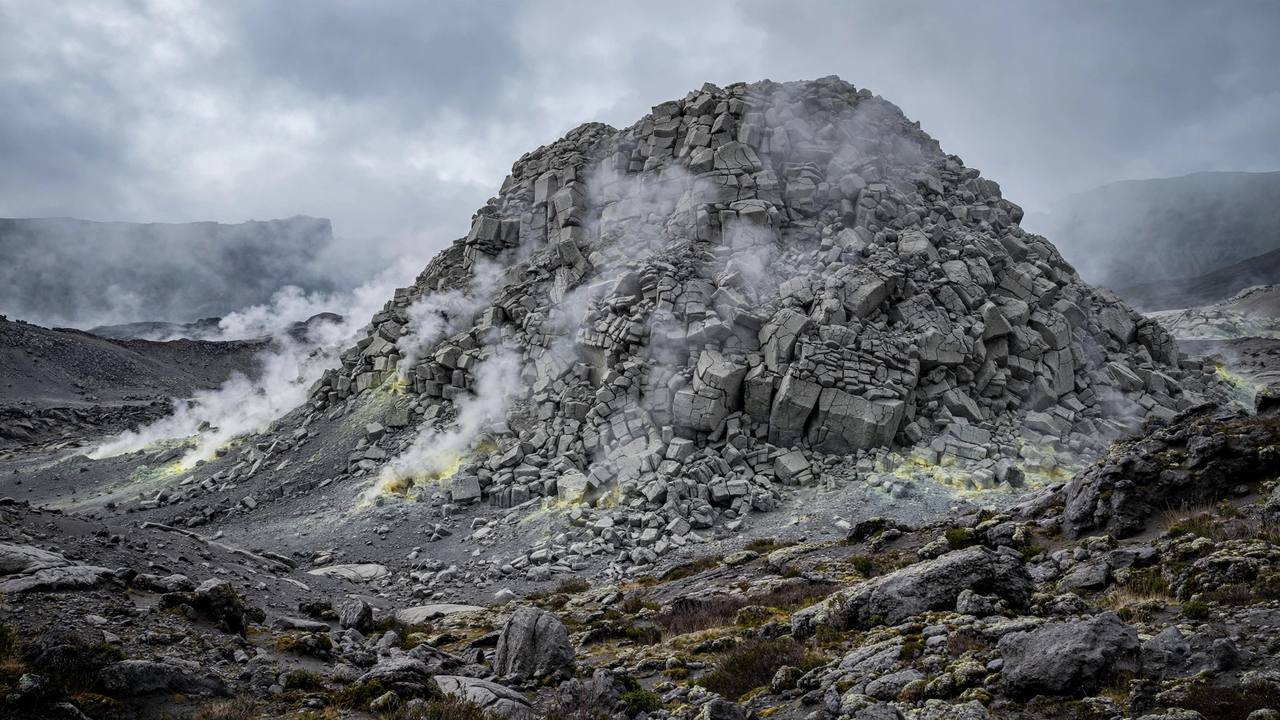
Volcanic domes are formed by relatively small, bulbous masses of lava too viscous to flow any great distance. This is the far end of the viscosity scale: where a shield’s basalt runs for miles, dome lava barely runs at all. On extrusion, it simply piles up over and around its vent.
A dome grows largely by expansion from within. Fresh lava pushes the mass outward from inside, while the outer surface cools and hardens, then shatters, spilling loose fragments down its sides. Some domes form craggy knobs or spines over the vent; others form short, steep-sided lava flows known as coulees. There is no crater-building eruption and no layered cone — just slow, stubborn accumulation, which is why a dome’s shape looks less like a mountain and more like a mound of rubble that is still being pushed up from below.
Often Inside Other Volcanoes: Novarupta
Volcanic domes commonly occur within the craters or on the flanks of large composite volcanoes — a dome is frequently a feature inside a bigger volcano rather than a standalone mountain, which is one reason some shorter classifications leave it off the main list. The nearly circular Novarupta Dome, which formed during the 1912 eruption of Katmai Volcano in Alaska, measures 800 feet across and 200 feet high, and its internal layering — lava fanning upward and outward from the center — shows that it grew largely by expansion from within. Mont Pelée in Martinique and Lassen Peak and the Mono domes in California are further examples of the type.
Other Forms You Will See Named
Two more names appear in textbooks often enough that you should place them correctly, without promoting them to main types. Fissure eruptions are eruptions flowing from long cracks in the Earth rather than from a central vent — in some eruptions, basaltic lava pours out quietly from long fissures instead of central vents and floods the surrounding countryside with flow upon flow, forming broad lava plateaus of the kind seen in Iceland and along the Columbia River. A fissure is a way of erupting, not a shape of mountain. Calderas are large, steep-walled, basin-shaped depressions formed by the collapse of a large area over and around a volcanic vent — the top of a volcano falling in after a huge eruption drains what supported it, as happened at Crater Lake in Oregon, where a high volcano once stood. Calderas range from roughly circular depressions 1 to 15 miles in diameter to elongated ones as much as 60 miles long, so they dwarf ordinary craters, which measure only tens to hundreds of meters across. A caldera is something a volcano can end with, not a kind it starts as.
Which Type Is Most Dangerous?
At the type level — and only at the type level, because ranking individual volcanoes is a different question — the honest answer follows the magma. The types built from sticky, gas-trapping magma are the ones associated with explosive eruptions: composite volcanoes, whose stickier magmas — andesitic rather than basaltic — tend to erupt explosively rather than flow (rhyolitic and andesitic magmas are the explosive end of the composition range), and lava domes, whose growth can be accompanied by destructive events. The warning example is a dome: an extremely destructive eruption accompanied the growth of the dome at Mont Pelée in 1902, when the coastal town of St. Pierre, about 4 miles downslope, was demolished by a high-velocity ash flow and hot gases. Shield volcanoes and cinder cones sit at the other end of the pattern — their runny or small-scale eruptions mostly flow or fall close to home — but treat that as a tendency of the type, never as a promise about a specific volcano.
Frequently Asked Questions
Shape, material, and magma. A shield is broad and gently sloping, built almost entirely of fluid basaltic lava flows that spread widely and cool as thin sheets. A composite is tall, steep-sided, and symmetrical, built of alternating layers of lava flows and loose fragments — ash, cinders, blocks, and bombs — from stickier, more gas-rich magma. If it looks like a warrior’s shield, it flowed; if it looks like a classic cone, it alternated.
Yes — the names are synonyms. Composite describes what the volcano is made of (a composite of lava and fragment layers); stratovolcano describes the same layers as strata. One volcano, two naming habits.
The cinder cone. It is the simplest type, built from cinders ejected from a single vent, and it rarely rises more than about 1,000 feet above its surroundings.
The shield. Some of the largest volcanoes in the world are shield volcanoes, and the largest active volcano on Earth, Mauna Loa in Hawaii, is one — over 28,000 feet from the ocean floor to its summit.
In the USGS’s general grouping, yes — it is the fourth main kind. The complication is that domes commonly grow within the craters or on the flanks of large composite volcanoes, so a dome is often part of a bigger volcano at the same time as it is a volcanic feature in its own right. That double life is exactly why some textbooks list three main types and mention domes separately.